Fisheries

Big inventory of Alaska pink salmon presents marketing challenge

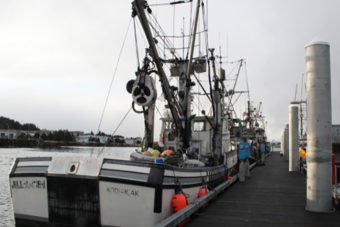
seiner1The record setting pink salmon catch in Alaska last year has left seafood processing companies with several year’s worth of inventory of canned product, although not all of the pink salmon winds up in a can. In fact, industry in recent years has been freezing and reprocessing around half of Alaska’s pink catch. Analysts say that move has helped weather the boom and bust cycles of salmon returns.

“The 2013 pink harvest was the largest on record,” said Joe Jacobson, director of the state’s division of Economic Development, testifying before the House fisheries committee this month. “It’s led to a glut of supply and it will probably, there will be downward pressure on prices because of it. And it’s really been a pretty tremendous impact.”

Fishing fleets caught 219 million pink salmon in Alaska last year. That helped fill up an estimated four million cases of tall pink cans and its left companies with almost five million cases in inventory.“Even though the catch was big, we’re not having any real problems moving through it,” said Tom Sunderlund, vice president of marketing for Ocean Beauty Seafoods, one of the companies that processes pinks in Alaska. He says the demand for Alaska salmon seems to keep growing.

“That isn’t to say we don’t have a lot of inventory, we do. We’re in a heavy inventory position right now and that’s always a little worrisome when you’re holding more inventory than you want but it is selling well. That’s what I’ve heard from other processors as well. No one’s in any kind of panic mode. Nobody feels the need to start dropping prices or taking any kind of drastic action. So at this point even despite the heavy catch it looks like it’s going okay.”

Companies say a can of salmon has a shelf life about six years so processors don’t need to sell all of the 2013 catch right away. Andy Wink is a seafood analyst for the McDowell Group, a consulting firm that works with the Alaska Seafood Marketing Institute.

“Given where sales have been the last several years, we’re looking at inventory of about 2.6 years, in terms of how much supply do we have and how much inventory do we have. So that would take us beyond 2015 even if we did not can another salmon for the next couple years.”

Wink says a chronic oversupply depressed prices in the early 2000s.

“That made it very difficult obviously to sell new production, but through a lot of hard work, through lot of marketing and actually through just shifting a lot of that product out of the can, we were able to bring that inventory down and price has improved as a result. So I think we’ve probably in this area before but it has been some time.”

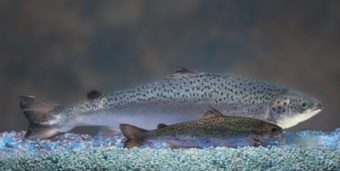
Fishing fleets caught 219 million pink salmon last year. (Photo courtesy NOAA fisheries)

Pinks that don’t end up in cans are often headed and gutted, then frozen and shipped overseas for more processing. That’s become an increasing portion of the catch, according to the Institute of Social and Economic Research’s Gunnar Knapp.

“Processors have increasingly started freezing salmon and shipping it to the far east to countries like China, Vietnam and Thailand for reprocessing into value added products.”

That fish is processed into many different kinds of products, including pouched pink salmon and then sent back to the US or elsewhere around the globe. “I think that what is going to make things somewhat easier with this year than compared to other years is that not as large a share is going into cans. And so they’ve got a big inventory but it would have been a lot bigger if it was all going into cans,” Knapp says.

Analysts say that product diversification has helped drive down inventory and improve prices for Alaska’s pinks. Wholesale prices for cases of tall pink salmon cans topped $100 in 2012 and 2013, more than double what they were a decade ago. There’s some expectation that those high prices will start dropping. But there’s also help on the way for the big inventory of cans.

The Department of Agriculture will be buying $20 million of canned pink salmon for food assistance programs across the country. That’s an expanded purchase over past years and the decision was hailed by Alaska’s Senators in January.

Analyst with the McDowell Group, Wink says it will be a process to move through the big catch.

“But I think there is the capacity for the market to absorb it. And again one other thing for canned salmon, especially with this buy by the federal government, the hope is we can introduce new people to the product. Because it’s really hard to double production, or triple it and then assume you’re gonna move that into the same number of consumers. When that happens you’ve gotta get new people buying the product.”

That’s where marketing comes in.

“Well it certainly presents a marketing challenge when you have such a huge catch and trying to maintain the value,” says Tyson Fick, Alaska Seafood Marketing Institute’s communications director. “But it’s very much a good problem to have.”

Fick says ASMI will be spending an additional one point five million dollars to move pink salmon and notes companies don’t want to hold a big can inventory for too long. “And at the same time we don’t wanna be dumping product on the market and crashing the price because that’s not good for anybody either. So that’s where the marketing effort comes in is to try and maintain the value, while at the same time incentivizing product moving.”

That means recipe and coupon campaigns to bolster sales in traditional domestic markets for canned pinks, places like the southeastern United States. Fick says they also hope to market some of the Alaska product to canned food companies in the United Kingdom.

“Looking to partner in the UK with places like John West and Princes, where the UK is a very big traditional canned salmon market, currently more focused on sockeyes but again this is an opportunity to come in at a little bit lower cost with our largest canned salmon export market.”

Fick says canned salmon’s biggest competitor is probably canned tuna fish and other proteins that customers reach for in the supermarket. Traditional customers are the baby boomer generation and their parents but ASMI also wants to promote canned fish to new potential customers in the younger generations.

Reifenstuhl: Regional hatcheries return investment seven-fold

Medvejie Hatchery south of Sitka is one of the salmon enhancement facilities operated by NSRAA. (Photo courtesy of NSRAA)

Commercial fisheries have never been more important to Southeast Alaska, and the region’s hatchery programs are a critical part of that success.

That was the message Steve Reifenstuhl delivered to the Sitka Chamber of Commerce last week.

Reifenstuhl is the general manager of the Northern Southeast Regional Aquaculture Association based in Sitka. NSRAA is one of two regional nonprofit hatchery programs in the panhandle, and one of the most successful in the state.

In this brief excerpt, Reifenstuhl runs the numbers.

Here’s what the fishing community brings to Sitka–to Sitka’s economy. Nearly 2,000 people earn money catching fish or processing fish in Sitka. It’ by far the largest employer. Eleven percent of Sitka’s population fishes commercially. Think about it: that’s over one in ten. We have three major processors in town and a combined payroll of $13.5 million. In 2013 they processed 90 million pounds of fish, valued at $72 million. That’s to the fishermen, referred to as ex-vessel value. The first wholesale value of this fish is somewhere around $150-million, as it goes out the processor’s door. And as it swirls around Sitka’s economy, it has a total economic output of over $200 million. That’s just for one year.

Listen to Reifenstuhl’s entire presentation to the Sitka Chamber of Commerce.

Except for a brief detour to Silver Bay Seafoods, Reifenstuhl has been at NSRAA for his entire 34-year career. He discussed the circumstances in the 1970s that led to the creation of NSRAA and its counterpart, the Southern Southeast Regional Aquaculture Association — also known as SSRA.

There have been lean years in NSRAA’s history, but not recently. Last season alone it contributed over $20-million in value to the commercial fisheries.

Now, no individual fisherman is getting rich off this. I don’t want you to think that. There are roughly one-thousand hand trollers, but the permit holders that focus much of their time during the season are the power trollers (just under a thousand of those), the seiners (380 of those), and gillnet (425). So roughly 2,000 dedicated fishermen fishing each summer on salmon. That money gets spread among them. I thought it was important not to have a misconception — $20-million is a lot of money. But when you think of it spread out, it’s very helpful but it’s not enough to pay all the bills. Wild stocks are what they really depend on to make their season.

In his half-hour presentation, Reifenstuhl stressed the value of the guided sport fisheries in Sitka, and the contribution of both the commercial and guided sport sectors to Sitka’s tax base.

But he did give the commercial sector exclusive credit for one thing: Voluntarily imposing a 3-percent tax on their harvest to support the nonprofit hatchery programs. An investment of about $33 million over the decades, he said, that has produced value of almost $234 million.

He told the chamber, “I want that to be your takeaway.”

KCAW’s Rachel Waldholz contributed to this story.

Meet the greatest dating service agent in Iceland’s fishing industry

Iceland’s seafood industry has its own dating service. The man behind it gave a talk Wednesday at the Juneau Economic Development Council’s Innovation Summit.

In 2011, Thor Sigfusson (shown here holding a dried cod head) founded the Iceland Oceans Cluster, which he calls the "greatest dating service" for businesses in Iceland's fishing industry. Photo by Casey Kelly/KTOO.
In 2011, Thor Sigfusson (shown here holding a dried cod head) founded the Iceland Oceans Cluster, which he calls the “greatest dating service” for businesses in Iceland’s fishing industry. Photo by Casey Kelly/KTOO.

If you’re a fisheries business in Iceland, Thor Sigfusson is kind of like your wingman.

“I’m probably the greatest dating service agent in Iceland, and I’m proud of it,” said Sigfusson, who started the Iceland Ocean Cluster in 2011. In economic development terms, a “cluster” refers to an organization designed to foster collaboration within an industry.

The group grew out of Sigfusson’s doctorate research at the University of Iceland and was initially affiliated with the school. It’s now a private company with about 60 clients. While he gets some grants, Sigfusson makes most of his money by charging other companies to join the group, where he can set them up with similar businesses to work on like-minded projects.

“It is very important for businesses to talk to each other, and try to figure out a way to get more involved, try to figure out a way to create jobs, to create new ideas,” Sigfusson said.

He says Iceland’s cod fishery was worth $680 million in 2011, double its value 30 years earlier. That’s despite a decrease in the amount of fish harvested, from 460,000 tons in 1981 to 180,000 tons in 2011.

Sigfusson says the industry is more efficient with the catch, creating byproducts from what used to be fish waste. He says Icelandic seafood businesses will soon utilize close to 80 percent of each cod harvested in Iceland.

“Now what’s interesting here is that nearly a quarter of the export value of the cod now are products that we threw into the dustbin some 20 years ago,” he said.

Converting fish waste into a product that has value is not a new concept. In fact, many companies in Alaska’s seafood industry have been doing it for years with products like fish meal. Julie Decker is Executive Director of the nonprofit Alaska Fisheries Development Foundation.

“It’s sort of a worldwide trend, and Alaska knows about it,” said Decker. “But we have a lot of real unique challenges in the sense that we have sometimes short fisheries that are very strong and all spread out into little tiny communities. So dealing with those is part of what we have to do to move forward.”

Decker is also a member of the Juneau Economic Development Council’s Ocean Products Cluster. She says one of her biggest takeaways from Sigfusson’s talk was seeing how private companies that normally compete against each other can work together. And she sees the Iceland Ocean Cluster as a potential collaborator with Alaska’s seafood industry.

JEDC’s Innovation Summit continues Thursday at Centennial Hall. For the agenda, click here.

Summit aims to spark collaboration, new ideas in SE Alaska’s economy

Thor Sigfusson, founder and Managing Director of the Iceland Ocean Cluster will speak on opportunities for collaboration in the seafood industry at this week's Innovation Summit, sponsored by the Juneau Economic Development Council. Photo courtesy JEDC.
Thor Sigfusson, founder and Managing Director of the Iceland Ocean Cluster will speak on opportunities for collaboration in the seafood industry at this week’s Innovation Summit, sponsored by the Juneau Economic Development Council. Photo courtesy JEDC.

New connections, collaborations, and perspectives on Southeast Alaska industries will be the focus of this week’s Innovation Summit, hosted by the Juneau Economic Development Council.

JEDC Executive Director Brian Holst says the event is designed to help the community understand a successful economic development process.

“We bring in outside perspectives to share best practices from other places to help inform our thinking about how we address the opportunities and challenges in our economy,” Holst said. “And then we also see a focus on key industries in our region. What I mean by that is the industries where we see most of the employment and traded industries, industries that bring in money from around the region.”

This year’s summit includes a talk on the seafood industry by Thor Sigfusson, Founder and Managing Director the Iceland Ocean Cluster. In economic development-speak, “clusters” are basically industry groups designed to foster collaboration. The Iceland Ocean Cluster started at the University of Iceland, but now operates as a private company.

Other speakers include Mary Jo Waits, Director of Economic and Workforce Development for the National Governor’s Association. She’ll be part of a panel discussion about the role of government in economic development, featuring Alaska lawmakers, commissioners, and industry leaders.

The winners of the Path To Prosperity contest will also be announced during the summit. The contest is sponsored by Haa Aanì, the community development arm of Sealaska, the regional Native corporation for Southeast Alaska and the Nature Conservancy. Two winners will receive up to $40,000 in seed money for their new businesses. The idea is to create small businesses that can survive and grow in Southeast Alaska.

This is the third year JEDC has held the Innovation Summit. Holst says networking has been one of the biggest benefits of previous conferences.

“We’ve got these keynote presentations from these outside perspectives that are really world class. And then interspersed we have plenty of time for people to not only engage with each other, but we’ve also set aside time for participants to be able to engage with the presenters.”

The Innovation Summit will be held Wednesday and Thursday at Juneau’s Centennial Hall. The cost to attend both days is $150, including food. Other pricing options are available for students or those who only want to attend part of the summit.

Link:
Innovation Summit agenda

Southeast commercial halibut catch increased for 2014

Images_Pacific_halibutSoutheast Alaska’s commercial halibut catch limit is going up.

The International Pacific Halibut Commission concluded its annual meeting Friday in Seattle and approved catch limits for Alaska, British Columbia, and the west coast of the U.S.

The combined commercial and charter catch for Southeast’s Area 2C will be 4.16 million pounds. That includes a commercial catch limit of 3,318,720 pounds, that’s an increase of about 11 percent from last year. Southeast is the only area that will see an increased catch from 2013.

The commission also approved a catch sharing plan recommended by the North Pacific fishery Management Council and implemented by federal fishery managers for Southeast and the central Gulf. That’s a first. The catch sharing plan allocates pounds to the charter fleet and replaces the old system of a guideline harvest level for charter anglers. It’ll also allow annual purchases of commercial quota by the charter fleet.

That plan will mean a limit of over 761-thousand pounds to the Southeast charter fleet for 2014. As a result, charter clients will have a one-fish daily bag limit in Southeast with what’s called a “reverse slot limit.” Charter anglers in the Panhandle can keep a fish up to 44 inches, or 76 inches and longer, but not anything between those lengths.

Coast-wide the commissioners did not go with the roughly 30 percent catch reduction as presented by staff in December. The so-called “blue line” numbers, presented to the commission by staff, applies long-standing harvest percentages to the estimated legal-sized halibut for each regulatory area. Instead the commission approved a larger coastwide catch limit of over 27 and a half million pounds.

US commissioner Jim Balsiger, regional administrator for NOAA Fisheries in Alaska, called it the toughest halibut commission meeting he’s attended.

“We’re in a trying position with the resource, the halibut resource not rebuilding as rapidly as we’d like it to,” Balsiger said.” We have some issues with that. I think it is important to note, and we went over this earlier but, the decision table which contains the blue line, the entire table contains recommendations from the staff on how to set the catch limits. Where we operate in that decision table is really a reflection of the conservative nature of the various halibut commissioners, because they’re all valid positions it just depends on how much risk is deemed appropriate, how much conservatism has to be cranked into those tables.”

The commercial catch in area 3A, the central gulf, will see a big cut this year, about 33 percent, down to 7.3 million pounds. And the charter fleet’s limit in the gulf was set at 1.7 million pounds. Charter clients there will have a two fish daily bag limit with a 29 inch limit on a second fish.

The commercial and sport catch in British Columbia will see a small reduction, but not the 29 percent cut initially considered in the “blue line” number presented by IPHC staff.

The commission approved a season start date of March 8th and fishing will be open through November 7th.

Commercial fishing film festival celebrates third year

An Alaska fishing trawler.
An Alaska fishing trawler. (Photo by Emmett Hume)

There’s a big mix of commercial fishing footage in Alaska and elsewhere, from the historical to the hysterical online this week for the Third Annual Commercial Fishing Film Festival.

The collection of fishing movies from around the globe is being broadcast online this week through January 18. Viewers can vote for their favorites and upload their own video for next year. It’s the creation of Juneau fisherman and writer David Clark, who has a commercial fishing website.

The videos can be viewed here: There’s also a live viewing planned at the Fisherpoets Gathering in Astoria Oregon in late February.

Listen to the full story at KFSK.
Site notifications
Update notification options
Subscribe to notifications