Fisheries

It’s salmon derby time in Southeast Alaska

Jan Herron displays the 41.2-pound fish that won Wrangell's 2008 derby (KSTK)
Jan Herron displays the 41.2-pound fish that won Wrangell’s 2008 derby (KSTK-FM file photo)

http://ktoo.s3.us-west-2.amazonaws.com/2014/05/08DerbySE-L.mp3

Organizers say things are looking good for this year’s Wrangell King Salmon Derby. Organizers are always optimistic — but this year, they’ve got evidence.

“I’ve been seeing some pictures on Facebook. People are already out there catching fish. So I think it’s going to be a great year,” says Cyni Waddington, who runs the derby for Wrangell’s Chamber of Commerce.

The organization promises more than $30,000 in prizes for contestants. They range from $6,000 for the overall biggest Chinook to smaller prizes for youth and seniors.

Not all winners get cash.

“One of the local Native artists … does a sterling silver salmon bracelet for the woman who catches the biggest fish in the derby and that’s very popular,” she says.

Wrangell’s salmon derby runs through the first week in June.

KetchikanSitkaHaines and Petersburg have salmon derbies over the Memorial Day weekend. Ketchikan continues for two more weekends, Haines and Sitka for one.

Skagway’s Game Fish Derby is near the end of June. And Craig and Klawock have one running this and next month, with another starting in July.

Juneau has two large derbies, and one is already underway.

“It seems like the run is just fantastic this year. I don’t hear anyone complaining about long rod hours. Everybody’s catching,” says Leslie Isturis, organizer of the capital city’s Spring King Salmon Derby.

It’s a project of the regional Central Council of Tlingit and Haida Indian Tribes of Alaska. Proceeds go to scholarships.

The contest runs all of this month, and the prize for the top fish is $10,000.

Isturis says other payouts are a little different from last year.

“Rather than have a lot of the money in the regular prize listing, we split it up between daily and weekly prizes,” she says.

Juneau’s longest running derby, the Golden North, runs the second weekend in August.

Many of the prizes are goods or services rather than cash.

Wrangell’s Waddington says that’s part of the fun.

“We actually get lots of prizes from the community … for derby award night. We just basically go down the ladder from the largest weight. I think last year everybody who entered a fish got a prize of some sort,” she says.

Tlingit-Haida’s derby has its own collection of prizes donated by individuals and businesses.

Isturis says there’s even a mystery prize, donated by two local carvers.

“They gave me a check inside an envelope and they said we’ll let you know about half-way through what the weight is. They won’t even tell me,” she says.

The derbies help merchants sell fishing gear, groceries, and other important supplies, such as beer.

Wrangell’s Waddington says they also promote tourism.

“There’s a good number of people who come from other places in Alaska, but there’s definitely a good number of people who come from the Lower 48 as well, who make this one of their travel destinations to come fishing,” she says.

Anglers should have a better chance to catch the big one this year.

The resident bag limit is three kings a day, 28 inches or larger, with no annual limit. That’s up from one a day in 2013.

Big turnout for Juneau’s Blessing of the Fleet

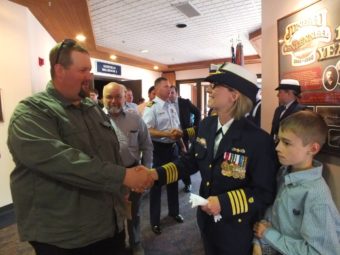
More than a hundred people attended Saturday’s Blessing of the Fleet in Juneau to honor those who work in Alaska’s commercial fishing industry.
Six names were added to the Alaska Commercial Fishermen’s Memorial wall, and eight boats received blessings performed by the Rev. Gordon Blue of the Church of the Holy Trinity. The Alaska Youth Choir and the City of Juneau Pipe Band performed. Lt. Gov. Mead Treadwell was the keynote speaker.

The names added to the fishermen’s memorial wall this year were Daniel Glass, Jim McCormick, James Jensen, Peter Wright, and John and Elizabeth Clauson.

This was the 23rd annual Juneau Blessing of the Fleet. According to a fact sheet handed out with this year’s program, fishermen landed about $23 million worth of seafood in the capital city in 2012. Between fishing boats and processors, the local fishing industry employs more than 1,000 people.

Former Rep. Carl Moses dies

Carl Moses at the dedication of Unalaska's small boat harbor, named for him two years ago. (Photo courtesy city of Unalaska).
Carl Moses at the dedication of Unalaska’s small boat harbor, named for him two years ago. (Photo courtesy city of Unalaska).

Former state Rep. Carl Moses died Wednesday, according to Unalaska city officials. He was 84.

Moses was the state’s longest-serving member of the state House of Representatives. He represented the Aleutians region for a total of 11 terms — first from 1965 to 1972 and then again from 1992 to 2007.

In that time, he was known as an advocate for Southwest Alaska fisheries and business. He spearheaded the state’s shared fishery resource landing tax, which brings millions of dollars into Aleutian communities and other coastal towns every year.

Moses lived for years in Unalaska and Sand Point.

Two years ago, Unalaska’s newest boat harbor was named for Moses.

In a news release on Wednesday, Unalaska Mayor Shirley Marquardt said Moses’ “commitment to the communities he served and the fisheries that sustain them was rock-solid.”

Gov. Sean Parnell has ordered state flags to be lowered on Friday and raised to full-staff at sunset.

NMFS clears commercial fishing in sea lion habitat

A 2010 review resulted in fisheries being closed in 2011 to protect Stellar Sea Lion habitat. (Photo courtesy National Marine Mammal Laboratory)

After a research review, the National Marine Fisheries Service is prepared to loosen controversial limits on commercial fishing in the western Aleutian Islands.

NMFS closed fishing grounds three years ago to protect an endangered population of Steller sea lions. That triggered several rounds of litigation and a new evaluation of the science behind fishing bans.

Brandee Gerke is a NMFS resource management specialist. She helped the agency write its new biological opinion on whether increased fishing would harm sea lions.

“We don’t have any direct scientific evidence that fisheries are causing nutritional stress in Steller sea lions,” Gerke says.

That has cleared NMFS to open more fishing grounds in the western Aleutians, according to a plan that was approved by the North Pacific Fishery Management Council.

Gerke says that biologists still have lingering concerns about how to harvest fish safely in critical habitat areas without disturbing Steller sea lions.

“NMFS is still recommending that the fishery be dispersed over a greater amount of time,” Gerke says. “So not going in and catching fish in a very concentrated fashion.”

Those recommendations will be included in a proposed rule from NMFS. They’ll take public comments on the regulations. But if they’re finalized, fishermen will have access to previously forbidden stocks of Atka mackerel, Pacific cod and pollock as early as next year.

Michael LeVine says that’s pretty sudden. LeVine is a lawyer for Oceana — an environmental group that’s been fighting for years to uphold fishing bans in the western Aleutians.

“The controversy is about whether removing 60% of the fish that used to be there is contributing to the continuing decline of the species and its overall failure to recover,” LeVine says. “Historically, the agency has said that is has. This new analysis, we think, reflects a step back from that very well scientifically-justified position.”

LeVine wouldn’t comment on whether Oceana might sue to keep fishing grounds closed.

At least one group applauded the decision to loosen restrictions. The Aleut Corporation holds a small amount of pollock quota in the western Aleutian Islands. It’s supposed to bring business to Adak, but the share is an area that was closed — until now.

In a statement, the Aleut Corporation said it’s grateful for any new fishing opportunities that will come as a result of the federal study — for Adak, and for other communities throughout the Aleutian Chain.

Herring seiners hit target — and then some — in quick Saturday opener

Seiners in Starrigavan Bay during the first opening of Sitka’s 2014 sac roe herring fishery. (Photo by Rachel Waldholz/KCAW)

The 2014 Sitka Sound sac roe herring fishery is over.

The 48 permit holders caught the last remaining fish in this year’s harvest limit — and then some — in a wild 45-minute opener Saturday afternoon right in front of downtown Sitka.

The preliminary estimate from the Alaska Department of Fish & Game for Saturday’s harvest is just shy of 4,000 tons, bringing this year’s total catch to 17,200 tons — about 900 tons more than the guideline harvest level.

The final harvest numbers will be known once processing is complete. In both 2012 and 2013 seiners undershot their harvest limit significantly, as widespread spawning occurred just as fishing started.

ADF&G will continue to conduct aerial surveys of the shoreline as the spawn progresses. At last word, there were 3.8 nautical miles of spawn. The herring typically continue spawning into late April, depositing eggs along 70-80 miles of beach.

The department’s research vessel, Kestrel, will also return to the Sound sometime after the first week in April to conduct dive surveys of egg deposition. These studies help determine the biomass forecast for future years, and the associated harvest level.

Meanwhile, the traditional subsistence harvest of roe-on-hemlock and roe-on-kelp is beginning in earnest in the areas around Middle Island. One subsistence fisherman at Sealing Cove Sunday morning reported making three large sets of hemlock branches, all of which had received a heavy coating of eggs.

Boost in B.C. mining has Alaska fishermen nervous

KSM mapThe head of British Columbia’s government has pledged to spur mining development in the western Canadian province, and that has fishermen in Southeast Alaska nervous. A group from Southeast flew to Washington D.C. this week to see how it can raise its voice in Canada.

B.C. Premier Christy Clark is making good on a promise to break ground on eight new mines and expand nine others by next year. The increased activity has already brought more than 2,000 jobs to B.C.

“Well, if there’s any doubt that here in British Columbia we are in favor of mining …  I’m going to dispel that now!” she said to applause at a mining conference in January, as she announced plans to continue a $10 million tax credit to help finance mineral exploration companies. The province has already streamlined its permitting process, cutting in half the turnaround time for one type of mining permit.

“It has made a heckuva difference in raising revenue in B.C. and we’re going to keep doing it!” she said at the conference, speaking of the tax credit.

British Columbia now has more than 20 major mines and expansions moving through the permitting process. The largest, known as the KSM mine, would be about 45 miles from Hyder, Alaska. Brian Lynch of the Petersburg Vessels Owners Association says his group isn’t anti-mine, but they’re wary of the KSM mine and at least four other proposed projects in B.C. that are upstream from Alaskan waters.

“They’re huge, probably some of the largest mines in North America, if they go forward and we just have a great deal of concern,” Lynch said. “We want input because we have multi-million dollar fisheries on the U.S. side.”

Lynch was part of a group of five Alaskans in Washington this week to ask for help from the State Department and the Congressional delegation. Lynch says they’re concerned B.C. regulators may not be able to keep up with the new pace of mining and that water quality and fish habitat may suffer. A spokesman for Sen. Lisa Murkowski says she plans to raise the issue with Secretary of State John Kerry.

The British Columbia Ministry of Environment declined several requests for an interview this week, saying it had no one available. But in an email, the ministry said an environmental assessment of KSM is underway and a decision is expected mid-year. The Ministry says U.S. and Alaska state officials have participated in a technical working group that provides comments for that assessment.

Dale Kelley, a Craig fisherman, came to Washington on behalf of the Alaska Trollers Association. She says they haven’t been very involved in the Canadian process and have no particular reason to think they’d be rebuffed.

“But they don’t really have to listen to us,” she said. “So I think it would be nice to have a mechanism between the countries where, whether it’s our state or our federal government, can actually weigh in and have some authority for ensuring our interests are protected on the downstream side.”

The two countries have an International Joint Commission to work out boundary water issues. Lynch says as he understands it, the commission can’t help until a threat occurs, and by then it’s too late.

Site notifications
Update notification options
Subscribe to notifications