Fisheries

Subsistence users criticize miners, regulators at Nome meeting

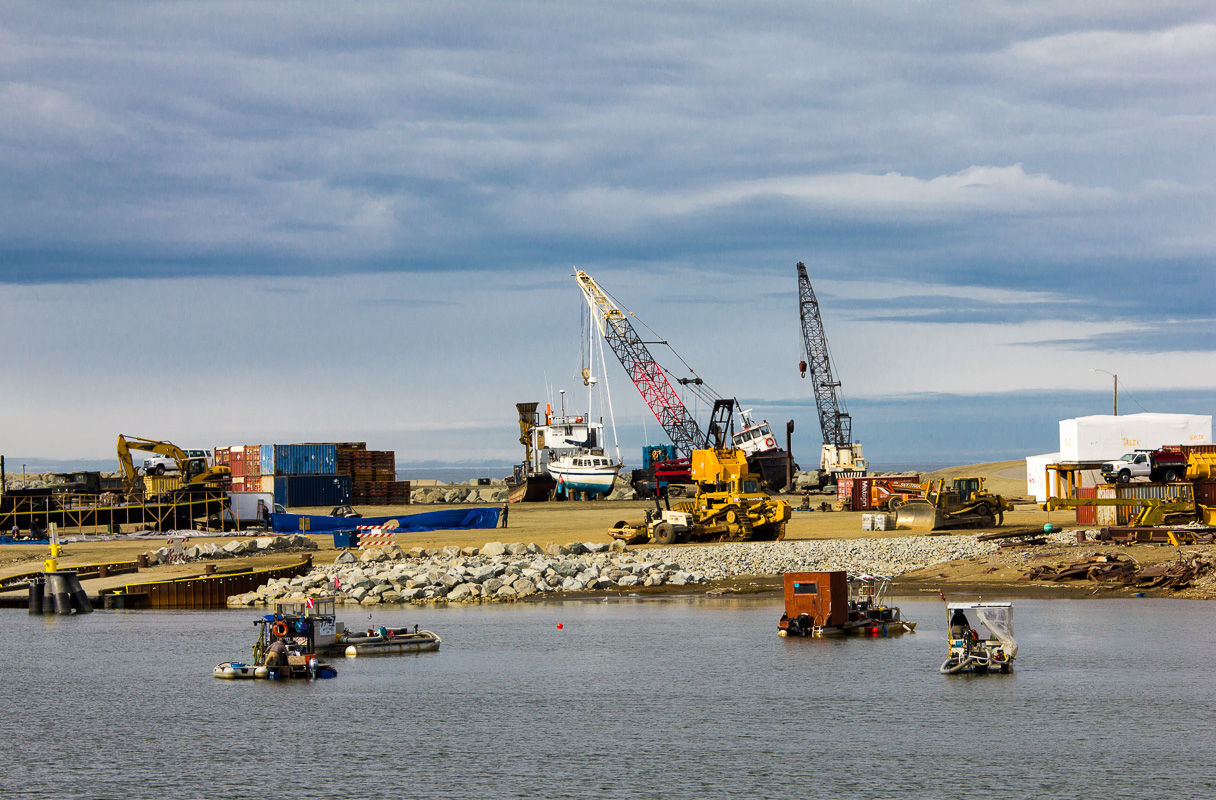
Since DNR lease sales in 2011, Nome has been undergoing another gold boom. But not everyone is happy about it. (Photo by Zachariah Hughes/ KNOM)

Some subsistence users blame gold miners and regulators for failing to take into account the negative impacts mining is having on other resources around Nome.

Yesterday, at Old St. Joe’s, officials from different agencies held a public meeting for community members and miners. Some government representatives used the opportunity for clarification on details.

“We just ask you to stay 300 feet from the nets,” explained Jim Menard with the Alaska Department of Fish and Game to the crowd of more than a hundred.

Other speakers, like Coast Guard Lieutenant Brierley Ostrander, sternly broke down which regulatory policies are voluntary, and which are required.

“Pollution reporting is mandatory. If you spill oil in the water,” Ostrander said from behind the podium, “you’re required to call the Coast Guard National Response Center. Not optional, mandatory.”

But the tone set by officials, including those from Nome was generally one of mutual cooperation.

“Nome and mining kind of go hand in hand,” said City Manager Josie Bahnke. “So, hope that you would just enjoy your time here, be safe, help keep our town clean.”

But the mood shifted during public comments. The vast majority of speakers were subsistence users expressing frustration with gold miners, but especially with state and federal officials, and the Department of Natural Resources in particular.

“The negative impact that you’ve had on the local people—I mean it’s just that, negative,” said Brandon Ahmasuk, Kawerak’s subsistence director. “I am questioning DNR’s permitting process for off-shore mining: local residents are fed up with the treatment that they are being dealt. At times it even seems like non-local miners who are just here for the money and then leave are given preferential treatment, and the residents are stuck with the aftermath.”

Many of the comments came from members of Teller and Brevig Mission who drove more than 70 miles to Nome for the meeting. They offered testimony against a permit under review that would allow a barge-sized vessel to dredge in Grantley Harbor, just east of Port Clarence.

Carolyn Oquilluk spoke for the city and tribe in Teller, and said the community only learned of the permit application two days before, though approval could bring up an operation as early as this season.

“Mining and dredging will only hurt our local communities. We strongly discourage the thought of mining and dredging in the Port Clarence, Grantley Harbor, and Tuksuk channel,” Oquilluk said to the crowd.

But not everyone agreed with the condemnation, or with the idea that traditional values should take priority over mining. One speaker, a young man who didn’t give his name, spoke excitedly about what Nome’s gold sector brings to the community.

“I mean right now most of the miners are also living off the land. Ok? And if you want to help the further generations, how can we help them? They gotta understand the time right now. How can you stop mining? How can you say people gotta stop mining? No! No, this is not acceptable.”

The meeting was led by Scott Pexton, the chief of mining for DNR, who wrapped up public comments to give attendees time to speak one-on-one with officials. He clarified that while DNR and the Department of Environmental Conservation are reviewing a permit for the waters near Brevig Mission and Teller, it has complied with statutes on filing public notice. DNR uses an online portal for submitting public comments, which are looked at as permit applications are reviewed.

You can find DNR’s resource and permitting guide for off-shore dredging here.
Federal fisheries money heads to Senate

The U.S. Senate is poised to pass a spending bill that includes more than $150 million for federal programs important to Alaska’s fishing industry and marine navigation.

It includes $4 million for electronic monitors for the fishing fleet. Alaska fishermen on small boats have asked for cameras as a substitute for some of the human observers that record catch data. Sen. Lisa Murkowski told her colleagues electronic monitors will allow the mission to continue while “recognizing that our small fishermen just simply cannot put another body on their boat as they’re out working.”

The bill also includes $25 million for sonar mapping of coastlines, with an emphasis on the need for more data on the Bering Straits and the Arctic. It has $6 million for removing marine debris, especially debris from Japan’s 2011 tsunami that washed up on federal land.

The bill funding commerce, justice and science programs passed the Senate Appropriations Committee this week. Both Alaska senators sit on that committee, and Murkowski sits on the subcommittee that drafted the bill.

Coast Guard Sector Juneau gets new leadership

U.S. Coast Guard Sector Juneau has a new commanding officer.

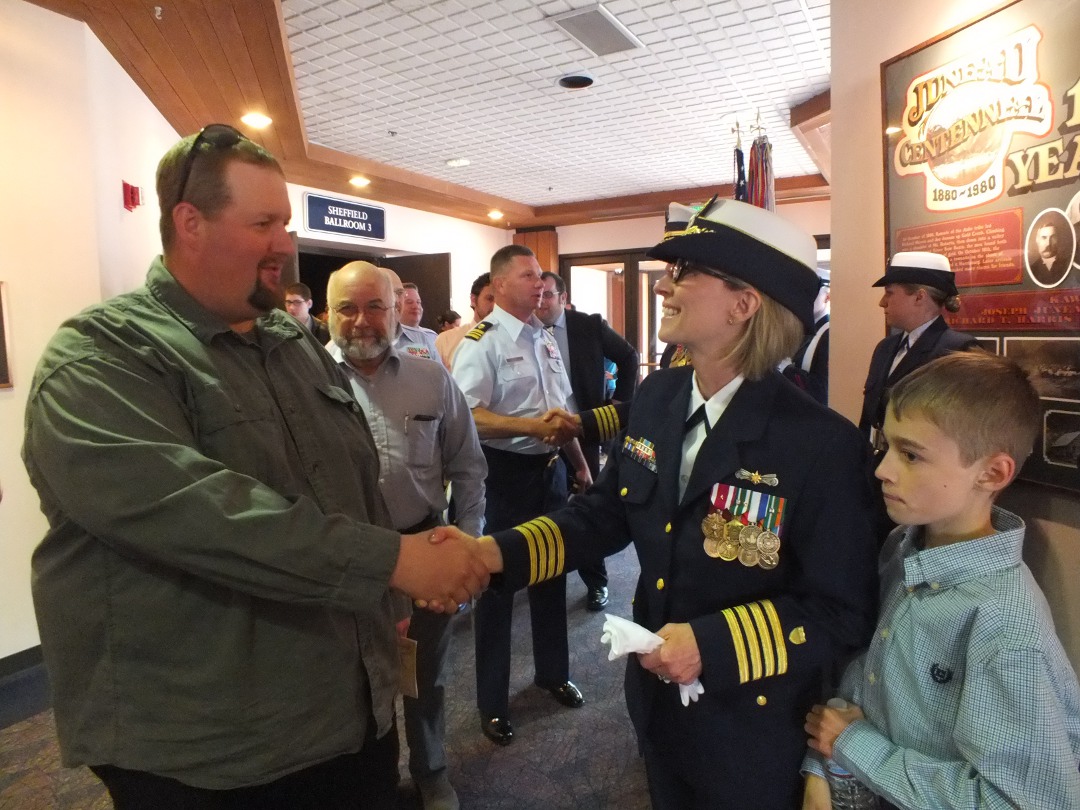
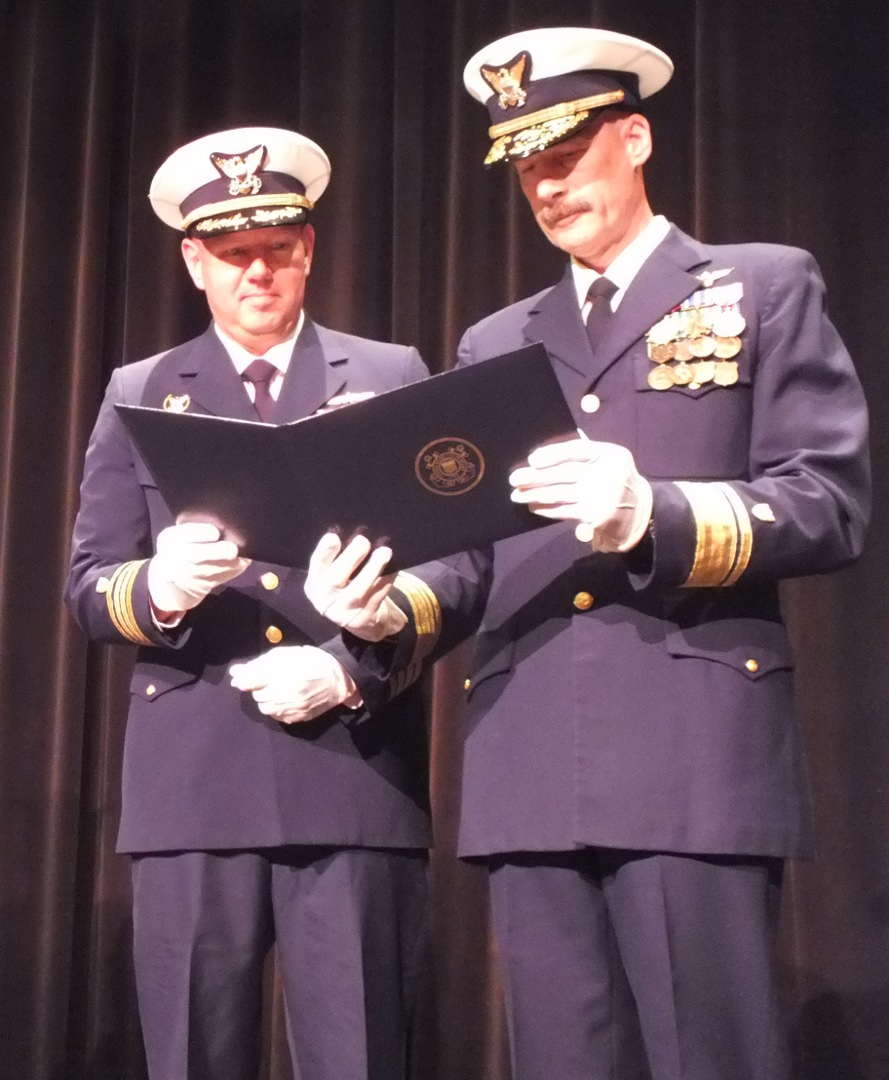
Capt. Shannan Greene took over for Capt. Scott Bornemann in a ceremony Friday at Centennial Hall.

Bornemann led Sector Juneau for the past three years. He said the men and women under his command during that time are the best the Coast Guard has to offer.

“I’d match them with any crew in the country,” he said, before listing some of their accomplishments.

“You sank a derelict Japanese fishing vessel,” Bornemann said, referring to the Ryou-Un Maru, which sailed across the Pacific Ocean without a crew following the 2011 Japanese earthquake and tsunami.

“You planned and conducted multiple unified command-based exercises that broadened stakeholder and tribal engagement and group participation with key agencies in search and rescue, security and natural disaster scenarios,” he said. “You also ensured the safety of the pristine marine environment in Southeast Alaska.”

Bornemann is staying in Juneau as Chief of Prevention for the Coast Guard’s 17th District. He’ll oversee maritime safety, maritime security and environmental stewardship for the entire state.

Greene most recently served as Deputy Chief of Incident Management for the Coast Guard’s 1st District in Boston, where she supervised hazard response and search missions for eight Northeast states. According to a Coast Guard biography, highlights of her tour there include coordinating responses to Hurricane Sandy and the Boston Marathon bombing.

Greene said she was impressed by all aspects of Sector Juneau during her transition week working with Bornemann.

“To our many partners throughout Southeast Alaska, we could not be successful without your expertise and involvement,” she said. “I look forward to continuing the robust relationship that already exists today.”

Greene’s husband is a Coast Guard commander. They have three young sons.

Coast Guard Sector Juneau has about 250 active duty, reserve and civilian employees.

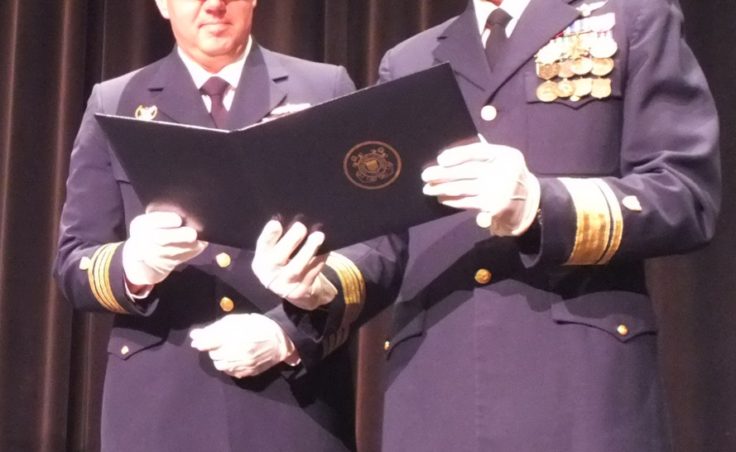
District 17 Commanding Officer Rear Adm. Thomas Ostebo presented Bornemann with a citation for meritorious service to Sector Juneau. Ostebo has been promoted to a position in Washington, D.C. His change of command ceremony is June 12.

Wrangell’s new boat lift is the biggest in Southeast

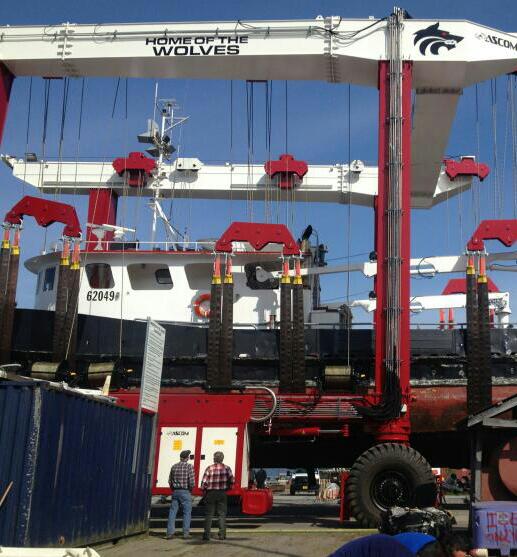
Wrangell’s new Ascom boat lift hauls the 98-foot fish-packer St. Jude out of the water Saturday, May 24. (Delton Claggett /KSTK)

Wrangell’s new boat lift is Southeast Alaska’s largest. It means more big ships can be maintained and repaired without leaving the region.

A 98-foot fish-packer out of Ketchikan was the first to be hauled out of the water.

Wrangell Harbormaster Greg Meissner says it was the St. Jude.

“He’s been chomping at the bit and working with us and trying to adjust his schedule to get hauled out. So he’s happy he’s coming out of the water. He’ll do some work on the boat and get it out when the season starts,” he says.

The new 300-ton lift is the biggest in Southeast and one of the largest in Alaska.

“I believe that it will keep a lot more repairs on those larger vessels happening in Wrangell,” says Erich Schaal deputy port engineer with Juneau’s Docks and Harbors office.

“Right now, those vessels either have to go out to Kodiak or back down to Washington somewhere … to have repairs made,” he says.

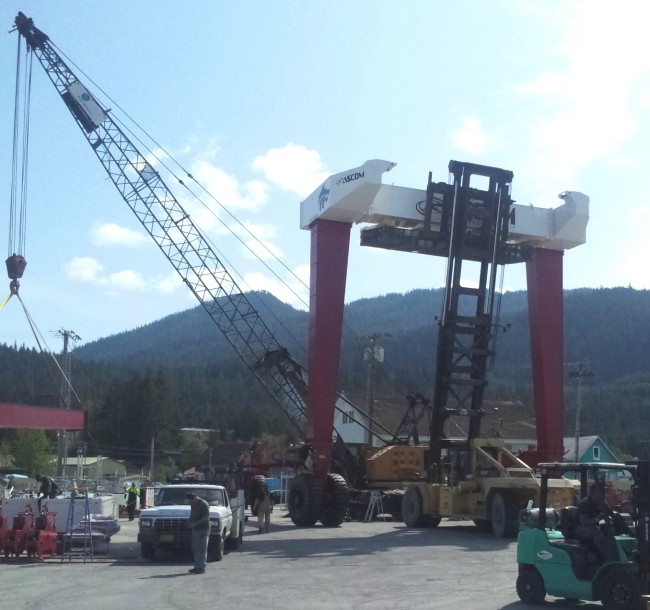
Wrangell's new 300-ton boat lift was assembled on site in May. (Renee Claggart/KSTK)
Wrangell’s new 300-ton boat lift was assembled on site in May. (Renee Claggett/KSTK)

The lift was built by the Italian company Ascom  and cost about $1.3 million. It’s part of a larger project mostly funded by a legislative grant.

Harbormaster Meissner says some of the funds were used to improved the new lift’s support structure.

“The dock was built to hold a 200-ton machine in its payload. So we had to go in and strengthen the dock to handle the payload, plus the weight of a 300-ton machine,” he says.

Other coastal Alaska communities have been adding or expanding boat repair and maintenance facilities. Some installed lifts, from 5 to 200 tons. Others added storage or industrial space.

And in some cities, it’s a private venture rather than a government service.

Schaal, of Juneau’s harbors office, says Wrangell’s addition is great, but it needs more room.

“The lift itself could probably fulfill all the needs of Southeast Alaska … but the uplands of where these repair jobs are bottlenecked. You need a lot of space for the vessels that a 300-ton lift can pick (up),” he says.

Wrangell’s already looking at that issue.

Borough Manager Jeff Jabusch says leaders have already identified an unused industrial location.

“We’re looking at maybe the mill site at 6-mile, and someday the possibility of actually moving a portion of the boat haul-out facility out there where there’s a lot more room. But I think that’s a long way in the future,” he says.

Wrangell also operates a 150-ton lift. Both are part of a larger effort to expand the community’s marine service center.

The new lift began hauling boats in the latter part of May.

Harbormaster Meissner says it was supposed to be up and running sooner.

First, a competing company, Marine Travelift, challenged the city’s contract award. Then, a shipping company sent it to the wrong place.

“They brought it across on a ship to Tacoma. And they took it from Tacoma to Seattle and inadvertently took it to the barge that went to Anchorage. And since nothing said Wrangell on it at the time, off to Anchorage it went. So it took a two-week detour on the way to Wrangell,” Meissner says.

He says the municipality did not pay for the extra shipping.

Committee moves bill updating Magnuson-Stevens Act

Salmon were jumping out of the water in Amalga Harbor.
(Photo by Heather Bryant/KTOO)

The U.S. House Natural Resources Committee yesterday moved a bill to update the Magnuson-Stevens Act, the primary fisheries law in federal waters. Alaska Congressman Don Young amended the bill to allow subsistence fishermen a voice on the North Pacific Fisheries Management Council.

Fish like halibut and pollock are caught at sea, but Young says inland fishermen should also have a say in how they’re managed.

“All I want is for them to have a voice, the same voice that the commercial and sport fisheries have, so they have utilization for a living source of food,” Young said.

Nominees for the North Pacific Council can be qualified based on their commercial or recreational fishing expertise. The law doesn’t mention subsistence users, and Young says they’re being short-changed on the Council.

“There has been a decline in fisheries that are used for subsistence and yet the subsistence users are neglected as far as taking in consideration the amount of fish that can be caught,” Young said.

His amendment would require the Alaska governor to consult with subsistence users before nominating North Pacific Council members. Tribes in the Y-K Delta and the Interior have been asking for representation on the Council. People there suspect Bering Sea fisheries are aggravating the Chinook salmon crisis. The Pollock industry says its cut way down on its Chinook bycatch, down to about 30,000 fish. But to subsistence users barred from catching even one, it sounds like a lot.

Sky Starkey, an attorney for the Association of Village Council Presidents, says the amendment is a good start in getting subsistence users into the Magnuson-Stevens Act, but Starkey says tribes want a dedicated tribal seat on the council to press subsistence concerns.

“And the amendment that was introduced at mark-up today would not accomplish that purpose, at least not directly so,” Starkey said.

Current law says membership on the management councils should be “balanced” between different types of fishermen, commercial and recreational. Young’s amendment doesn’t change the balancing requirement to give any weight to subsistence.

It passed the committee with no opposition. The bill itself is largely similar to the draft in circulation since December.

Resources Chairman Doc Hastings told the committee they’d have more opportunities to shape the bill as it moves forward.

NMFS nears new Steller sea lion restrictions

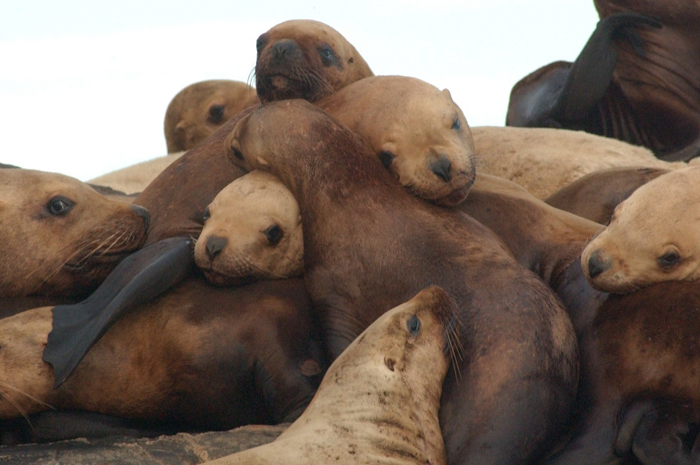
Group of eastern Steller sea lions, taken during research conducted by Alaska Department of Fish and Game in 2007. (Photo by Jamie King/ADFG)

The new year will likely bring new fisheries to the western Aleutian Islands, now that the National Marine Fisheries Service has issued its final report on the way commercial fishing affects an endangered population of Steller sea lions.

The agency came out in favor of allowing more fishing in its environmental impact statement, or EIS, on Friday morning.

This is a major move for NMFS. As recently as 2011, the agency shut down fishing grounds in the Bering Sea and Aleutians. Biologists didn’t want the Steller sea lions to have to compete with fishermen for pollock, Atka mackerel, and Pacific Cod.

But the fishing industry argued that there wasn’t enough scientific proof that commercial harvests were putting pressure on the endangered species.

The issue went to court, and a federal judge ordered NMFS to go back to the drawing board. The agency was required to come up with this new environmental impact statement, which looks at the scientific and economic implications of different protection plans.

Last year, the North Pacific Fishery Management Council told biologists they preferred an option that would relax some bans on commercial fishing. It would allow a small pollock harvest near Adak, for instance.

NMFS has been studying that plan ever since. The agency ruled that more fishing — at certain times of year, in certain areas — is not likely to jeopardize sea lions.

Now, NMFS will start turning that into a federal regulation. It could be ready by January 1, 2015.

Site notifications
Update notification options
Subscribe to notifications