Economy

Slick roads cause accidents on Juneau roads

Icy roads have caused a number of accidents in Juneau today (Friday).

Egan Drive inbound at Fred Meyer was closed briefly at about 10:30 after a two-vehicle accident at the Yandukin intersection that totaled a PT Cruiser and a Dodge Durango. Police re-routed traffic to Glacier Highway for about 20 minutes, until they were able to open up one inbound lane. The driver of the PT Cruiser was cited for failure to yield and taken to Bartlett Regional Hospital for treatment of non-life threatening injuries.

Not long after that accident, there was a single-vehicle roll-over at Tee Harbor that sent a driver to the hospital with unknown injuries. Police says that vehicle was also totaled.

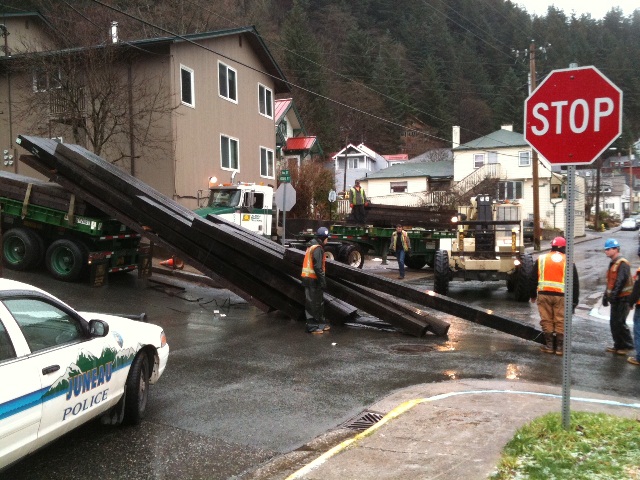
Truck loses load on Gold Street

Timbers bound for the Basin Rd. Bridge reconstruction project broke loose from a truck this morning, blocking Gold St. for a couple hours. Click to enlarge image. (Photo by Matt Miller/KTOO)

Gold Street was closed this morning between 5th and 7th streets after a tractor-trailer lost part of its load of lumber bound for the Basin Road trestle reconstruction project. No one was injured.

The truck was heading up Gold Street about 11 a.m. when two of the straps securing the load apparently broke. A stack of 8-inch by 14-inch timbers, each about 20-feet long, came off the trailer at 6th and Gold and slid down the hill. The load appeared to sideswipe a sedan and knock a mid-size pick-up truck onto the sidewalk. A bundled load of 2-inch by 4-inch lumber also slid into the truck. Before the driver was able to stop, other large timbers partially came off the trailer.

An unnamed Alaska Marine Trucking supervisor said only the driver’s pride was hurt and he was shaken up. The supervisor attributed the lost load to the broken straps and the creosote-treated lumber getting wet.

Hours after the load came off the trailer, Alaska Marine Trucking workers were still reloading the lumber and clearing the streets.

Jump in 3Q earnings, dividend announced by Hecla

Hecla Mining, operator of Greens Creek mine on Admiralty Island, reported third quarter earnings this week. Company officials say higher metals prices this year are responsible for increased third quarter revenue and more cash flow. The first-ever dividend linked to the price of silver is also going out this month.

Total sales for the third quarter of 2011 were up slightly to $120.5 million. The amount of cash flow was nearly $61 million. Net income for the quarter was $55.8 million, or about $0.20 a share. That’s easily twice the net income for third quarter of 2010 at nearly $19.8 million. Earnings after adjustments were $35.4 million, or $0.13 a share.

Hecla Board of Directors also announced this week the first quarterly silver price-linked dividend. It’s $0.20 a share based on the average silver price last quarter of $37.02 an ounce. It’ll be paid out November 29th to shareholders-of-record on November 18th.

Production at Greens Creek, considered one of the top silver producers in the country, is down this year compared to last year. About 1.4 million ounces for the third quarter of 2011 and 4.5 million ounces for the first nine months of this year. Mining and milling costs are up this year because of lower ore volume and higher electricity costs, blamed in part to lower precipitation that feeds Juneau’s hydroelectric facilities.

Hecla also operates the Lucky Friday Mine in Idaho. Production of 2.5 million ounces so far this year is identical to last year’s production levels.

Record 3Q metal sales for Coeur d’Alene

The owner and operator of the Kensington Mine says last quarter was an all-time company record for any third quarter. Metal sales for company’s entire operations came in over $343 million dollars. That’s nearly half-again higher than the second quarter of 2011 and nearly three times as much as the third quarter of 2010.

Sales for the first nine months of 2011 totaled $774 million.

Coeur d’Alene Mines came out with their third quarter results Monday morning. They reported adjusted earnings of nearly $94 million or a $1.05 a share. That’s a big change from last year’s third quarter net loss of $4.5 million or $0.05 a share.

There was a record $151 million of operating cash flow for the third quarter as well. Overall silver production for entire company was up to 4.9 million ounces for the company, while gold production was down slightly to 57,052 ounces.

In addition to the Kensington Mine near Juneau, Coeur d’Alene Mines also operates the Rochester silver mine in Nevada, the San Bartolome silver mine in Bolivia, and the Palmarejo silver and gold mine in Mexico which is considered the company’s biggest generator of sales and cash flow.

Latest exploration efforts at the Kensington Mine included the Raven zone that’s located west of the Kensington ore body, and a new target called Kensington South.

Meanwhile, company officials say processing at Kensington will be reduced to 700 tons per day, about half of previous levels.

That’s expected to allow time to accelerate underground development, a fill-in drilling program, completion of an underground paste backfill plant and other facilities underground and on the surface, and overall safety improvements.

Alaska airports help drive economy

Alaska airports are key drivers of the state’s economy and an area for growth.

A new report looks at the economics and community importance of 12 airports around the state. Conducted by Northern Economics, it shows Alaska’s aviation industry supplies 47,000 jobs, and pumps $3.5 billion into the state’s economy.

Eighty-two percent of all Alaska communities are accessible only by air.

Deputy Commissioner of Aviation Steve Hatter says Alaska is a major stopover for international air carriers. Anchorage is among the world’s busiest cargo airports and Fairbanks is in the top 100. At 9 and a-half hours from 90 percent of the world’s gross domestic product, Hatter says Alaska is well-positioned as a refueling stop.

“It’s really an amazing strategic reality and we want to take advantage of that,” Hatter says. “The fact we have such a significant cargo through-put operation in our system, speaks to the strategic location. So it’s sort of the perfect stop for balancing payload versus fuel.”

Hatter says major facility upgrades at Fairbanks and Anchorage airports allow for new growth, beyond re-fueling.

“Take advantage of those cargo transfer rights we have here in Alaska to get them to do other things besides just get cash, (such as) transfer to other carriers, other partners,” he says. “Multiplication-wise, things happen here from a business perspective. We think there’s lots of opportunity for growth there.”

The Northern Economics study looks at the number of direct and indirect jobs attributable to Alaska aviation as well as the value of passenger, freight, and mail moving through the 12 airports.

Fairbanks International is Alaska’s second busiest airport. It’s a hub for more than 50 communities in Interior and Northern Alaska that rely upon air freight, mail, and commuter services. The airport is also an economic engine with one in 20 jobs attributed to the airport.

According to the study, the Juneau International Airport provided a total of 1,240 direct and indirect jobs in 2009.

Juneau is a Southeast regional hub and makes a significant contribution to the Lower 48 economy as well. The report indicates that Seattle’s role as the largest “first order” recipient of cargo reflects Juneau’s role in shipping out perishable seafood goods.

Bethel Airport is the state’s second busiest cargo airport serving 56 villages in the Yukon-Kuskokwim Delta. The report says one in 14 jobs is attributed to the Bethel airport.

Economic and Community Attributions of Selected Alaska Airports can be found at alaskaasp.com.

Permanent Fund drops $3.1 billion in value

The Alaska Permanent Fund is no longer worth over $40 billion after a suffering a $3.1 billion decline in value for the first three months of the fiscal year.

Fund managers say investments returned a negative 8.3 percent for the first quarter of the fiscal year. That was largely attributed to slow growth, and political and economic difficulties around the world.

Most of the decline in the fund’s value because of the recent drop in stocks. August was a particularly rough month with equity markets plunging as much as 19 percent in just days.

Chief Executive Officer Michael Burns said when they reported more than a 20 percent return for the last fiscal year, he said his enthusiasm was tempered because bull markets don’t last forever.

Burns said in a written statement issued Wednesday that they don’t chase returns or take a reactive approach to investing. Instead, he said they build an all-weather portfolio that doesn’t change to reflect market conditions.

Stocks may have declined, but Burns said their real estate holdings remained essentially flat and they had modest returns on their bond holdings. Burns said that’s how such a portfolio is supposed to work.

The statutory net income for the quarter, used to calculate dividends, totaled about $468 million.

Site notifications
Update notification options
Subscribe to notifications