Transportation

Bus drivers say new Capital Transit plan is flawed

Juneau city staff told the assembly Monday night they’re back to the drawing board on a new Capital Transit plan after hearing from bus drivers that they don’t support the changes.

The new Transit Development Plan was supposed to add bus service to Riverside Drive, start service earlier and end later, and generally improve on-time reliability. All of this called for an additional $200,000. But due to a multi-million dollar budget shortfall, instead of adding money to Capital Transit, the city took some away.

City staff had worked with Nelson\Nygaard Consulting Associates for more than a year developing the plan. And then spent more time tweaking it after budget cuts to implement as much of the plan as possible. The bus drivers didn’t receive a draft of the new schedules until the end of July.

“How can we do more with less?” asked Kirt Stage-Harvey, a Capital Transit bus driver. He was one of about ten drivers who attended the assembly’s work session Monday night.

Even though there's no public comment at Assembly work sessions, nearly a dozen Capital Transit bus drivers attended the meeting. (Photo by Lisa Phu/KTOO)
Even though there’s no public comment at Assembly work sessions, nearly a dozen Capital Transit bus drivers attended the meeting. (Photo by Lisa Phu/KTOO)

On Sunday night, an even bigger group of drivers held their own meeting and invited city staff and consultants.

“We feel very strongly that our voice wasn’t heard effectively through the whole process and it became incumbent upon the drivers and staff at Transit to take initiative to reach out to the city administration to offer our services in helping to develop the best plan for this city to move forward,” Stage-Harvey said.

The drivers have basic concerns about time. Over the years, as traffic lights, congestion and road construction increased, the time allotted for drivers to get from one stop to the next didn’t. Stage-Harvey said the new schedule doesn’t address that.

“We do not have the current time needed to accomplish the routes already. We are operating behind schedule quite a bit and we are doing amazing things out on the road to make transfers on time and to service the public,” he said.

In a letter to the Assembly, the drivers wrote that they don’t like the reduced service to the Express route or on Back Loop Road. And while they agree adding service to Riverside Drive is important, Stage-Harvey said it must be done safely and efficiently.

“We’re very concerned with trying to add more service and cutting lots of other needed service to accomplish such short goals of adding Riverside service,” Stage-Harvey said.

Deputy city manager Rob Steedle said city staff had hoped to implement a new bus plan this fall, but it’s still a work in progress. He said the Sunday night meeting with the drivers was productive.

“We heard their concerns loud and clear and we’re going to continue to evolve our plan,” Steedle said.

Assembly member Karen Crane equated the process of developing a new capital transit plan with hitting her head against a concrete wall.

“We’re not making any progress here and it’s just really frustrating,” Crane said.

Assemblyman Jerry Nankervis agreed with Crane.

“It seems like a dog and pony show. We listened to all the plans, we come up with a budget and make a decision, and now we get input from the drivers. Thank you, drivers. I thought while the transit study was going on, it would’ve been incorporated,” Nankervis said.

City manager Kim Kiefer said the drivers couldn’t evaluate the new plan until the schedules were in place. Now that they have, she said the plan is a moving target.

“We know we have to live within the existing budget. We know the main goal is to provide bus service to Riverside Drive and that’s what we’re trying to do and meet all the other needs – meet the transfers, making sure the drivers have time in between routes so they can have their breaks that they need. We’re trying to address all those pieces,” she said.

Kiefer said the city will hopefully have a new bus plan in place by the end of the year.

Alaska Marine Highway officers’ union rejects tentative contract agreement

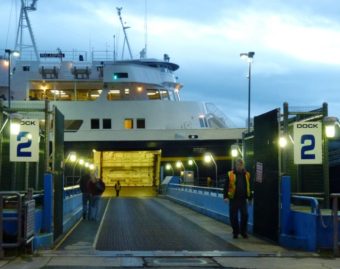
State ferry Fairweather
Crew members from the state ferry Fairweather get ready to tie up to the dock in Sitka. (Photo by Ed Schoenfeld/CoastAlaska)

The licensed captains and officers who navigate Alaska Marine Highway System vessels have rejected a tentative contract agreement with the state.

The International Organization of Masters, Mates and Pilots voted down the proposal by mail-in ballot. Union representative Ron Bressette says the votes were counted last week.

“I’ve been a member of the Masters, Mates and Pilots since 1992, worked out on the ferries myself and up until now we’ve never rejected a tentative agreement. So this is a first for me,” Bressette says.

He declined to say whether the vote was close or if an overwhelming majority of members were opposed to the deal. MMP represents about 100 ferry workers, including captains, chief, second and third mates, and pilots.

Union leaders had recommended approval of the deal, reached June 29, a day before the workers’ old contract expired. Bressette says many members were frustrated that the agreement included no pay increase in the first year, a 1 percent raise in 2015 and a 2 percent increase in 2016. Second mates would also get a 3 percent raise in year two.

“They feel that the wage increases that we negotiated were not adequate,” he says.

Bressette hopes to meet with state officials Friday to discuss what to do next. Options range from negotiating a new agreement to binding arbitration. He won’t rule out members going on strike.

“We’re making the preliminary steps to be ready to go on strike, you know, start the planning process and that. That option is available to us,” he says.

Department of Administration spokesman Andy Mills says the state’s negotiating team is looking forward to hearing union members’ concerns and figuring out the best way forward.

“Obviously when both sides are having a negotiation at a table, I don’t think either side takes anything completely off the table,” Mills says. “But I don’t actually think we’re that far apart. It’s about polling the members and finding out what are those differences.”

The other two unions representing Alaska ferry workers also have tentative agreements pending. The Inland Boatmen’s Union of the Pacific will tally its members’ votes Aug. 26. The Marine Engineers Beneficial Association has not yet mailed ballots to its members.

Engine problems cancel Fairweather trip

Fast ferry Fairweather docked in Auke Bay. (Photo by Ed Schoenfeld/CoastAlaska News)
Fast ferry Fairweather docked in Auke Bay in 2013. (Photo by Ed Schoenfeld/CoastAlaska News)

The fast-vehicle ferry Fairweather canceled its voyage to Sitka today after a mechanical problem was discovered shortly after its departure from Juneau.

Spokesman Jeremy Woodrow says the Fairweather was not far along on its trip to Sitka when the crew detected trouble with the exhaust systems in the ship’s two starboard engines.

Woodrow says the Fairweather immediately turned around and returned to Juneau, where Alaska Marine Highway System engineers were able to get right to work on the problem.

Woodrow says repairs have been completed, and the Fairweather is expected to return to service Thursday on its regular summer run to Angoon and Sitka.

The Fairweather is one of two fast-vehicle ferries operated by the state. The 235-foot catamaran is powered by two engines in each hull. It cruises at about 35 miles per hour.

Damaged navigational marker replaced near Petersburg

(Photo courtesy KFSK)

A damaged navigational marker just outside Petersburg’s ferry terminal has been replaced.

Marker 58 in the Wrangell Narrows was struck by a passing vessel in August of 2013 and was leaning over.

Dave Seris, assistant chief of the Coast Guard’s waterways management branch in Alaska, said the old tower was leaning but still operating. He said the cutter Elderberry did some work on the marker last summer.

“Back in last August what the crew of the Elderberry did was they went out to the leaning tower and repositioned the light so it was still on a horizontal plane to the water.”

This summer the Coast Guard contracted with a pile-driving tug and barge to remove the old navigational tower and install a new one. Seris said the Coast Guard does this type of replacement maybe once a year, or every other year in Alaska. He said it’s not the first time navigational markers have been damaged in the Wrangell Narrows with the shipping traffic near Petersburg.

In fact, he says an older, damaged marker tower was recovered nearby. Seris said the National Oceanic and Atmospheric Administration found that one during a sea-floor survey several years ago.

“About 15 yards to the south of here as they were doing their survey work they found the remains of another tower that had been probably caught up in a log tow and it went missing years ago and we never knew where it was. So NOAA found that for us when they did the survey work,” Seris said. “If you look at a chart there’s a two fathom shoal that’s just directly to the south of light 58 on the far side of the channel and since we had the contractor out there they were able to recover the wreckage from that tower as well.”

The total cost of this year’s tower replacement was $267,000 dollars.

Petersburg leaders support new ferry use of boat ramp

Officials are supporting the idea of a ferry that could connect to the southern end of Mitkof Island south of Petersburg. (Photo courtesy of KFSK)

Petersburg officials are supporting a proposed ferry from Coffman Cove on Prince of Wales Island that could connect to the southern end of Mitkof Island south of Petersburg.

The independent ferry service has been in the planning stages for years but could start up in 2015. The ferry authority wants to use the boat launch ramp at Banana Point to load and unload passengers and vehicles.

The Coffman Cove-based North End Ferry Authority had hoped to have the Rainforest Islands Ferry up and running in 2012, then in 2013, but it has hit delays. Originally the authority purchased a 160-foot oil rig supply vessel, using about $2 million of a $3 million loan from the U.S. Department of Agriculture’s Rural Development Program.

“When we got bids for its overhaul and refit they were too high for us to incorporate in the present financing and we couldn’t get additional financing,” the authority’s manager Kent Miller, told Petersburg’s borough assemmbly. “So we sold that boat and found that we could make a purchase and sale offer for this smaller boat and we’re still working with USDA under the original financing have sufficient capital to put this boat into service.”

The smaller vessel is a nearly 65-foot landing craft called the Silver Eagle, currently in Wrangell. Miller told the Petersburg borough assembly that the vessel would make four day a week connections between Coffman Cove, Wrangell and the southern end of Mitkof Island.

The authority wants to use the state’s mothballed South Mitkof Ferry Terminal, 25 miles south of Petersburg. That facility was completed in 2006 at a price tag of over 10 million dollars. It was first used by the Inter-Island Ferry Authority, or IFA, an independent authority that offered trips to Wrangell and Coffman Cove. That route was suspended in 2009 and it hasn’t been used since.

Miller said using South Mitkof would require converting the docking area for the authority’s front end loading landing craft. He noted the state wants to see the independent authority operate before committing to something like that.

“They’d like to see how we do, however and I guess I can’t blame them for that. After all IFA couldn’t continue its service. We’ve made some very important changes that we expect to enable us to continue this service. But, nevertheless skepticism is healthy.

Among those changes, Miller said are a smaller ferry, which will burn less fuel and require a smaller crew. And until the state agrees to the changes at South Mitkof, the authority hopes to use a boat launch ramp at Banana Point for loading and unloading. He asked the borough assembly to support that request to the state.

“I know that any intrusion on a facility like Banana Point, which is one valuable facility for use by recreational boaters and others is always a sensitive issue and one has to be concerned that the uses are compatible.”

Miller thought the uses of the launch ramp were compatible. He noted the landing craft would be loading and unloading passengers and vehicles four days a week on Sunday, Tuesday, Wednesday and Friday. He thought the ramp would be tied up for a half hour on those days, just before 2 in the afternoon.

Assembly member Bob Lynn wondered about conflicts with other boat ramp users.

“I’m hearing from users out there the concern that there’s only limited amount of parking space there available. The question rises then if we bring the additional traffic, I don’t know if we’re gonna double it, I’ve heard all kinds of figures but the concern from the users out there is even if you’re there for only a two hour period then obviously you take precedence, they’re trying to get in and out, how do you propose or what’s your though process to work out those, what I’ll call, conundrums where we have a conflict of interest here?”

The ferry authority’s Miller thought there would be enough parking for ferry customers and boat ramp users. The Rainforest ferry has capacity for 28 passengers and seven cars. Miller project the service will ferry 6,000 passengers a year and 2,000 vehicles over 200 days a year.

Other concerns focused on trash collection and other maintenance at the Banana Point site but Miller thought the ferry authority could work with the borough to pay for those increased costs.

The authority also plans to provide van service from Banana Point to Petersburg and also from Coffman Cove to other Prince of Wales communities.

Assembly member John Havrilek voiced his support for the new service.

“The long range state plan for the area focuses on roads so it must have been written by someone from Iowa because it pretty much de-emphasizes ferries at all, which doesn’t make sense for an island. Your service may be the only thing we ever have. So I’m glad to see you stepping up and moving in there.”

Havrilek thought the service would benefit school sports teams traveling between the communities.

Petersburg’s assembly voted to support the ferry authority’s request to the state’s Department of Natural Resources to use the Banana Point boat ramp. If all goes as planned, the new service could start up next April.

State issues Alaska Class ferry RFP to Vigor

A 70 percent design drawing of the proposed Alaska Class Ferry. State DOT officials hope to have final design complete by the end of February. Image courtesy Alaska Department of Transportation and Public Facilities.

The Alaska Department of Transportation has released a Request for Proposals to the Ketchikan shipyard for construction of the Alaska Class dayboat.

Ketchikan’s shipyard is operated by Vigor Industrial, which has been working with the state on designing the new, smaller ferries. Two new ferries are planned, and will be used to serve the Lynn Canal route between Juneau, Haines and Skagway.

“This is part of the negotiations process that the department has been in with Vigor for several months now,” said DOT Spokesman Jeremy Woodrow. “It’s part of the construction manager-general contractor process, where Vigor has been working with the department to negotiate a guaranteed maximum price bid for the contract and construction of the new vessels.”

Woodrow says that through the construction manager, general contractor process, Vigor gets first dibs on responding to the RFP.

“This RFP goes to only Vigor. It’s not disclosed to any outside agency or company, it’s not even disclosed to the public,” he said. “It’s for them to review, as part of the contract that we have in place with them.”

Vigor officials now have three weeks to review the documents and respond to the RFP.

“From there, the department will review the response and if both parties are in agreement, the contract may be awarded sometime early September or to the second week of September,” Woodrow said.

Doug Ward is Director of Shipyard Development for Vigor’s Ketchikan operations. He said Vigor anticipates a notice to proceed with construction by the end of this month.

“The way that’s scheduled for production, the majority of production will really get underway in January, but there will be at least one module fabricated by the end of this year, so activity can pick up on that fairly quickly, pending notice to proceed, which we anticipate in August,” he said, speaking to the Borough Assembly on Monday.

State officials have repeatedly stressed that they want the ferries to be built in Ketchikan, as long as the bid comes in within the stated $114 million budget.

When completed, each Alaska Class dayboat will carry up to 300 passengers and about 50 vehicles.

Site notifications
Update notification options
Subscribe to notifications