State officials are set to hold an open house and public hearing tomorrow at Centennial Hall on the Juneau Access Improvements Project, the state-backed effort to extend the capital city’s main road.
The state wants to extend Glacier Highway north along the east side of Lynn Canal to the Katzehin River. There, a new ferry terminal would make short connections to Haines, Skagway and the road system.
Highway construction is estimated to cost $523 million, and new ferry terminal and vessel construction another $51 million.
Other options in the latest version of a federally required environmental impact statement released last month include no road construction and improving existing ferry service.
The open house begins at 1 p.m. and the public hearing begins at 5 p.m. at Centennial Hall. Additional open houses and public hearings are scheduled in Haines on Wednesday and Skagway next week. The hearings fall within the public comment period for the environmental impact statement. Public comment closes Nov. 10.
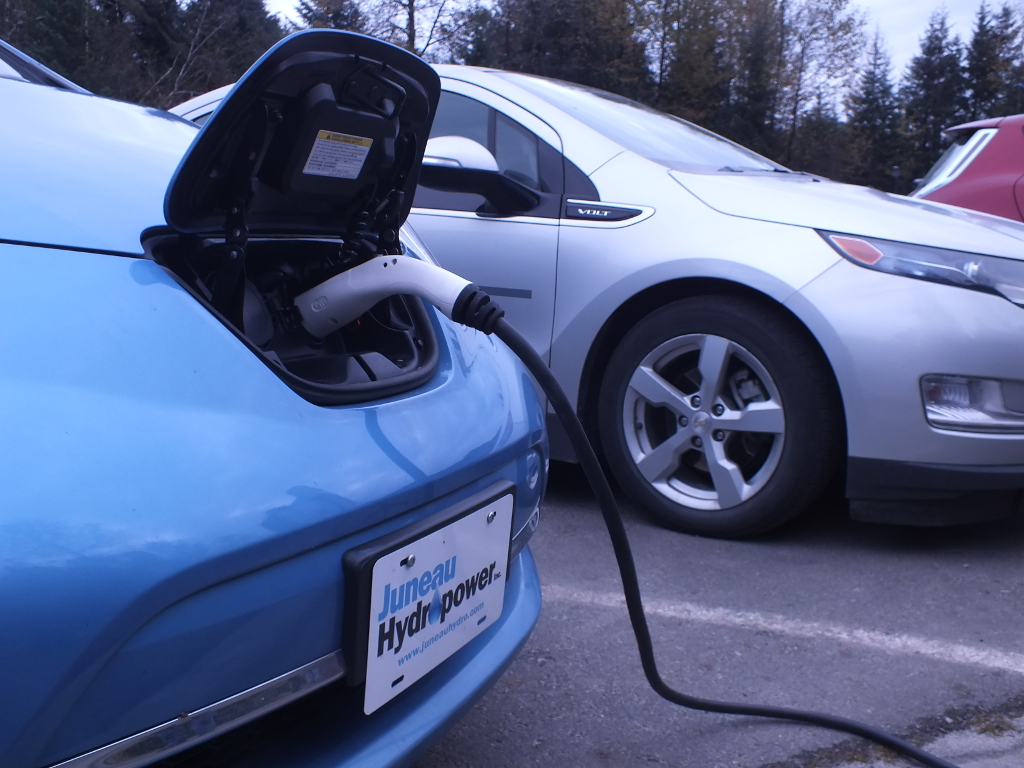
A Nissan Leaf owned by Juneau Hydropower’s Keith Comstock powers up at the Eagle Beach electric vehicle charging station. (Photo by Casey Kelly/KTOO)
A small group of electric vehicle owners on Friday celebrated the first of five public EV charging stations to be installed on the Juneau road system thanks to $50,000 raised by local businesses and nonprofits.
The two-outlet station is located at Eagle Beach State Recreation Area, about 27 miles from downtown Juneau.
Kyle Cuzzort owns a Nissan Leaf, which has a range of about 84 miles per charge. Like most EV owners, Cuzzort has a special outlet in his garage to allow for overnight charging. But he says he and his wife are excited to have the option of powering up out the road.
“We come out here to walk the dog pretty often, and everybody goes, ‘Oh, you drove all the way out the road?’ It’s great, I love it!” Cuzzort says. “It doesn’t cost me a whole lot. So I go out and I get to use all the trails all the time, because I’m not worried about, you know, ‘Oh crud, I just burned $10 in gas to walk the dog.'”
The Juneau Economic Development Council secured a $25,000 grant from Florida-based Funders Network for Growth and Livable Communities to expand the number of charging stations in the capital city. The grant required local matching funds, all of which came from private donations. Duff Mitchell is with Juneau Hydropower, which gave $10,000 to the cause.
“Three years ago I think we had two electric cars running around (Juneau), and now we have probably 25,” Mitchell says. “With the chargers, I think you’re going to see more and more people. They’re just going to have that safety net to be able to go in and charge everywhere, and you’re going to see a lot more people become comfortable with electric vehicles.”
Besides Eagle Beach, EV charging stations will be installed at Eaglecrest Ski Area, the Marine Parking Garage, the new Mendenhall Valley library and the University of Alaska Southeast. Additional grant money will be used to buy charging stations for local businesses that pay the cost of installation.
The Coast Guard says they’re still investigating a grounding of a tour boat north of Juneau on Monday.
Lt. Jennifer Ferreira could not say how extensive the damage was to the 34-foot Voyager, or how the grounding occurred. She said that’s part of the ongoing investigation.
Fourteen passengers and an operator were on board when the tour boat operated by Gastineau Guiding went aground on Little Island, which is located just to the north of Lincoln Island.
The passengers evacuated to Little Island. They were taken by a small boat from the Coast Guard cutter Naushon to other nearby tour boats. A small rescue boat from Station Juneau was also dispatched to the scene and eventually escorted the other vessels to shore.
Gastineau Guiding co-owner Dawn Wolfe said the passengers were not hurt and they just considered the experience as another adventure.
The Naushon then escorted the refloated Voyager back to Auke Bay.
The Coast Guard reports conditions in the area on Monday as five mph winds, one-foot seas, and five miles of visibility.
Wolfe said a gust of wind and a strong current pushed the boat close to a rock as the tide rapidly dropped.
The vessel’s propeller was dinged, but there was no other damage. Wolfe said there wasn’t even a mark on the hull to indicate that it set down on the rocks.
She said the boat is back in the water and running again after it was looked over by the Coast Guard.
Signs mark the end of Juneau’s Glacier Highway in 2013. The latest environmental impact statement maintains a preference to extend the road 47 miles north along the east side of Lynn Canal to a new ferry terminal. (Photo by Heather Bryant/KTOO)
Today, the Alaska Department of Transportation & Public Facilities put out a draft document that addresses environmental issues stemming from the battle to extend Juneau’s only highway north toward Haines and Skagway.
Juneau Access Project Open Houses
The Alaska Department of Transportation & Public Facilities is holding a series of open houses to present the draft supplemental environmental impact statement and solicit public comment.
Juneau, Oct. 14 at Centennial Hall
Open House: 1 p.m.
Public Hearing: 5 p.m.
Haines, Oct. 15 at Chilkat Center for the Arts
Open House: 3 p.m.
Public Hearing: 6 p.m.
Skagway, Oct. 23 at Skagway High School
Open House: 3 p.m.
Public Hearing: 6 p.m.
The new document maintains a preference to build a road along the east side of Lynn Canal, north to the Katzehin River. There, a new ferry terminal would make a short connection to Haines, Skagway and the road system.
The new document attempts to fulfill a major regulatory hurdle to highway construction, estimated at $523 million. Ferry terminal and vessel construction is estimated to cost another $51 million.
The Southeast Alaska Conservation Council was one of the parties to challenge the 2006 environmental impact statement. It may do so again, says Executive Director Malena Marvin.
“Our lawyers have not analyzed it yet but it’s likely that it will be challenged.”
The federal courts in 2009 and 2011 said the original statement failed to adequately consider improved ferry service as an alternative to building the road. The new document addresses that and revises outdated information.
DOT spokesman Jeremy Woodrow says the next step for the department is to collect public comments that will eventually be integrated into an additional report.
“Depending on how many comments we receive will determine the length of time it takes us to put together the environmental impact statement for review by the Federal Highway Administration before we can reach a record of decision. So, that could take several months or longer.”
The public comment period on the draft document is open until Nov. 10.
This story has been updated with comment from the Alaska Department of Transportation & Public Facilities.
A ride-sharing service called Uber will start operating in Anchorage this week. Instead of calling a taxi, people who need a ride can use a smartphone app to hail a nearby private vehicle. But taxi companies in Anchorage and around the world say it’s unfair competition.
I took a conventional taxi to my interview with Uber. I called the taxi company, and the driver arrived right on time in a sweet-smelling Toyota Prius. The ride downtown cost me $17 including the tip. That’s about how much the Uber app estimates using their service would cost as well. So why would I use Uber? Their West Coast general manager Steve Thompson says it’s because of convenience and safety.
“You sign up, pinpoint your location, click a button that says ‘Request my Uber’ to come pick me up, and from there you can track your ride, to come directly to you. See them street by street. Know exactly who your driver is by photo, name, vehicle make and model number, license plate number. And within the same app you can actually contact your driver.”
Thompson says all drivers have to pass rigorous criminal and traffic safety background checks. They don’t employ any one who was a sex offender or has had a DUI. They also require the vehicles to have 19 point inspections, and the drivers and vehicles have $1 million insurance policies when they’re on the job.
But the cars are not required to have permits from the municipality like conventional taxis, and the drivers don’t have to undergo municipal training and testing. Jim Brennan, who represents the Anchorage Taxi Cab Permit Owners Association, says that’s not fair.
“This would be a blatantly illegal competitor to the local Anchorage taxi cab chauffeurs and owners of the taxicabs who are required to comply with extensive municipal laws which are there for the benefit both of the Anchorage customers of taxicab services and also for the general public.”
So is Uber legal in Anchorage?
“Well, under our existing codes, probably not,” says municipal transportation director Eric Musser. He says that doesn’t mean they aren’t open to the idea of ride-sharing services.
“As with most areas of the country, we’re wrestling with how we want to welcome them into this market.”
Musser says the city recognizes that the transportation industry is changing.
Local companies realize it, too. Alaska Yellow Dispatch, the largest taxi company in Anchorage, released an app that works like the Uber app. You can order and track vehicles, and request special items, like a car that is authorized to go on Base or carries a car seat for children. At this point, though, you cannot pay through the app. Uber is completely prepaid through the app.
Yellow Dispatch CEO Sloane Unwin says the major difference is, once the payment feature is working properly, their company is permitted in Anchorage.
Uber’s Thompson says they are already working with the local government to make sure the company can legally operate in the city. He says they’ve already received over a 100 applications for drivers, some of whom already work for taxi companies.
“It’s complete flexibility for moms who drop their kids off at school and just drive during the day. Retired individuals who want to make extra income. Or even students who are paying off loans. So a big part of what we’re focused on is a very dynamic driving community.”
He says they’re appealing to veterans and service members as well. In some parts of the country, however, they are facing lawsuits from drivers who say they are not given the tips they are promised.
Once the interview is over, I need to find a way back to the studio. I figure that being in downtown Anchorage, it should be fairly easy.
I walk straight up to an empty taxi.
“Hi! Are you available?”
“Yeah, yeah, yeah,” the driver replies enthusiastically.
“Great!”
And I head back to the studio, chatting with the driver, my smartphone tucked into my bag.
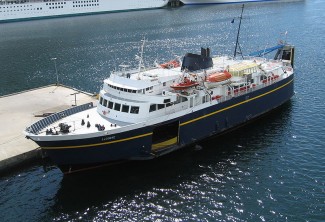
The ferry LeConte docks in Skagway in 2009. (J Webber/Creative Commons)
The state ferry system is planning a new route in Southeast Alaska. It’s being done in conjunction with a new, privately run ferry.
The new route will link unused ferry terminals south of Petersburg and on north-central Prince of Wales Island. Alaska Marine Highway General Manager Capt. John Falvey says it will begin next spring, when the summer 2015 schedule takes effect.
“We’re going to do some runs once a month to Petersburg, South Mitkof and Coffman Cove,” Falvey says. “ We want to start using the Coffman Cove and South Mitkof terminals a little bit.”
The ferry docks were built last decade for routes that no longer exist.
One sent a fast state ferry between Ketchikan and South Mitkof, about 25 road miles from Petersburg. The other was an Inter-Island Ferry Authority route connecting Coffman Cove, Wrangell and South Mitkof.
More than $15 million in federal transportation funds paid for construction. But officials say the money needs to be paid back unless the terminals are used.
Falvey says that’s a reason for the new route. “We want to take a look at it and give it an honest try,” Falvey says.
He says the small ferry LeConte will make a monthly trip on the route. As a result, Hoonah will lose one monthly sailing from Juneau.
The ferry will not stop in Wrangell, which is between Petersburg and Coffman Cove. The Petersburg and South Mitkof stops duplicate each other, since South Mitkof was built for access to Petersburg.
“It’s necessary to show that the terminals built with federal money are being used for their intended purpose,” Falvey says.
Kent Miller is manager of the North End Ferry Authority. That’s the group preparing a used, 65-foot landing craft to sail along a similar route.
The authority expects what it’s calling theRainforest Islanderto dock at other landings at the start. But it hopes to adapt the Mitkof and Coffman terminals for its use. And that requires them to remain in state hands. Miller says the authority intends to start service in spring of 2015, around April 15th, and continue the service year-round.
The Coffman Cove-based ferry will sail to Wrangell and the South Mitkof terminal four days a week. A shuttle van will bring passers to and from Craig, Prince of Wales’ largest city. It will also take riders the 25 miles from South Mitkof to and from Petersburg.
“Our service will have to pay for itself out of the fare box,” Miller says. “And our financial analysis says that it can do that.”
Miller and the state ferry system are working together to avoid conflicts. Both support each other’s plans.
The state’s route is part of a proposed summer 2015 schedule just released for public comment. A teleconference is scheduled for Sept. 25 at 10:00 a.m. for Southeast and 1:30 p.m. for Southwest and Southcentral.
That schedule includes a few other changes. The fast ferry Fairweather will begin spring service May 15th, about two weeks later than usual. It links Juneau, Angoon and Sitka.
Also, the Tustumena will begin its far-Southwest sailings a little later this year, due to repairs to its drive system.
“We’re looking at May 5th. If we get the shafts repaired quicker, we’ll go ahead and run that earlier chain run if we can,” Falvey says.
The Tustumena will also call at Old Harbor, on Kodiak Island, six times next summer, up from four.
Falvey says he knows other communities want more state service. But the money isn’t there.
“We’re working hard to find efficiencies,” Falvey says. “And I’m finding efficiencies here and there. … We’re maintaining the same service and doing it with a hold-the-line budget right now.”
The proposed schedule covers May through September of next year.
Written comments on the plan will be accepted via email at dot.amhs.comments@alaska.gov and by fax at 907-586-8365 prior to Sept. 23.
The Sept. 25 teleconference will begin at 10 a.m. for Southeast schedules and 1:30 p.m. for Southwest and Southcentral schedules.
The meeting will be held in Ketchikan. The number is 1-800-315-6338, conference code 03902#.
Close
Update notification options
Subscribe to notifications
Subscribe
Get notifications about news related to the topics you care about. You can unsubscribe anytime.

 State officials are set to hold an open house and public hearing tomorrow at Centennial Hall on the Juneau Access Improvements Project, the state-backed effort to extend the capital city’s main road.