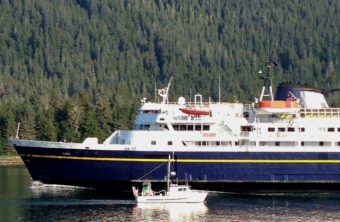
The ferry Taku sails into the Wrangell Narrows on its way south in August 2013. The ship will be drydocked in December for repairs. (Ed Schoenfeld/CoastAlaska News)
The Alaska Marine Highway ferry Taku will go into drydock for repairs the second week of December.
Spokesman Jeremy Woodrow says the drive system for one of the ship’s two propellers needs work. He says no other ferry is available to fill in.
The Taku sails from Prince Rupert to Skagway, with stops in Haines, Juneau, Sitka, Kake, Petersburg, Wrangell and Ketchikan.
Woodrow says the repair timing is intentional.
“We did chose the week of Dec. 8-15 as a way to avoid the Thanksgiving holiday and to have the ship back on line before the Christmas and New Year holiday,” he says.
He says a hydraulic fluid line in the propeller’s variable-pitch drive system needs repair.
Woodrow says wear and tear, not a specific incident, caused the problem.
“The ship can still operate under current conditions. It’s just operating inefficiently,” he says.
Woodrow says it’s using too much fuel.
The Taku will go into drydock at the Ketchikan shipyard.
The ferry can carry up to 600 passengers and 135 vehicles. But the numbers are much smaller this time of year.
There were no injuries and no major damage reported after Saturday morning’s landing at the Juneau International Airport of a small plane with malfunctioning landing gear.
Capital City Fire/Rescue Assistant Chief Ed Quinto says the pilot of the twin-engine Piper could not fully extend the aircraft’s nose gear after its hydraulics failed.
“The pilot landed, and did a great job of landing on the runway,” Quinto said. “Damage occurred only on the prop and the aircraft. There were no reported injuries of the pilot or the passengers.”
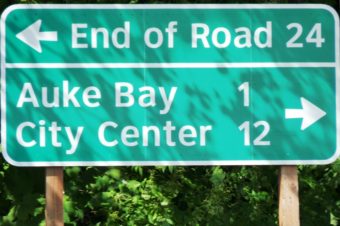
Signs mark the end of Juneau’s Glacier Highway in 2013. A state transportation plan calls for extending the road north 47 miles to a new ferry terminal. (Photo by Heather Bryant/KTOO)
Tuesday is the last day to weigh in on the latest environment document on the Juneau Access Project, commonly called the Juneau Road. The state has received tens-of-thousands of comments so far on the project, according to state Department of Transportation spokesman Jeremy Woodrow, a number the department expected.
“We were anticipating a large volume of comments coming in for this project based on the comment history based on the previous comment period for the project in 2006,” Woodrow says.
A revised Supplemental Environmental Impact Statement was released on the project in September. It examines ways to improve access between Juneau and Northern Lynn Canal communities.
The state Department of Transportation favors extending a road north of Juneau to the Katzehin River where an unmanned ferry terminal would be built. Ferries would transport vehicles and passengers between Katzehin, Haines and Skagway.
That option is estimated to cost about $523 million for road construction, and new ferry terminal and vessel construction another $51 million.
The DOT held meetings in the three communities about the impact statement. People registered their comments on the project at those meetings but the bulk of the comments have come in written form. Woodrow says many of those submissions are from national advocacy groups, like Sierra Club, whose members submitted form letters and signed online petitions. Woodrow says DOT was expecting a delivery of 20- to 40,000 comments from the group Earthjustice on Monday.
DOT does not have to respond to each comment individually, but it does have to respond to each issue raised, Woodrow says.
“Responding to the comments is really responding to the information presented in the comments. If the information is similar to other comments, then responding to those questions or concerns in one response meets the criteria of responding to those comments,” he says.
DOT estimates it will take about a year to incorporate all the comments into the final environmental impact statement.
Gov. Sean Parnell has favored the road alternative and pushed its progress through his term. Incoming governor Bill Walker has said he questions the project’s costs.
A police officer was able to resuscitate a collapsed, 81-year-old man at the Juneau International Airport on Monday. (Photo by Heather Bryant/KTOO)
Sgt. David Wrightson was upstairs at the Juneau International Airport terminal near the TSA screening area just after 6 o’clock on Monday morning when a building-wide page alerted him to a disturbance near the first floor entry area near the stairs.
When he arrived at the scene, he found a man lying on the ground and unresponsive. Other travelers standing around the victim didn’t know if the man had tripped or fallen, or if he collapsed because of a health issue.
Wrightson said the man, identified by Juneau Police only as an 81-year-old, was not breathing and had no pulse. The man’s coworker and traveling companion indicated that he recently had heart surgery.
So, Wrightson enlisted someone else to help him with CPR, or cardiopulmonary resuscitation. Wrightson asked the assistant to open up the victim’s airway while he started chest compressions. He said it wasn’t long before the man gasped for air, took a big breath, and then started breathing on his own.
He opened his eyes. He didn’t say anything. But he started to get color back to his face. And, by then — a couple minutes later — CCFR showed up.”
Wrightson says he doesn’t know the man, but he was partially conscious as he was taken to the hospital by EMTs from Capital City Fire/Rescue.
“I was relieved for sure,” said Wrightson. “He’s not breathing and he’s getting cold. It was great and wonderful when he gasped for air. I was just thinking: ‘Keep breathing, keep breathing.’ And, he did. I was very grateful that I was there and able to help him.”
Wrightson said he retrains on CPR techniques on a regular basis.
Capital City Fire/Rescue said Wrightson’s quick action saved the man’s life.
At last report, the patient was all right and wanted to meet Wrightson.
I’ve since learned that he was a Navy SEAL. Everyone’s saying I’m a hero. I’m no hero,” Wrightson said. “He’s a hero in my book. So, I was glad I was there to help him.”
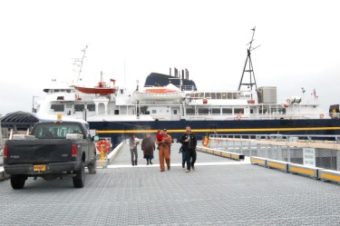
Extra ferry life rings lean against other spare parts at the Ketchikan Marine Engineering Facility at Ward Cove last January. (Photo by Ed Schoenfeld/CoastAlaska News)
The Alaska Marine Highway System won’t ban solo travel by children and teenagers, at least for now.
New rules announced earlier this month would have required anyone under 18 to travel with an adult. Chaperoned youth groups, such as school sports teams, were to be exempted.
Spokesman Jeremy Woodrow says those rules won’t go into place until sometime next year.
“We did receive several comments from Alaskan residents who had a strong reaction, that the policy timing was going to be a burden on families. It was going to create difficulties during the holiday season,” he says.
Woodrow says changes may be made to the new rules before they’re re-released. But they will still increase restrictions on traveling minors.
Current rules allow 16- and 17-year-olds to take the ferry on their own. Those 12 to 15 need a note from a parent or guardian. And kids under 12 must travel with an adult, but it could be anyone.
The proposed new rules say everyone under 18 needs to be with a parent, legal guardian or have notarized authorization from a parent or guardian.
Woodrow says ferry employees do not have time to oversee children and teenagers.
“We’re trying to stress to folks that if you don’t have to put your child on the ferry unaccompanied, we prefer you to not go that route,” he says.
He says the ferry system will give the public more notice of rule changes when they’re reintroduced.
Horizon Lines has operated from the Unalaska Marine Center for more than 20 years. (Photo by Annie Ngo/KUCB)
After years of financial trouble, Horizon Lines has announced plans to sell off its routes in Alaska and Hawaii.
Horizon started moving cargo in Alaska 50 years ago. Back then, the company was still known as Sea-Land. And they hadn’t gone through the string of mergers and sales that have become common in the shipping industry.
As it’s changed hands, Horizon has been stacking up debt — now more than half a billion dollars’ worth. Chief financial officer Michael Avara says they tried refinancing and restructuring, but it just wasn’t sustainable.
That’s why Horizon has decided to shut down their operations in Puerto Rico and sell the rest.
In Hawaii, a shipping line called the Pasha Group has offered $142 million to pick up Horizon’s service. And for $69.2 million, Matson will get the Alaska operations and all of Horizon’s stock.
Avara says they’re in a good position to take it on.
“Matson is a large, profitable company with roots tracing back 150 years or so to Hawaii,” Avara says. “They have an excellent balance sheet and I think they’ll be a very good steward of the Alaska service.”
Until now, Matson’s mostly been focused on shipping in Hawaii and the South Pacific. They wanted to expand north. But spokesperson Jeff Hull says there wasn’t room — until Horizon fell on hard times.
The company was part of a long investigation into price fixing in the cargo industry. In 2011, Horizon pleaded guilty to inflating their rates and agreed to pay a $15 million fine.
The Justice Department also asked Matson to produce records, but they were never charged with a crime.
Even though Horizon’s been on shaky footing, they’ve still been a major player in domestic shipping under the Jones Act. The law says that operators have to be American-owned, using domestically built vessels and American crews, in order to move cargo between U.S. ports.
Horizon has more than a dozen vessels that meet those standards — including three in Alaska. They provide regular service between Tacoma, Anchorage, Kodiak and Unalaska.
“And basically they are carrying our fresh produce, our groceries, household goods,” says Peggy McLaughlin, Unalaska’s ports director.
Horizon has been using the same municipal dock in Unalaska for more than 20 years. For most of that time, they operated under a special contract. But since it lapsed in December, Horizon has been paying tariffs to the city government to move cargo.
For reasons beside revenue, McLaughlin says the route is important.
“We hope that Matson recognizes that that domestic line haul service is really critical to Unalaska and our supply chain — and that the service level remains at least status quo,” McLaughlin says.
While there could be some personnel changes in Alaska, Jeff Hull says Matson will leave the actual shipping services intact.
In Unalaska, that means Matson will try to step into a partnership with Maersk, the international shipping giant.
Maersk exports seafood utilizing Horizon as its local agent, with laborers from the International Longshore and Warehouse Union. Matson already has a contract with the union at other ports on the West Coast, according to Hull.
The one thing that could change is Horizon’s fleet. At almost 40 years old, the vessels are showing their age. And Hull says it might take some work to bring them up to speed with new air emissions regulations.
It wouldn’t happen until after federal trade regulators approve the deal between Matson and Horizon. The companies are expecting to hear back next year.
Close
Update notification options
Subscribe to notifications
Subscribe
Get notifications about news related to the topics you care about. You can unsubscribe anytime.