Transportation

Blindingly bright ‘moose lights’ worry Troopers – but they’re legal, unregulated

Sgt. Jess Carson, with Alaska State Troopers' Bureau of Highway Patrol Fairbanks office, says extremely bright after-market headlights may help the motorist behind the wheel, but they also may create a hazard for motorists in oncoming vehicles by diminishing their night vision.  (Creative Commons Photo by  Sharat Ganapati)
Sgt. Jess Carson, with Alaska State Troopers’ Bureau of Highway Patrol Fairbanks office, says extremely bright after-market headlights may help the motorist behind the wheel, but they also may create a hazard for motorists in oncoming vehicles by diminishing their night vision. (Creative Commons Photo by Sharat Ganapati)

High-intensity headlights are popular and getting more so, especially here in Alaska during the long, dark winter months. They’re called “moose lights,” because they help drivers see farther down the road than conventional headlights to spot animals and other hazards. But Alaska State Troopers say moose lights can also create a hazard by temporarily blinding oncoming motorists in the other lane.

Ben Knix works at the NAPA auto parts store in Delta Junction, and he says he likes the added visibility he gets with his Light Force 240 high-intensity discharge lights he’s got mounted on his pickup’s rollbar.

“Yeah, I mean I have them just to see more moose, and anything else you might encounter while driving,” he said. “And they do really great. I like ’em.”

Knix says the bright lights also are popular among his customers.

“Y’know, we do sell a lot of them,” he said. “A lot of people like ’em.”

But Dave Slater says those extremely bright headlights really bother him.

“These brights are so bright – I mean, they’re even brighter than regular, standard-beam bulbs on high,” Slater said. “And they’re blinding.”

That’s what worries Sgt. Jess Carson, with the Alaska State Troopers’ Fairbanks Bureau of Highway Patrol office. Carson says Troopers have been getting a half-dozen or so complaints like Slater’s annually over the past few years. But he says they can’t really do much more than sympathize with them.

“We just explain to them that we share their frustration,” he said. “We understand that it is very difficult to see around them. That it limits your vision while you’re passing them, when you’re next to them and then for a little ways after you pass them. It’s almost the equivalent of somebody pointing a high-output flashlight in your eyes. It takes a little while for your eyes to adjust after that.”

Carson says there are no state laws or regulations that set standards on those after-market lights and fixtures – nor any that authorize enforcement.

“The current laws in Alaska don’t have any statutes that would allow us to enforce it.”

He says federal regulations set some standards. But they mainly govern the types of headlights that auto manufacturers install.

“What happens is people add after-market lights to the vehicles,” he said. “And that’s where we’re running into the problems.”

Carson says the federal regs also apply to the colors of light emitted by after-market units. But only those that that emit greenish or yellowish colors. Not the bright blue-ish light that many complain of – but which the federal regs classify as white-ish.

“When you see the blue lights out there, although our eye picks up some blue, it still falls within the white spectrum,” he said.

Carson says headlight systems that manufacturers install in vehicles have been tested and certified as safest for all motorists. He says they provide enough light for drivers to see a safe distance ahead, while still allowing those in the oncoming lane to preserve their night vision.

He says that’s the balance that the federal regs seek to maintain – the balance that’s thrown out-of-whack by extremely bright headlights.

“The light is designed for the maximum output for the individual behind the wheel. And you have to run a happy medium there of your ability to see versus what you’re causing to other vehicles around you.”

Carson says that’s the basis of his counter-argument to those who say moose lights make driving safer: that those bright lights can blind the other drivers, causing them to hit the ditch – or an oncoming vehicle.

“So, although you’re able to see moose, you’re able to see a little farther, you’ve now put a several-ton piece of metal flying at you at 55 miles an hour, and ruin their ability to see their lane anymore,” he said.

Carson says unless and until motorists decide something needs to be done about extremely bright headlights, and get legislators to pass laws to regulate them, Troopers can’t do much about them – unless they happen to be nearby and see a motorist failing to dim them.

Slater, who complained about the bright headlights in a letter to the editor of the Fairbanks Daily News-Miner, says he’s not arguing in support any sort of legislation. He says he’s just trying to point out the need for motorists to think of the other guy in the oncoming vehicle.

“Y’know I hate to have a new law imposed on people,” he said. “I would rather it be something that people just do out of courtesy to their fellow man.”

And on that point, both Carson and Knix, the auto-parts store worker, agree.

Steedle: New timeline for Capital Transit plan update

(Photo by Kelli Burkinshaw/KTOO)

Deputy City Manager Rob Steedle says officials have hit the reset button in the ongoing effort to update Juneau’s Capital Transit bus plan.

After delaying changes last month, Steedle told the Juneau Assembly on Monday that the process needs more input from drivers.

“The extent that the drivers were excluded from the process early on has caused us to really suffer and there’s a lot of negative feelings right now with that workforce,” he said.

The city has been working with consultants Nelson\Nygaard on the bus plan update for more than a year. Drivers and riders roundly criticized earlier versions of the proposed changes.

One of the goals was to expand service to Riverside Drive in the Mendenhall Valley. But that’s been complicated by budget cuts and the fact that expanding service in one area would likely mean reducing it elsewhere.

Some Assembly members have suggested restoring funding to the bus system, but Mayor Merrill Sanford questions where the money would come from.

“That’s where we are with our dollars right now,” Sanford said. “So, every time we juggle dollars, and if we say ‘We want to put a million more dollars into the transit system,’ that has to come from somewhere.”

Steedle said the number one goal in his mind is for the city’s bus system to run on time.

“When you have buses running as infrequently as 30 or 60 minutes having timed transfers, I think, is essential,” Steedle said.

The new timeline for implementing route changes calls for getting input from drivers in January and February, before putting the plan out for public comment in March. The plan would come back to the Assembly in April, with implementation tentatively set for early July.

Ferry fares going up in summer of 2015

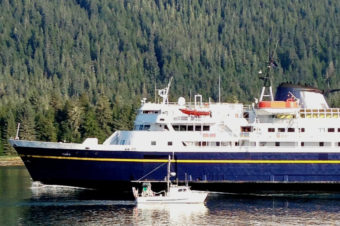
A Petersburg fishing boat passes the ferry Taku near the entrance of Wrangell Narrows in August, 2013. (Ed Schoenfeld/CoastAlaska News)

It will cost passengers more to ride the state ferry starting in the summer. That’s when fares for most Alaska Marine Highway trips will increase by 4.5%.

According to the Department of Transportation, tickets booked after the first of the year for travel after May first will reflect the new rates. Tickets booked before the New Year will fall under the current rates.

The new fare structure is spurred by the recommendations of a recent rate analysis. The Marine Transportation Advisory Board saw the preliminary recommendations of that report during a recent meeting in Ketchikan. DOT spokesman Jeremy Woodrow says the department was planning to raise fares even before the recommendation

“The department knew its rates were out of balance and by increasing most fares by 4.5%, that was consistent with a lot of other recommendations that were coming through the department as a way to help increase revenues to offset operating costs,” he said. “So the department would likely move ahead with this rate increase regardless. So by announcing it now, we’re giving the general public the most amount of time possible to prepare for that increase.”

The analysis was conducted by Northern Economics. It recommends the Marine Highway System set rates so that they to cover between 39 to 65 percent of operating expenses. Revenues currently cover less than one-third of the operating budget, according to the department.

Woodrow says the complete rate study will be released to the legislature in February. More changes in operating costs may come after that.

“The rate increase that was just announced was one of the first preliminary recommendations from that report,” he said. “The study is not complete yet so we’ve not released the first report. We’ll do that when we release the full report to the legislature this upcoming session.”

The analysis suggests that rates more than 25 percent above average NOT change. Woodrow says that means about 30 fares within the system will remain unchanged, such as the route between Skagway and Haines, the highest per mile rate in Southeast.

For the Ketchikan area, fares that are more than 25 percent above average are those between Ketchikan and Annette Island, and Ketchikan and Petersburg.

Another electric vehicle charging station to go online in Juneau

electric vehicle
An electric vehicle owned by Juneau Hydropower owner Keith Comstock powers up at Eagle Beach. (Photo by Casey Kelly/KTOO)

Another electric vehicle charging station will go online in Juneau the day after Christmas.

The station at the Marine Parking Garage is the fourth public EV charging station on the Juneau road system. The others are at Eagle Beach State Recreation Area, Alaska Electric Light and Power, and the Ted Stevens Marine Research Institute.

More are planned at Eaglecrest Ski Area, University of Alaska Southeast and the new Mendenhall Valley Library under construction at Dimond Park.

Electric vehicle drivers will need to pay 75 cents an hour to park at the Marine Parking Garage. But use of the charging station is free.

The Juneau Economic Development Council secured a $25,000 grant to expand the number of EV charging stations on the road system.

Tulsequah mine study outlines Taku River barging

Taku River
The Taku River. (Photo courtesy Rivers Without Borders)

Chieftain Metals Corp. has released new details on its plan to barge supplies and minerals to and from the Tulsequah Chief Mine, up the Taku River south of Juneau.

Chieftain is trying to re-open the long closed zinc, copper and gold mine in British Columbia. The company filed an updated feasibility study with Canadian financial regulators earlier this month. It says the Taku is likely to be impassable about 23 percent of the time during the proposed barging season from May to September. Another 23 percent of the time, barges will need a tug to help navigate the river.

Chris Zimmer with the environmental organization Rivers Without Borders says the report is light on other details about the company’s barging plan.

“When you look at this, you just think, ‘Boy, how are they going to make this work?'” Zimmer says. “Because they’ve got to get concentrate out on schedule to get it on a barge and to get it down to a freighter in Seattle. And given the conditions in the river, I just can’t see how they’re going to be able to make this work.”

According to the feasibility report, Chieftain would need four custom-built tugs and barges to make the nearly 40-mile run from the mouth of the Taku to the Tulsequah.

The company expects to ship more than 867,000 wet metric tons of concentrate to market over the proposed 11-year life of the mine. At its operational peak that would be more than 93,000 tons per year. About 17,000 tons of supplies and fuel would be shipped up the river every year as well.

Zimmer worries what will happen if Chieftain misses a few barge runs and tries to make them up when river conditions improve.

“They’re probably going to try to run a lot of barges in a very short time to make up for that shortfall,” he says. “And I think they’ll probably push the envelope for what’s safe in the river there.”

Chieftain officials previously have said the mine would not be built unless there was a road leading to it from Atlin, B.C. In October, the company announced the road is no longer being considered. The Taku River Tlingit First Nation has sued to stop the project, saying B.C. officials failed to consult them about an environmental permit.

Ron Maas is the former owner of Taku Glacier Lodge, and still owns about 150 acres up the river. He’s disappointed in Chieftain’s plan to barge.

“I just hate to see them tear up the whole damn country for a few bucks,” Maas says.

He remembers when former Tulsequah owner Redfern Resources tried barging on the Taku, and how the vessels would pass right by his property overlooking the glacier.

“It’s a gorgeous, gorgeous place, and it is just a shame to have that barge coming by,” he says. “You can hear it, you know, five miles away.”

Lynden Logistics — one of the largest freight companies operating in Alaska — last month announced it had signed a non-binding letter of intent with Chieftain to provide barging services for the Tulsequah project. Officials with both companies have declined multiple requests for comment.

Chieftain is still seeking financing to reopen the Tulsequah. Cominco last operated the mine in 1957.

Juneau state lawmakers formed the Taku River Fact-Finding Task Force in 2011 to address local concern over renewed interest in the mine. Rep. Cathy Muñoz says the city’s legislative delegation is still reviewing the updated feasibility study, and will talk about getting the task force back together early next year.

“It’s a high priority,” Muñoz says.

Traffic now crossing Brotherhood Bridge replacement

View of railing and traffic crossing the first phase of the Brotherhood Bridge replacement project. (Photo by Matt Miller/KTOO)

The Brotherhood Bridge replacement project is far from complete. But Juneau drivers may have noticed they’re already driving on the first phase of the new bridge.

A new two-lane, single span of Glacier Highway crosses the Mendenhall River adjacent to the old 319-foot bridge.

Orion Marine Contractors is currently demolishing the nearly 50-year-old span. It will be shipped south and melted down.

Once the old bridge is gone, the second phase of the new bridge will be constructed in its place. It will be a little wider than the first phase to accommodate two lanes of vehicle traffic and a separated multi-use path.

Department of Transportation spokesman Jeremy Woodrow said there’s a posted speed limit reduction in the construction zone. It’s normally 50 mph through that area, but it’s now 35 mph over that bridge.

“We ask that drivers that go through that construction zone that they be very aware of the crews and the construction equipment,” Woodrow said. “The lower speed limit is for their safety as well as the safety of the crews. So, provide extreme caution and definitely provide extra braking distance, especially in the winter time when you’re going through that construction zone.”

Woodrow warns drivers to watch for the new traffic pattern marked by barrels and candlesticks or skinny cones on either side of the span.

“There is no left turn coming out what’s called Glacier Highway,” Woodrow said. “It’s a part that comes from the Old Dairy Road – Glacier Highway area that loops back to Brotherhood Bridge. That’s the only major significant change right now is that you can’t take a left out of that.”

The $25.1 million cost of the project is not just for the bridge. It also includes improvements to vehicle and pedestrian traffic on Glacier Highway from Riverside Drive to Engineer’s Cutoff Road.

Estimated completion of the new bridge is October 2015. The bronze medallions that were installed when the original Brotherhood Bridge was dedicated in 1965 will be installed in the handrail of the new bridge.

Site notifications
Update notification options
Subscribe to notifications