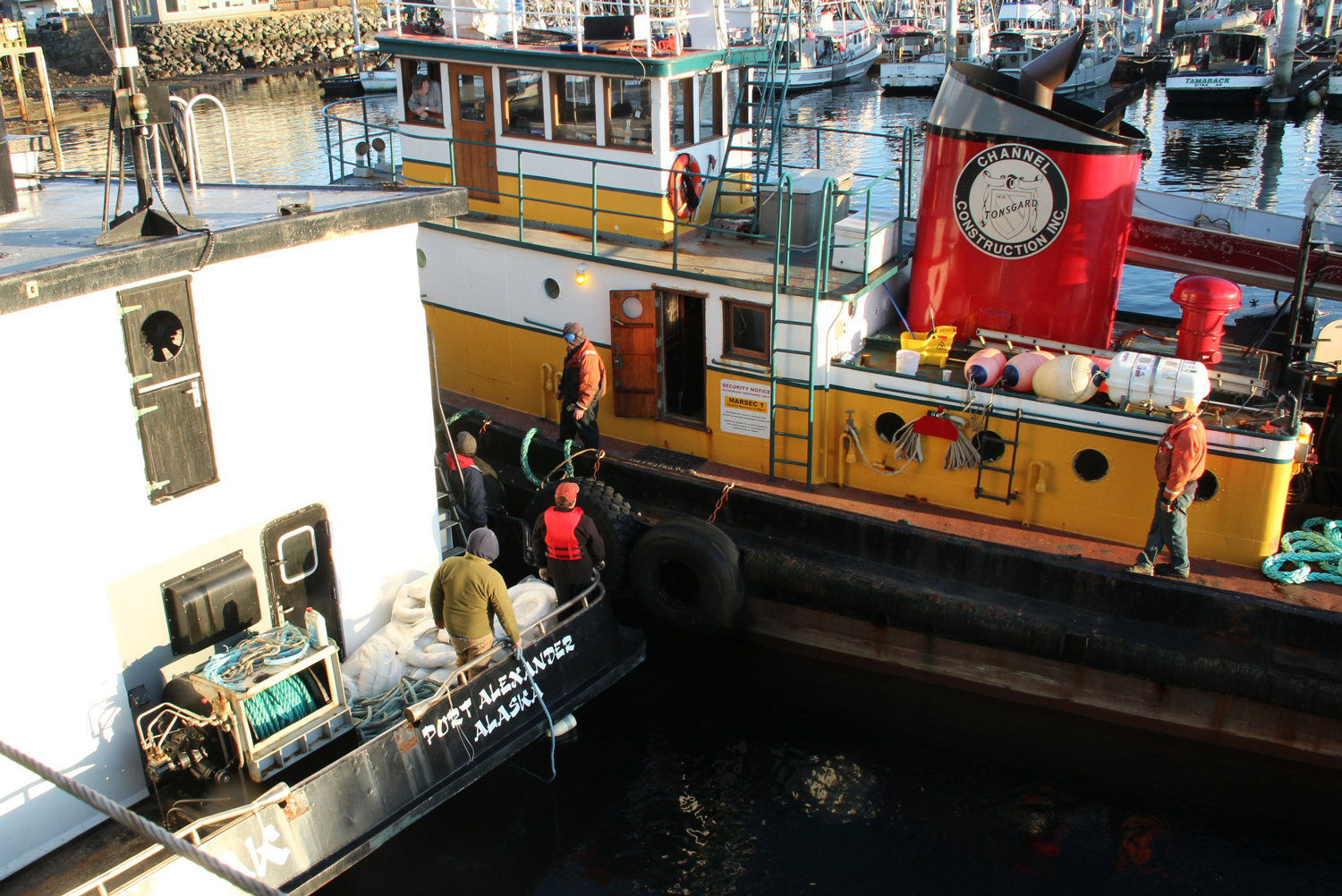
The Eyak bids goodbye to the tugboat Marauder, which brought it into Sitka Channel. (Photo by Rachel Waldholz/KCAW)
The Eyak is back in Sitka.
Ten days after the 80-foot tender and mail boat ran aground and sank just north of the Goddard hot springs, it’s back afloat — after a virtual alphabet soup of state and federal agencies and local companies worked together to salvage it.
At about 3 p.m. on Friday afternoon, the tugboat Marauder chugged into Sitka Channel with the Eyak in tow. Those watching as the vessel was tied up at Sitka Sound Seafoods said the plan for now is to take the Eyak to Wrangell for repairs.
Michael Wortman, the head of the Coast Guard marine safety detachment in Sitka, said that in total, the Eyak spilled about twenty gallons of fuel — a fraction of the 800 to 1,000 gallons the boat was believed to have on board.
“We, honestly, got really lucky,” Wortman said. “Since the vessel inverted, all the oil was trapped inside, and SEAPRO and SEAL did a great job preventing a lot more from being discharged into the water.”
The vessel was upside down in forty feet of water, Wortman said, which counter-intuitively limited leaking.
And Wortman said most of what was spilled was soaked up with absorbent material by the Southeast Alaska Petroleum Response Organization, or SEAPRO, the agency tasked with responding to local spills.
The Eyak is a crucial lifeline for the small communities of southern Baranof Island.
Mayor Debra Gifford, of Port Alexander, said the Eyak’s owner and captain, David Castle, has been supplying the town for more than two decades. Finding someone to fill the gap will be hard, Gifford said.
“It’s going to be kind of difficult because the Eyak was a multi-service operation,” she said. “Because they did all those things — the mail, the freight, buying fish — he was able to make a living doing those. But to do any single one of those is not super cost-effective, so we probably are going to have to think about the future here, to consolidate things and only get stuff in once a month or every few months. I’m just not really sure how that is going to play out yet.”
But for now, the town’s 45 year-round residents are in good shape, Gifford said. Castle owns a second, smaller boat, the Silver Arrow, which is taking mail and groceries down to Port Alexander while the Eyak is out of commission. Fuel comes in on a separate barge.
So while there’s no way to get, say, a couch or a new washing machine, or lumber for a building project, nobody is in dire straits.
“Everyone’s got food to eat and that kind of thing,” Gifford said. “I think mostly people, off the bat, are pretty heartbroken for Dave Castle. The loss of the Eyak is more than just him bringing us stuff, it’s his home, and it’s a lifestyle for him to come out here and, you know, be a part of the infrastructure of our community. He’s a good friend to all of us out here.”
The Coast Guard’s Wortman said Castle had insurance, which is paying for the salvage operation. Friends also set up a fundraising campaign for Castle. So far, it has raised over $25,000.
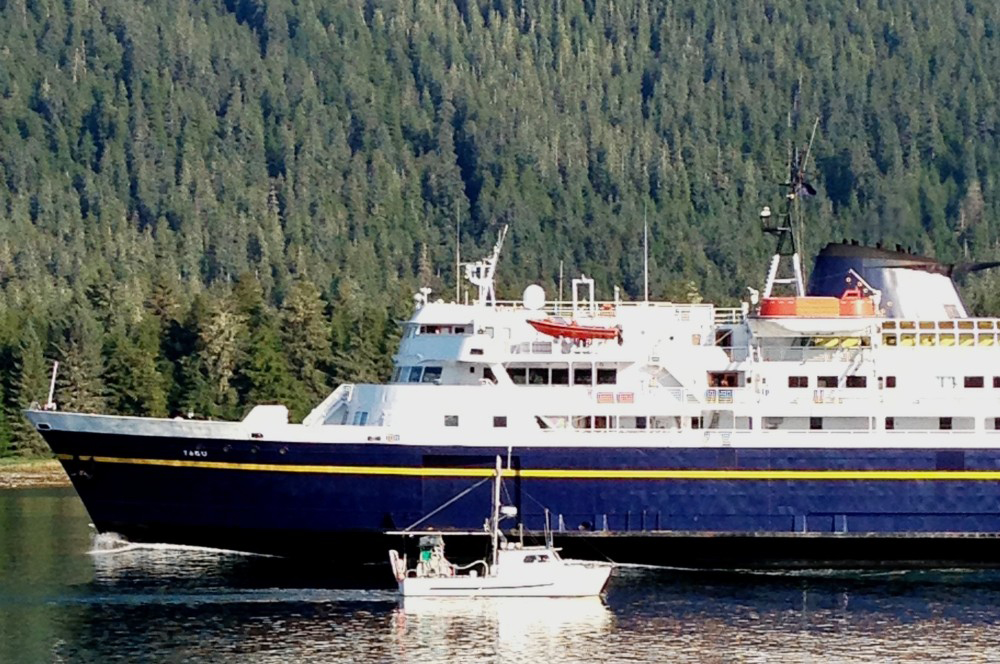
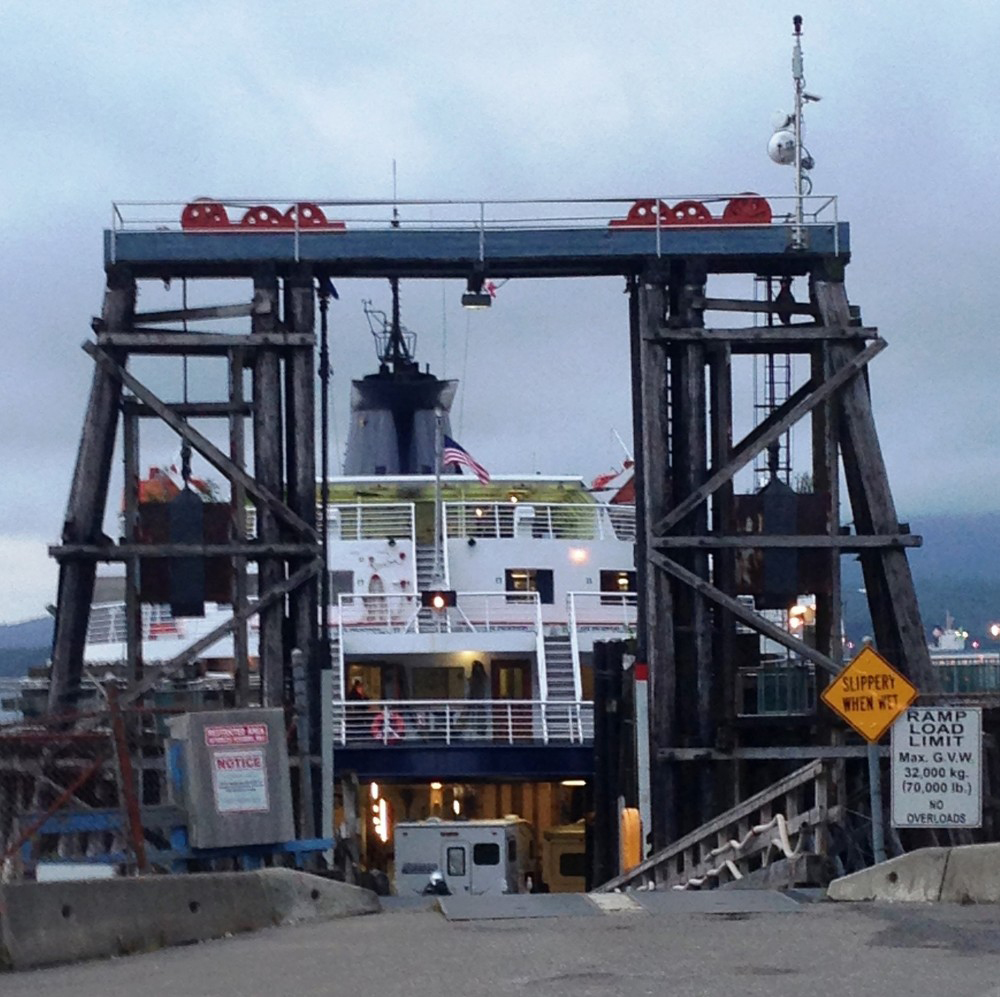
A Petersburg fishing boat passes the ferry Taku near the entrance of Wrangell Narrows in August, 2013. (Ed Schoenfeld/CoastAlaska News)
The Alaska Marine Highway System is closing bars on state ferries, a move that state Department of Transportation officials say will save about $750,000 a year.
According to a DOT, the ferry bars lose money every year, and closing them will help limit other potential reductions in service. Spokesman Jeremy Woodrow said the biggest savings will be in salaries, but no current employees will lose their jobs.
“Crewmembers that work in the bars currently, they’ll be put in other positions. Then those positions wouldn’t be hired for the summer and then through the next winter,” he said.
Six state ferries have bar service: The Kennicott, the Matanuska, the Columbia, the Tustumena, the Malaspina and the Taku. The bar-closure dates will vary, depending on when they’re scheduled for their spring overhaul.
Woodrow said bar lounges will be offered as additional general lounge areas. The bars themselves will be closed off, but not removed, in case the state decides to offer that service again in the future.
Even though the bars will be closed, passengers 21 and older will be able to purchase beer and wine in the cafeteria areas during scheduled meal service times.
Woodrow said how that will work has not yet been determined.
“That’s something the department is going to be working on as these ships enter into their overhaul status, they’ll be working on the ship and finding a safe place, but also a convenient place to be able to store the beer and wine so that when passengers are purchasing their meal, they also can purchase a beer or wine to go along with their meal,” he said.
Woodrow said the first ship due for an overhaul is the Kennicott in March. The last one is the Taku, which is scheduled for June.
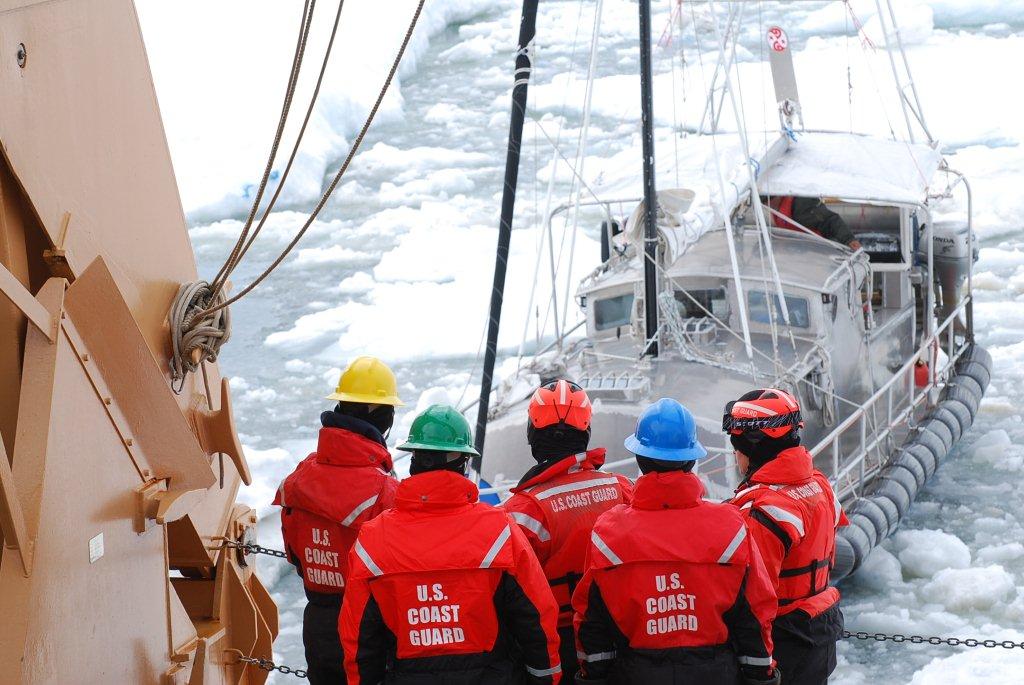
41 foot sailing vessel Altan Girl is towed out of the sea ice by USCGC Healy after getting stuck about 40 miles northeast of Barrow in July 2014. (Photo by Ensign Carolyn Mahoney, U.S. Coast Guard)
Anticipating increased traffic through the Bering Strait as retreating sea ice opens up the Arctic Ocean to more vessels, the U.S. Coast Guard is accepting public comments on proposed vessel routes off northwestern Alaska.
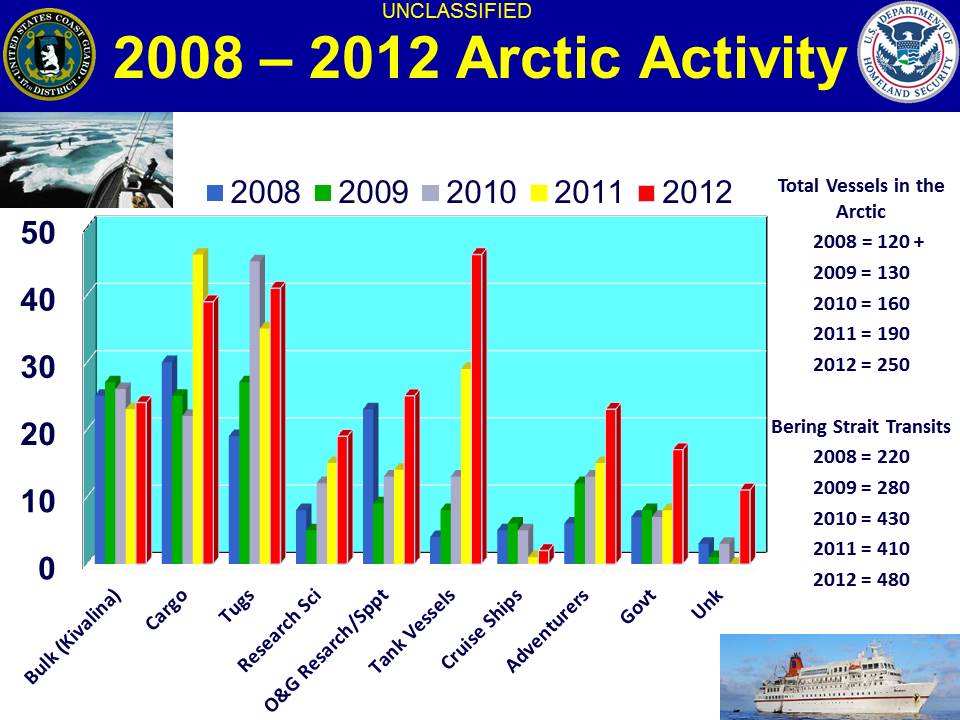
“We get about 400 transits up through that part, a year. Generally, that’s about 200 vessels since some of those are repeat customers,” says Rear Adm. Daniel Abel, commander of the U.S. Coast Guard’s 17th District.
Abel says traffic through the Bering Strait has essentially doubled over the last seven years. The Coast Guard’s Port Access Route Study is intended to reduce accidents and promote efficient traffic between the Bering and Chukchi Seas.
“So, this will help control how vessels get basically from the Aleutians all the way up, to then turn to the Northwest Passage and the northern sea route,” Abel says. “This is going to be a huge step forward on getting our arms around routing of the vessels in and out of the Arctic.”
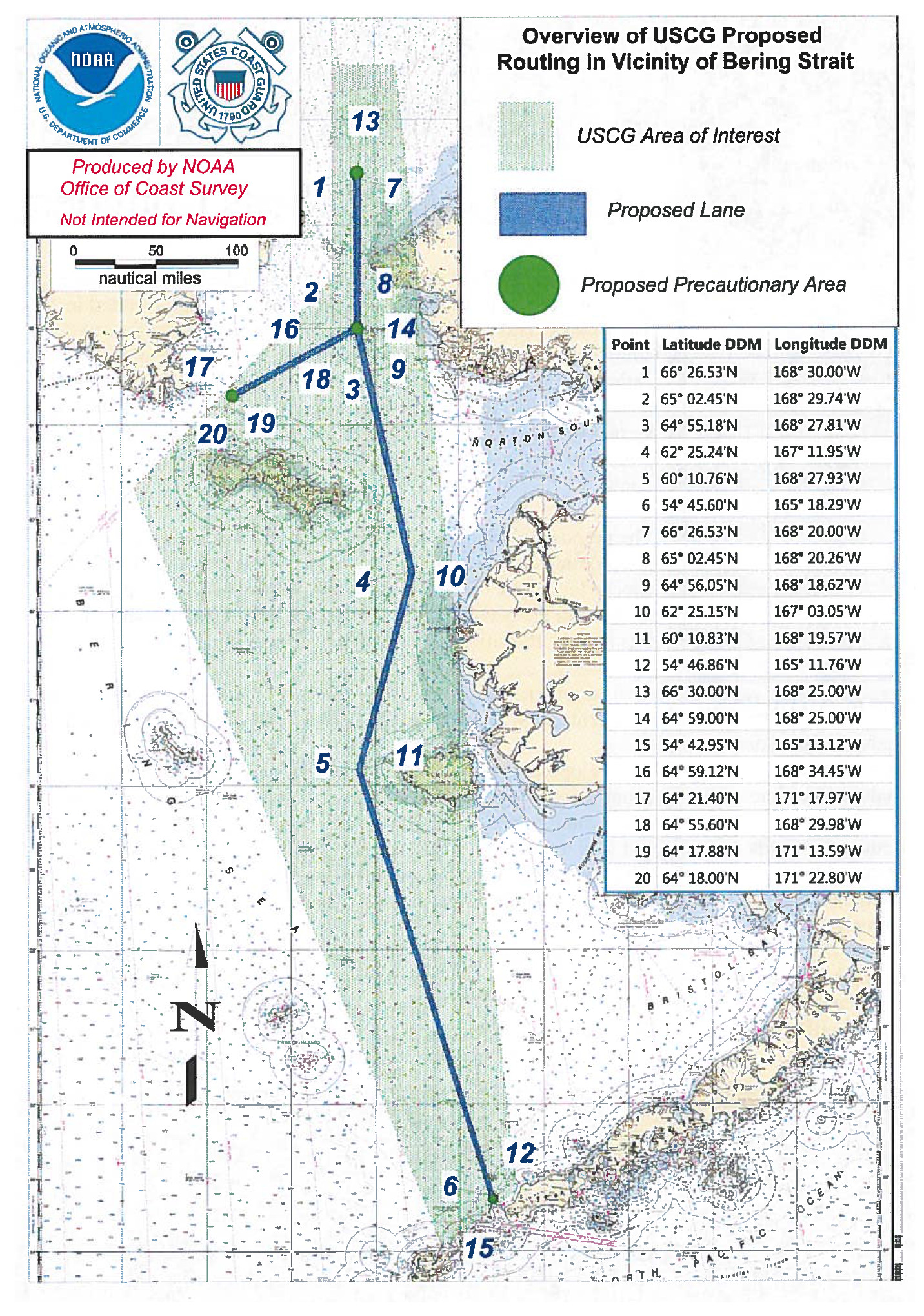
The proposed traffic lanes would run from Unimak Pass in the Aleutian Islands, a slight jog around the west side of Nunivak Island and up through Bering Strait. Traffic from Asia would pass the west end of Saint Lawrence Island before entering the Bering Strait. The four-mile wide, two-way routes are designed to avoid active commercial fishing grounds or environmentally sensitive areas.
Click to enlarge this chart of proposed traffic lanes through the Bering Sea. More detailed charts of particular segments can be found at the comment link at the bottom of this page.
Abel says the routing would likely be voluntary for vessels.
The goal would be by making it voluntary, eventually insurance companies and agents would ask ‘Why didn’t you follow what the Coast Guard recommended?’ That would reinforce the voluntary nature of the access routes to and from the Arctic,” Abel says.
Ed Page, head of the Marine Exchange, a Juneau non-profit specializing in maritime information and vessel tracking, says it makes sense.
“Provide some order, some predictability to manage the risk by prescribing where vessels should and should not go,” Page says.
Page expects ships would occasionally deviate from the proposed lanes to avoid sea ice in the central Bering Sea.
“I think a lot of this is focused on locking the barn door before the horse gets out type of philosophy,” Page says. “Let’s put some safety measures in place before it builds too far and too extreme. Some controls, some procedures, some risk mitigating visions in place early on than after the fact.”
In just five years of statistics compiled by the Coast Guard, tanker vessels, tugs, and adventurers were among the vessel types that have dramatically increased in numbers through the Bering Strait.
Graph shows detail of recent Bering Strait traffic. In addition, preliminary numbers indicate there were 440 transits of the Bering Strait in 2013, and at least 340 transits counted during 2014. (Courtesy U.S. Coast Guard)
Page says some of those vessels include oil tankers and bulk zinc ore carriers heading to Asia from ports above the Russian Far East.
Traffic density recently fluctuated with offshore oil exploration efforts, but it’s still very low. As an example, it’s still barely five percent of the marine traffic in portions of Southeast Alaska.
“Down here in Juneau, we have about 7,000 vessels trampsing right by Juneau every year between the cruise ships, and the ferries, and the tugboats, and cargo vessels that go to Greens Creek (mine) and what have you,” Page says.
Page doesn’t believe Arctic marine traffic will really increase that much within the next 20 years. More bulk carriers may try that route, but there’s still too much uncertainty about ocean floor charting and the dynamic pack ice which may make it a risky route for container vessels on time-sensitive schedules.
“You need to have reliability,” Page says. “You have to make sure it shows up on Tuesday. ‘Well, it’ll be there when we get there. It depends on the weather, it depends on the ice, it depends on…’ No, that’s not acceptable.”
Page also says it’s unlikely that responsible shippers would take on the high liability of using vessels that don’t meet the Polar Code. Adopted last November by the United Nations International Maritime Organization (IMO), the Polar Code sets standards for design, construction, equipment, operations, training, search and rescue, and environmental protection for vessels in Arctic and Antarctic waters. It goes into effect in 2017.
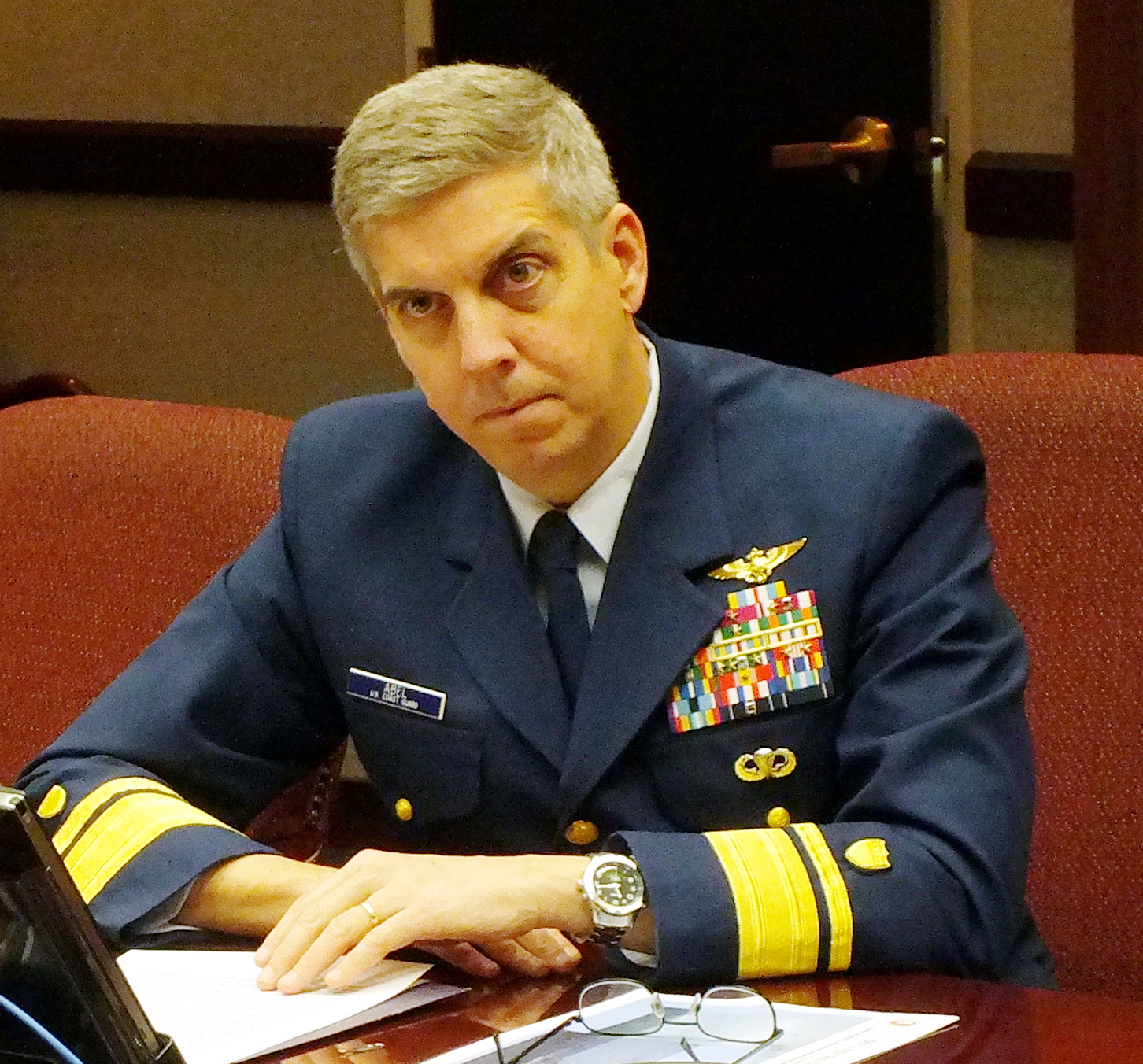
Rear Admiral Daniel Abel, commander of the U.S. Coast Guard’s 17th District. (Photo by Matt Miller/KTOO)
Coast Guard Rear Admiral Daniel Abel says the proposed traffic route and Polar Code are only two elements of a broader effort to increase governance, safety, and security in the Arctic. He says the last leg of the three-legged stool includes the just-created Arctic Waterways Safety Committee.
“And that’s consistent with what we would do with any other port,” says Abel “So, let’s say if you were in Boston, there would be a Boston Harbor Safety Committee. It brings together all of the stakeholders and partners in the port – industry; communities; in this particular case, the villages; Alaska Natives; the subsistence communities – and we turn to them on ‘What would you like in your transportation system as far as routing, regulation?’”
Public comments are being taken on the proposed Port Access Route Study until June. Check out the link below to submit comments or find more information.
You can submit comments, and find charts and other supporting documents by going to http://www.regulations.gov
Type “USCG-2014-0941” into the search bar and press “search”.
Federal funds covering most of the project require U.S. steel to be used. Canadian officials won’t let that happen.
At a recent press conference, Walker said he expected to find a way around the conflict.
“It’s an important part of what we do as far as our Alaska Marine Highway System. So, we’ll continue to have that discussion and I’m sure we’ll come to some sort of understanding so the project can move forward,” Walker said.
Prince Rupert is about 100 miles southeast of Ketchikan. It’s the only ferry port on the mainland road system in the thousand miles between Skagway and Bellingham, Washington.
State Transportation Department officials say the current dock and ramp will last no more than five years.
The terminal had to close for repairs when it was deemed unsafe in 2008. But that was only a temporary fix.
Since then, there state has negotiated a $3.3-million, 50-year lease for the terminal, which is part of Prince Rupert’s port.
Transportation Department spokesman Jeremy Woodrow said that’s a long-enough commitment to justify reconstruction.
“Usually when we build facilities, bridges, roads they have a finite life. And 50 years is a pretty good estimate for a lifespan of a terminal,” Woodrow said.
Bidding documents listed the cost at $10 million to $20 million.
Woodrow says if the project proceeds, it’s expected to take one or two construction seasons to build.
Marc Luiken stands in his office in 2011 during his first go-around as state Department of Transportion commissioner. Gov. Bill Walker named him to the post Friday. (Ed Schoenfeld/CoastAlaska News)
There’s a new boss at the state agency overseeing roads, airports and ferries.
Gov. Bill Walker on Friday named Marc Luiken as his commissioner of the Department of Transportation and Public Facilities.
Luiken served in the same post from 2010 to 2012 under Gov. Sean Parnell. He’s a retired U.S. Air Force colonel who also worked on oil production with ConocoPhillips.
Walker says he liked Luiken’s approach the last time he was commissioner.
“He has somewhat of a shared vision I have, as far as what can be done in the Department of Transportation. I think there’s some more efficiencies we can do, do things differently than they’ve been done over the past,” Walker says.
Kemp and two other officials were told to resign after they released a report Walker said criticized his freeze of transportation megaprojects, including the Juneau Access road.
Kemp said it was an informational report, not a challenge.
Walker says the new commissioner agrees with his decision to stop most work on the projects.
“We don’t want to be spending money we don’t need to spend while we’re looking at them. So, we are eye-to-eye on looking into all projects and making sure it makes sense to go forward,” he says.
Luiken’s appointment is one of the last needed to fill out Walker’s cabinet.
The Alaska Department of Transportation cleaned up a small landslide along Glacier Highway Wednesday afternoon.
DOT spokesman Jeremy Woodrow says the slide occurred in the White Path avalanche area of Mount Juneau, and was mopped up relatively quickly.
The National Weather Service issued a landslide warning Tuesday for several Southeast Alaska communities due to heavy rain and winds. A small stream flood advisory is in effect overnight Wednesday.
Close
Update notification options
Subscribe to notifications
Subscribe
Get notifications about news related to the topics you care about. You can unsubscribe anytime.