State environmental officials and the U.S. Coast Guard are investigating an oil spill at Statter Harbor in Juneau’s Auke Bay.
Sarah Moore is a spill prevention coordinator with the Alaska Department of Environmental Conservation. She says people first noticed a rainbow sheen and heavy, black oil in the harbor sometime Sunday.
“It looks to be some kind of a used motor oil is our best guess at (this) time, and we’re still trying to identify the source,” she says.
The Coast Guard notified DEC of the spill after receiving a report around 7:30 last night. By the time officials arrived, Moore says it was too dark to start cleanup.
She says the sheen was originally estimated at 500 feet by 1,000 feet in size, but it’s hard to tell how much oil spilled. By this morning, she says the heavier oil was mostly collected in the corners of the floats in Statter Harbor.
Moore says a variety of tools are being deployed to soak up the spill.
“We have the sorbent material, which is referred to often as diapers. And it’s that white, thick material that collects just the oil and not water, and so we’ve been using that in a lot of the corners,” Moore says. “We’ve also been using something that’s called snare, which looks a lot like a high school cheerleader’s pompom… And then we’ve also been using just some regular containment boom to keep it in as small an area as possible.”
Moore says the oil most likely came from a vessel. DEC and the Coast Guard are investigating the exact cause.
She says there have been no reports of impacts to wildlife.
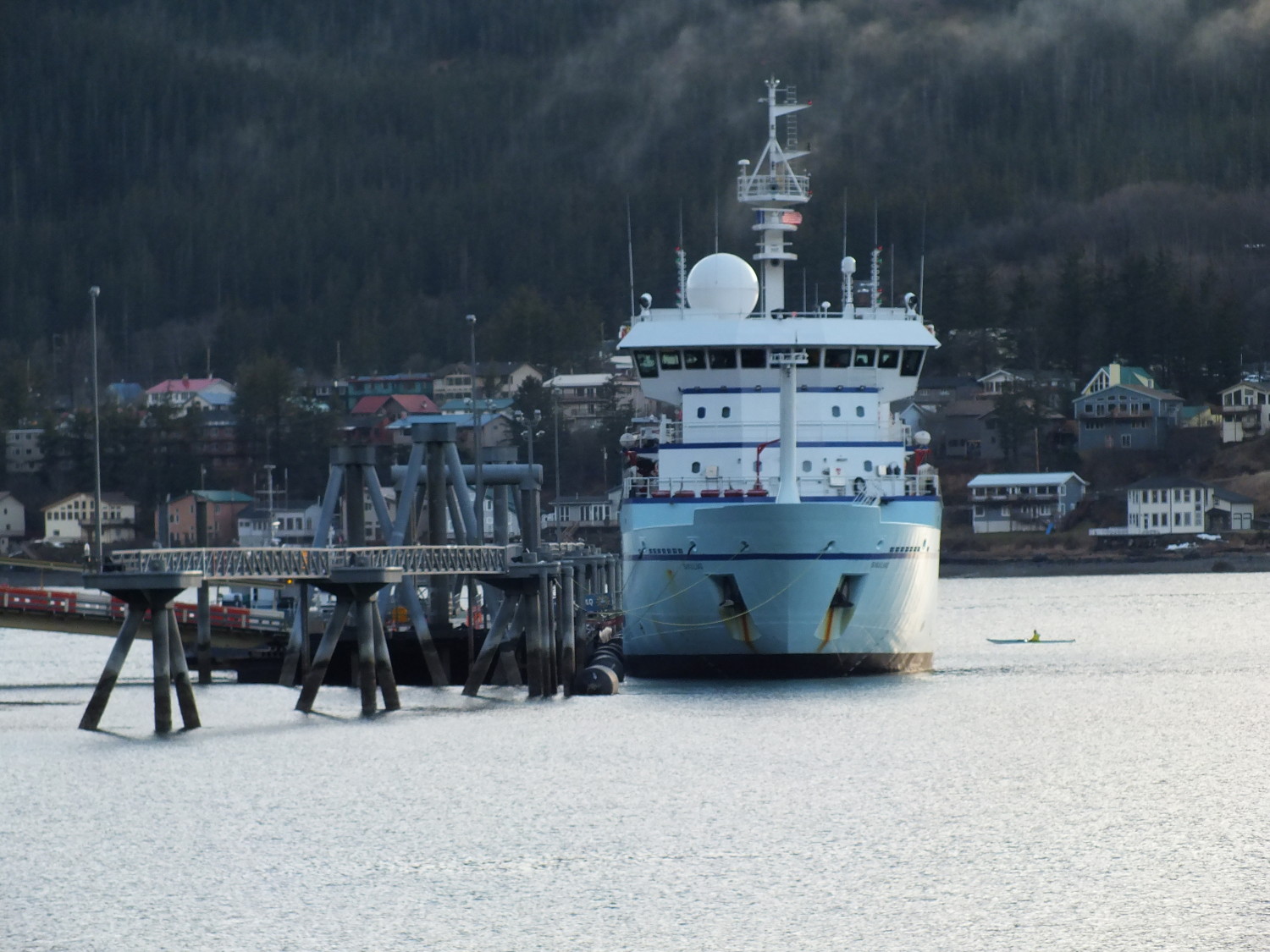
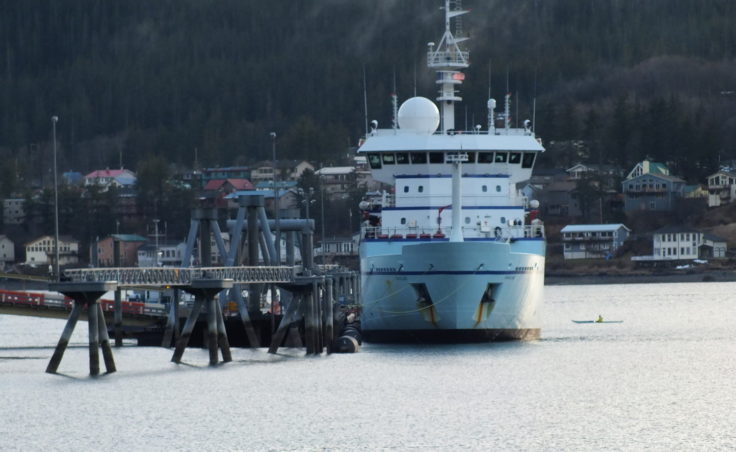
A kayaker inspects R/V Sikuliaq while it is tied up to the AJ Dock on the downtown Juneau waterfront. (Photo by Matt Miller/KTOO)
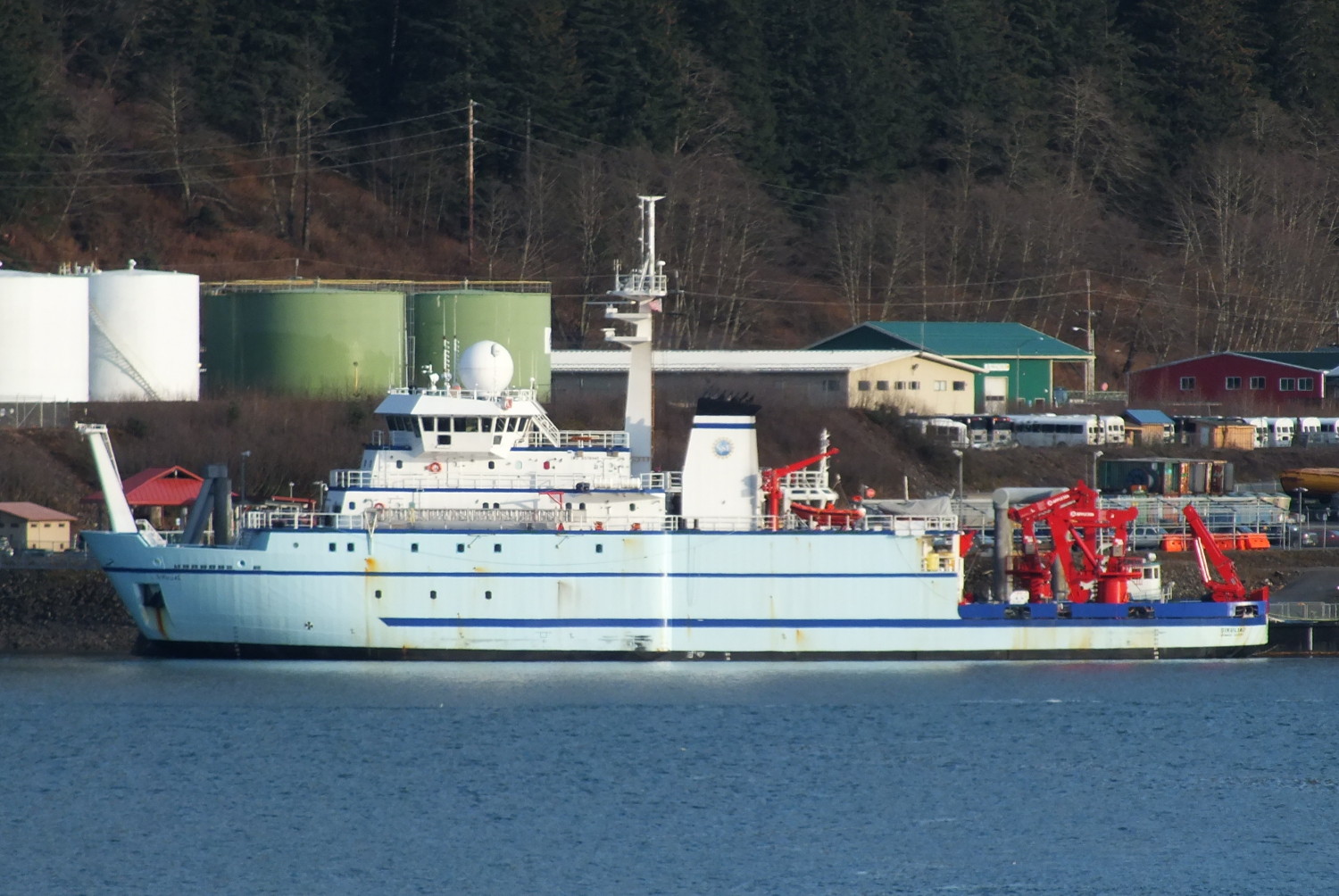
View of R/V Sikuliaq from West Juneau. (Photo by Matt Miller/KTOO)
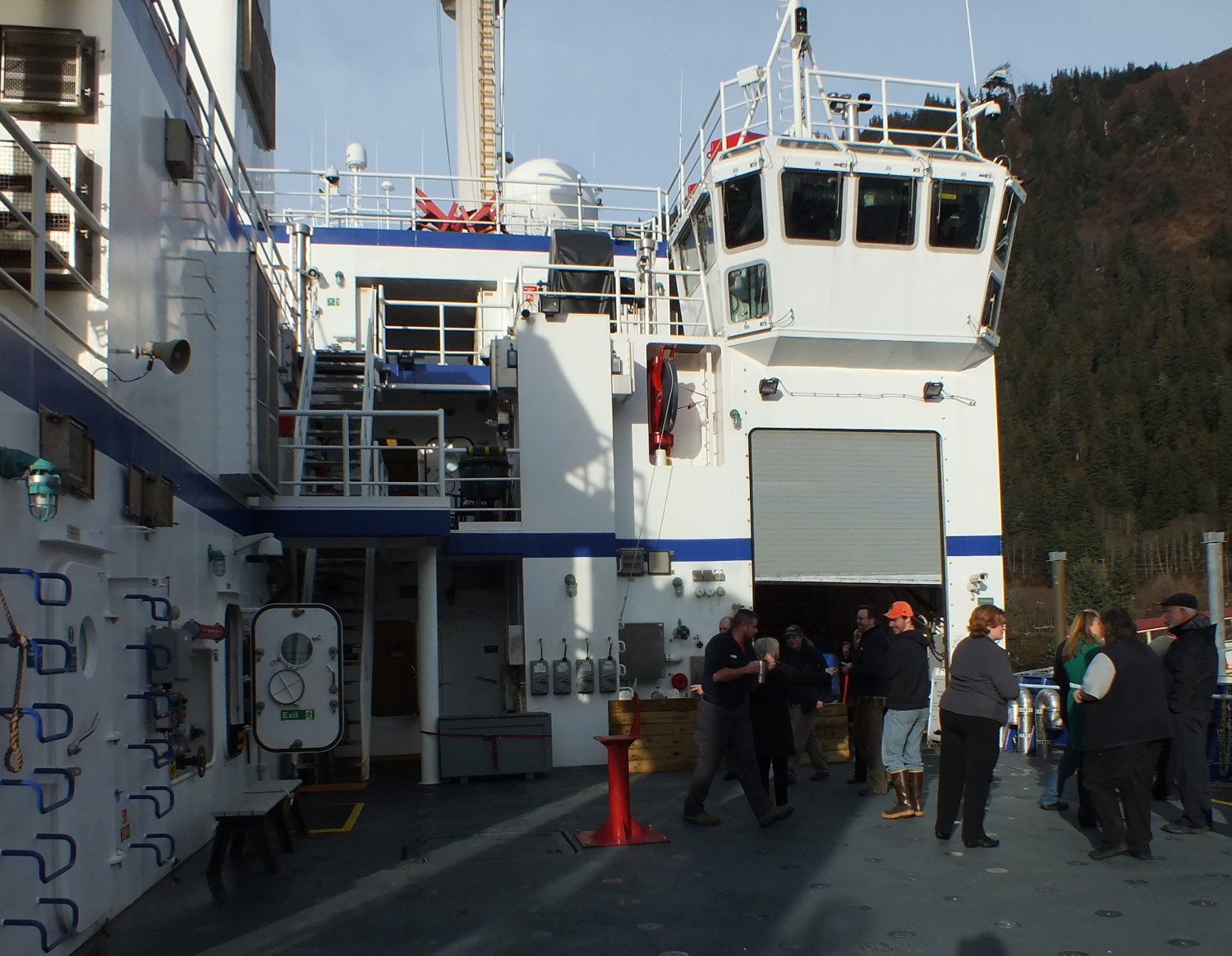
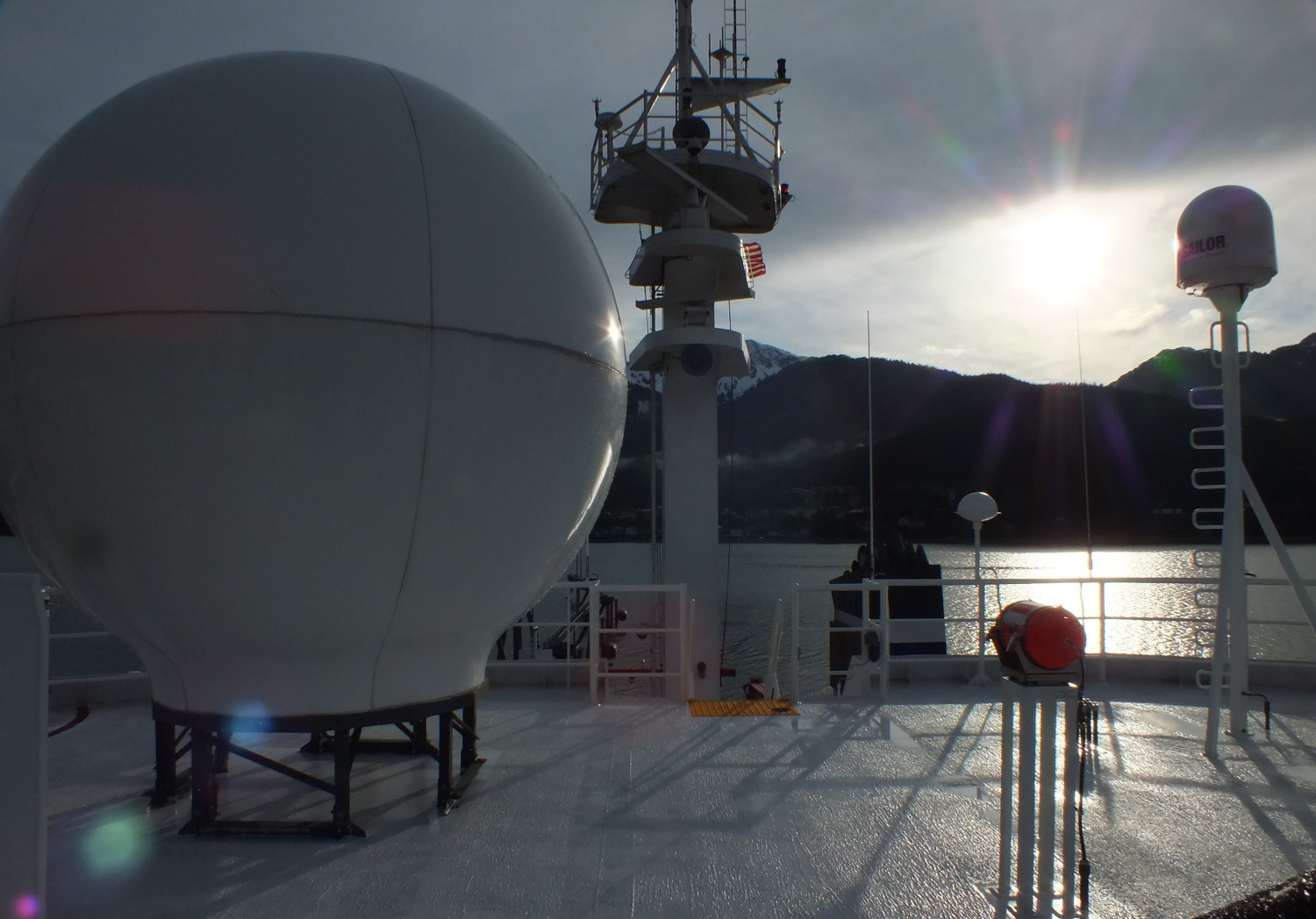
View looking ahead from the main deck. (Photo by Matt Miller/KTOO)
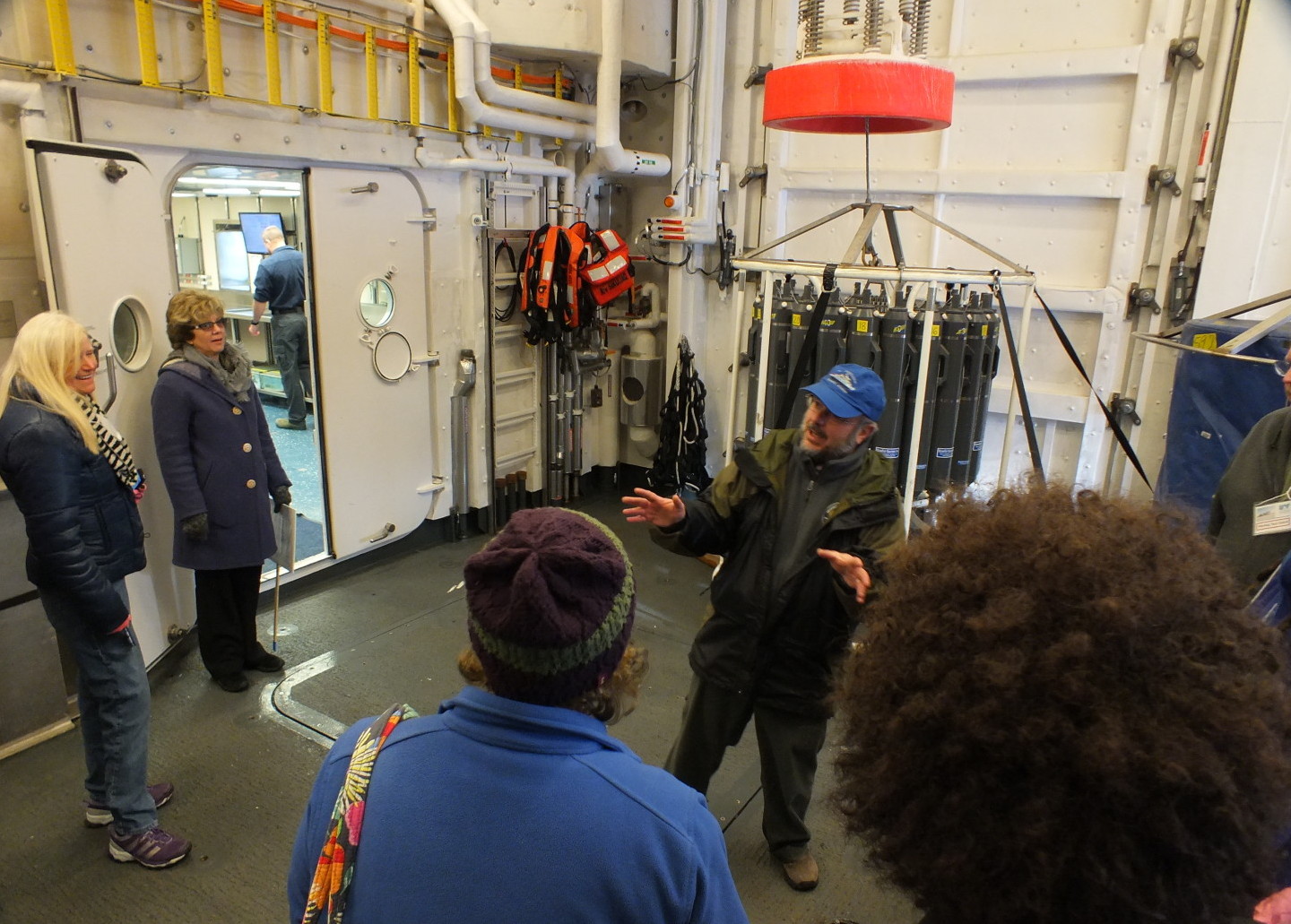
University of Alaska‘s Michael Castellini (blue cap) entertains and educates Juneau residents during a public tour of the R/V Sikuliaq. In the background is a Conductivity-Temperature-Depth (CTD) rosette that is used for sampling water at various depths. The CTD is lowered and retrieved with a robotic arm that extends over the side of the vessel through an opened hatch. (Photo by Matt Miller/KTOO)
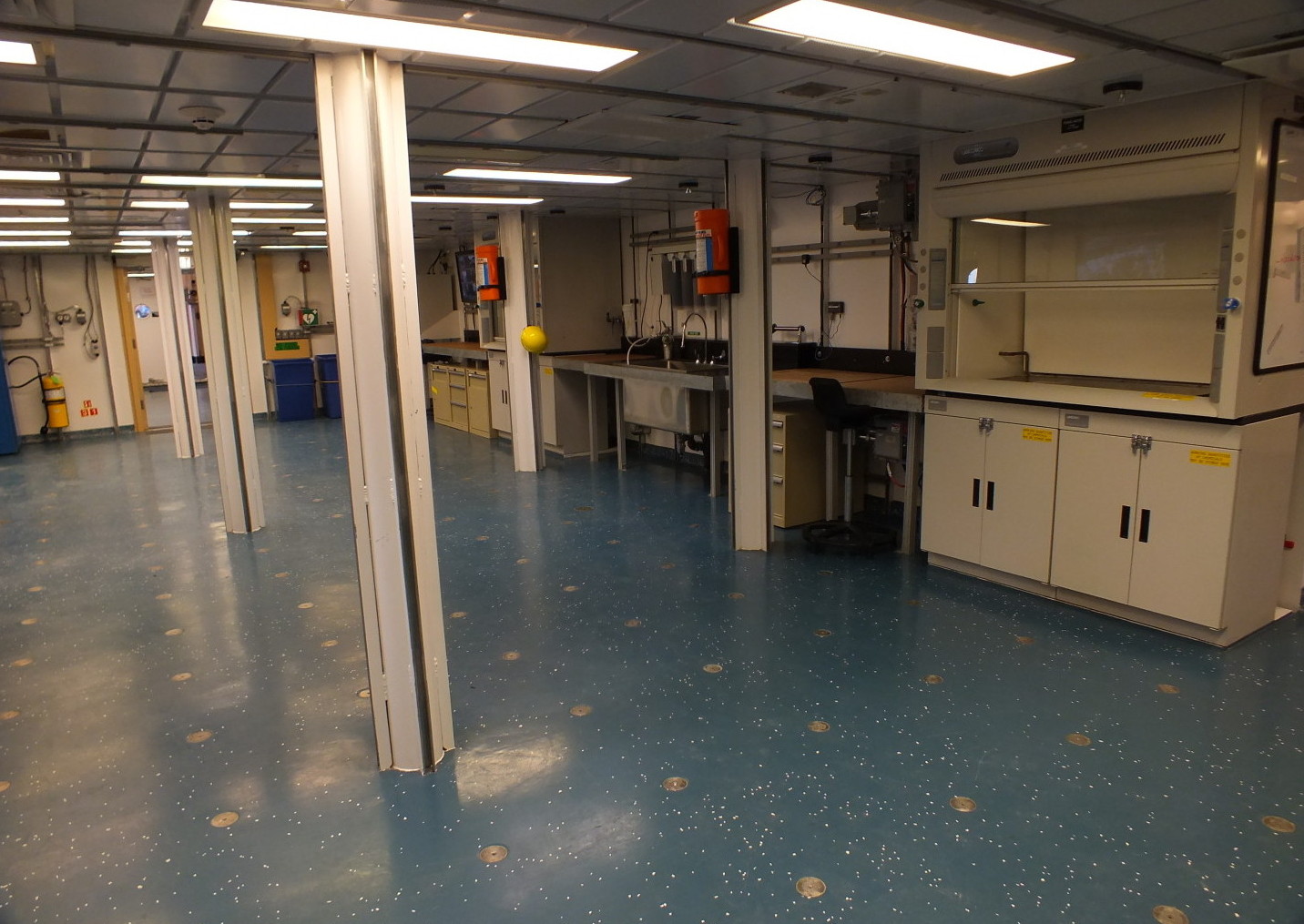
A view of the wet lab aboard the Sikuliaq that shows some of the counter space, flume hoods, and minimal equipment. Bolt patterns visible on the floor allow scientists to modify and rearrange the room according to their research needs. (Photo by Matt Miller/KTOO)
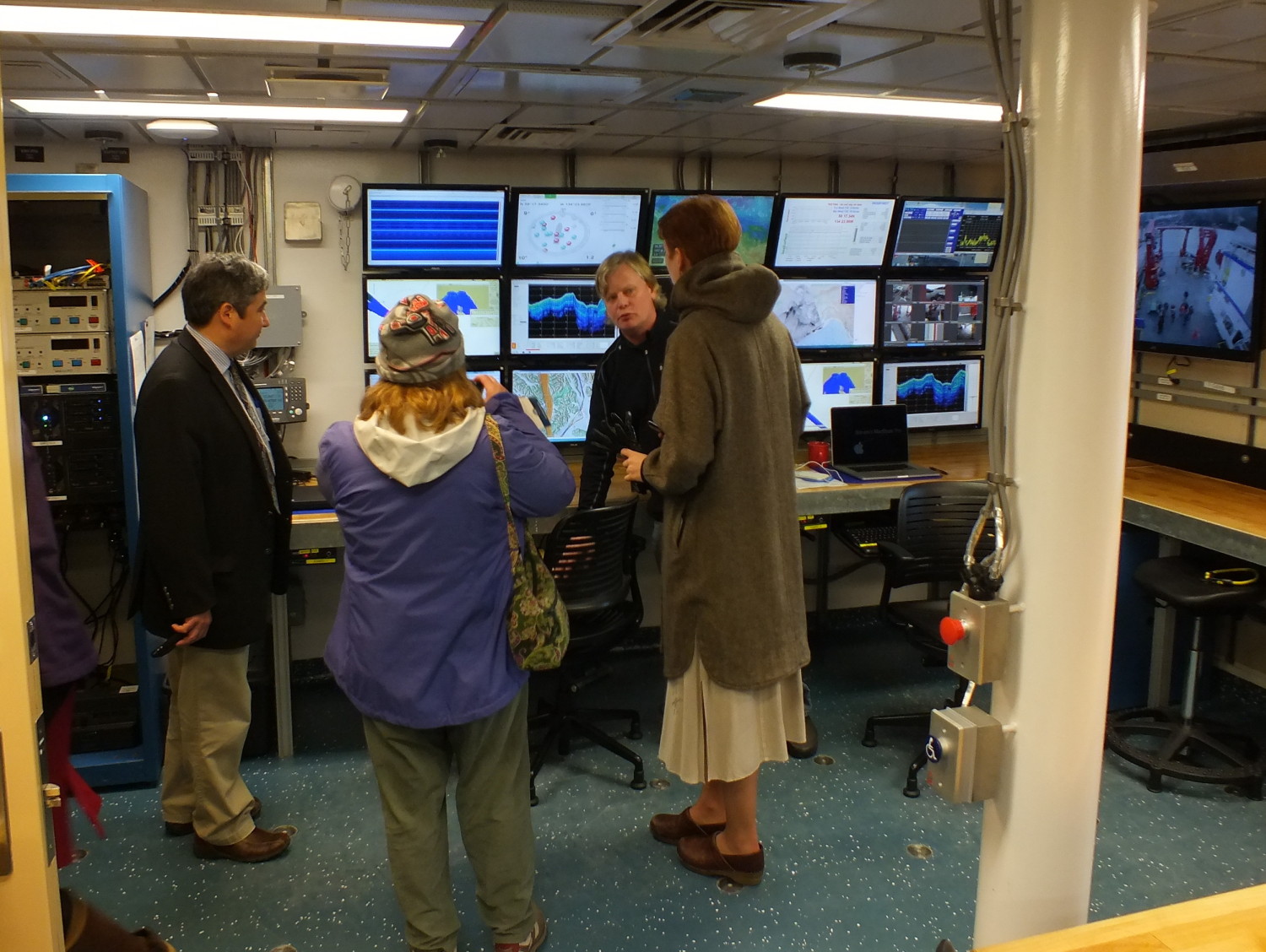
Sikuliaq crewmember Steven Hartz (black sweater second from right) explains the various data displays in the technical and computer lab to Juneau visitors. (Photo by Matt Miller/KTOO)
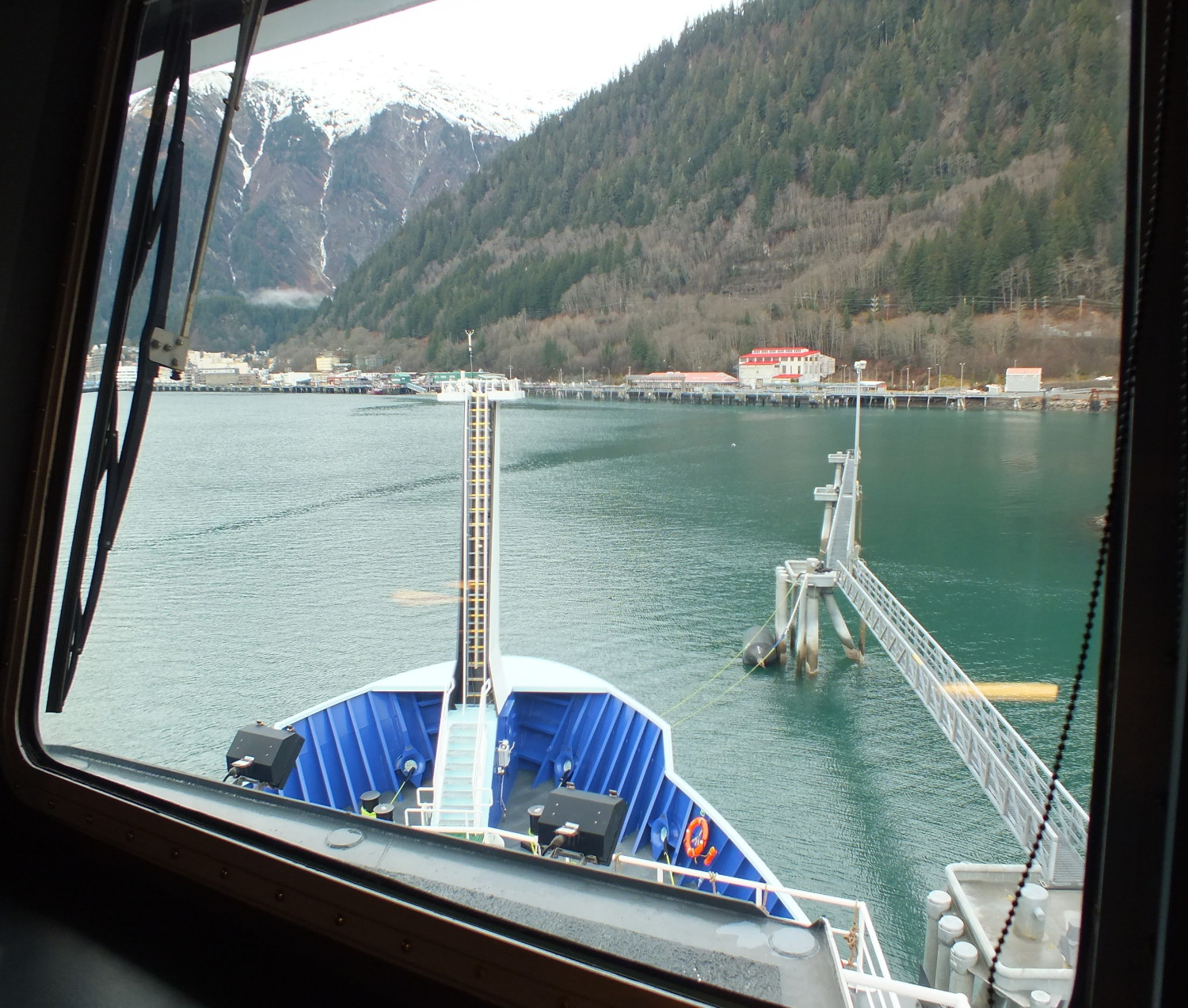
The foremast visible in this view from the bridge can used for positioning air quality sampling equipment away from any ship sources that may contaminate the sample. (Photo by Matt Miller/KTOO)
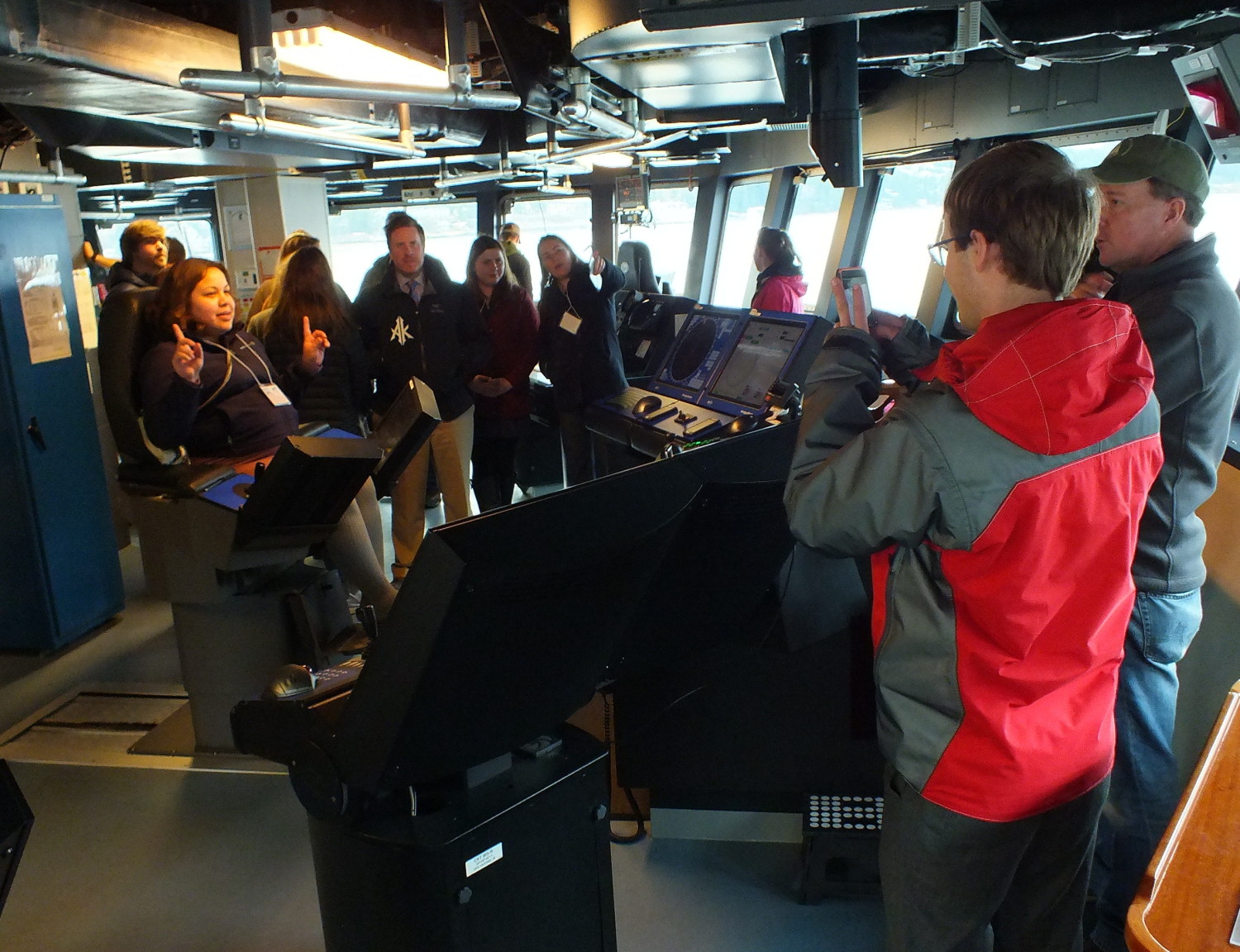
Everybody wants a picture of themselves in the captain‘s chair. (Photo by Matt Miller/KTOO)
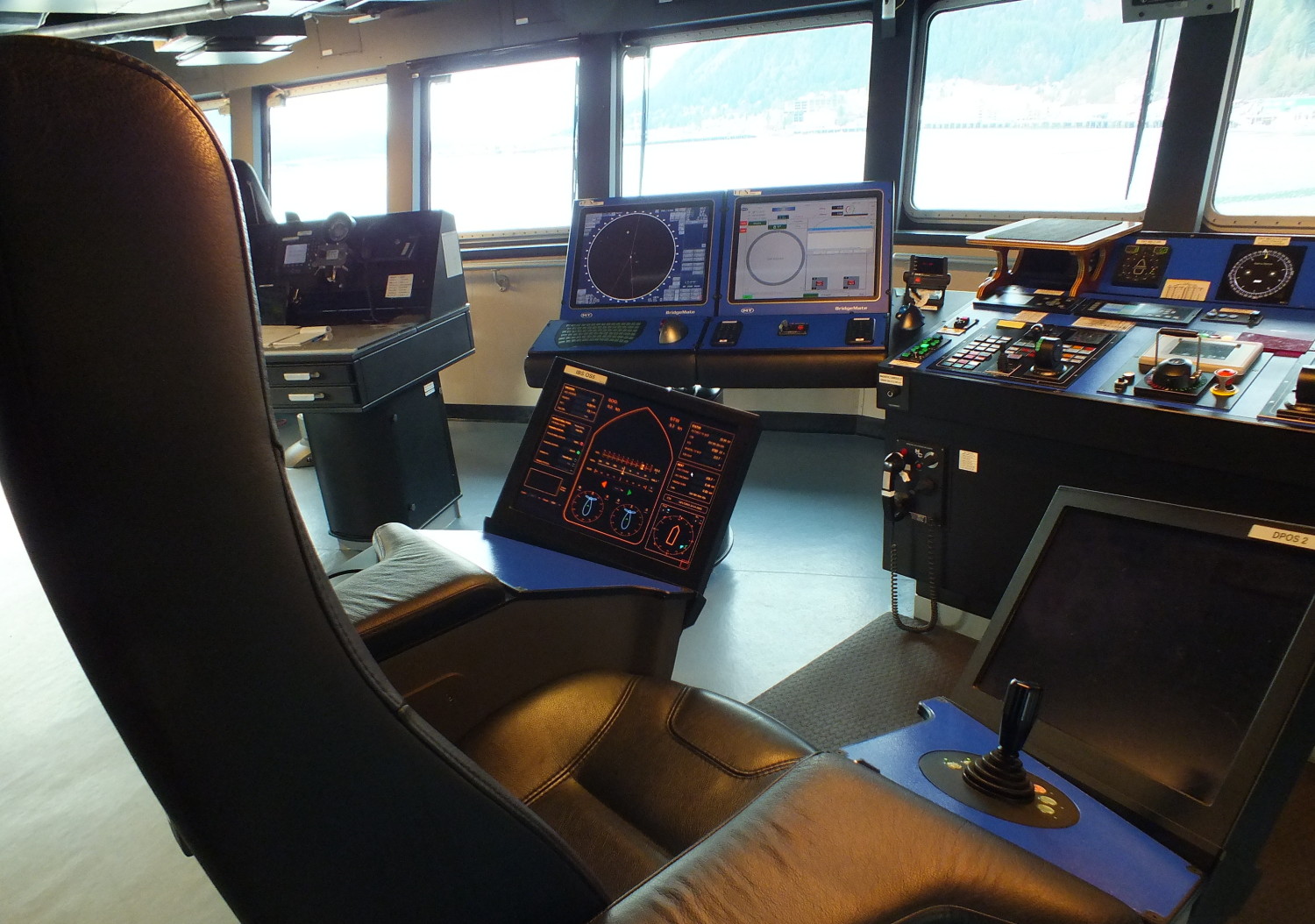
Make it so: Comfortable, high-tech captain‘s chair on the Sikuliaq. (Photo by Matt Miller/KTOO)
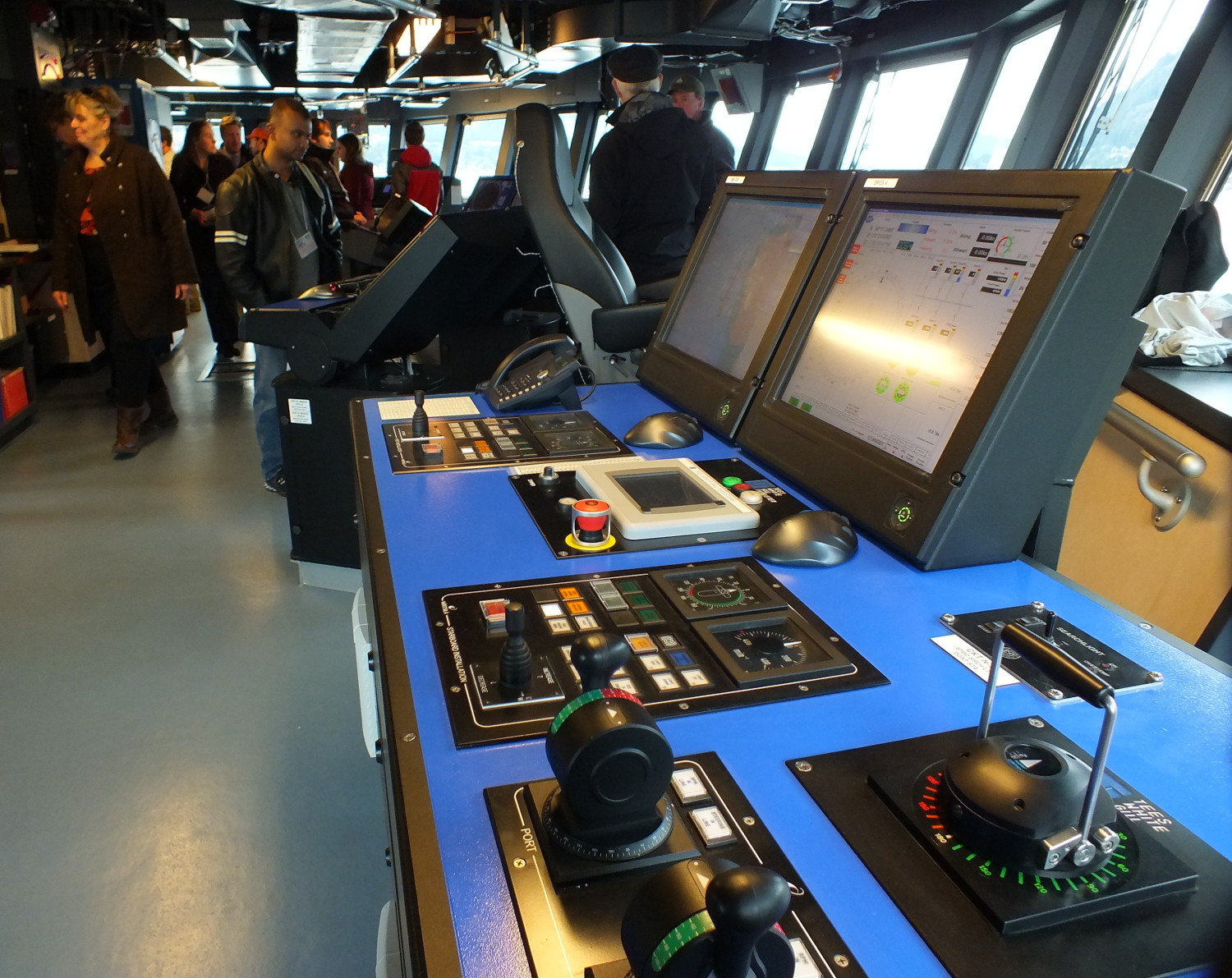
Multiple controls also allow the helmsman to operate the vessel from stations located at the sides of the bridge. (Photo by Matt Miller/KTOO)
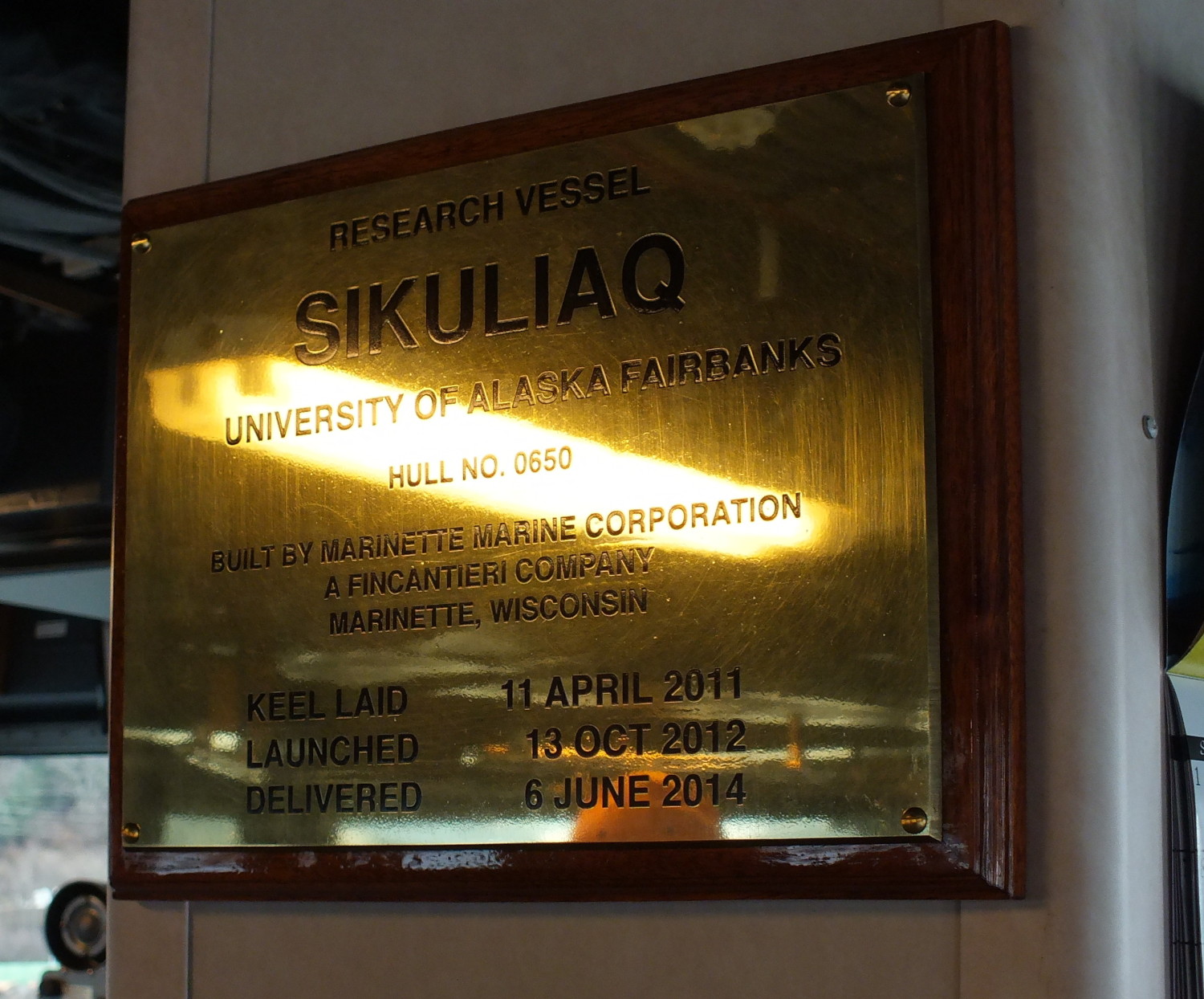
Ship builder‘s plaque on the bridge. (Photo by Matt Miller/KTOO)
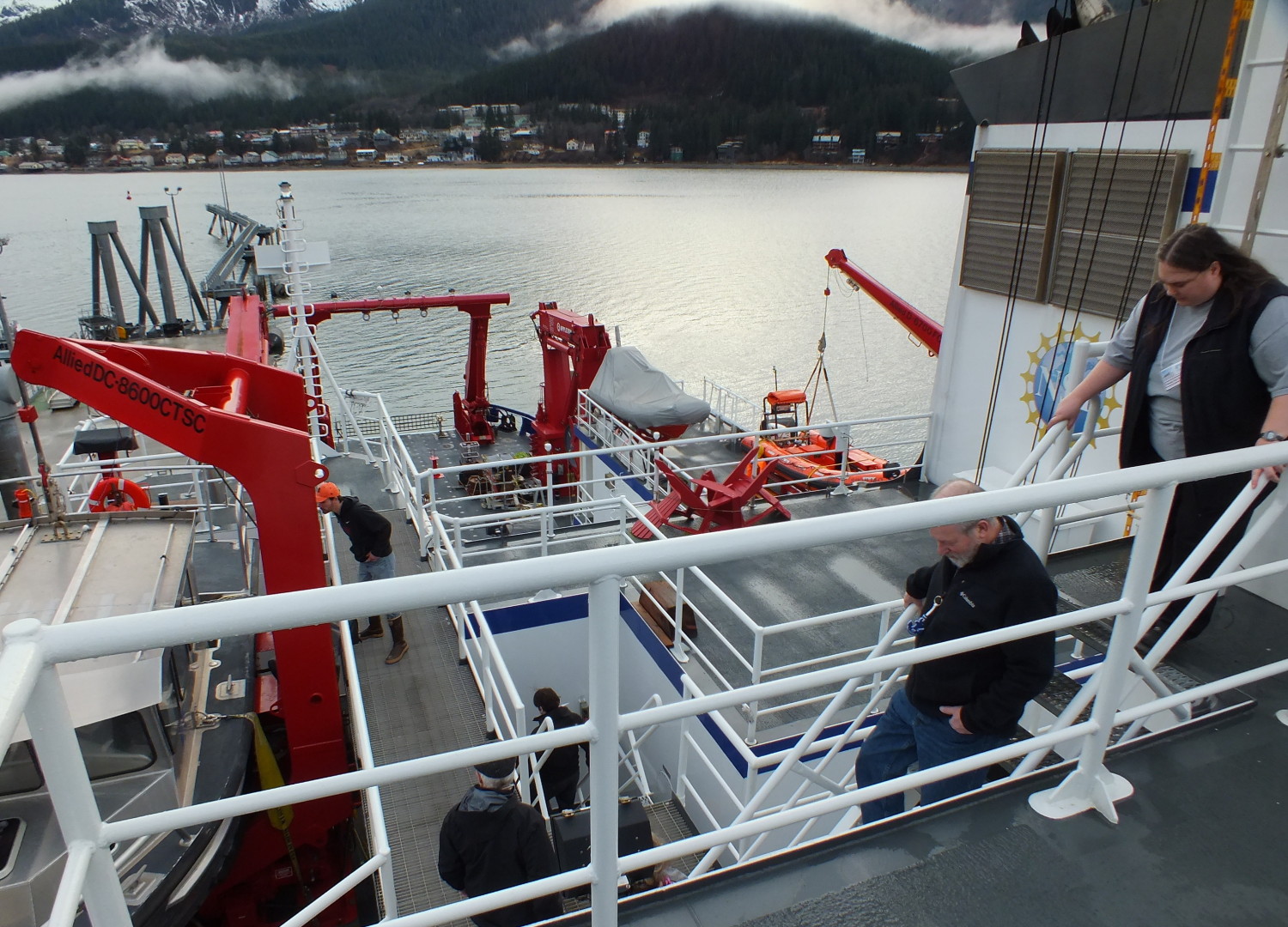
Public tours were held Feburary 17th while the vessel was tied up to the AJ Dock. (Photo by Matt Miller/KTOO)
View looking astern at the mainmast from atop the bridge. (Photo by Matt Miller/KTOO)
(Photo by Matt Miller/KTOO)
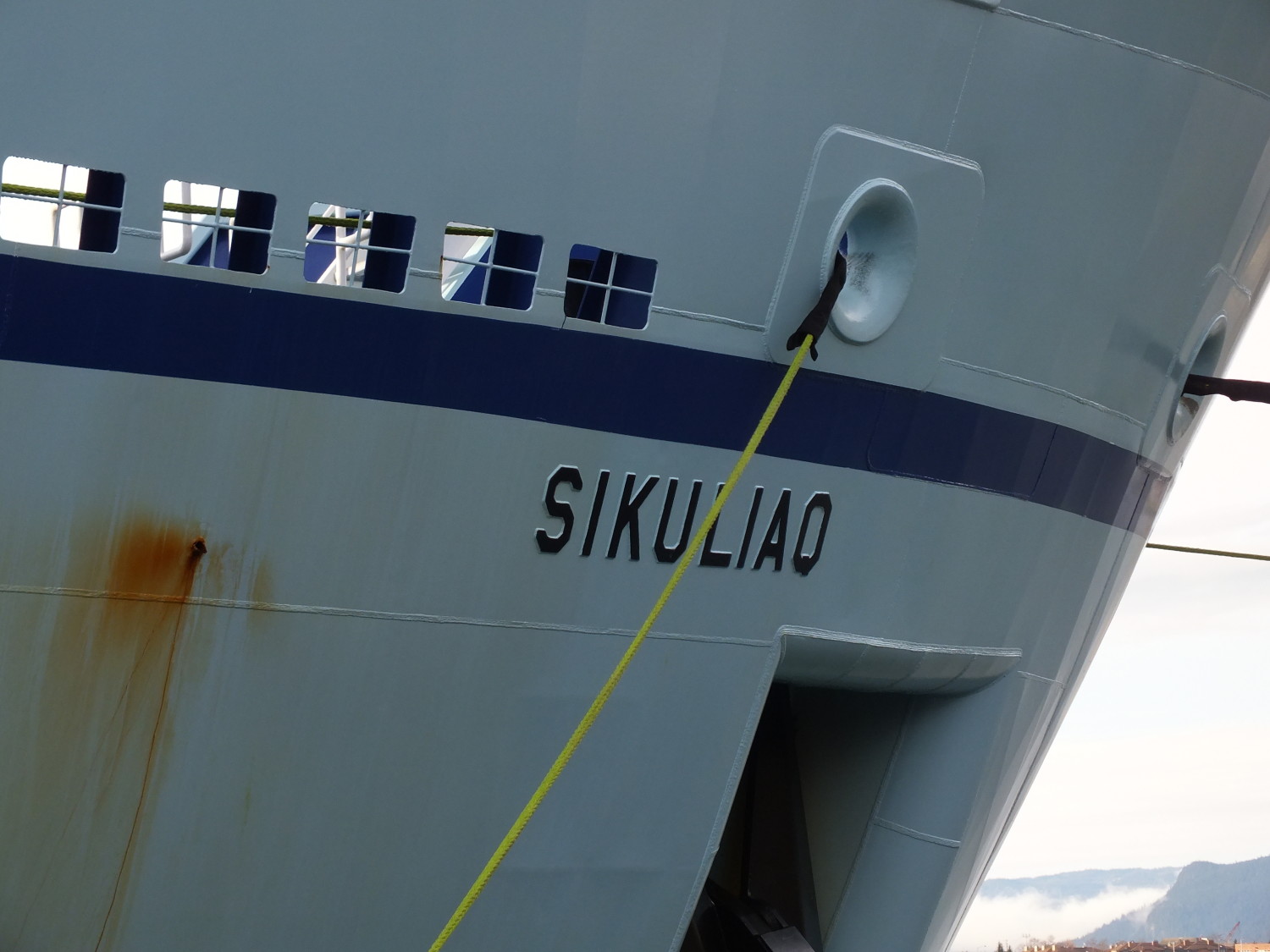
Juneau residents recently had a opportunity to view the newest research vessel that will be devoted to the study of polar ocean regions. The R/V Sikuliaq stopped in Juneau last week while heading to an official commissioning ceremony at its homeport in Seward.
“We’ve been working on this for over thirty years. Three deans’ worth of people,” says Michael Castellini with laugh. Castellini is the former dean of the University of Alaska-Fairbanks School of Fisheries and Ocean Sciences. He is now associate dean for the University of Alaska’s entire graduate school and also associate dean at the Center for Arctic Policy Studies. Castellini was one of several university officials and Sikuliaq officers who hosted public tours for the vessel last Tuesday.
The vessel, constructed at the Marinette Marine Corporation shipyard in Wisconsin, was launched in 2012 and completed last year. Castellini says it has already completed two full, deep-water science cruises in the central Pacific Ocean.
“One was looking at the impact of coral mining on the submerged seamounts northwest of the Hawaiian Islands,” Castellini says. “The second project was looking at the geomagnetic patterns on the bottom of the ocean which they use for studies of continental drift and global magnetic patterns. Those two projects were extremely successful.”
The 261-foot vessel was built with $200 million in federal stimulus funds. The National Science Foundation owns the vessel and will reimburse UAF for the estimated $14 million in annual operational costs.
Castellini says the Sikuliaq is the only ice-capable vessel out of over twenty oceanographic research vessels around the world, and the vessel’s name comes from an Inupiaq word meaning ‘first-year sea ice that is safe enough for a man to walk on’. The vessel’s inch-thick steel hull and knife-edge bow can cut through three feet of first-year sea ice, but it’s not considered to be a functioning icebreaker which will typically run up onto the multi-year pack ice, crush it, and then push it aside.
The vessel was designed to focus on polar oceanography and ice studies, but it could be deployed for NSF research anywhere in the world.
After its commissioning March 7th in Seward, the Sikuliaq will undergo ice trials in the Bering Sea and then go into a shipyard for warranty work, a wrap-up of construction and fixing any mechanical and electrical glitches.
Castellini says the vessel is already booked for research through the middle of 2016.
“There are people just writing proposals left and right for it,” Castellini says. “It’s going to be no problem keeping her busy for a long time.”
Bridge officer John Hamill says most of the spaces, including the deck and wet lab, are designed to be configured according to the scientists’ needs. Bolt patterns on the deck, structure, and masts allow a quick installation and removal of research-specific equipment without an overhaul or renovation of the vessel spaces before each cruise.
Chief Mate Bob Anderson says the vessel’s Arctic focus will tie into a lot of theories on climate change.
“We don’t have a lot of historical data on the formation and deformation of the ice floes,” says Anderson.
Chief Mate Bob Anderson says the inch-thick steel hull is one reason why the Sikuliaq is an expensive vessel. The stern is narrower abeam than the bow to allow it to more easily travel through the ice.
The vessel can cruise at 10 knots and cover over 270 miles a day with three thrusters, two at the stern and one in the bow.
The Sikuliaq is operated by 20 crew and can accommodate as many as 25 scientists and their equipment.
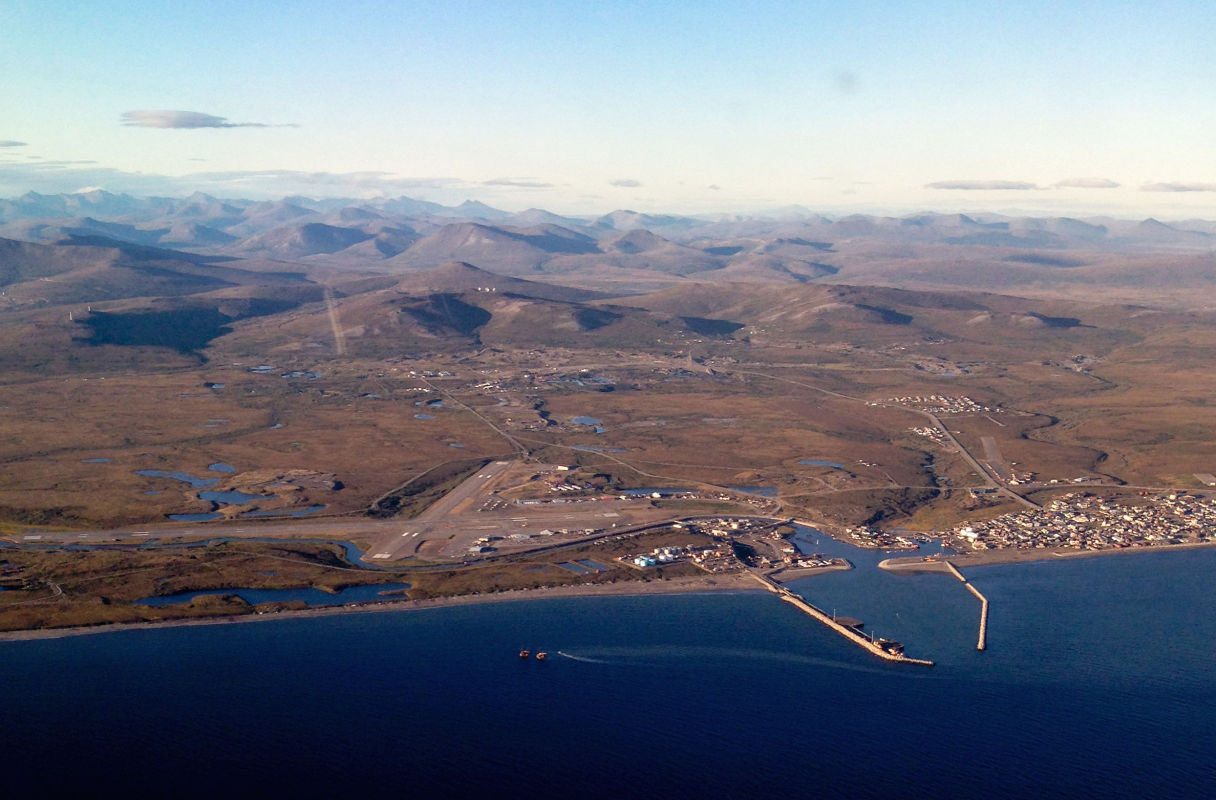
An aerial view of Nome. (Photo courtesy David Dodman)
The U.S. Army Corps of Engineers is set to unveil its first steps toward expanding deep-water Arctic ports in Alaska, and Corps officials said Friday they plan to start by expanding the existing Port of Nome.
“The report is making the recommendation for Nome, for construction at Nome at this time, basically due to its highly developed area, having a good runway, good hospital, already strong support that’s already there,” said Bruce Sexauer, the Alaska Army Corps’ chief of civil works.
Being first pick for a deep-water port—a pick Sexauer stressed is still provisional until public comment and other evaluations are complete—includes the Corps’ plan for a 2,100-foot extension of Nome’s causeway, the building of a new 450-foot dock, and dredging the port down to a depth of 28 feet.
Nome’s causeway currently has two docks, measuring about 200 feet each, and the harbor now goes to a depth of 22 feet. A middle dock project set to start construction this coming summer would add a third 200-foot dock.
The Corps eventually hopes to develop a system of deeper ports will be developed throughout western Alaska. That includes the natural deep water of Port Clarence near Brevig Mission and Teller, but residents of those communities near the western tip of the Seward Peninsula have opposed that plan. They’ve voiced concern over how a busy port would endanger seals, fish, and other subsistence resources.
Sexauer pointed to increased traffic in the Bering Strait, and growing resource extraction in the Arctic—including potential oil and gas development in the Chukchi and Beaufort Seas—as necessitating the Arctic ports, starting with Nome.
“This port will be able to provide support for those types of activities that are going on out there,” he said. “This will provide [resource developers] with a closer area where they can bring in their resupply ships and offload crews closer up in the Arctic.” He said expanded port capacity would similarly increase the ability for agencies to respond to emergencies in Arctic waters.
The City of Nome has thrown its support behind the Corps’ plans. Port Commission Chair Jim West Jr. said, ideally, the port could be deepened to 35 feet, but said Friday that “any extension would help us tremendously.”
“The other side of the harbor … is already about 30 to 32 feet deep,” West said, noting that the shelf falls away rapidly further from shore. “I’m thinking 2,100 feet is going to get plenty deep for us,” he said.
The Corps’ plans to expand to a 28-foot depth would likely accommodate larger ships from maritime groups like the U.S. Coast Guard, West said, but would fall short of the biggest fuel tankers transiting Bering Sea waters.
“The bigger the boat we get in here, the better we’ll be,” he added.
The U.S. Army Corps of Engineers will be in Nome Tuesday, Feb. 17, to meet city and port officials. The Corps’ full report will be released to the public by the end of next week.
A loaded tractor-trailer flipped onto its side near Stabler’s rock quarry Thursday morning. No injuries were reported and no significant amount of fuel was spilled, though the accident blocked traffic on Veterans Memorial Highway near the Auke Bay ferry terminal for about 90 minutes.
Juneau Police Sgt. David Wrightson says the truck lost traction while heading down a steep road from the quarry to the highway. Wrightson reports the driver tried to steer the sliding truck into the guardrail, but the truck continued over the guardrail and onto the highway. The tractor-trailer combination rolled on its side and dumped its load of rocks across both lanes of traffic.
Bob Mattson with the Department of Environmental Conservation says only about 30 gallons of diesel fuel and lube oil spilled from the truck.
“We were fortunate in that apparently the truck tank hadn’t been filled this morning because they were doing something else with the tank that did that,” Mattson says. “So, it wasn’t a full tank to begin with. That made it even better.”
A sphagnum moss-based material soaked up some of the fuel and an absorbent boom contained some of the run-off from the road.
Mattson says Miller Construction, the contractor and operator of the truck, brought out a street sweeper to vacuum up any oil or diesel fuel.
“Oh yeah, it was great. In fact, it was a good choice of tool,” Mattson says. “So, they could use that for collecting oil on the surface of that snowmelt water initially. Also, the free product that was on the road that they could get.”
Sgt. Wrightson says there was about $2,000 worth of damage to the guardrail and about $6,000 worth of damage to the truck.
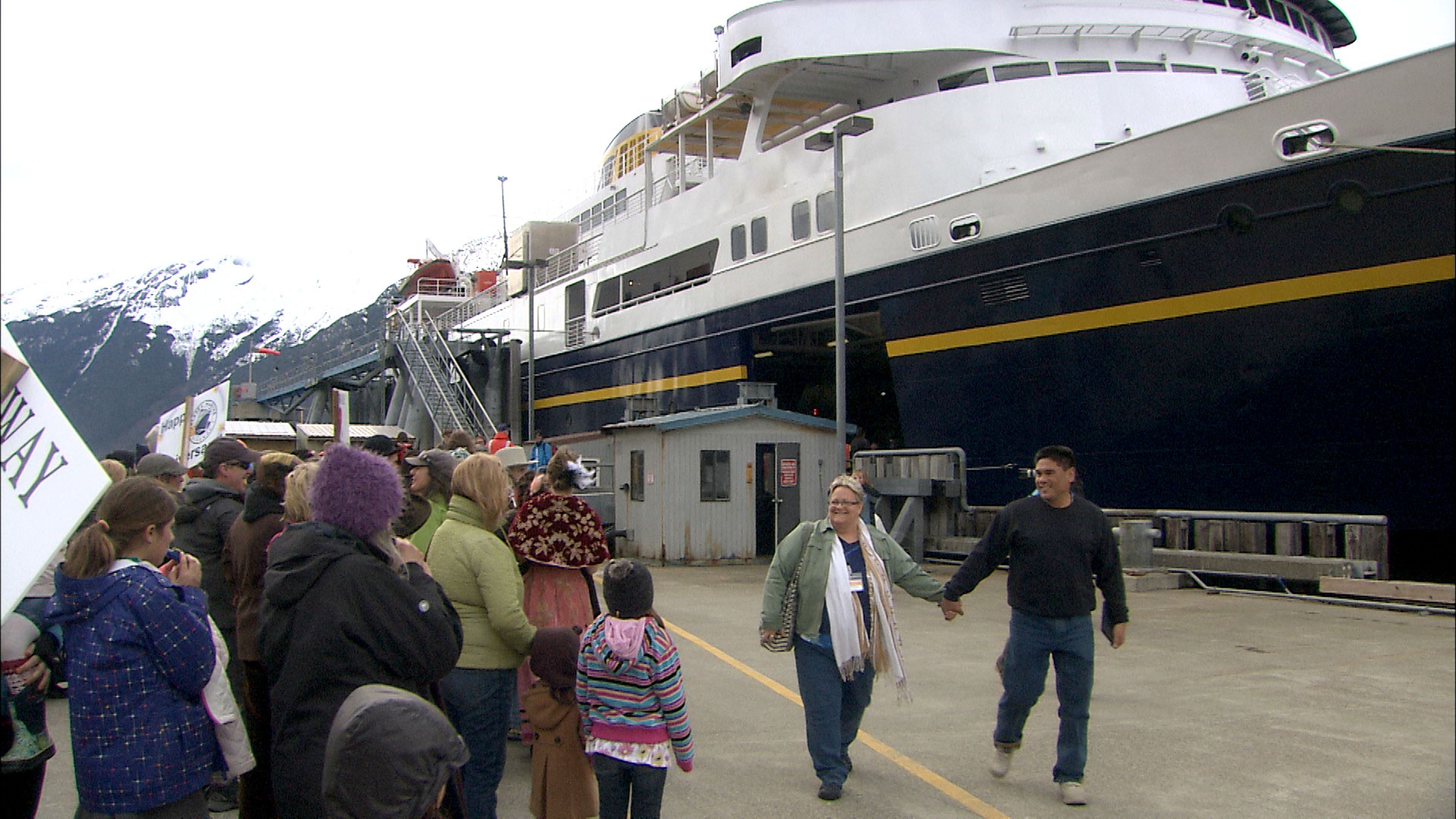
The M/V Malaspina in Skagway. (Photo by Mikko Wilson/360 North)
The state Department of Transportation is proposing reductions to marine highway service that would affect ferry service across Southeast and in Prince William Sound if the legislature holds the line on Gov. Bill Walker’s budget.
The proposed changes could have significant impacts in communities along the marine highway. They could also save the department about $7.5 million dollars. DOT spokesman Jeremy Woodrow says the reductions are just suggestions at this time.
“It is just a proposal or recommendation of a direction the department may go (in) if the budget were to be passed today,” Woodrow says.
The department is proposing taking the Taku and Malaspina out of service for the summers. The Northern Lynn Canal would be served by the LeConte and other mainliners with fewer port calls. Mainliner service to Sitka and other Southeast communities would also be reduced. With the Taku out from May to September, service to Prince Rupert would decrease from four days a week to two.
Fast ferries would also operate less in the summer under the proposal. They wouldn’t operate at all in the winter.
There would be reduced service in Prince William Sound and increased travel time between ports with only the Chenega serving that area under the proposal.
Juneau Democratic Rep. Sam Kito III also represents Haines and Skagway, two of the busiest ports in the marine highway system. He says in light of the revenue shortfall facing the state, the proposal to reduce ferry service isn’t surprising.
“I think it’s going to have to happen just because the department’s budget is about half marine highways and general fund budgets, and half are the rest of the functions, so roads and airports and buildings. So I think he’s being reasonable in trying to decrease service,” Kito says.
The state subsidizes the marine highway at nearly 70 percent. At that cost, Kito says the state has to find a way to provide ferry service more efficiently.
“There should be ways to look at our asset base, the number of vessels we have, our transportation network — so all of the communities to be connected together — and figure out how we can provide adequate service that is more sustainable than it is right now,” Kito says.
The proposed reductions follow other cost saving measures already implemented by the department, including closing gift shops and bars aboard ferries and a planned rate increase this summer.
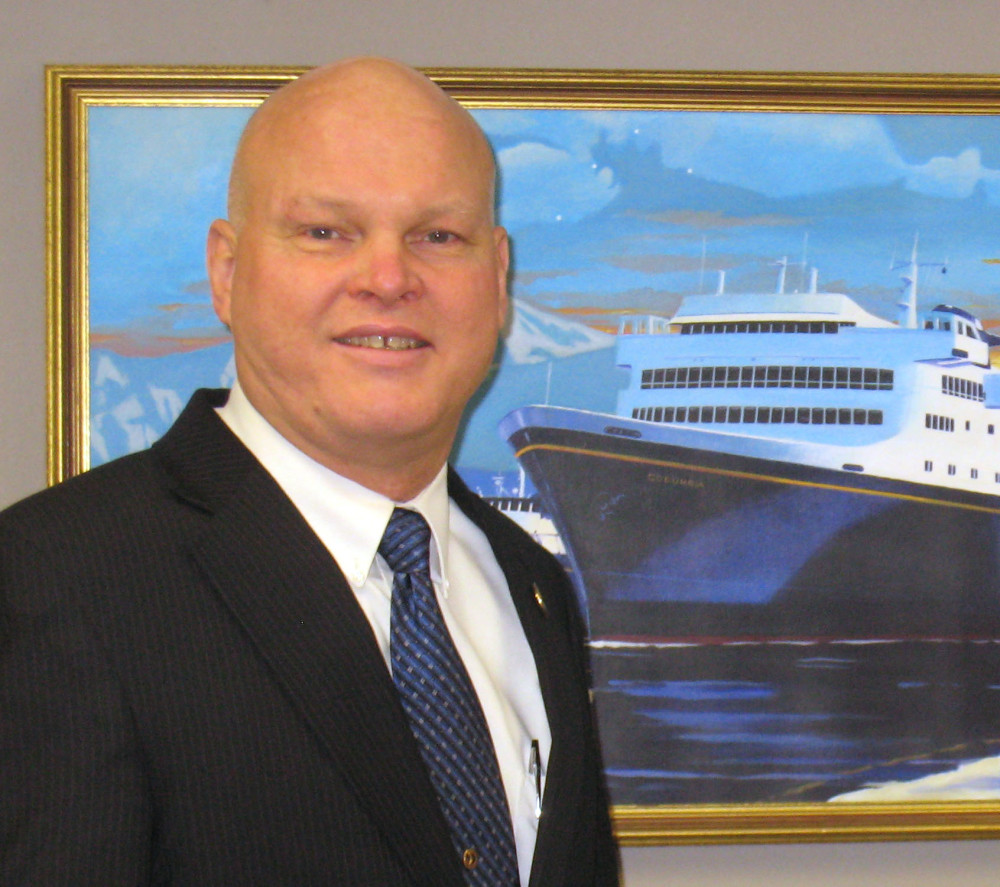
Capt. Mike Neussl is the state Department of Transportation’s new deputy commissioner overseeing ferries. (Courtesy AMHS)
The Alaska Marine Highway System has a new boss. Mike Neussl began work Monday as the Department of Transportation’s deputy commissioner overseeing ferries.
He held the post before, but left under pressure.
Neussl retired after 30 years as a Coast Guard pilot, engineer and manager before entering state service. He was deputy commissioner for marine operations in 2011 and 2012.
“Priorities are safe, efficient and cost-effective transportation. And given the budget situation the state is facing, cost-effective transportation will be a big challenge with the marine highway system,” he says.
He’s not ready to say what might change. Cuts already made include closing bars and gift shops, and installing equipment that regulates vessel speed to save fuel.
Neussl says he has no immediate plans for significant staff changes.
“Capt. (John) Falvey has done an excellent job, I think, as the general manager running the system. He’s been there for a number of years, has extensive knowledge of the system and I’ve got full faith and confidence in his abilities,” he says.
Neussl was appointed by Department of Transportation Commissioner Marc Luiken, who also just began his job. Luiken had the same post from 2010 to 2012 and hired Neussl the first time around.
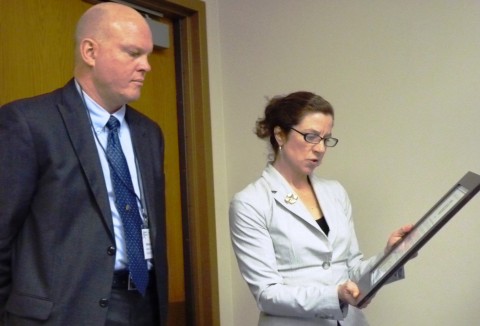
Ferry chief Mike Neussl listens as legislative aide Cecile Elliott reads a legislative proclamation commending the Alaska Marine Highway System in 2012. (Ed Schoenfeld/CoastAlaska News)
Luiken says his new deputy commissioner is a “proven leader” and will have his support, as will the ferry system.
“Especially in Southeast and Southwest Alaska, those communities depend on that mode of transportation. So it is going to continue to be looked upon as that essential mode of transportation,” he says.
When Luiken left the commissioner’s job a little more than two years ago, Pat Kemp took his place. He told Neussl to resign, which he did. He was replaced by Reuben Yost, who Walker pushed out when he dismissed Kemp.
“Capt. Neussl has certainly got a command of the knowledge and has certainly showed in his previous tour of duty that he has a quick command of the facts. So I think there won’t be a learning curve there and I think he’ll slide right in,” he says.
Venables says the board was not asked for input on the hiring decision.
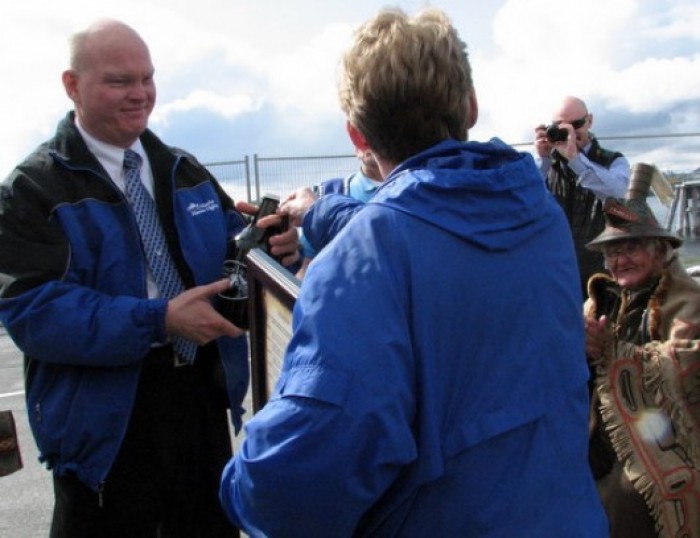
Ferry Chief Mike Neussl helps celebrate the resumption of Sitka-Angoon service at the Baranof Island city’s terminal in May, 2012. (KCAW photo)
Neussl says he looks forward to working with the panel again, but the relationship has limits.
“We consult with them when there are issues that need to be consulted about. But they are advisory in nature and that’s the way I see them continuing,” he says.
DOT Commissioner Luiken also appointed a second deputy commissioner, Steven Hatten. He served in the post from 2011 to 2014, overseeing aviation.
The third deputy commissioner is John Binder, who served under Kemp and remained after he left. Binder filled in as commissioner between Kemp and Luiken.
The commissioner has not yet appointed a regional director for what’s called the south coast area of the state. It includes Southeast, Southwest and the Gulf of Alaska.
Close
Update notification options
Subscribe to notifications
Subscribe
Get notifications about news related to the topics you care about. You can unsubscribe anytime.