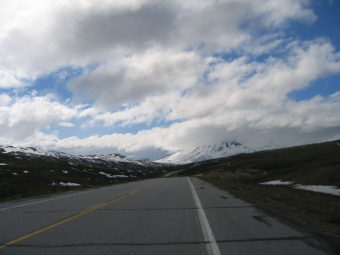
Keystone Canyonn avalanche cleanup. (Photo courtesy of the Alaska Department of Transportation)
Update | Feb. 5, 12:06 p.m.
The wait is over for residents in Valdez. The Richardson Highway is now completely open to motorists ahead of schedule.
The announcement comes after avalanches buried and flooded the roadway nearly two weeks ago.
Valdez residents now have complete access to the Richardson Highway thanks to crews spending most of the night and this morning removing avalanche debris and snow from the Keystone Canyon area.
Original Story | Feb. 5, 6:26 a.m.
After nearly two weeks, the Alaska Department of Transportation says the Richardson Highway in the Keystone Canyon area could reopen as soon as Wednesday.
Crews took advantage of favorable conditions and made significant progress in cleaning up the Keystone Canyon area.
Officials are confident that crews will have the area cleared by 3 p.m. Wednesday. DOT spokesperson Jeremy Woodrow says there maybe some cautions once it reopens.
“There may be some flaggers for the initial opening just in case there is a little bit of extra debris on the side of the roads, but they’re working on trying to clear as much of that debris and put it off the side of the road so that it isn’t an issue for traffic.”
DOT says the roadway is in good condition and can support both passenger and commercial vehicles.
The cleanup of the Keystone Canyon area of the Richardson Highway comes following nearly two weeks after being underwater to an avalanche.
A 70 percent design drawing of the proposed Alaska Class Ferry. State DOT officials hope to have final design complete by the end of February. Image courtesy Alaska Department of Transportation and Public Facilities.
Final design for the Alaska Class Ferry is expected to be complete by the end of this month, clearing the way for the state to award a construction contract to a shipyard this summer.
Department of Transportation Deputy Commissioner Reuben Yost says the state has preliminary estimates from Vigor Alaska, formerly Alaska Ship and Drydock of Ketchikan, and Elliott Bay Design Group of Seattle. If the shipyard and architect are close on the final estimate, Yost says the ferries will be built in Ketchikan.
“When we have the contract design complete we will get estimates from both entities. That’s in early March,” Yost told the state House Transportation Committee Tuesday. “Then based on that, we will either be negotiating a maximum price with the shipyard or we will be advertising.”
Representative Jonathan Kreiss-Tomkins (D-Sitka) asked Yost what factors the department will weigh when deciding whether to award the contract to Vigor Alaska or go outside.
Rep. Jonathan Kreiss-Tomkins (D-Sitka). Photo by Casey Kelly/KTOO.
“I think everybody’s got a vested interest in seeing the vessel built in Alaska,” Kreiss-Tomkins said. “Presumably we would still build the vessel in Alaska even if the maximum price is a little bit higher than competitor shipyards in the lower 48, just because we’re keeping dollars in state. But do you have any sense of how big that discrepancy has to get before you would look at awarding the contract to an out of state shipyard?”
Yost said the most important thing is for the project to stay within its $117 million budget.
“If we face a situation where we had very strong evidence that the vessel could be built within the existing budget out of state, through a competitive bid process, but not at the Ketchikan shipyard, then we would have to seriously consider whether we would continue with this process,” Yost said.
According to Yost, Vigor Alaska and Elliott Bay Design Group are bound by confidentiality agreements that prevent them from sharing cost estimates with each other.
Yost said the state hopes to award a contract by June, with the first ferry completed by mid-2016 and the second vessel by mid-2017.
The 280-foot Alaska Class Ferries will be used primarily in Lynn Canal and on shorter Alaska Marine Highway System routes in Southeast Alaska. The vessels will be able to carry up to 300 passengers and 53 vehicles. Initially, the Parnell administration wanted open car decks on the boats, but the design was changed after input from the public and ferry designers.
Note:This story originally referred to Vigor Alaska by its former name, Alaska Ship and Drydock.
The State Department of Public Safety is reviewing its safety procedures following a helicopter crash that took the lives of three men in March of last year.
A helicopter crash that took the lives of three men in March of last year is still under investigation. The Alaska State Trooper’s Helo – 1 crashed near Talkeetna during a rescue mission, killing its pilot, a state Trooper and one civilian in early 2013.
Trooper director Colonel Jim Cockrell says in light of the accident, the state Department of Public Safety is reviewing its safety procedures. He says the National Transportation Safety Board has pointed out some concerns that need to be addressed:
“Including reviewing all our internal policies regarding our use of our aircraft with our department pilots. We’re hiring a safety manager or safety officer to oversee all aspects of safety at the aircraft section. We’ve hired a new aircraft supervisor with an extensive aviation background, and the same with a new commissioned lieutenant we put in the aircraft section. “
Cockrell says the NTSB recommendations are not directly related to last year’s accident. In addition to the three new hires, the Troopers are now evaluating aviation training programs, and are making changes in risk assessment. The decision to send Trooper aircraft out on a mission will no longer be on one person’s shoulders:
“The issue is to ensure that we have some oversight on these missions to make sure that we are not taking undue risk. And we’re not asking the pilot to make that final decision. And, sometimes, people’s lives are definitely at risk, and it’s hard for our personnel who’s joined the department to provide public service, it’s hard for them sometimes to say ‘no’ and that’s why we want to make sure that we have someone outside, the if you want to call it the loop, that makes the decision if it’s worth our risk to handle this call.”
Trooper helicopters are operated under the division of Alaska Wildlife Troopers, which provides the department with 43 aircraft and 50 pilots. Adjustments to the safety management system include installing real time satellite tracking devices in aircraft, which allow monitoring of all aircraft 24/7 by cellphone.
Troopers are working with the NTSB to determine the cause of the 2013 Helo 1 crash, but results are inconclusive at this time. The NTSB has released some 2,000 pages of documents related to the Helo 1 investigation on the agency’s website. The night-time crash took the lives of pilot Mel Nading, Trooper Tage Toll and snowmachiner Carl Ober. A report on the crash’s probable cause is expected in late summer.
Keystone canyon avalanche and flood. (Photo courtesy Alaska Department of Transportation)
Updated | Jan. 27 at 4:22 p.m.– Alaska Department of Transportation continues to monitor the Richardson Highway after avalanches over the weekend cutoff road access to the city of Valdez.
Officials gave an update on the situation during a teleconference earlier Monday afternoon.
Valdez may not have road access, but progress has been made to provide transportation to its residents.
Following an aerial assessment of multiple areas, the Alaska Department of Transportation determined that some mountains along the Richardson Highway are still fairly active. DOT maintenance engineer Jason Sakalaskas said once those areas are deemed safe, crews will begin work on the northern end of the avalanche area near Milepost 39.
“On the north side we do not see a lot of large avalanches, which is good,” Sakalaskas said. “So the cleanup efforts in that location should be fairly minimal, or fairly expeditious.”
As for the Keystone Canyon area, there is still a significant amount of water behind the north side of the dam created by Saturday’s slide. Sakalaskas said there is no safe way to approach relieving the water without removing it from the downstream side.
He did see one positive from the area. The Lowe River in the canyon has begun flowing again.
“We do this as a positive measure because obviously it will drain the impounded flow, but also will be a controlled release of the water, which is on the north side of the canyon,” Sakalaskas said.
Temperatures are expected to be in the 20s and 30s for the rest of the week, but DOT officials are hoping for cooler temperatures to help stabilize avalanche conditions especially at higher elevations. They don’t expect find any road damage from the slides.
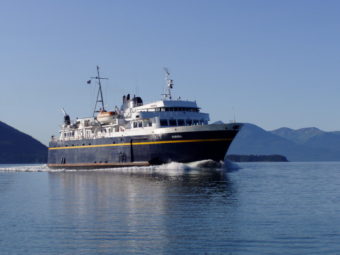
Valdez is still accessible by ferry and plane. The Alaska Marine Highway System modified its schedule to three direct trips between Whittier and Valdez. Normally, the ferry Aurora sails clockwise from Cordova to Whittier to Valdez and back to Cordova. DOT Deputy Commissioner Reuben Yost explains…
“On Tuesday there will be a trip in each direction starting in Valdez to Whittier, then back from Whittier to Valdez. Thursday, we’ll have the normal Whittier to Valdez sailing; Friday we’ll have a Valdez to Whittier Sailing; Saturday, another Whittier to Valdez and finishing up Sunday with a Valdez to Whittier.”
Era Alaska also added a fourth flight between Valdez and Anchorage.
A voluntary evacuation advisory from the city is still in effect for residents of the Nordic and Alpine Woods subdivisions of the 10 mile area.
The Valdez City Council plans to hear an update on the situation during a special meeting tonight.
Original Story:
Valdez remains cutoff by road from the rest of the state due to avalanches and flooding over the weekend.
Progress has been made in clearing some of the debris on the Richardson Highway, but crews still have a long way to go.
Crews from the Alaska Department of Transportation spent Sunday stabilizing slopes along the Richardson Highway. They were also able to clean up some debris around the 39 Mile area.
DOT spokesperson Jeremy Woodrow says no progress has been made near the Keystone Canyon due to a lake forming behind an avalanche damn.
“The water is coming out of the old railroad tunnel and so water is flowing, which is good news,” Woodrow said. “Though it would be more helpful if the water were decreasing at a faster rate than it is.”
The Nordic and Alpine Woods subdivisions in the 10 Mile area have been under a voluntary evacuation advisory as a result. Valdez Public Information Officer Sherri Pierce says the city is closely monitoring the area.
“We’ve asked them to be prepared if we have any reason to believe that they’re in any sort of imminent danger,” Pierce said.
City officials are working with the Alaska Marine Highway system to increase ferry service to Valdez.
A DOT maintenance engineer arrived Sunday night to assess to the situation as is expected to make a report the findings Monday afternoon.
Valdez City Manager John Hozey, Valdez Police Chief Bill Comer, and Valdez Fire Chief George Keeney plan to do their own assessment via helicopter.
As seen from inside the plane: Two to three gallons of fuel spilled from Alaska Airlines Flight 76 when the fueler’s auto shut-off failed to work. (Photo courtesy of Marian Call)
A small fuel spill occurred with an Alaska Airlines jet at the Juneau International Airport Thursday afternoon. As Aero Services was fueling southbound Flight 76 at Gate 4, the auto shut-off function failed to work, spilling two to three gallons of fuel.
Airport manager Patty deLaBruere says the Department of Environmental Conservation was notified and the spill was responded to quickly:
“Capital City Fire and Rescue was called because it’s part of the response team for fuel spills. It’s Alaska Airlines out there helping out, the airport helping out, the actual fueler, which is Aero Services – everybody jumps in to make sure it’s contained rapidly.”
deLaBruere says the majority of the fuel was cleaned up with oil absorbent pads. Any residual sheen, she said, will drain into an oil-water separator.
deLaBruere says small spills happen at the airport about every other year, but it’s been several years since a large spill occurred.
The floating breakwater dislodged from its pilings Tuesday afternoon and landed on the beach. (Photo courtesy of Pep Scott)
The state-owned breakwater remained on the beach all day Wednesday. It's scheduled to be removed Thursday. (Photo courtesy of Pep Scott)
When the steel float dislodged in January, it swung into the timber floats, destroying two sections. The state paid $32,000 to replace them. (Photo courtesy of Pep Scott)
Tuesday’s storm in Southeast caused a state-owned breakwater in Gustavus to dislodge from its pilings and wash ashore on the beach. The 200-foot steel structure also serves as a popular floating dock facility for local residents running charter fishing and whale watching boats. Now, Gustavus residents are wondering what this means for their tourist season.
“I didn’t want to watch but I couldn’t look away. It was pretty intense,” says Gustavus resident Pep Scott.
She was at the Gustavus dock facility Tuesday from noon to 6 p.m. watching the floating breakwater and pilings rock back and forth. Workers with the state Department of Transportation had tried to secure it with heavy line, but it didn’t work. The floating structure eventually broke loose and landed on the beach.
Scott calls the breakwater, which also serves as a dock, Gustavus’ livelihood. “I run a fish processing plant so I rely on the charter boats and the commercial fishing boats and without a float for anybody to come and put their boat in or for any goods to come in and go out, we’re just kind of stuck,” she says.
As the breakwater dislodged, it swung into city-owned wooden floats causing damage to those as well and leaving Gustavus residents without many options for docking, especially during the busy tourist season coming up in May.
“At this point in time, if we go with what’s left, it looks like we’ve got about a 40-foot section of dock that 20 to 30 boats would have to use every day,” says Mike Halbert.
Halbert has owned Glacier Bay Sportfishing for almost 30 years. Between the end of May and September, he takes up to eight tourists out on the water every day. Boats use the state-owned breakwater and the city-owned wooden floats for whale watching, charter and commercial fishing, kayak transport, and recreation. Halbert says the community with a year-round population of 450 relies heavily on tourism, “It’s life or death. If it’s not there then none of us can operate.”
The breakwater went into service in 2012 and cost the state just under $1.4 million. It’s located in the same facility as Gustavus’ ferry dock, which was not damaged during Tuesday’s storm.
Al Clough is Southeast Director of DOT. He says a storm in December had previously damaged the floating breakwater. At the time, the state conducted surveys and determined that it had to be removed due to unstable pilings. “Unfortunately, before we could get a crew, to get a barge and a crane mobilized out there to remove that breakwater, another storm came in,” he explains.
Clough says he has no idea when the breakwater will be repaired but it’s not going to be put back in the near future:
“We have to redesign a new structure and then we have to permit it and secure funding and everything else. There is not a quick fix, and obviously that breakwater, the way it was installed is not robust enough to handle this major storm event we had so we’re not just going to be put the same thing back in there.”
According to the National Weather Service in Juneau, the maritime wind in Gustavus Tuesday was at least 40 miles per hour.
Gustavus resident Dan Lesh shot this short video of the steel breakwater before it dislodged.
Original story published Jan. 15, 1 p.m.:
Tuesday’s storm caused a state-owned breakwater in Gustavus to wash ashore around 4 p.m. The 200-foot steel breakwater also serves as a popular dock facility for local residents.
Al Clough is the Department of Transportation’s Southeast Director. He says another storm that occurred last month had previously damaged the floating breakwater. The state conducted surveys and determined that it had to be removed due to unstable pilings.
“Unfortunately, before we could get a crew, to get a barge and a crane mobilized out there to remove that breakwater, another storm came in and dislodged that float from its mooring structures and it’s now sitting on the beach,” Clough says.
It will not be replaced in the near future, he says:
“We have to redesign a new structure and then we have to permit it and secure funding and everything else. There is not a quick fix.”
The state breakwater was completed roughly two years ago. As it washed ashore Tuesday, it caused damage to the city-owned boat harbor. Clough hopes to get the breakwater removed off the beach today.
Meteorologist Joel Curtis says the maritime wind in Gustavus yesterday was at least 40 miles per hour. Peak wind recorded 60 miles away at Cape Spencer was 85 mph out the west.
Close
Update notification options
Subscribe to notifications
Subscribe
Get notifications about news related to the topics you care about. You can unsubscribe anytime.