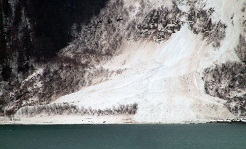
View of the Thane Road avalanche as seen from the end of 3rd Street in Douglas. Photo by Matt Miller/KTOO News
Avalanche danger in Juneau continues to be high.
Thane Road is currently blocked by a slide that occurred about 12:20 a.m. in the main avalanche chute area. Debris is covering the road all the way to Gastineau Channel.
Juneau Police Sargeant Chris Burke says dispatch got calls from Douglas residents who spotted the slide.
No injuries or property damage have been reported. State DOT crews plan to do avalanche mitigation by triggering controlled slides before trying to clear the road. They say it could take through 6 p.m.
Meanwhile, yesterday afternoon (Wednesday) around 4 o’ clock, a big slide rumbled down the Behrends path on Mt. Juneau. While it may have looked bad from the streets below, CBJ Emergency Programs Manager Tom Mattice says fortunately it stopped short of causing any property damage.
“It looks like it came down and stopped short up on the hill, up on the upper trails that are blocked and signed and posted,” he says.
Mattice says this week’s warmer temperatures have significantly reduced the snowpack. Rain-soaked snow at lower elevations is also helping to slow down slides before they get to roadways.
“There’s actually been several naturals going around the community off Mt. Juneau and Mt. Roberts both,” Mattice says. “The sizes have not been huge, because things got so wetted it really slowed-them-down down low which has been the saving grace.”
Mattice says residents should continue to be cautious for at least the next 48 hours, and avoid marked avalanche zones.
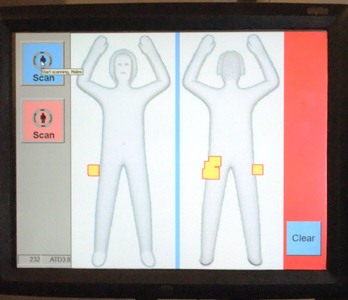
This passenger would require a pat down of yellow area. Photo by Rosemarie Alexander
TSA will begin using Advanced Imaging Technology at the Juneau International Airport on January 23rd.
Transportation Security Administration officials demonstrated the newly installed machine Thursday. It began with a TSA officer giving these instructions to some would-be passengers:
“You guys want to make sure you take everything out of your pockets.”
Like the current system, passengers must take off their shoes, belts, coats and unload their pockets; all that stuff goes through the standard security x-ray.
Then the person walks into the circular unit and is told to raise arms above the head. The TSA officer presses a pink or blue button, depending on the gender, then gives these directions:
“You’ll face this direction. Look at the photo on the wall and assume that stance. Hold it until I ask you to release it. Go ahead and release. Step this way,” and the passenger exits.
To demonstrate the unit, TSA employees role-played passengers for the media. The officers are already going through training to learn how to use the Advanced Imaging Technology unit and Automated Target Response software.
Lorie Dankers is the spokeswoman for the TSA in Alaska.
“The units at this airport use what is called millimeter-save technology, which bounces harmless electromagnetic waves, essentially radio waves, off the body during the screening process,” she explains. “This is not an x-ray.”
The results are real time and the passenger sees it at the same time as the TSA officer. The computer-generated outline of a person on the screen is identical for all passengers. No body parts can be seen.
“So if a person has had a hip replacement or knee implants of some sort, it won’t detect that because it’s only looking at items on the outside of the body,” she says.
If the underwear bomber is carrying explosives in his shorts, the package will show up as a yellow image on the screen and the officer would follow-up with a targeted pat down.
“It’s not the machine’s job to tell us what the item is, it’s just to cue us that there’s something that needs to be followed up on. And so it’s not going to look different from one item over another,” Dankers says.
Advanced Imaging Technology is already in use at Anchorage and Fairbanks airports and will be installed in Ketchikan at the end of the month.
More than 540 AIT units are in airports across the U.S., but older full-body x-ray type scanners are used at other airports, including Seattle.
Federal security director for Southeast Alaska Ray Culbreath says the AIT scanners will not displace any TSA officers; Juneau currently has 54.
In addition to being the capital city and Alaska’s gateway city, Juneau and Ketchikan have been selected for Advanced Imaging Technology due to the high volume of tourists that come through their airports every summer, Culbreath says. In Juneau…
“This time of year we’re averaging between 650 and 750 passengers a day and during the summer months that more than triples,” he says.
According to Culbreath, an average of 275,000 passengers depart from the Juneau International Airport annually.
The Alaska Department of Transportation is moving forward with a supplemental Environmental Impact Statement for the Juneau Access project.
In February 2009, Federal District Court Judge John Sedgwick directed the state and Federal Highway Administration to re-do the original EIS with a full analysis of improvements to Lynn Canal ferry service as an alternative to a new highway.
Earlier this year the state exhausted its appeals to the federal 9th Circuit Court, and decided to proceed with the supplemental EIS. Today (Tuesday), DOT announced that it has contracted with HDR, Inc. to prepare the document.
Juneau Access Project Manager Reuben Yost says the update will likely take another year and a half.
“Federal highway regulations state that, when you do a supplemental EIS, you follow the similar process for an initial EIS in that you produce a draft supplemental EIS. That’s released to the public. You have public hearings, where the public has a chance to comment. And then you analyze those comments and then prepare a final EIS, which is also released for review,” says Yost. “And then, it’s not until that process is complete before federal highways can then issue a new Record of Decision.”
The draft supplemental EIS is expected by this time next year, with public hearings in January 2013, and final completion by June 2013.
Juneau Access would extend the highway north of the Capital City by 50 miles, from Echo Cove to the Katzehin River. It would end at a new ferry terminal, where a boat would carry passengers and vehicles the rest of the way up Lynn Canal.
The project was challenged in court by the Southeast Alaska Conservation Council and other groups. Though Judge Sedgwick only ruled on the EIS issue, Yost says DOT will look at other claims made in SEACC’s lawsuit.
SEACC Spokesman Dan Lesh is hopeful that the analysis will seriously consider the pros and cons of the proposed road.
“We identified what we thought were misleading assumptions about traffic forecasts under the different road and ferry alternatives. Ways of analyzing the difference between ferries and roads, we felt like didn’t properly capture the differences between roads and ferries, and was a little biased toward roads,” Lesh says. “We identified issues around sea lions, old growth forest habitat, cultural resources, bald eagle nests – all those things are just part of the public interest and they should be addressed.”
HDR, the firm DOT contracted to do the supplemental EIS, has extensive experience preparing Federal Highway Administration environmental documents in Alaska. Yost says the update will cost about two-million dollars, most of which will be paid for by the Federal Highway Administration.
Icy roads have caused a number of accidents in Juneau today (Friday).
Egan Drive inbound at Fred Meyer was closed briefly at about 10:30 after a two-vehicle accident at the Yandukin intersection that totaled a PT Cruiser and a Dodge Durango. Police re-routed traffic to Glacier Highway for about 20 minutes, until they were able to open up one inbound lane. The driver of the PT Cruiser was cited for failure to yield and taken to Bartlett Regional Hospital for treatment of non-life threatening injuries.
Not long after that accident, there was a single-vehicle roll-over at Tee Harbor that sent a driver to the hospital with unknown injuries. Police says that vehicle was also totaled.
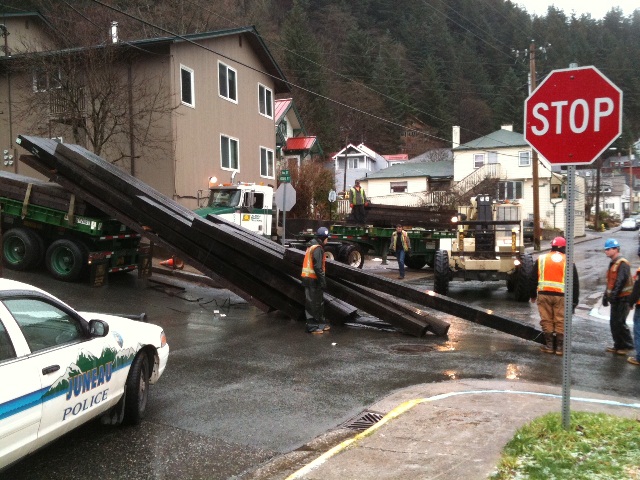
Timbers bound for the Basin Rd. Bridge reconstruction project broke loose from a truck this morning, blocking Gold St. for a couple hours. Click to enlarge image. (Photo by Matt Miller/KTOO)
Gold Street was closed this morning between 5th and 7th streets after a tractor-trailer lost part of its load of lumber bound for the Basin Road trestle reconstruction project. No one was injured.
The truck was heading up Gold Street about 11 a.m. when two of the straps securing the load apparently broke. A stack of 8-inch by 14-inch timbers, each about 20-feet long, came off the trailer at 6th and Gold and slid down the hill. The load appeared to sideswipe a sedan and knock a mid-size pick-up truck onto the sidewalk. A bundled load of 2-inch by 4-inch lumber also slid into the truck. Before the driver was able to stop, other large timbers partially came off the trailer.
An unnamed Alaska Marine Trucking supervisor said only the driver’s pride was hurt and he was shaken up. The supervisor attributed the lost load to the broken straps and the creosote-treated lumber getting wet.
Hours after the load came off the trailer, Alaska Marine Trucking workers were still reloading the lumber and clearing the streets.
National Transportation Safety Board investigators have started piecing together the cause of the weekend helicopter crash that killed William Zeman, of Juneau.
Bad weather prevented a visit to the accident site until Tuesday. Senior Air Safety Investigator Clint Johnson says the ERA helicopter went down about six miles southwest of Iliamna.
“We spent most of the day there, documented the accident scene and we are in the process of working with the operator to get all the parts and pieces and the wreckage moved back into Iliamna,” Johnson said. “Then the engine and some other parts and pieces will be shipped to Anchorage and we will be doing more testing as time goes on.”
He says the helicopter engine will eventually be sent to an NTSB lab in Texas for testing of possible mechanical issues.
The 66-year-old pilot was the only person onboard the helicopter. Johnson said Zeman had been headed to Anchorage and had made refueling stops in Unalakleet and Bethel. He planned to spend the night in Iliamna.
ERA’s GPS and web-based tracking system received a final signal from the helicopter about 8 p.m. Saturday. Searchers found the wreckage on Sunday. Zeman’s body was sent to the state medical examiner’s office in Anchorage for an autopsy.
While the weather at the time of the crash is not known, Johnson says snow showers had been moving through the area. He says NTSB meteorologists are doing a weather study.
Johnson expects to issue a preliminary report in the next few days, but the cause of the crash likely will not be known for several months.
Zeman was the company’s most senior pilot and had been with ERA Helicopters for 39 years.
Close
Update notification options
Subscribe to notifications
Subscribe
Get notifications about news related to the topics you care about. You can unsubscribe anytime.