Monday is the filing deadline for municipal election candidates to run in Juneau and no one has confirmed they’re running for two seats on the Juneau School Board.
The seven-member board governs a district with an $85 million budget, about 4,700 students and nearly 700 employees at more a dozen schools.
As of Friday, school board incumbent Phyllis Carlson says she’s still undecided about running again. Incumbent Destiny Sargeant could not be reached for comment, though she’s previously said she’s undecided.
Andi Story is an uncontested incumbent in a third seat.
Juneau Assembly
Dixie Hood ran a five-day campaign as a write-in candidate against Jerry Nankervis in 2012.
On the Juneau Assembly, the District 2 seat held by Jerry Nankervis is now a three-way race. Nankervis is being challenged by Dixie Hood, a marital and family therapist and active volunteer, and Jason Puckett, a GCI store manager, marshmallow entrepreneur and Marine Corps veteran.
Mayor Merrill Sanford and District 1 Assemblyman Loren Jones remain uncontested.
Candidates must collect at least 25 qualified voters’ signatures. They also must file a letter of intent, a financial disclosure and campaign finance paperwork with the Alaska Public Offices Commission.
Write-in candidates have until Oct. 1 to file their paperwork.
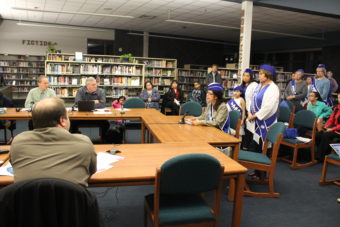
Supporters for a new charter school in Juneau filled the audience at Tuesday night’s school board meeting. (Photo by Lisa Phu/KTOO)
A group of educators and parents in Juneau are advocating for a new charter school focusing on science, technology, engineering and math. They think it would be the first elementary STEM school in the state.
More than two dozen people at Tuesday night’s school board meeting were wearing paper badges pinned to their shirts that said “Summit STEM School Supporter.” The blue and green logo on it shows an abstract design of a mountain.
“We don’t have a local indigenous or a local Native design there,” said Alberta Jones, a member of the formation committee for the Summit STEM School.
“That needs to be brought from our school members, from our people involved in the community to give us a local indigenous name. We spent a lot of time with this, trying to think, ‘OK, summit. What’s the Tlingit name for summit?’ But it’s really important that it’s a community buy-in of students and people in our community, so that we’re following proper protocols,” Jones said.
Jones is Tsimshian and Alutiiq. She’s a retired teacher from the Juneau School District and has coordinated Native education grants. She says a key component to the charter school is integrating local indigenous knowledge.
The committee proposes putting Summit STEM School within an existing Mendenhall Valley elementary school. Up to 80 students would be in multi-age classrooms – two classes of kindergarten through second graders and two classes of third through fifth graders. The hope is to later add a preschool level.
Advocates for the Summit STEM School wore these pinned to their shirts. Alberta Jones, a member of the school’s formation committee, says the logo is incomplete. (Photo by Lisa Phu/KTOO)
Juneau mom Stephanie Buss spoke in support of the STEM school. She says it would give parents more choice. Buss has been homeschooling her two kids since last year and says the charter school could bring her family back to the district.
“As a scientist and a business owner, I feel there is a real need for more targeted education in math and science. Each and every child in the district should be given a strong opportunity to be proficient in science and math. I love science and math and would love to see more kids excited about these fields,” Buss said.
The charter’s formation committee has been working on the proposal for two years, but Lexie Razor just heard about it a couple weeks ago. Razor is a math teacher at Juneau-Douglas High School.
“Right away it was something that struck me as something that Juneau needs. I’ve been teaching math for 15 plus years. All my years have been with minorities and low socioeconomic students. I noticed the main thing is just their confidence. And the more opportunities they have with the math, with the engineering, science, all of it, they’d be more comfortable with it,” Razor said.
Summit STEM School hopes to serve students who are economically disadvantaged – they’d make up 50-75 percent of the student population.
School Board member Barbara Thurston says the district’s existing placement process makes that goal highly unlikely.
“We’ve had issues with our placement process over the years with our other alternative programs, probably none of which have what we would consider the ideal ratios, distributions of demographics in them,” Thurston said.
The applicant pool for alternative programs tends to be made up of non-targeted students, she added. Thurston wants the board to set up a subcommittee to review the placement process.
The School Board will have a work session on the Summit STEM School on Aug. 31. If the board accepts the charter application on Sept. 15, it would go on to the State Board of Education for final approval.
The new charter school would receive an allocation of $1.1 million if it has 80 students, according to the district.
The Summit STEM School hopes to open fall of 2016.
Juneau voters will not be asked to approve new debt to fund school facilities maintenance in the Oct. 6 municipal election.
Instead, the Assembly Finance Committee last week unanimously recommended partially funding the school district request with $800,000 in leftover sales tax revenue.
Superintendent Mark Miller. (Photo by Lisa Phu/KTOO)
The district anticipates spending about $300,000 to hire experts to write a comprehensive facilities plan. The balance will be used on deferred maintenance, says Superintendent Mark Miller.
“Clearly, safety of both our students and the environment, are very high on that list,” Miler says.
“It’s good for the school district. We can certainly use it to make sure that don’t have any catastrophic failures and that we kind of keep things up and running as best we can,” Miller says.
Though all members sit on the Finance Committee, they must meet as the full Assembly to finalize the transfer.
A primary voter fills out a ballot at the Juneau Arts and Culture Center on Aug. 19, 2014. (Photo by Jeremy Hsieh/KTOO)
Local voters could elect up to six new members to the Juneau Assembly and School Board this fall — if candidates step up.
The filing period for candidates in Juneau’s regular municipal election opens at the end of next week. Election day is Oct. 6.
So far only one newcomer has formally declared his candidacy.
Juneau Assembly
Merrill Sanford
On the nine-member Juneau Assembly, the mayor and two others are up for re-election.
Mayor Merrill Sanford says he is seeking a second term.
“With the budget coming down from the State of Alaska and our budget situation, it could be very interesting, what we have to try to do to make our budget balance, for sure,” Sanford says.
District 1 Assemblyman Jesse Kiehl shot down rumors from a political blog that intimated he was running for mayor.
“Nope, no plans to do that. I’m very happy serving in my current seat,” Kiehl says.
He won reelection to his second term on the Assembly unopposed last year.
Incumbent District 1 Assemblyman Loren Jones could not be reached for comment by press time. However, Jones filed a letter of intent in March to run again.
Loren Jones
The only other candidate to formally file so far is newcomer Jason Puckett, who would face incumbent Jerry Nankervis in District 2.
“I figured it was time, cause we’re going through a lot of changes right now,” Puckett says. “Especially with, you know, tourism season is bigger and bigger every year, there’s a lot of new businesses downtown. Economy isn’t the best it’s ever been. We import most of our workers from other places as opposed to having people that live here have those jobs. So jobs are a big issue, affordable housing is a big issue for me.”
Jason Puckett
He also says he can help with the transition to legalized marijuana in Juneau. He says he lived in Colorado during the transition there, and saw what worked and what didn’t.
Puckett has lived in Juneau for about 2 years. He’s a GCI retail store manager, marshmallow entrepreneur and has served in the U.S. Marine Corps.
Jerry Nankervis could not be reached for comment.
Juneau School Board
Phyllis Carlson
Three incumbents on the Juneau School Board are finishing their fourth term.
Board President Phyllis Carlson says she hasn’t decided if she’ll run again.
“I do have time, but I do have grandkids,” she says. “And I just have things that I, that my family would probably like me around for more, but I am still also very passionate about our district and our public education system.”
Destiny Sargeant is also undecided. She cited concerns about caring for an elderly relative.
The final incumbent, Andi Story, is seeking her fifth term. She’s also finishing up a one-year term as president of the Association of Alaska School Boards.
“We really have to have a good budget process and plan at the state level so we can plan, you know, effectively at the local level, and so I’m really committed to keep working on that,” she says. “We’ve made some headway over the years. ”
Candidates for Juneau Assembly and Juneau School Board must collect at least 25 qualified voters’ signatures and turn them in to election officials by Aug. 17. Candidates also must file a letter of intent, a financial disclosure and campaign finance paperwork with the Alaska Public Offices Commission.
Write-in candidates have until Oct. 1 to file their paperwork.
Assembly and School Board members serve 3-year terms. The mayor is paid $30,000 a year and regular Assembly members paid $6,000. School board members are paid a monthly stipend that amounts to $3,240 a year.
To vote in Juneau’s local elections on Oct. 6, you must be registered by Sept. 6.
Thirteen educators participated in Discovery Southeast’s Teacher Expedition on the Mendenhall Glacier. (Photo by Lisa Phu/KTOO)
“Teacher training” usually means spending time in a library with textbooks and PowerPoints. But for 13 Alaska educators last week, it meant hopping on a helicopter, donning crampons and toting an ice ax on top of the Mendenhall Glacier as part of Discovery Southeast’s Teacher Expedition. I was invited to tag along.
From the Juneau airport, less than 10 minutes fly by before the helicopter lands on the ice of the Mendenhall Glacier.
Bev Levene, who works at the glacier’s visitor center, says she look at this glacier every day, “But now I’m actually seeing it, touching it, being on it, and it’s really cool and kind of surreal in a way.”
(Photo by Lisa Phu/KTOO)
The glacier expedition is just one of several teacher trips that Discovery Southeast offers in the summer. Teachers pay tuition to learn in an outdoor classroom for a week and can get continuing education credits from the University of Alaska Southeast.
Richard Carstensen is one of the founders of the outdoor education nonprofit and an instructor.
“This is our backyard in Juneau,” Carstensen says. “And they’re going to bring this back to their classes, even if they can’t actually the walk the kids around on the ice. It’s going to just give them a much more full body understanding of what this glacier is doing.”
Teachers were outfitted with crampons, helmets and ice axes. (Photo by Lisa Phu/KTOO)
Cathy Connor is a retired geology professor at University of Alaska Southeast and another expedition instructor.
“If you teach teachers, you teach the world. If you just teach kids, that’s just a flash in the pan. They’re the parade moving, but teachers are your pivot point. They’re the railway station that all the trains come through,” Connor says.
During the expedition, teachers were supposed to spend three days on the Juneau Icefield. Due to weather, ice time was limited to the day on the Mendenhall Glacier. Matt Potter says the days spent off the ice were just as rewarding. Potter is in the process of moving from Anchorage to Circle, where he’ll be the lead teacher.
“We hiked up somewhere and there was this gravel pile and we had a bunch of 5-gallon buckets and we dumped water down it just to look at what the effect of concentrated run off is, how it sorts out the rocks from the gravel from the silt,” Potter says. “It was a really good hands-on activity to show in real time the processes of erosion. That’s something that no matter how old you are, you’re going to have fun dumping water down a hill, right?”
(Photo by Lisa Phu/KTOO)
But it’s the glacier that draws the most awe.
“There’s just nowhere else on Earth like this,” says Allie Smith, a teacher at Juneau’s Auke Bay Elementary School.
“And the one thing that I’m so amazed with today is watching all the melt streams on the surface of the glacier. I always knew there was melting but there’s just a lot more channels and dynamics to see up here than I realized,” she says.
Throughout the day, the instructors pose this question to the group of teachers:
“Do you guys have any ideas on what you might take to your classrooms about the process that’s happening out here?”
The teachers have some ideas, like using algebra to predict snow accumulation and ablation cycles, nature walks in areas where the glacier once was, experiments that model how ice carves away at cliff sides. But they have weeks before school starts, so while they’re on the glacier, they might as well goof off for a few minutes.
Palmer teacher Nicolas Owens stands over a small glacial river.
“It’s a very technical thing we’re doing here. We’re going to drop the orange in. We should probably measure something off or eyeball a measurement and then we’re going to calculate how fast the water’s flowing,” Owens says.
Discovery Southeast Naturalist Steve Merli drops the orange. (Photo by Lisa Phu/KTOO)
“On your mark, get set, go.” The orange is dropped into the flowing glacial water.
“Oh no,” Owens says, as someone laughs. “It’s in the eddy,” he says. “The orange is stuck in the eddy.”
Superintendent Mark Miller expects the next budget cycle to be just as rough as this year, if not rougher. (Photo by Lisa Phu/KTOO)
The Juneau School District was finally able to put its budget to bed after the Alaska Legislature wrapped up last week.
Superintendent Mark Miller says he’s relieved, even though he thinks the district is worse off than it was this time last year.
“Not knowing where exactly we were going to land caused more than a few sleepless nights for me. So it feels great to actually know exactly how much we’re going to be getting,” Miller says.
“Basically we anticipated what the legislature would do so we do not need to make any additional budget changes,” says the district’s finance head David Means.
Overall, the district says it cut spending by about $2.5 million. Means says almost 11 positions were cut, most of which is being absorbed through attrition. Class sizes in the elementary schools will stay the same, but they’ll increase in middle and high school.
The district postponed buying a new social studies curriculum. The high school activities program was also pared down.
“We will pay for officials, coaching salaries and the dues that we have to pay to our state associations and then travel is basically going to be up to the teams and the students to figure out,” Superintendent Miller says.
The district still hasn’t touched the extra $500,000 allocated by the Juneau Assembly for the budget year that’s ending this month. Miller says it’ll be up for board discussion.
Miller expects next year to be rough, too.
“We will not get enough money to keep up with inflation; we just won’t. And so we’re going to end up next year having to spend more with about the same amount of revenue coming in, so exactly where those cuts need to be made and where scaling back needs to happen are all discussions that are going to have to occur,” Miller says.
District administration and the school board will start the whole budget process again in just a few months.
Close
Update notification options
Subscribe to notifications
Subscribe
Get notifications about news related to the topics you care about. You can unsubscribe anytime.