Riverbend Elementary School went into stay-put mode this afternoon after receiving a suspicious call pertaining to a school shooting. Thunder Mountain High School also went into stay-put since it’s nearby. This is the fifth time in two weeks that a school has received a threatening phone call.
Juneau School District spokeswoman Kristin Bartlett says the call came in around 1:30 p.m.
“From what I understand it was another computer generated or digitally altered voice type message,” Bartlett said.
The Juneau Police Department responded to the situation and didn’t find anything wrong. Officers made sure the school was secure and the stay-put was lifted after about 30 minutes.
The suspicious calls started last Monday. Juneau-Douglas High School and Yaaḵoosgé Daakahídi Alternative High School each received one. Glacier Valley Elementary School got one this past Monday and went into lock down mode. Juneau-Douglas received a second call on Tuesday.
In a statement, Juneau Police says the messages were not identical but all the threats were related to a school shooting. A detective is reviewing all the threats and the department is working with the Alaska State Troopers and the FBI in the investigation.
Several other schools across the state have also received threatening phone calls in the last two weeks.
The Marie Drake Building was built in 1965 and hasn’t gone through any major renovations since. Juneau schools Superintendent Mark Miller says that’s not changing any time soon. (Photo by Lisa Phu/KTOO)
The Juneau School District will no longer be advocating for a special election on a $21 million school bond to renovate the Marie Drake Building. This comes after Gov. Bill Walker let a bill stopping state reimbursements for school renovations become law. The Anchorage School District, on the other hand, already had its election and still expects to be reimbursed.
Even though Gov. Walker allowed the bill to become law, he didn’t sign it. In a Friday letter to Senate President Kevin Meyer, Walker wrote about the public’s confusion regarding the bill’s effective date and the bill’s retroactive clause. He says he supports efforts to reduce the state budget, but would’ve preferred that “this have been done in a manner more understandable for Alaskans.”
Even Alaskans inside the Capitol building were confused. Two weeks ago, Juneau Rep. Sam Kito III explained:
“When the bill takes effect, the retroactivity clause will still take place. The bill’s retroactivity kicks in to Jan. 1.”
But Laura Pierre said something entirely different. Pierre is chief of staff to Eagle River Sen. Anna MacKinnon, co-chair of the Senate Finance Committee, which sponsored the bill.
“The retroactivity failed so it wouldn’t be retroactive to Jan. 1,” Pierre said.
According to Assistant Attorney General Cori Mills, “The retroactivity clause and the effective date are two different legal items in a bill.”
And she says they have nothing to do with each other. “The effective date is 90 days from when it’s enacted by the governor,” which in this case is July 23.
The confusion likely stems from when the House of Representatives failed to pass an effective date clause, which Mills says would’ve made the bill effective immediately.
“The retroactivity clause is not a part of the effective date, was not a part of the vote,” says Mills. “It’s within the bill and it has to be called out and so that’s why it has its own provision for retroactivity, and the retroactivity applies regardless of the effective date. So although the effective date is 90 days from last Friday, the bill will be retroactive to Jan. 1, 2015.”
A letter from Attorney General Craig Richards to Gov. Walker dated April 16 says, “If a municipality holds a bond election after January 1, 2015, under the bill, the state would not provide debt reimbursement to the municipality.”
Juneau Schools Superintendent Mark Miller got a copy of that letter on Monday.
“What’s very clear is that whether we have an election or not, the state will not be giving us money for any portion of that bond,” Miller says.
The Juneau School Board wanted the city to hold a special election in June to take advantage of state’s current debt reimbursement program, which would’ve covered up to 70 percent of a $21 million debt.
With all the new information, Miller now thinks a special election would be pointless. He says the district will slow down on the renovation process and figure out a way to phase it in.
The Anchorage School District is moving forward with renovations to eight schools. During the city’s regular April 7 election, voters approved a $59.3 million general obligation bond.
Anchorage schools Chief Operating Officer Mike Abbott says the district got confirmation from the state in December that the renovations were eligible for reimbursements.
“It’s our understanding that our 2015 school bond will be eligible for debt reimbursement,” Abbott says.
Abbott learned of the bill’s retroactive clause on Tuesday.
“We clearly need to work with the governor’s office and likely the AG to make sure they understand why we don’t think that the retroactivity should apply in this case,” Abbott says.
Even without state reimbursement, Abbott says the district is still moving forward with selling the bond.
“We are clear with voters, and we always have been, that the property taxpayers of Anchorage are on the hook for the entire obligation,” he says.
Abbott hopes, and expects, the state will maintain its commitment to the debt reimbursement obligation, but he says there’s no guarantee.
Several Juneau school kids attended Monday’s Assembly meeting to show support for full funding for education. They also led the Assembly in the flag salute before the meeting. (Photo by Casey Kelly/KTOO)
More than 30 kids packed the Juneau Assembly Chambers last night to testify on behalf of full funding for the school district’s 2016 operating budget.
Annika Schwartz, who attends Gastineau Elementary School, said she experienced overcrowding in her second grade classroom and worried about the future.
“If we don’t get a good education, then who will be sitting where you are right now when you leave? And who will take care of our world?” she asked Assembly members. “I know that we are on a tight budget that we’re trying to handle. But on your list of things you could cut, education should be the very last.”
The proposed budget would appropriate more than $86 million dollars to fund the Juneau School District next year. Both general operations and student activities would receive an increase over fiscal year 2015.
Joan Pardes, a parent, said maximizing the funding could fix a blight that’s weakened the school system for years.
“I know families that are leaving Juneau because of education. I know five families in the past three years that have left because of education,” said Pardes, a former volunteer host of KTOO’s “A Juneau Afternoon.”
The Assembly voted to send the school district budget back to the Finance Committee for further consideration. Members also held onto the city and borough’s overall operating budget of more than $319 million dollars. Property taxes would remain unchanged from the current year. No one from the public testified on the proposed city budget or the property tax mill levy.
The new fiscal year starts July 1. The full Assembly has until May 31 to appropriate the school district budget and until June 15 to adopt the city’s operating budget.
The Juneau Assembly plans to give schools the maximum local contribution allowed by state law, but that amount is based on how the Alaska Legislature will fund schools, which hasn’t been settled yet.
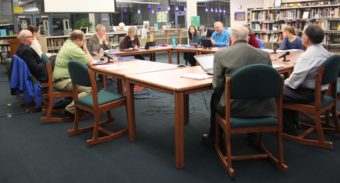
The Juneau School Board met with the Juneau Assembly on March 4 and asked for full funding. The Assembly has a meeting tonight to discuss education funding. (Photo by Lisa Phu/KTOO)
The Juneau School District submitted a budget request of more than $25.5 million dollars to the Assembly at the end of March. The Assembly is budgeting for that amount, but at tonight’s meeting, the city manager is recommending $1 million less.
Assemblyman Jesse Kiehl is the Assembly liaison to the school board. He spoke at the board’s special meeting last night.
“The charter mandates us to provide a guaranteed minimum of funding, however we are permitted to go above that amount as we complete our budget process,” he said.
Kiehl said the Assembly won’t know how much it’s allowed to provide the schools until the legislature passes a budget.
“So I would anticipate it being, even more so than usual, setting a minimum and everyone hoping that there will be an opportunity to provide more,” Kiehl said.
Last year was the first time in years the Assembly hasn’t funded schools to the maximum, It was $500,000 shy of the cap. It also reduced funding for activities, to which the cap doesn’t apply, by almost $400,000.
Kiehl said the Assembly is still considering giving supplemental money to the school district for this current fiscal year. He said that decision will be made independent of next year’s funding.
The Marie Drake Building was built in 1965 and hasn’t gone through any major renovations since. (Photo by Lisa Phu/KTOO)
The Juneau School District wants a special June election asking voters to approve a bond measure for school renovations before a law stopping state reimbursements for school construction takes effect. The governor still hasn’t signed the bill, but if he does, the school district has 90 days before it becomes a law to hold an election. Even if all goes smoothly and the district beats the countdown, it’s still unclear if it will get reimbursed.
The Marie Drake Building was built in 1965 as a junior high school. Now, it houses Yaaḵoosgé Daakahídi Alternative High School, Montessori Borealis and some district offices.
“It’s very difficult to teach science in a classroom that has one sink that is as old as the building that works most of the time, but not all the times,” says Ryia Waldern, science teacher at Yaaḵoosgé Daakahídi, which doesn’t have any lab facilities.
“We do different squid and fish dissections. We also teach a really incredible forensics class where it can get pretty messy because we’re doing different blood splatter analysis,” Waldern says.
All of that is done in a normal classroom.
“And my floors and the lights are original to the building and when the students upstairs in Montessori are doing their really fun activities, our lights shake and it’s very loud. And I’m glad they’re having fun up there, but it can be a little distracting when we’re taking notes and things like that,” Waldern says.
The room off Ryia Waldern’s classroom has one sink and is used for storing lab equipment and cleaning up. (Photo by Lisa Phu/KTOO)
Getting proper science labs for both the high school and Montessori is part of renovation plans for Marie Drake. Other improvements include the heating and ventilation system, lighting and general updates to learning spaces. The school district would ask voters to approve about $21 million in bond debt, mostly for the Marie Drake building. A small portion, about $1 million, would fund upgrades at Juneau-Douglas High School.
The district has been working on the capital improvement process for the past few years. Originally, the district planned to have it on the normal election ballot in October, but that would be too late if Senate Bill 64 becomes law.
With the state currently reimbursing up to 70 percent of a school construction bond, Superintendent Mark Miller says a lot’s at stake.
“There’s $14 million on the table and if we don’t get an election in the next 90 days that $14 million is gone, I mean, it’s gone forever,” Miller says.
Superintendent Mark Miller (Photo by Lisa Phu/KTOO)
With the state facing multibillion dollar deficits, Miller says he understands the legislature wanting to be fiscally solvent. But he also wants to protect the Juneau School District.
“The law is the law. The law is clear about when bills take effect and we have every right to do what’s legally acceptable in order to do what’s best for our kids,” Miller says.
Elizabeth Nudelman is head of school finance and facilities for the Alaska Department of Education. She says the department hasn’t received a completed application for Marie Drake debt reimbursement from the Juneau School District, but anticipates receiving one.
“If they have their application reviewed as eligible by the department, if the voters approve the project and if the sale of the bonds is in compliance, and the procurement and design and reporting is in compliance, then they would move through the system for reimbursement,” she says.
But Nudelman says even if the state enters into a contract with the district, nothing is guaranteed if the bill becomes law.
“There’s language in the contract around future events that could happen or could not happen. And in a funding for construction programs, it always is based on the legislature appropriating funds,” Nudelman says. “So I think that there are a lot of questions out there that really would need to be solidified to come up with a final answer.”
Laura Pierre is chief of staff to Eagle River Republican Sen. Anna MacKinnon, co-chair of the Senate Finance Committee, which sponsored the bill.
“I would be very surprised if the Department of Education approved any application at this point knowing what the legislature’s intent is,” Pierre says.
But Rep. Sam Kito III, D-Juneau, thinks it’s a smart move for the district to try to enter into a legal contract with the state.
“It appears as though there will be some grey area, but any contracts entered into between now and when the bill actually takes effect should be valid,” Kito says.
And he says it’ll be hard for the legislature to undermine that contract.
Gov. Bill Walker’s press secretary says the governor is still reviewing SB 64.
“Shin-chi’s Canoe” by Nicola Campbell, “Not My Girl” and “When I Was Eight” both by Christy Jordan-Fenton and Margaret Pokiak-Fenton, and “My Name is SEEPEETZA” by Shirley Sterling will be available in fourth grade classrooms and elementary school libraries. (File photo)
The Juneau School District has chosen a book to replace the controversial texts it decided to remove from the fourth grade language arts curriculum.
Last August, community members raised concerns about school texts depicting Alaska Native and Native American tragedies, including the boarding school experience in Alaska. The texts were called distorted, inaccurate and insensitive.
The district has chosen “Shin-chi’s Canoe” by Nicola Campbell.
Nicola Campbell is a First Nations writer from British Columbia. Her children’s book, “Shin-chi’s Canoe” depicts life in an Indian boarding school from a child’s perspective.
In the free-verse picture book, a character describes being punished for not understanding English – “They cut her long braids and threw/ them away/ and washed her head with kerosene.”
Paul Berg is a former teacher and a cultural specialist at Goldbelt Heritage Foundation. He says even though “Shin-chi’s Canoe” describes a boarding school in Canada, he thinks it’s accurate to what Alaska Natives experienced.
“The stories, the accounts that I’ve heard from elders have been pretty brutal treatment during the boarding school years in Alaska, so that would not be an exaggeration,” Berg says.
Berg evaluated the controversial texts, which are part of the McGraw-Hill Reading Wonders program. His report on the readers was the formal complaint that led to their removal. He said the texts misrepresented the historical reality and marginalized the experiences of the victims.
“Shin-chi’s Canoe” and other books the district is ordering for the classroom are interim solutions. When the superintendent decided to remove the McGraw-Hill readers, he said they’d be replaced by place-based material developed locally in partnership with Goldbelt Heritage.
Berg says this takes time and involves historical research, like interviewing elders. He says the local material will depict real events and share the cultural life of the Native community. He says it would be great to have material describing Tlingit cultural ceremonies that are still part of the Native community in Southeast.
“And just having an account of that even, for example, in the reading program would be a great cross-cultural sharing. But also, for the Native students, an affirmation in the school system of a part of their lifestyle,” Berg says.
Ted Wilson is the district’s director of teaching and learning. He says the district spent about $1,300 for 90 copies of “Shin-chi’s Canoe,” which will be distributed to fourth grade classrooms for use in small reading groups.
He says McGraw-Hill plans on replacing the four readers the Juneau School District removed with new readers at no cost.
Close
Update notification options
Subscribe to notifications
Subscribe
Get notifications about news related to the topics you care about. You can unsubscribe anytime.