Juneau Schools

Juneau School Board candidates split on STEM charter school

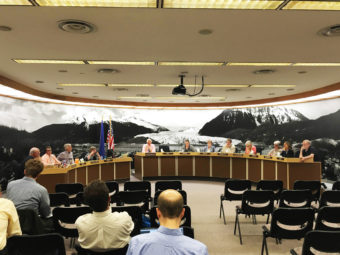
Juneau District School Board candidates answer questions from KTOO's reporter Lisa Phu and the Juneau Empire's managing editor Charles Westmoreland during a Juneau Votes! debate at the @360 Studio on Monday. The candidates from left are: Jason Hart, Josh Keaton, Emil Mackey, Jeff Redmond and Andi Story.
Juneau School Board candidates answer questions during a Juneau Votes debate @360 on Monday. The candidates from left are: Jason Hart, Josh Keaton, Emil “Robert” Mackey, Jeff Redmond and Andi Story. (Photo by Michael Penn/Juneau Empire)

Listen: School Board Candidate Debate
7 p.m. Thursday, Oct. 1
KTOO-FM 104.3

Attend: Juneau Assembly Candidate Debate
5:30 p.m. Tuesday, Sept. 29
Egan Lecture Hall, University of Alaska Southeast

At Monday’s Juneau School Board debate, candidates expressed their opinions on everything from a STEM charter school to a Tlingit immersion program and Planned Parenthood.

Voters get three picks on the Oct. 6 ballot for Juneau School Board but five candidates expressed why they’d make the best fit.

One of the topics that divided the panel with one undecided was the proposed Summit STEM Charter School. It focuses on science, technology, engineering and math based curriculum. Josh Keaton, a NOAA fishery biologist, was reluctant to back it.

“I personally feel that STEM should be involved in all schools,” Keaton said. “So whether another charter school is needed and the financial drain that might happen, I’m not decided at this point in time.”

Emil “Robert” Mackey said he wasn’t a fan of charter schools and proposed an alternative. Mackey pointed out Juneau-Douglas High School isn’t at full capacity.

“If we could, though, create an enhanced curriculum at that high school and attract students that then would opt in to that alternative curriculum using a magnet model, I think that would be a lot better than using a charter school model,” Mackey said.

But Jeff Redmond said he supported it and wondered how it might be good for schools overall.

Juneau District School Board candidates answer questions from KTOO's reporter Lisa Phu and the Juneau Empire's managing editor Charles Westmoreland during a Juneau Votes! debate at the @360 Studio on Monday. The candidates from left are: Jason Hart, Josh Keaton, Emil Mackey, Jeff Redmond and Andi Story.
Juneau School Board candidates. (Photo by Michael Penn/Juneau Empire)

“The data that we can collect from the these alternatives could be useful to bring back to the main curriculum,” Redmond said.

As for the rest of the candidates, incumbent Andi Story said no on the charter school while candidate Jason Hart said  yes.

But when Story was asked during the Q&A if she would support a K-12 Tlingit language immersion school, she said yeah. “Very much.”

“It’s something we owe the first people of where we live in this place. … What I’d want to do is work with our partners who really want that. And see how can they see that happening,” Story said.

Hart, on the other hand, said no.

“I think having that be a class that can collaborate with UAS would probably be the best way to go about it. In reality, I don’t see how we could have a school that’s taught that way,” Hart said.

 The other candidates echoed the same sentiment, wondering if a Tlingit immersion preschool was more feasible. But for 20-year old David Russell-Jensen who asked the question, it wasn’t enough.

“If you look at the Hawaiian model for their immersion schools in Hawaii, they teach every single concept in Hawaiian,” Russel-Jensen said. “I mean, sure you might have to make up new words for some concepts. But it’s entirely possible. It’s a living language, it’s dynamic.”

There was one topic all the candidates agreed on, however. Planned Parenthood should have a presence in the schools.

The debate was organized by Juneau Votes, KTOO and the Juneau Empire.

Juneau School Board candidates talk priorities, budget

Upcoming Debates

School Board Candidate Debate
5:30 p.m. Monday, Sept. 28
@360, KTOO

Juneau Assembly Candidate Debate
5:30 p.m. Tuesday, Sept. 29
Egan Lecture Hall, University of Alaska Southeast

The five candidates for Juneau School Board fielded questions Thursday about their priorities, testing, teacher pay and the budget situation at a forum held by the Juneau Chamber of Commerce.

Most of the candidates expressed concern about college and career readiness, and all of them acknowledged the challenge of attracting teachers and compensating them enough given the high cost of living. Responsiveness to the community and transparency also seemed to be a priority for several candidates.


Jeff Redmond

Jeff Redmond at the school board candidate forum held by the Juneau Chamber of Commerce (Photo by David Purdy/KTOO)
Jeff Redmond. (Photo by David Purdy/KTOO)

Jeff Redmond is a long-time Alaska resident who moved to Juneau two years ago. He studies education and English at the University of Alaska Southeast and has a 3-year-old daughter.

He spoke about the importance of connecting the education system to the community and the need for transparency. For student assessments and evaluating teacher performance, he emphasized a balance between quantitative metrics and flexibility.

“I think teachers need enough space to be creative, and that constant analysis and assessment may detract from the magic of teaching,” he said.

He suggested curtailing charter school expansion as a possible cost-saving measure, but said he would consult with experts on further budget issues.

Andi Story

Andrea Story at the school board candidate forum held by the Juneau Chamber of Commerce (Photo by David Purdy/KTOO)
Andi Story. (Photo by David Purdy/KTOO)

Andi Story has lived in Juneau for 28 years and is in her 12th year on the Juneau School Board. She has three children who went through the school system.

She emphasized increasing the quality of instruction through continuing support of teachers with professional development.

“The number one in-school factor that increases student learning is the teachers’ skill set and their relationships with their students,” she said.

When asked about the fiscal situation, she emphasized ensuring adequate funding for the district, adding that administration costs had already been cut “down to bare bones.” She also suggested smaller class sizes for younger students and working with the community partnerships like reading tutors.

Josh Keaton

Josh Keaton at the school board candidate forum held by the Juneau Chamber of Commerce (Photo by David Purdy/KTOO)
Josh Keaton. (Photo by David Purdy/KTOO)

Josh Keaton has lived in Juneau for 15 years, where his two children attend Mendenhall River Community School.

He spoke about the importance of community responsiveness and transparency for the school board. He also favors qualitative over quantitative analysis of teacher performance.

Rather than just looking at a number, he suggested asking questions like, are “the students leaving the class excited about learning?”

He also suggested smaller kindergarten through second grade class sizes, programs for gifted students, college and career readiness as a priority, and encouraging learning at home. While he said he does not currently have a deep enough understanding of the budget to suggest specific cuts, he does advocate increasing funding for schools.

Jason Hart

Jason Hart at the school board candidate forum held by the Juneau Chamber of Commerce (Photo by David Purdy/KTOO)
Jason Hart. (Photo by David Purdy/KTOO)

Jason Hart has lived in Juneau for 17 years and has one child in fourth grade at Mendenhall River Community School.

One of his priorities is making the school board more available and responsive to the community.

“I’d like to bridge the gap between the community and the board,” he said.

He also mentioned the importance of pre-K and wants to restore funding for sports programs. He expressed skepticism about the reliance on test scores as the sole measure of student learning and feels they do not adequately account for individual learning styles.  While he did not offer any specific suggestions for the budget, he mentioned the importance of carefully allocating the money available.

Emil Mackey

Emil Mackey at the school board candidate forum held by the Juneau Chamber of Commerce (Photo by David Purdy/KTOO)
Emil Mackey. (Photo by David Purdy/KTOO)

Emil Mackey has a masters in education from the University of Alaska Fairbanks and a  doctorate in public policy. He has worked as a student affairs professional for the University of Alaska and the University of Arkansas. While he does not have children, he says if he does, he would enroll them in Juneau public schools.

When it comes to the budget, Mackey advocated increasing efficiency.

“We do not control our revenue sources, but we do control our expenditures,” he said.

His suggestions included possibly combining junior and senior high schools. He said that high school facilities are underutilized compared to overcrowded lower grades.

He favors exploring voluntary specific college and career tracks for students, community partnerships with the University of Alaska and local unions, and incentivizing retirement for more senior teachers, who earn more than newer teachers.

Election day is Oct. 6.

Juneau schools awarded $500,000 arts grant

The Juneau School District has won a $500,000 grant to incorporate more art into the classroom.

The funding from the Margaret A. Cargill Foundation is for two years. Director of Teaching and Learning Ted Wilson says the funding could continue for up to 10.

He says the grant will provide professional development for K-12 teachers.

“Train teachers on just artful thinking, what does it mean to think artfully when you’re presenting your curriculum? Then some of the work will be, how do you integrate art into your classroom, into the daily activities of your class?” Wilson said.

The grant will bring in visiting artists, including people from The Kennedy Center in Washington, D.C.

Summit STEM School supporters must wait longer for board action

Summit STEM School supporters and organizers sit in the audience of Tuesday's regular School Board meeting. (Photo by Lisa Phu/KTOO)
Summit STEM School supporters and organizers sit in the audience of Tuesday’s regular School Board meeting. (Photo by Lisa Phu/KTOO)

Final action has been postponed for a proposed charter elementary school focusing on science, technology, engineering and math. The Juneau School Board heard about potential legal issues and opposition from within the district in a meeting Tuesday.

Summit STEM School hopes to serve students who are economically disadvantaged — they’d make up 50 to 75 percent of the student population. At least, that’s the goal.

To do this, the charter school organizers propose heavy recruiting and partnering with organizations that cater to low-income families. They’d also use the district’s current placement process for optional programs, which gives preference to low-income students. That may be illegal, according to City Attorney Amy Mead.

City attorney Amy Mead says there are legal issues with the current charter school application. (Photo by Lisa Phu/KTOO)

“Weighted lotteries are not allowed for charter schools under Alaska law,” Mead said.

Mead said they’re allowed for optional programs within the district like the Montessori Borealis and the Tlingit Culture, Language and Literacy program, but not for charter schools.

Applications for the Summit STEM School’s 80 spots would be open to all students in the district.

“When there are too many applicants for the spots available, federal law and state law require a lottery to fill the spots,” Mead said. “State law is very specific about how you fill spots for a charter school and it’s by random drawing.”

School board member Barbara Thurston said the charter school can’t guarantee the makeup of the student body because the organizers have no control over it.

“They have control to the extent that they can do really good outreach among certain communities, but they can’t control who else puts their name in the applicant pool,” Thurston said. “If they get a great number of applicants from low-income kids, but they get three times as many applicants from high-income kids, that’s just the way to works out.”

Mead said there were other problems with the charter school application, like potential issues with the collective bargaining agreement, transportation and its contract with the district.

The school board also heard opposition to the proposed charter school during public comment.

Lori Hoover is principal of Auke Bay Elementary School. Five of her current teachers want to work at the charter school.

“They are incredible teachers who work and do incredible things with kids every day, and I’m not saying anything these teachers don’t know, but I’m not in favor of the charter school. I’m just not in favor of it. I don’t believe that Juneau is big enough for another charter school and the impact that [it] has on all the other schools and all the other programs that are currently in place,” Hoover said.

Every student in Juneau, she said, should have access to the concepts brought forward by the charter school, like project-based learning and the focus on STEM.

“Any one of the teachers in my building could say, ‘I want to do a STEM-integrated unit. How do I go about doing this?’ We have lots of resources in the building [and] in the community that allow for that to happen. I think we need to see that, not pull apart schools or go into other schools, but work the best we can for the kids in the system,” Hoover said.

Amy Jo Meiners is a parent and an extended learning teacher at Auke Bay and Riverbend Elementary schools. She opposes the charter school. Instead, she wants to the board to “empower our neighborhood schools.”

“I would love to see this be Riverbend. Let us adjust our hours. Let us meet the needs of our kids,” Meiners said.

Nancy Norman is one of the Summit STEM School organizers. She’s a former teacher, has won national teaching awards and is an education consultant. She agrees that all Juneau students should have an opportunity for the kind of education they’re proposing. She said the rest of the district can learn from their school being a model.

“One of the things is, even if the charter school isn’t approved, it has at least sparked a conversation. I’m not convinced the conversation will get results. I am convinced that if they approve the charter school that we will get results,” Norman said.

Norman plans on working with the superintendent, district staff and the city attorney to get the legal issues resolved.

The next regular school board meeting is scheduled for Oct. 20, at which point the school board could have up to three newly elected members.

High school activities fee creep causes sticker shock

The JDHS swim team practices at Augustus Brown Swimming Pool, Aug. 19, 2015. (Photo by Jeremy Hsieh/KTOO)

Classes in Juneau are just starting on Thursday, but some high school activities have been underway for weeks. This school year, the district has drastically cut funding for activities and athletics, leaving some parents paying hundreds of dollars more for their kid to participate.

Michelle Norman has two kids at Thunder Mountain High School. Her daughter is on the swim and dive team. At the first parent meeting for the activity, she was asked to pay “an activity fee of $600 and approximately $150 travel fee for each meet out of Juneau.”

Last year, Norman paid $275.

She says this higher fee struck her as ridiculous. So Norman did her own research on travel costs to meets in Ketchikan and Sitka, and says the $600 activity fee only makes sense if her daughter qualifies for state competition.

“My daughter has a good chance of qualifying for state and I expect if that happened that I’d contribute more, but I’m not comfortable with paying $600 now for a $200 expense,” Norman says.

According to Juneau School Board policy, individual activity fees for participation and travel must be approved by the activities director and the superintendent. For students who are in financial need, the district has a scholarship fund.

Superintendent Mark Miller says he hasn’t approved any activity fees.

“To my knowledge we do not have actual individual fees,” he says.

Miller doesn’t call the costs put on students or parents “fees.”

“Different sports are going about fundraising in different ways and some are asking for contributions from participants in order to limit or defray the amount of fundraising that they do,” Miller says.

Thunder Mountain High School Activities Director Jake Jacoby says every fall sport does have an activity fee.

“This is an individual fee that varies from activity to activity and it’s very low for activities that have low budget needs and it’s pretty darn high for the more expensive programs,” Jacoby says.

He says $600 for the swim and dive team isn’t the highest. The coaches come up with the fees, and Jacoby approves them, but he hasn’t taken them to the superintendent.

Jacoby says the fees go toward gear and travel, but the cost shouldn’t be coming out of pocket.

“There are fundraising opportunities that need to be provided by the teams in order for students to raise the money,” Jacoby says.

In an email from the swim and dive booster board at Thunder Mountain High School, parents were instructed to “bring your checkbook” to an Aug. 4 meeting. The main fundraising event is selling Christmas trees and parents were asked to think of other ideas.

Due to district budget cuts to activities, Jacoby says everyone – coaches, booster clubs, parents, activities directors – is working through a new process this year.

“I have had conversations with various coaches within the last week about fundraising and funding and we’ll continue to do so as all teams figure out what this means as far as funding all of their own travel,” Jacoby says.

Last school year the district budgeted about $1.5 million for the high school activities program, including staff. About $600,000 of that went toward travel.

For this school year, the district budgeted less than a million dollars for high school activities. Close to $600,000 of that came from the Juneau Assembly, and the majority of it goes toward administrative costs.

Superintendent Miller says in the past, the district covered the majority of travel costs for high school activities.

“Unfortunately we’ve been dipping into the bank in order to cover those costs and our bank account ran dry last year and so this is really the first year that we’ve had to say we can’t go over what we’ve allocated under any circumstance and we can’t allocate what we used to,” Miller says.

The district has set aside $150,000 of the Juneau Assembly money for potential travel to state competitions, travel that teams don’t necessarily budget for because it’s last minute. It’s hard to say if that’s enough money because it depends on how well teams do. There will likely still be fundraising post-postseason.

Juneau election deadline closes with 11 candidates vying for 6 seats

The filing deadline to run for Juneau Assembly and Juneau School Board closed Monday  with 11 candidates vying for six seats.

Juneau’s candidates for local office tend to file at the last minute, and that was true of this cycle, too.

In 72 hours, the capital city went from having just one contested race and zero candidates for a pair of Juneau School Board seats, to having just a single uncontested race.

Juneau Assemblyman Loren Jones is unopposed seeking his second term, barring write-in challengers, who have until Oct. 1 to file their paperwork.

Fisheries consultant Greg Fisk is challenging incumbent Juneau Mayor Merrill Sanford. Fisk says he’s concerned about the economy like everyone else. He wants to diversify it and says a lack of affordable housing inhibits a lot of potential. He supports mixed-use and transit-friendly development.

“I think the mayorship is a chance to heighten awareness of certain items. I mean, it’s a bit of a bully pulpit as they say. You get asked a lot, you get a chance to speak on the city’s behalf, and I think there’s a lot we can do,” Fisk says.

In Juneau’s council-manager form of government, the mayor doesn’t directly manage municipal employees and is largely ceremonial. The mayor presides over the Juneau Assembly with the same voting power as the other eight members, and that body collectively sets policy and directs the city manager.

The other Assembly seat in the October election remains a three-way race between incumbent Jerry Nankervis and challengers Jason Puckett and Dixie Hood.

Juneau School Board

On the Juneau School Board, two longtime incumbents who were on the fence about seeking another term did not file. Board President Phyllis Carlson and member Destiny Sargeant will not be on the October ballot.

A third longtime incumbent, Andi Story, will compete in a five-way race for three seats with Jeff Redmond, Josh Keaton, Emil “Robert” Mackey and Jason Hart.

All four of the new candidates filed their paperwork on the last eligible day.

Election day is Oct. 6.

Site notifications
Update notification options
Subscribe to notifications