Juneau Schools

How Juneau students stack up in new state assessment

(Modified Creative Commons photo by Horia Varlan)
(Creative Commons photo by Horia Varlan)

Juneau students performed second best among the state’s five biggest school districts in Alaska’s new standardized test. Alaska Measures of Progress evaluates third through 10th grade students on math and English language arts.

About 40 percent of Juneau students that were tested meet the standards, while roughly 60 percent partially meet the standards. That’s better than how the state did as a whole. Sixth grade math is the only area where Juneau students fell behind state averages, according to the superintendent.
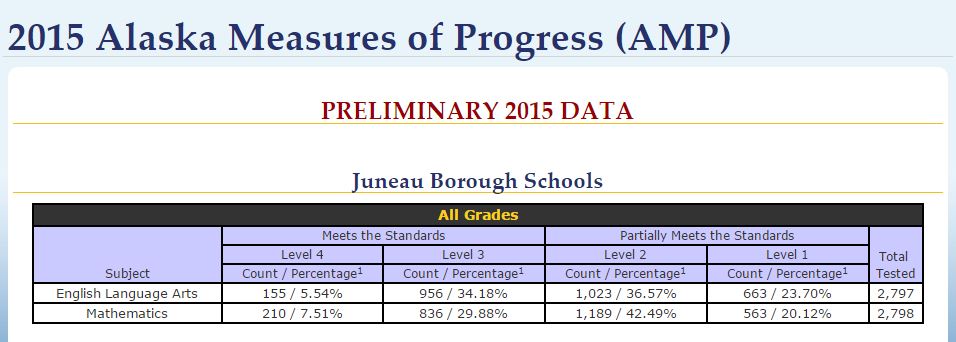
Results of Alaska Measures of Progress were released Nov. 9.

The test was administered this past April. It’s based on state standards revised in 2012 and replaces a test based on 2006 standards.

Phil Loseby, assessment evaluation coordinator for the Juneau School District, said the new standards are more rigorous.

“Alaska is not a Common Core state, but roughly 90 percent or more of our state standards align either very closely or exactly with the national Common Core,” Loseby said.

Old standards wanted fourth graders to know their multiplication tables. New standards have that expectation and more of third graders.

Students are scored on four levels. Students who score on the 1 or 2 level only partially meet the standards, while students who score on the 3 or 4 level meet the standards.

“The ‘meet’ and ‘partially meet,’ it’s really you meet the standard or you’re below the standard,” Loseby said.

Of all Juneau schools, Auke Bay Elementary had the top English scores with close to 55 percent of its students meeting the standards. Gastineau Elementary topped the district in math scores with close to 50 percent meeting standards.

Loseby says the test provides only one measure of assessment and shouldn’t be used in isolation. The district also administers the nationally-normed Measures of Academic Progress test three times a year. He says that assessment allows parents and teachers to track performance throughout the year and helps identify instructional targets.

The new Alaska Measures of Progress test has critics that include many superintendents, and a state lawmaker is drafting a bill to repeal it.

Juneau superintendent Mark Miller said the district is still trying to figure out what the test means.

“The test itself has some quirks and some flaws that we’re going to be working with the state around to figure out what exactly it means. It’s not very good to help us inform instruction. It doesn’t help us get much better at what we do,” Miller said.

Individual student scores will be sent out around Thanksgiving.

Tlingit language and culture program begins Saturday at youth center

Paul Marks
Paul Marks discusses the Raven story at the UAS Egan Lecture Hall in March 2015. (Photo by Lisa Phu/KTOO)

Goldbelt Heritage Foundation is beginning a free Tlingit culture and language program at Zach Gordon Youth Center on Saturday.

Over the next five Saturdays, kids will make and paint traditional Tlingit drums, learn some language and hear stories with Paul Marks, a Tlingit language and culture specialist with Goldbelt Heritage.

The 3-hour sessions begin at 1 p.m. this Saturday.

The program is free, but limited to 15 participants age 8 and older. It’s geared toward families, and elementary and middle school students.

Register through the Zach Gordon Youth Center at 586-2635.

Juneau School Board ratifies new teachers’ contract

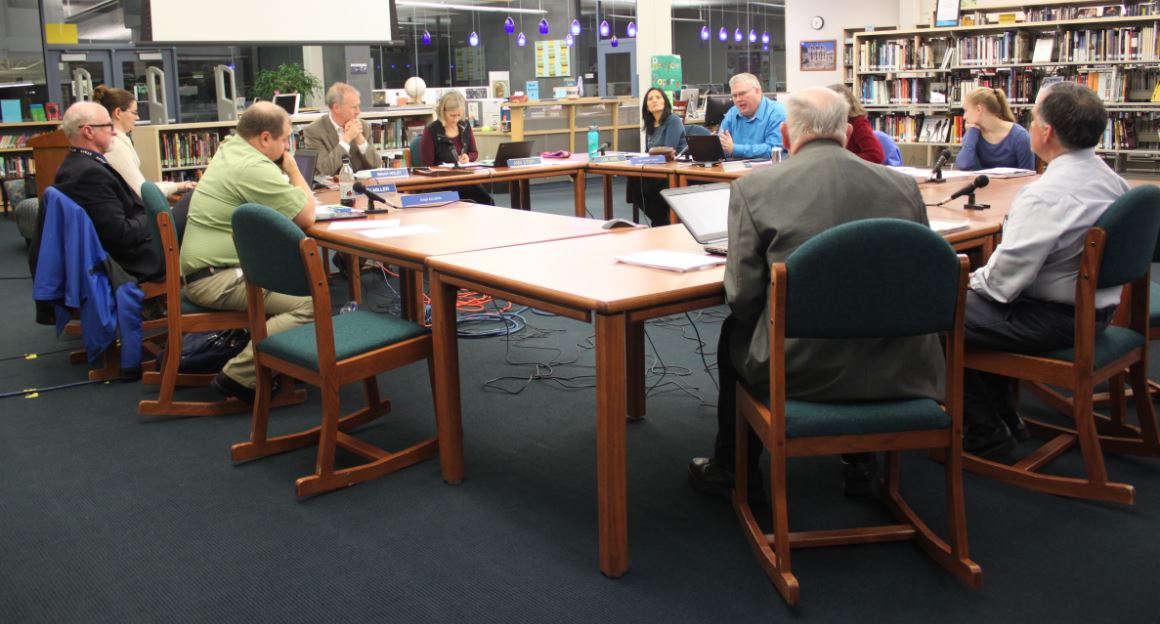
The Juneau School Board during its regular meeting on Nov. 10, 2015. (Photo by Lisa Phu/KTOO)
The Juneau School Board during its regular meeting Tuesday. (Photo by Lisa Phu/KTOO)

Juneau teachers are getting a 2 percent salary increase. On Tuesday night, the Juneau School Board approved the negotiated contract between the school district and the teachers’ union.

Negotiations began in January. The Juneau School District and the Juneau Education Association reached a tentative agreement in mid-October and the teachers’ union voted to approve it at the end of the month. The board approval was the final step.

The 2 percent raise includes a 1 percent permanent salary schedule increase and a 1 percent temporary increase. The negotiated agreement also includes a more competitive starting pay for specialist positions and compensating some teachers for extra meeting hours at a rate of about $33 an hour.

The estimated fiscal impact of the contract for this budget year is about $650,000. This will come out of budget savings from the general operating fund.

The Juneau School Board unanimously ratified the contract. Board vice president Andi Story said the district has an outstanding teaching staff.

“They work really hard for our kids. They’re very dedicated and we’re very grateful for them. We wouldn’t be much without them. They’re the ones who are in front of our kids each day, our most valuable resources,” Story said.

Board member Emil Mackey said he’s worried about class sizes getting bigger as budgets get smaller.

“I’m extremely concerned that we’re on a non-sustainable path that is not good for kids, is not good for the teachers, is not good for the district. And in the future negotiation, I really hope we collaborate on getting those class sizes down,” Mackey said.

Juneau Education Association President Dirk Miller said neither side got everything they wanted, but the teachers’ union is happy. He said the collaborative bargaining method worked out well.

“I guess the difference between this and other negotiations is, I brought pie to the last bargaining team meeting and we all talked and it was congenial,” Miller said. “This was a nice path and it led to a resolution of something that is important for all of us.”

For future contract negotiations, both the district and the teachers’ union want equity in teacher preparation time, which currently varies across grade levels. The district also wants to explore the possibility of a seven-period high school day, as opposed to the current six-period day, which would allow students more opportunities to earn credits toward graduation.

This is a one-year contract. It’s retroactive to July 1 and goes through June 30 of next year.

Juneau educator named 2016 Alaska Teacher of the Year

Amy Jo Mieners
Amy Jo Mieners

Juneau teacher Amy Jo Meiners has been named 2016 Alaska Teacher of the Year.

Alaska Education Commissioner Mike Hanley made the announcement Sunday at the Association of Alaska School Boards conference.

Meiners works with gifted and talented students as an extended learning teacher at Auke Bay and Riverbend elementary schools.

The selection process is based on a written application reviewed by a committee of educators, followed by interviews with the top ranked applicants.

The state title puts her in the running to be the National Teacher of the Year to be announced in April. The national teacher of the year serves as a spokesperson for the profession who is given a paid leave of absence for one year to travel for speaking engagements and policy commissions.

Juneau teachers approve tentative contract with school district

(Creative Commons photo by Todd Petrie)

The Juneau teachers union voted Thursday night to approve a one-year tentative contract with the school district.

The negotiation process ended earlier this month and members of the Juneau Education Association had a week to look at the tentative contract. It includes a 2 percent pay increase, a more competitive starting pay for specialist positions and compensating some teachers for extra meeting hours.

A majority of members passed the tentative contract, though JEA President Dirk Miller wouldn’t get into percentages. He said close to 180 of about 355 members voted, and that’s a good turnout.

Miller said the negotiating team did a good job of working with the district, although there were things the teachers didn’t get.

“There are lots of issues out there that will come up again. Unfortunately, they’ll come up in the next year’s negotiation because it’s only a one-year contract. So the things that the two sides were able to agree on were pretty good for students in the district, teachers and families,” Miller said.

Miller said the collaborative interest-based bargaining was a better arrangement than traditional negotiating. He said the process wasn’t contentious.

“I think our relationship with this administration is a lot more solid. I think the hope is that the path that they laid with this contract will lend itself into the next contract, so we won’t have to start from scratch and maybe they can pick up where they left off and come to a speedier resolution,” Miller said.

The negotiating process lasted nearly a year. Miller said some of the delay was due to the Alaska Legislature taking so long to pass a budget.

The contract remains tentative until the school board votes it through. It’s expected to be on the November agenda. The last contract expired June 30, but its terms remain in effect.

Miller said contract negotiations between the teachers’ union and the school district are expected to begin again in January.

Site notifications
Update notification options
Subscribe to notifications