Education

Getting to Graduation gathers students and community to talk about dropout crisis

Juneau public broadcasting’s months-long American Graduate project culminated Dec. 10 in Getting to Graduation, a community discussion broadcasted live on TV, radio and online.

The project, spearheaded by KTOO, KRNN, KXLL and 360 North, was a result of a grant to get local stations involved in discussing the dropout crisis facing many communities.

In Juneau, nearly 1 in 3 students won’t attain a high school diploma. Ninety-three students dropped out of Juneau high schools in the last school year. Statewide, more than 2,830 students quit school for one reason or another.

The hour and a half of talking circles featured kids and families, representatives of education and community programs, and local policy makers.

The evening emphasized the participation of students telling their own stories.

Kayla Ryan, graduated in 2008 at the age of 21, two years after she should have graduated. Ryan says she suffered from learning disabilities and an unstable home life. She dropped out of school after becoming frustrated with feelings that teachers didn’t want to waste time on her because of her learning disabilities.

Ryan says she didn’t just want a GED, she wanted her diploma. She found out about the program at Yaakoosge Daakahidi Alternative High School, and returned to school.

When asked about what could be done to help students, Ryan says it’s about understanding what students are facing.

[quote]“Listen, we have drama. I’ll give you that. But there’s usually something to that drama,” Ryan said.[/quote]

Crystal Rogers graduated from Yaakoosge in 2002 and is almost finished with her bachelor’s degree. Her journey to graduation was tumultuous, dealing with multiple foster homes and separation from her twin sister.

Rogers says it’s important to remind students that no matter what they are going through, or what it may look like from the outside, “they are not defective human beings and they have it in them to do whatever it is that they want to do.”

The principal of Yakoosge, Sarah Marino, works with students facing a wide range of obstacles.

Marino says that one of the most important parts of her job is helping student dream.

[quote]“Many students don’t know what they want next and that makes graduating so much harder,” Marino says.[/quote]

Laury Scandling, the Assistant Superintendent for the Juneau school district, was a project coordinator for the American Graduate series and the Getting to Graduation event.

[quote]“The point was to stimulate conversations about graduation. I did not expect that there would be an answer. There is no answer. There are a variety of strategies that help a variety of youth. Because youth are not monolithic. Every kid has a different set of needs.”[/quote]

Scandling says she’s taking notes on the concrete commitments that were made by leaders and on things that students said were important. She plans to work in those ideas into what the school district is doing.

For more information about the American Graduate project, check out the project page with the full community discussion, interviews with students and local educators and a stories leading up to the community discussion.


Local foods shake up the menu at Thunder Mountain High School

lunch options
Students can chose from a variety of entrees including pizze, cheeseburgers and halibut. (Heather Bryant/KTOO)

Salmon and halibut on a school lunch menu – it’s been happening in Juneau as the school district looks for healthier and more local foods for kids. Juneau schools in August received a state grant to help fund Alaska Grown lunches. The school district plans to expand the program, but for now students, staff and suppliers are still getting used to the new meals.

Students flood the hallways as lunch starts at Thunder Mountain High School. They congregate at the lunch line, speeding through so they can sit and socialize. Most choose pizza, or a cheeseburger, but 18-year-old Alora Pilgrim picks up halibut with broccoli and red potatoes.

[quote]“I usually get a sandwich or a salad, or if there’s something that looks especially yummy like the halibut I’ll get that.” Pilgrim said. “It’s really good, it seems like it’s more like actual ‘real food’ than maybe some of the other things they serve.” [/quote]

Pilgrim plans to major in biology after high school. When she learned the halibut and potatoes come from Alaska, she said she likes eating a lunch that’s better for the environment.

[quote]”I like eating food that’s local and sustainable.” Pilgrim said. “I think it’s really good because it does help our economy and it’s nice because other things that we do have to fly in are maybe not so fresh, like fruits and vegetables.” [/quote]
halibut
Greg Regester, the general manager for NANA management services, prepares the halibut. (Heather Bryant/KTOO)

The day’s halibut came from Taku Smokeries in Juneau, and Matanuska-Susitna Valley potatoes came from Anchorage-based Charlie’s Produce.

Earlier in the year, the Juneau school district offered sockeye salmon from Taku and a coleslaw mix from Mat-Su. It also shipped in vegetables from Merry Weather Farms in Gustavus.

“We literally purchased all her carrots and sugar snap peas.” says Adrianne Schwartz, the food services supervisor for the Juneau School District. She learned this year that Juneau schools were eligible for an $85,000 one-time state grant that would pay for local foods in school lunches.

[quote] “Our main resource in our state I believe has a lot to do with fishing and any way that we can help maintain that or promote, I think, is really good and why not be purchasing foods that are grown right here in our state rather than ordering from elsewhere if we can?” Schwartz says. [/quote]

Schwartz says parents and staff praise the new options, and the district plans to survey students. The menu notes when a food’s from Alaska, and kitchen employees provide more details when students ask about the unfamiliar foods.

pizza
Regester says that no matter what is on the menu, pizza is still the most popular item by far. (Heather Bryant/KTOO)

18-year-old Katherine Wray sits without a lunch at a table with other students. She has not tried the Alaska fish when it’s available.

“That sounds gross,” Wray said.

Schwartz says meals are $3.25 for a combination of an entrée, items from the salad bar and milk. Students can choose between a few entrées, but other drinks, or additional entrées, cost extra.

Schwartz says school lunches are in flux nationwide. Posters hang on the walls of the cafeteria urging students to remember the healthy food plate, instead of the familiar food pyramid. The plate is half fruits and vegetables, half grains and proteins, and a glass of milk The local food grant is one facet of a changing lunch program.

[quote]“Sometimes people just aren’t able to get out and hunt and fish or it’s too expensive.” Schwartz says. “And so, you know, I just feel like it’s a very nutritious offering that we can provide to our students and it also exposes them to our local foods and would encourage them to try to eat that type of food outside of school.” [/quote]

The grant is available to other school districts. This is not the first time Southeast schools have provided local food, but the funding allows for a more comprehensive effort to provide it on an ongoing basis. A USDA program funded Juneau school district meals from Taco Loco and Trident Seafoods. Schwartz says the Sitka school district pushed for local options even before funding was available.

The last couple of years they started a program that they were able to do because they were receiving fish donations from the community and then NANA Management Services was paying a processing fee, and so it made it so it was affordable for them to provide fish on the menu,” Schwartz says.

It’s unclear if grant funding will be available next year, but Schwartz says Juneau students periodically will be able to get local, healthy foods.

Greg Regester is the general manager for NANA management services, the food contractor for the Juneau School District. The Thunder Mountain High School kitchen provides ready-to-cook meals for eight other schools in the district. They sell about 1,500 meals a week. Regester says kitchen staff prepared 150 pounds of halibut for lunch on December 7. He’s still analyzing how much more it costs to ship potatoes in from the Mat-Su.

“Cost-wise it looks like it is a bit more expensive to have purchased these items.” Regester says. “But that’s not to say that we still wouldn’t use them, because they are fresher and closer to home.”

In the future, Schwartz plans to offer processed game in addition to more fish and vegetables.

School board elects Worl to vacant seat

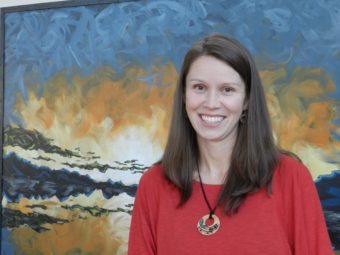
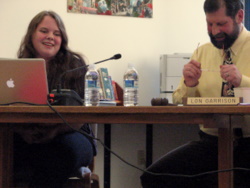
A smile from Lisa Worl as the Juneau School Board announces her election to fill out the term of Kim Poole.

The Juneau School Board has selected Lisa Worl to finish out the term of Kim Poole, who recently resigned.

The board Tuesday night voted for Worl, who was among six candidates for the seat, including two who had run in the fall municipal election.

All six were interviewed by the board on Monday.  At Tuesday’s meeting, members cast two secret ballots – the first for their top three choices, then a runoff ballot.

Worl competed against Myrna Gardner, Janice Hotch, Jennifer LaRoe, Michelle Johnston and Will Muldoon.  Johnston and Muldoon were among five candidates who ran for the board in the October election.

Worl has been on the Auke Bay Elementary and Floyd Dryden Middle School site councils, a substitute teacher and classroom volunteer.  She also served two years on the school board’s Budget Advisory Committee.

She will be sworn in at the first meeting in January, as the new budget committee begins its work.  Worl says the work of the expanded committee – which includes members from each school site council – is crucial to the budget process.

It’s really important to get that input throughout because the decisions are going to be very difficult,” Worl says.  “We’ve had to cut so much – nearly $4 million last year and it’s getting very,  very challenging and it will be a painful process.  Nobody wants their programs cut and they’re all very important.”

 Worl says it is likely she would run for the school board seat next fall, when her short term is up.

Fun with physics at the Roller Coaster Riot

The floor of the Juneau Arts and Culture Center is a mess of construction paper, tape and elaborate design drawings.

There are no rules at the Roller Coaster Riot. Students are given kits that include various tracks, loop-de-loops, funnels and corkscrews, and told to use their imaginations to create a roller coaster that gets a marble from point A to point B.

“First we got 30 minutes to plan, and then we went over there to that table and got the paper, some scissors, and some tape,” says nine-year-old Brianna McKeel. She’s standing next to her group’s creation, “The Dolphin,” so named because the twin starting tracks at the top resemble a dolphin tail.

McKeel goes to Riverbend Elementary School, but for this project she’s working with students from other schools around the Capital City. As part of the Juneau School District’s Extended Learning Program for gifted students, they’ve been learning about physics, specifically Newton’s three laws of motion.

“The first law is an object in motion stays at motion unless a force acts on it,” McKeel says. “And Newton’s second law is an acceleration of an object is related to the force applied on it and is inversely related to its mass.”

That second law is expressed in the formula f = ma, or as the kids learn it, “F equals mama.”

McKeel also recites Newton’s third law: For every action – or force – there is an equal and opposite reaction. In a paper roller coaster, she says there are two forces at work on the marble.

“The force is from the gravity, like us dropping it, and [from] the way our tracks are tilted,” she says.

Ten-year-old Auke Bay Elementary School student Ben Ng says his group’s roller coaster, “The Ultimate,” went through several redesigns to get the right combination of forces acting on the marble.

“In one of our first designs we had a flat track and a loop-de-loop, and the ball barely made it up the loop-de-loop,” Ng says. “So we had to make more speed.”

Ng says they solved the problem by making their roller coaster taller.

“Gravity forces the ball to go down, and it builds up more momentum, so it goes faster,” he says.

Amy Jo Meiners is an Extended Learning teacher at both Auke Bay and Riverbend Elementary Schools. She says Roller Coaster Riot is a great way to teach kids physics at an early age.

“They have to use critical thinking skills and be creative in their problem solving,” Meiners says. “And it’s a great set up to do that.”

The activity is a partnership between the school district and the Juneau Economic Development Council. JEDC’s STEM education program is designed to expose kids to concepts and activities that lead to careers in science, technology, engineering and math.

The Roller Coaster Riot activity is partially funded by a grant from NASA.

School board to choose new member to fill vacancy

The Juneau School Board will appoint a new member Tuesday to replace Kim Poole, who recently resigned.

The board had 30 days to replace Poole, who submitted her resignation on Nov. 13 and moved to Oklahoma to work in a family business.

Six people have applied for the seat, including two school board candidates in the fall municipal election.

Michelle Johnston and Will Muldoon were among five who ran for the board in October.  On Election Day, Johnston received 12 percent of the vote, and Muldoon, 16 percent.

Current board members interviewed the six for the vacant position on Monday.

In addition to Johnston and Muldoon, Myrna Gardner, Janice Hotch, Jennifer LaRoe and Lisa Worl hope to be the nominee.

School District spokeswoman Kristin Bartlett says the board will vote a secret ballot at Tuesday’s regular board meeting.

“There will not be an executive session; it will all be done in public,” Bartlett says.  “They’ll have a ballot and it may take more than one vote because there are so many candidates.  But it will all be done at the board meeting in public.

All the education board candidates but Muldoon either have or have had children in Juneau schools.

KTOO’s American Graduate series culminates tonight in “Getting to Graduation”

Last year more than 90 Juneau students left high school before graduation.  Statewide figures place the number at more than 2,800 students who quit school.

Monday, from 7 to 8:30 p.m., KTOO and 360 North will host a community conversation aimed at coming up with solutions for the problem.

KTOO this fall partnered with the Corporation for Public Broadcasting’s Center for Media Engagement to raise awareness about Alaska’s very high dropout rate.

Thunder Mountain High School students at lunch. (Photo by Heather Bryant/KTOO)

The American Graduate series is a nationwide public broadcasting effort to investigate the dropout issue, highlight solutions and raise graduation rates.

For Juneau School District Assistant Superintendent Laury Scandling, dropping out is a complicated issue beyond the school institution.

“It’s not an event, it’s a process and it begins often times before a child even enters school if they live in poverty,” Scandling says.  “So I see it as a social justice issue.”

Scandling has been a consultant for the American Graduate project throughout the fall and is helping organize Monday’s event, called “Getting to Graduation.”

The broadcast will be the culmination of KTOO’s American Graduate radio news series and Zach Gordon Youth Center’s “Drop In Day,” which re-enrolled two students in school and gave them the opportunity to intern at KXLL radio.

Monday’s “Getting to Graduation” will be broadcast on 360 North, KTOO radio, and streamed at www.360north.org.

The program will be composed of three discussion circles, the first with students and parents, the second with school and community members, and the third group will consist of elected officials.

KTOO Radio Station Manager Cheryl Snyder says the idea is to get multiple viewpoints on the subject and inspire solution-oriented conversations.

“Hopefully, if our program has been successful, we will have come up with some very tangible things that people can do,” Snyder says

Scandling hopes every program participant and audience member will want to get involved in the issue.

“The goal is that every participant, every viewer, every listener, could go away with an idea of one single thing they could do to contribute to supporting youth on their path to graduation.”

“Getting to Graduation” will be streamed to Zach Gordon Youth Center, where director Kristi West says students will be asked for feedback as the program is going on. Their reactions will be broadcast live during the last segment of program.

“So they’ll have that opportunity, those who want their voice heard, to speak up,” she says.

West hopes the event will inspire innovative ideas among the student audience.

“Hopefully it will get some ideas flowing that they might not have thought of to be able to give input to their teachers that are here, Zach Gordon staff that are here,” West says.

Dropouts risk profound economic hardship.  Statistics show they have greater risk of falling into a life of crime, experiencing serious health issues as well as greater dependence on the public health and welfare system.

According to the state Department of Labor and Workforce Development, Alaskans who worked in jobs that did not require a high school diploma earned an average of $29,196 in 2011; whereas people who worked in jobs that required a high school diploma, or GED, earned an average of $47,140.


Site notifications
Update notification options
Subscribe to notifications