Glacial Outburst Flooding

Updates for Juneau’s 2025 glacial outburst flood

Water flows down a river with homes on either side, showing some overflow onto surrounding streets. a glacier sits miles away in the background
Water flows down the Mendenhall River downstream of Brotherhood Bridge, reaching into backyards along Meadow Lane. (Eric Stone/Alaska Public Media)

This is a developing story. Check back for updates.

KTOO’s livestream coverage has ended, but an archive will be available here

Update, 1 p.m.:

During a press briefing Friday morning, members of the 2025 Juneau Glacial Lake Outburst Flood Joint Information Center provided status updates on flood recovery efforts in the Mendenhall Valley.

Juneau Mayor Beth Weldon and Central Council of the Tlingit and Haida Indian Tribes of Alaska President Chalyee Éesh Richard Peterson both shared their appreciation for local responders and relief that damage in this year’s flood was minimal compared to last year.

An official shared that debris pickup will begin Monday to allow residents more time over the weekend.

According to the city’s website, “Crews staffed by Tlingit & Haida, CBJ, and community volunteers will make a first round of debris collection from flood-impacted neighborhoods on View Drive, Marion Drive, Meander Way and Meadow Lane starting Monday, August 17 at 8 a.m. Please move your debris to the right of way for crews to pick up.”

Sabrina Grubitz, Tlingit & Haida public safety manager, shared resources for residents in need of assistance, including the recovery hotline — 1-844-445-7131 — and ready.alaska.gov where residents can apply for state individual assistance via web application. The deadline to apply is Oct. 14.

Ryan O’Shaughnessy, Juneau’s emergency manager, outlined the city’s initial damage assessment over more than 700 homes in the affected area with breakdowns based on damage level. Sixteen homes saw a relatively small amount of water in a garage or crawl space, categorized as “affected.” Another 25 homes saw a “minor” amount of damage extending into living space but not affecting electrical wiring.

Six homes saw major damage. Of those, only one was within the area protected by the city’s HESCO barrier. The rest are located on View Drive, which is not protected by the barrier.

O’Shaughnessy said there are some unverified homes that have been visually assessed from the public right of way but where city staff have not been able to contact the owners.

“It’s clear that the HESCO barrier project has saved hundreds of homes from that damage,” he said.

Nate Rumsey from the city’s Public Works department said staff are continuing to assess damage to the HESCO barrier. Several areas saw damage due to debris strikes, including a 15-foot section of the barrier by Dimond Park Field House that was most likely taken out by a tree.

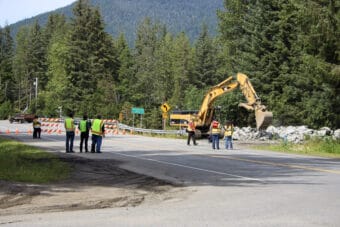
South Coast Region Director for the Alaska Department of Transportation Christopher Goins said a section of the Back Loop Bridge was lost during flooding. Crews are starting work on the repair tomorrow but they do not have a timeline for when the bridge will reopen.

Update, Friday 10:30 a.m.:

The 2025 Juneau Glacial Lake Outburst Flood Joint Information Center will hold a press briefing at 11 a.m. Tune in above.

Update, 2 p.m.:

The United Way is set up in Melvin Park in the Valley from 10 a.m. to 7 p.m. Thursday and Friday to help residents impacted by flooding with requests for volunteer help with everything from pulling out wet insulation to moving sandbags. They can also provide meals.

Update, Thursday 11 a.m.:

The 2025 Juneau Glacial Lake Outburst Flood Joint Information Center held a press briefing at 10:00 a.m.

Officials said the river level has fallen to around 5 feet. Back Loop Bridge is still closed after floodwater scoured part of the bank. The Alaska Department of Transportation says the bridge will remain closed while they asses the damage.

No residents lost access to drinking water during the flood and there are no pollution concerns, according to the Alaska Department of Environmental Conservation.

Officials also shared that 30 residents of Riverview Senior Living, which sits along the Mendenhall River, were evacuated during the flood to a local church. About 20 residents stayed with local friends or family.

As the damage assessment becomes more clear, local officials will provide more information on individual assistance on Friday.

Update, 3 p.m.:

Emergency officials issued an alert that the flood threat has ended and evacuated areas are now open to residents only.

Back Loop Bridge remains closed, but power has been restored to most of the affected area.

The river level has receded to minor flood stage.

Update, 10:15 a.m.:

The flood zone remains under an evacuation advisory, but Capital City Fire/Rescue Assistant Chief Sam Russell said during a press conference that emergency responders did not need to make any rescues overnight as waters levels rose. 

Ryan O’Shaughnessy, Juneau’s emergency manager, says AEL&P is starting to restore power to affected areas. He also said officials are continuing to assess the HESCO barriers. City officials say the barriers protected homes that would have otherwise been more severely damaged by record-breaking flood levels, even though some flooding still occurred. Damage is still being assessed. 

KTOO’s Clarise Larson shot this footage from Meander Way this morning.

Update, 9:30 a.m.:

The water level continues to drop on Mendenhall Lake and River. The current gauge level is 14.5, which means we remain in major flood stage. The National Weather Service says water is receding quickly and should reach minor flood stage later this afternoon.

Once again, the 2025 Juneau Glacial Lake Outburst Flood Joint Information Center will hold a press briefing at 10:00 a.m. KTOO will carry the briefing live on 360TV, on the radio and here via the livestream.

Update, 8:00 a.m.:

The National Weather Service has confirmed that the river crested at 16.65 feet a short while ago and water levels are now dropping.

Read the latest update here.

Update, 7:45 a.m.:

The 2025 Juneau Glacial Lake Outburst Flood Joint Information Center will hold a press briefing at 10:00 a.m. KTOO will carry the briefing live on 360TV, on the radio and via livestream.

“Today’s briefing will provide an update on the status of the flooding, actions taken by the Unified Command over the last 24 hours, as well as overview of planned next steps,” the media release states.

Update, 7:15 a.m.:

The City and Borough of Juneau wants residents to avoid driving on flooded streets.

The flood barriers continue to hold, but water is being observed seeping around them.

Onlookers watch as water seeps through a HESCO barrier on Riverside Drive near Melvin Park. (Eric Stone/Alaska Public Media)

Update, 6:30 a.m.:

AEL&P has cut power to parts of the Mendenhall Valley as flood waters continue to rise.

Update, 6:00 a.m. Wednesday:

The sun is up over the Mendenhall Valley as the water level on Mendenhall River currently stands above 16 feet — a new record for glacial outburst flood height in Juneau.

The river reached major flood stage around 1 a.m. and is still forecast to peak later this morning between 8 a.m. and noon. There are reports of water seeping under the temporary levee and water on some streets in the Valley.

Send any observations or pictures you’d like to share from your neighborhood to news@ktoo.org.

A KTOO webcam image shows water seeping below HESCO barriers along Meander Way shortly after 6 a.m. on Wednesday, Aug. 13, 2025. (Screengrab)

Update, 7:00 p.m. Tuesday:

The National Weather Service has updated its forecast for when the glacial outburst flood will crest. As of this evening, a crest somewhere between 16.25 and 16.75 feet is expected between 8 a.m. and noon Wednesday.

The initial flood forecast estimated a peak of around 16.6 feet on Wednesday afternoon.

Water levels are expected to go above major flood stage of 14 feet early Wednesday morning.

Update, 4:00 p.m. Tuesday:

The Juneau School District is canceling all extracurricular and school-sponsored events Tuesday and Wednesday.

The district is also closing Kax̲dig̲oowu Héen Elementary School, Mendenhall River Community School and Thunder Mountain Middle School at 4 p.m. today until the City and Borough of Juneau issues an all clear.

The district has not yet made a decision on closing schools on Thursday — the first day of school. It will make an announcement by Wednesday at noon. If any schools need to close, the district will close all campuses.

Update, 11:10 a.m. Tuesday:

During an 10 a.m. press conference, local officials shared public safety updates.

Nicole Ferrin, the warning coordination meteorologist at the National Weather Service in Juneau, said the record peak of 16.6 feet is expected sometime Wednesday afternoon. 

“This will be a new record based on all of the information that we have,” she said.

Ryan O’Shaughnessy, Juneau’s emergency manager, asked residents to stay away from the river and bridges. Backloop Bridge will close at 8:30 p.m. Tuesday. 

“This is a very dangerous situation,” he said.

On Monday, the city hung nearly 900 informational door flyers in Mendenhall Valley neighborhoods in the flood zone and launched a flood information hotline.

“There’s no need to rush out of neighborhoods, but we encourage folks to take a moment, take a deep breath, and remember that they have a plan,” O’Shaughnessy said. “This is something that we’ve been planning for as a community.”

Capital City Fire/Rescue Assistant Chief Sam Russell said emergency responses will become more difficult as the river rises. 

“As the flood goes up, our ability to navigate the waters goes down due to the debris that flows down through it makes navigating the river with a boat very, very difficult,” Russell said. “Please stay away from the river as much as possible.”

Update, 10:45 a.m. Tuesday:

The Juneau School District will make a decision on closing schools by Wednesday at noon. The district plans to close all schools if any campuses will be impacted by flooding.

Superintendent Frank Hauser said during a press conference Tuesday the district is requesting families update contact information in PowerSchool to ensure they receive the most recent updates from the district.

Update, 9:45 a.m. Tuesday:

Juneau’s glacial outburst flood has begun.

Just before 9:30 a.m. on Tuesday, the National Weather Service issued a flood warning and initial flood forecast of around 16.6 feet for Mendenhall River. That record peak is expected Wednesday afternoon.

This comes as the river is already in a minor flood stage due to significant rainfall over the past few days. The weather is expected to be dry Tuesday afternoon and Wednesday.

The forecast is subject to change. Typically it takes a day for the National Weather Service to see how fast the water is moving and adjust the forecast accordingly.

The City and Borough of Juneau issued an emergency alert via text that told residents in the flood zone that “evacuation is advised. Stay clear of rivers.”

An emergency alert sent to Juneau residents on Tuesday morning, Aug. 12, 2025. (Courtesy of Eric Stone)

An emergency evacuation shelter will be at Floyd Dryden Middle School later on Tuesday.

Update, 2:30 p.m. Monday:

City and tribal officials say they will begin hanging informational door flyers in Mendenhall Valley neighborhoods in the flood zone and launch a flood information hotline Monday afternoon.

The door hangars warn residents that the basin is full and that an emergency shelter will be available at Floyd Dryden Middle School once the flood begins. It also includes advice on how to protect property. 

Aaron Jacobs, the senior service hydrologist at the National Weather Service in Juneau, gave an update on Suicide Basin at a press briefing late Monday morning. Suicide Basin reached full capacity and began spilling over the top of the glacier Sunday night. 

“At this time there is no signs that the release has taken place,” he said. 

Ryan O’Shaughnessy, Juneau’s emergency manager, displays a flood informational door hangar at a press briefing on Monday, Aug. 11, 2025. (Photo by Clarise Larson/KTOO)

He said Monday’s rainfall will likely continue to raise water levels in Mendenhall River and Lake, which could affect the flood height once water does start releasing. But, he expects the precipitation to slowly drop off through Monday evening and into Tuesday.  

“I know there’s been some reports of a waterfall being seen at the face of the glacier, and that is what we’re seeing. There is just a general glacial flow in the runoff that we’re seeing from the precipitation and just the regular melt from the Mendenhall Glacier,” he said. 

Ryan O’Shaughnessy, Juneau’s emergency manager, said the city continues to advise people to prepare to evacuate. They have not issued a mandatory evacuation order, but officials highly recommend people leave once the flood warning is issued. This year’s flood will be the first test of the flood barrier the city installed this spring.

“We have a lot of confidence in the mitigation measures that have been put in place — that being said, this is not something that we want to gamble with,” he said. “The message to carry across please, is to ‘Yes, evacuate if you do get that notice.’”

The state’s Department of Transportation & Public Facilities is preparing for potential bridge and road closures along the river. Officials say when and where will depend on the height and timing of the flood. 

Original story: 

The countdown has begun for Juneau’s annual Glacial Lake Outburst Flood. Suicide Basin reached full capacity and began spilling over the top of the glacier Sunday night. 

That means flooding could begin any day.

The National Weather Service issued a special weather statement indicating that it could take up to six days for the basin to release floodwaters into Mendenhall Lake.

Once the water level in Mendenhall Lake begins to rise, the National Weather Service will issue a flood warning. From that point, it will take about 48 hours for the floodwaters to crest in the Mendenhall River. 

The City and Borough of Juneau issued an emergency text alert just after 8 p.m. that notified Juneau residents that the basin was overtopping. 

“Now is the time to make last-minute preparations, finalize evacuation plans, and pack a go-bag,” the alert stated. 

Aaron Jacobs, the senior service hydrologist at the National Weather Service in Juneau, said that the contingency forecast is a 16.5-foot flood — that’s subject to change. Jacobs said to check the Suicide Basin monitoring page for an updated forecast once the release begins and as it progresses. 

The contingency forecast is based on estimates that Suicide Basin has expanded compared to prior years and that the ice dam holding back the water is a bit lower. 

That forecast is also based on the past few days of increased rainfall, which have raised the water levels in the lake and river. Jacobs said the rain could affect the flood height if it doesn’t flow out to sea before the basin releases.

“So we’re hoping that the basin will not release at this time in the next day or so and then the Mendenhall levels can come back down to more normal levels,” he said. 

The city will issue another emergency text alert when the National Weather Service issues a Flood Warning. That will mean that the basin is releasing and the flood has begun. 

KTOO’s Alix Soliman, Clarise Larson, Adelyn Baxter and Jamie Diep contributed. 

Find the latest news on glacial outburst flooding and resources for how to prepare at ktoo.org/flood.

Governor issues preemptive disaster declaration for Juneau as Suicide Basin nears capacity

An image of Suicide Basin from the official webcam Sunday afternoon. (Courtesy of National Weather Service & USGS)

Gov. Mike Dunleavy issued a state disaster declaration Sunday in anticipation of a glacial lake outburst flood expected to hit Juneau’s Mendenhall Valley very soon.

That follows a preemptive disaster declaration issued Friday by the City and Borough of Juneau and the Central Council of the Tlingit and Haida Indian Tribes of Alaska.

According to the latest data, Suicide Basin — the glacial lake that is expected to unleash an outburst flood soon — is about to reach its full capacity. That capacity is the same or larger than the total water volume seen in prior years.

The annual release has been happening since 2011, but record-breaking outburst floods struck the Mendenhall Valley in August the last two years. Last year’s flood damaged hundreds of homes.

“Our goal is to act early to reduce impacts and preserve community safety,” Dunleavy wrote in the declaration.

Current reports from the National Weather Service estimate the basin will be full Monday, but a release can happen at any time.

Find the latest news on glacial outburst flooding and resources for how to prepare at ktoo.org/flood.

Juneau issues preemptive disaster declaration ahead of glacial outburst flood

Juneau City Manager Katie Koester, left, and the Central Council of the Tlingit and Haida Indian Tribes of Alaska’s first Vice President Kus.een Jacqueline Pata, right, answer questions during a press briefing at the Juneau Police Department on Friday, Aug. 8, 2025. (Photo by Clarise Larson/KTOO)

Juneau city and tribal officials announced a preemptive disaster declaration Friday in anticipation of the glacial outburst flood expected to hit the Mendenhall Valley soon. 

Ku.seen Jacqueline Pata is the Central Council of the Tlingit and Haida Indian Tribes of Alaska’s first Vice President. At a press briefing, she said declaring a disaster before the flood could expedite recovery efforts, such as financial aid applications with the state. 

“Being ahead of the curve really makes a big difference,” she said. 

The tribe has already ratified the declaration and the Juneau Assembly will hold a special meeting next Friday at noon to do the same.

The city and tribe have ramped up their communication with the public ahead of this year’s flood, compared to previous years. Ashley Heimbigner, the city’s communications and engagement director, said that’s a response to feedback from the public.

“For better or worse, we’ve had folks that lived through this last year, and they knew what information our residents were looking for, where we were lacking in terms of quick response with that information, and so it gave us sort of a workbook of how to do better this year,” she said.

Nicole Ferrin is the warning coordination meteorologist at the National Weather Service in Juneau. She says that Suicide Basin — the glacial lake that will soon release the flood — is nearly full. 

“Based on recent mapping by [University of Alaska Southeast] that were up there just a couple days ago, it has about 15 feet before it will be actually overtopping the ice dam,” Ferrin said at the briefing. 

She says that in the past, it has taken between one and six days for the flood to release out of Suicide Basin after water flows out over the top of Mendenhall Glacier. 

All agencies are on high alert because the basin can release at any time, no matter how full it is.

Outburst, Episode 1: The flood zone

Mendenhall Valley residents dry out their belongings following Juneau’s annual glacial outburst flood on Tuesday, August 6, 2024. (Clarise Larson/KTOO)

Hundreds of people in Juneau’s Mendenhall Valley are living on the front line of a climate change disaster they didn’t see coming. This is Outburst, the story of how glacial outburst flooding has escalated faster than human imagination – and public policies to protect people.

The KTOO newsroom and reporter Alix Soliman take you from the floodwaters to the glacier’s edge to uncover why the annual floods happen, how they got out of control and what can be done to keep Juneau safe.

On Aug. 6, 2024, many residents of Juneau’s Mendenhall Valley woke to freezing water rushing into their homes. Glacial outburst floods aren’t new to Juneau, but they’ve escalated dramatically in the last few years.

The first episode of Outburst unravels why so many people were surprised by the sudden severity of recent glacial outburst floods – and why Alaska’s capital city wasn’t prepared.

We’ll examine the science behind glacial outburst floods and how human psychology plays into policy.

KTOO’s Alix Soliman is our guide from flooded basements to assembly chambers and Juneau schoolrooms to understand how a disaster that’s been ramping up for years could shock people. KTOO reporter Clarise Larson cowrote this episode. 

Army Corps says permanent glacial outburst flood solution is years away, but patience is wearing thin

Erin Stockdale, Curtis Lee, Mike Records and Leif Hammes from the U.S. Army Corps of Engineers present the federal process to come up with a long-term flood protection solution for Mendenhall Valley on July 30, 2025. (Photo by Alix Soliman/KTOO)

Listen to this story:

As the next glacial outburst flood looms over Juneau’s Mendenhall Valley, around 200 residents filed into the Thunder Mountain Middle School auditorium last night to talk about a permanent solution. Officials from the U.S. Army Corps of Engineers said it’s years away. But residents in the flood zone said they need a solution sooner to feel safe in their neighborhoods.

Dominic Walsh’s home on Northland Street flooded last year. The temporary levee the city put up this year is meant to protect his home until there’s a permanent fix, but he doesn’t feel confident in that. 

“I don’t feel any safer with the HESCO barriers, maybe a little bit, but not really,” he said.

This is the first time the levee will be put to the test. Although city officials said they are confident the levee should work properly, they are urging residents in the flood zone to evacuate when the flood warning is issued. 

Walsh said he’s spent all year recovering from the last flood and preparing for the next one, and it’s challenging to imagine that he’ll be living with that anxiety for several more years while the federal process unfolds. 

Craig Loken lives on Emily Way, a street that got hit hard by the flood last August. He said the Army Corps’ slow approach is painful to watch.

“If it takes 10 years, there won’t be anybody left in the Valley to benefit from all these studies,” he said. 

His family has lived in the Valley for three generations. Loken said they are thinking about moving away, depending on how this long-term solution pans out. 

The Mendenhall Glacier and Lake are on federal land, so anything built there is under federal jurisdiction. The Army Corps is starting with a technical study to gather all of the physical data about the baseline conditions in the Valley. Congress allocated $4.75 million to the study and Army Corps officials said it will take a few years to finish.

That study will inform another report called a feasibility study. That’s where the Army Corps weighs each option and picks one. It could take another couple of years and millions of dollars more.

After that, engineers have to design the solution they pick, which can take another couple of years. Then the Army Corps has to build it.  

Leif Hammes is chief project manager in the civil works branch of the Army Corps in Alaska. During Wednesday’s meeting at Thunder Mountain Middle School, he explained that the building timeline depends on how big the project is, but that this is a top priority in his office. 

“We do look for ways to go faster, save time, get us there quicker, but from sort of where we are today to physical construction is multiple years — you know, six, seven, ten-ish years is not an unreasonable timeline,” Hammes said.  

Added together, Mendenhall Valley residents can expect a decade or more before there’s a permanent fix.

Hammes said that Army Corps staff can’t change the agency’s process because it’s grounded in federal laws. 

But Erin Stockdale, chief of the planning section at the Army Corps, told residents to speak up and tell their stories since Congress has the power to make things move quicker. 

“The ‘just build it’ avenue is not common, but I will say the squeaky wheel gets the grease,” she said. 

Lots of ideas were floated, including a tunnel through the ice, a lake tap at the bottom of Suicide Basin and a permanent levee. At this stage in the process, Hammes said the Army Corps isn’t ruling anything out yet. 

But one idea got more attention at the meeting than any other: a dam on Mendenhall Lake.

Dave Hanna has lived in Juneau his whole life. Although his place on Auke Lake isn’t in the flood zone, he said glacial outburst floods are the most devastating issue Juneau is facing. And he thinks a dam is a simple fix. He went up to the microphone and told the Army Corps as much.

“If you put a dry dam across the outlet of the lake, it would serve as a pedestrian bridge,” he suggested. “Find out what you’ve got to build on, and then figure out how to build it, because we can’t wait seven years.”

The crowd erupted into applause. Many residents agree with him.

Scientists are beginning to research other lakes farther up Mendenhall Glacier that might release outburst floods in the future. No one knows how big the risk is yet, but it could narrow down the options for a permanent solution. 

That’s a major reason Hanna is pushing for a dam. 

“Anything we do at Suicide Basin is probably not the correct thing to do, because it doesn’t address future basins,” Hanna said. 

Bob Deering lives along the Mendenhall River and is a retired engineer who once worked at the Army Corps. He thinks a dam is the only viable solution, and said that the process the agency laid out is too slow. 

“Frankly, it’s unacceptable,” he said. “I mean, everybody’s going through all this stress right now, with the flood, you know, looming above us, and we’re going to go through that for another 10 years?”

Suicide Basin is expected to be full around mid-August, but National Weather Service forecasters don’t yet know exactly when it will unleash the next flood. 

Find resources and the latest stories on glacial outburst flooding in Juneau here. 

Outburst: A new KTOO series coming this August

It’s been almost two years since Juneau’s glacial outburst flood got out of hand. 

On that August day, the water level rose swiftly on the Mendenhall River. That wasn’t unusual. Local experts had been tracking water levels in Suicide Basin — the glacial lake high up on Mendenhall Glacier that fills with rain and meltwater every summer — for years and gave ample notice of the annual release.

But unlike in previous years, the water level rose to nearly 15 feet.

“There is no comparison,” National Weather Service Meteorologist Nicole Ferrin told KTOO at the time. “We’re two feet over our last record.”

One unoccupied house crashed into the swollen river. Other homes had their foundations exposed by the eroded riverbank.

A house and condo buildings in the 4400 block of Riverside Drive hang precariously over the Mendenhall River after their foundations were eroded away during record high water from a glacial outburst flood on Saturday August 5th, 2023. (Mikko Wilson / KTOO)
A house and condo buildings in the 4400 block of Riverside Drive hang precariously over the Mendenhall River after their foundations were eroded away during record high water from a glacial outburst flood on Saturday, Aug. 5, 2023. (Mikko Wilson / KTOO)

The event caught everyone off guard, including those of us in the newsroom. Aside from some erosion and moderate flooding that threatened a few homes along the river, the annual outburst flood was in many ways more of a novelty up to that point.

The next year, the flood was even bigger and the consequences were much more serious. Hundreds of homes flooded when the river crested at 16 feet. 

KTOO Climate and Weather Reporter Anna Canny covered the aftermath of both record-breaking events. Last fall, she proposed a series examining the floods and secured funding from the Alaska Center for Excellence in Journalism to help make it happen.

KTOO reporter Anna Canny interviews emergency personnel along Mendenhall River during the August 2024 glacial outburst flood. (Photo by Clarise Larson/KTOO)

Now, as Juneau residents and officials prepare to take on a potential third year of flooding, our newsroom has a new series, Outburst, that takes stock of the evolving threat and efforts to keep residents safe.

Although Anna left Juneau at the beginning of the year to pursue new opportunities, this series would not have been possible without her. 

Climate and Environment Reporter Alix Soliman joined the newsroom in February and dove headfirst into flood reporting, picking up right where Anna left off. She’s reported extensively on the construction of HESCO barriers along sections of the river and preparations ahead of this year’s flood and hosts the series. 

ACEJ’s grant supported this four episode series, as well as outreach efforts to make sure information about the flood gets to the people who need it. Those included a community public safety barbecue this July and a set of maps that show the evolving course of the river, its flood paths and the recession of the Mendenhall Glacier.

Outburst premieres in early August. Find it here at ktoo.org/outburst, on the radio and wherever you get your podcasts.


Mendenhall Valley residents and local organizations gather to discuss glacial outburst flood preparation at Riverside Rotary Park on Thursday, July 17, 2025 for KTOO’s community barbecue. (Photo by Will Mader/KTOO)
Site notifications
Update notification options
Subscribe to notifications