Gardentalk

Gardentalk – Garlic harvesting

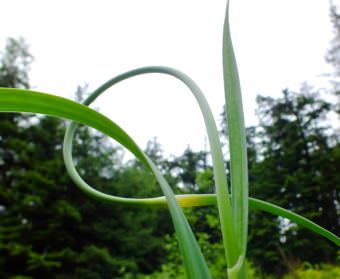
Garlic scape is all curled up in a North Douglas garden.
Garlic scape is all curled up in a North Douglas garden. (Photo by Matt Miller/KTOO)

Watch for the curl and then the uncurl. That’s what Master Gardener Ed Buyarski recommends while harvesting garlic this summer. He provided a primer during the latest edition of Gardentalk that airs Thursdays on KTOO’s Morning Edition.

The scape, or the bulbous top of the garlic stem, will curl up as the garlic plant’s lower leaves start turning yellow and dry out. When the scape straightens out and point up, then the garlic plant is ready for harvest.

Place the bulbs in a warm dry place to dry out.

Don’t wait too long to harvest garlic or the skin will begin to rot as it sits in the damp soil.

Garlic plants that show signs of mold or mildew on the bulb skin or the stem at ground level should be harvested as soon as possible and kept separate from the rest of your harvest. Remove any mold or mildew and wash your hands afterward. Use the cloves from those garlic plants as soon as possible.

Listen to July 20 segment about garlic harvesting and an upcoming gardening tour:


Gardentalk – Invasive species

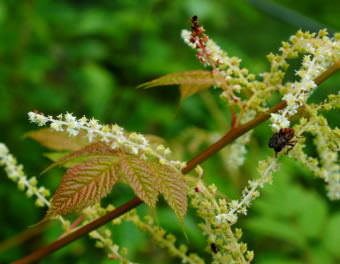
Uh, oh. This almost looks like Japanese knotweed that has a established a foothold in a North Douglas garden.
Uh, oh. This almost looks like Japanese knotweed that has a established a foothold in a North Douglas garden. (Photo by Matt Miller/KTOO)

In the latest segment of Gardentalk, Master Gardener Ed Buyarski briefs Juneau gardeners about some of the common invasive species that may crowd out vegetables and yard plants this season.

“Homeowners should at least try to control them if they are starting to sneak into their yards,” Buyarski said. “Because they can take over into lawns, into flower beds and other places.”

Orange hawkweed, reed canary grass and Japanese knotweed are some of the species that have been seen in the Juneau area.

Buyarski also warns about Irish moss, bishop’s weed, daisies, foxglove, lady’s mantel and sweet rocket, which sometimes can be found in retail nurseries or seed packets.

The U.S. Department of Agriculture has produced a small pamphlet on selected invasive species of Alaska that is available in some stores or online.

In some instances, pulling out the weed, bagging it up and sending it to the dump may be all that’s necessary.

But some species are especially tough and may requiring careful spraying or application of herbicide, vinegar or bleach.

For species that can sprout from seed or root fragments, Buyarski recommends covering the area with black plastic or plant fabric to kill off any buried root pieces.

Listen to the July 13 edition of Gardentalk about invasive species:

Gardentalk – Fungus among us

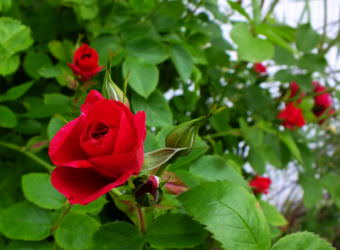
Horstmann roses bloom in the KTOO Agricultural Test Station and Garden of Science.
Horstmann roses bloom next to the KTOO building in downtown Juneau. (Photo by Matt Miller/KTOO)

In the latest segment of Gardentalk, Master Gardener Ed Buyarski explained how gardeners can keep fungus under control in a cool and damp environment.

“There are so many different kinds of fungus that live in the soil. The spores float off in the air,” Buyarski said. “Mushrooms, of course, are just the large fruiting bodies of this large fungus organism which is underground. (Of) what we see in the gardens, there’s a lot of powdery mildew which happens when right conditions of moisture and cool temperatures happen. It looks like white powder on leaves. Salmonberries have it. I’ve seen it on strawberries.”

Another form of fungus called gray mold can be found in our garden or greenhouse. Apple scab can be found on apple trees.

When it comes to fungus-infected leaves and stems, Buyarski said simply trim them off and throw them in the trash. Do not put the fungus infected trimmings in your compost.

A homemade spray solution also can work as a safe and cheap alternative to a commercial fungicide. Mix 1 to 2 tablespoons of baking soda and a couple drops of liquid soap in a quart of water. Spray the both the underside and tops of fungus infected leaves and stems.

Gardeners also can thin and trim back crowding plants or overgrown branches to encourage circulation and prevent fungus.

Listen to the June 6 edition of Gardentalk:

Gardentalk is a weekly feature that airs every Thursday morning on KTOO’s Morning Edition program during the spring and summer. You can sign up for the podcast or ask your own question for gardening help by going to the Gardentalk archive page.

Gardentalk – Garlic scapes and cabbage root maggots

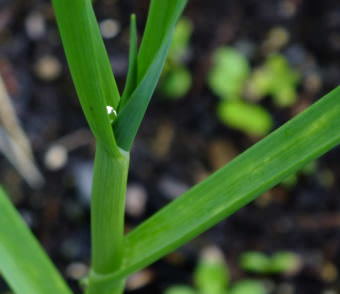
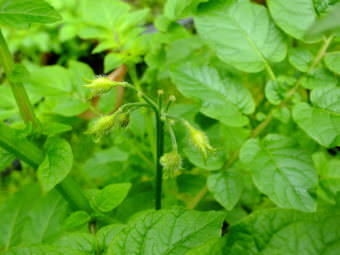
No scape yet: Close up view of garlic as it continues growing in a North Douglas garden.
No scape yet: Close-up view of garlic as it continues growing in a North Douglas garden. (Photo by Matt Miller/KTOO)

In this week’s edition of Gardentalk, Master Gardener Ed Buyarski reminds us about removing garlic scapes.

Much like the deadheading of flower bulbs that was covered in last week’s segment, Buyarski explains that clipping the emerging top bud or scape of a hardneck garlic plant sets aside more energy for the garlic bulb’s development.

Just don’t throw the scapes out after you clip them off. They’re edible. Buyarski’s favorite uses include as part of a salad, stir fry or as the main ingredient in a pesto.

Cabbage root maggot infestation is underway in Juneau

Buyarski also warns that manual removal of cabbage root maggots may be the only safe and effective way to remove the pests. They could be one-quarter-inch long and clinging to the remains of the roots of wilting cabbage, broccoli, kale or radishes.

“We want to remove these, harvest them, get them out of the ground,” Buyarski said. “Dig up some of the soil. Try to get rid of the root maggots that are left that may have fallen off.”

To prevent reinfestation, Buyarski recommends burning the soil or sealing it up securely in a plastic bag and then getting rid of it at the dump.

Listen to the June 29 edition of Gardentalk:

Gardentalk is a weekly feature that airs every Thursday morning on KTOO’s Morning Edition program during the spring and summer. You can sign up for the podcast or ask your own question for gardening help by going to the Gardentalk archive page.

Gardentalk – Deadheading and division

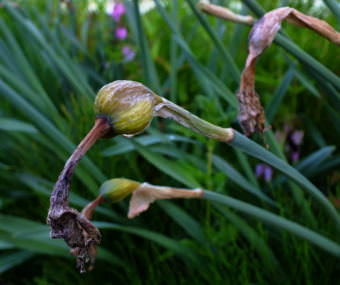
Close up view of daffodils in a North Douglas yard that disparately need to be deadheaded.
Close up view of daffodils in a North Douglas yard that disparately need to be deadheaded. (Photo by Matt Miller/KTOO)

Flowers and blooms from this spring’s annuals and bulbs are probably looking pretty pitiful by now. Beside just aesthetics, it’s also a good idea to start deadheading or cutting off the seed pods and wilted blooms of some plants.

As Master Gardener Ed Buyarski explained in the latest edition of Gardentalk, deadheading allows bulbs and plants like fuschias or rhododendrons to devote their energy to perpetuation instead of propagation.

“That takes a lot of energy from the plant which can be better put into growing more roots,” Buyarski said. “Or, with the annuals, it will tell them ‘we got to keep flowering so can make seeds to survive because we’re going to die in October or maybe earlier.'”

Buyarski also reminds Southeast gardeners that it’s still a good time to divide primoses and primulas. Rhubarb and other perennials like the trollius or the globeflower, which bloomed early, also can be divided now.

“I have people who watch me divide a perennial and they think I am sorely abusing that poor plant,” Buyarski said. In most cases, a well-placed sharp shovel or spade can do the trick. If you decide to dig out the plant first, then a hatchet may be necessary to split up the plant and its roots.”

“We want to keep several of those growing points together with a good clump of roots that we will then replant,” Buyarski said.

Mix in some compost or better soil before replanting.

Listen to June 22 Gardentalk segment about deadheading and dividing:

Gardentalk is a weekly feature that airs every Thursday morning on KTOO’s Morning Edition program. You can sign up for the podcast or ask your own question for gardening help by going to the Gardentalk archive page.

Gardentalk – Young fruit tree care and feeding

Master Gardener Ed Buyarski has just one word for gardeners with a new cherry tree. It’s patience.

In this week’s edition of Gardentalk, Buyarski has some tips for caring for fruit trees, both young and old.

“If we’ve got new young trees, we don’t want those trees to have too much fruit,” Buyarski said. “It can literally stunt their growth or can kill the tree because it takes so much energy for the tree to grow and ripen fruit.”

Buyarski said young fruit trees up to two years old should be allowed to grow a strong root system. They should also be pruned for shape and to encourage a strong branching structure.

Listen to June 15 edition of Gardentalk about fruit trees:


Fertilize your fruit tree with compost, seaweed, fertilizer or fruit tree spikes placed around base of tree along the drip line.

Water your fruit tree well.

Place landscaping fabric, mulch, wood chips or cardboard around the base of the tree to keep the weeds down.

Four-foot high wire fencing placed in a circle around the tree will make it difficult for hungry porcupines and deer.

In Southeast Alaska, Buyarski said cherries should be ripe in late July through early August. Apples should be ripe at the end of August through October.

Site notifications
Update notification options
Subscribe to notifications