Gardentalk

Gardentalk – Getting started now with seeds indoors

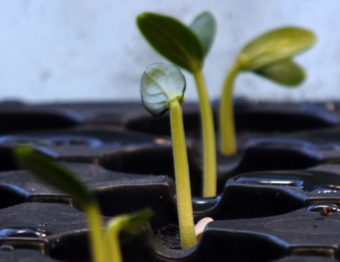
Cucumber seedling
These cucumber seed starts will be ready for planting outdoors when the ground warms up. For some locations around Juneau, especially in the Mendenhall Valley near the Mendenhall Glacier, the last frost can occur as late as Memorial Day. (Photo by Matt Miller/KTOO)

There may still be snow on the ground in parts of Juneau, but it’s certainly not too soon to begin gardening.

In this season’s first edition of Gardentalk, a weekly “Morning Edition” segment and podcast devoted to garden and yard care in Juneau, Master Gardener Ed Buyarski encourages us to prepare our seed starts.

Starting seeds indoors is a good way to get an early jump on the gardening season, especially if the ground is still frozen or it’s still too cold outside.
Listen to the March 15 edition of Gardentalk:

Vegetables with a long growing season and a preference for warm conditions — like tomatoes — are an obvious choice for starting now.

Peppers, eggplants, onions and leeks can all be started from seeds now. Buyarski said he’s also starting herbs like cilantro, basil and parsley.

But Buyarski said it ultimately depends on the different timing of each vegetable. He suggests checking the seed packet for the typical period between starting and then transplanting outside in a warm greenhouse or after the last frost.

“I don’t start something too early so they get too large under my lights before they go (outside),” Buyarski said.

He also advises using fresh potting soil and clean pots for your starts.

Do you have a question for Master Gardener Ed Buyarski about gardening or yard care? Then go to our archive page where you can pose your question in the form on the right. You can also browse through previous seasons’ Gardentalk segments.

Gardentalk – Season finale

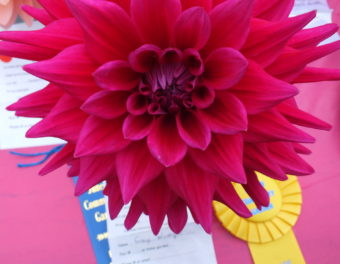
Dahlia (Photo by Matt Miller/KTOO)
An award-winning dahlia blossom as it appeared during the 2015 Harvest Fair at the Juneau Community Garden. (Photo by Matt Miller/KTOO)

In the final edition of Gardentalk for the 2017 season, Master Gardener Ed Buyarski provides some advice for fall and winter care of begonias, dahlias and fuschias.
If you haven’t done so, you should bring in those plants to your garage or some other cool, dry place before it gets too frosty overnight.

For dahlias, trim the browning tops and cut back the stems so they are short, only a few inches long. Carefully pull them out of the pots or ground, and rinse off the tubers in a cardboard box or paper bag and leave in a place with 40 to 50 degree temperatures.

For begonias, snap off the tops and let them dry out before you store the tubers like the dahlias.

Buyarski said it’s a good idea to label the variety and color of each bag as you put them into winter storage.

For fuschias, remove the leaves and trim them back the stems to 4 to 8 inches tall. Leave the plants in their pots and store in the garage or a crawlspace that doesn’t freeze during the winter. Check up on your fuschias and water them throughout the winter if they start getting dry.

Listen to the season finale of Gardentalk about begonia, dahlia and fuschia care:

Upcoming gardening events include the 4th Annual Garlic Lovers Potluck at the Canvas, Sunday, Oct. 22 from 4 p.m. to 6:30 p.m. that may include workshops and planting garlic for sale.

There’s also a gardening conference scheduled or February in Haines that will feature garden writer Jeff Lowenfels.

Gardentalk – Clean up and garlic planting prep

A whale of a potato harvest: A North Douglas gardener harvests his potato crop on Thursday. It's unclear why so many potatoes grew into the shape of marine mammals, but it likely has to do with the particular variety of fingerling potatoes. All of these potatoes will go into temporary storage unwashed since their skins are so thin and delicate.
A whale of a potato harvest: A North Douglas gardener harvests his potato crop on Thursday. It’s unclear why so many potatoes grew into the shape of marine mammals, but it likely has to do with the particular variety of fingerling potatoes. All of these potatoes will go into temporary storage unwashed since their skins are still so thin and delicate. (Photo by Matt Miller/KTOO)

The summer gardening season may be winding down, but many gardeners may be busy preparing for planting this fall and next spring.

In this week’s edition of Gardentalk, Master Gardener Ed Buyarski advises gardeners to finish harvesting late season vegetables and begin cleaning up garden beds and planters, especially if they will be used for planting garlic in October.

Vegetables like carrots and beets could stay in your garden if they are still growing, but old lettuce and Swiss chard should come out before they become prime habitat for slugs.

For those harvesting potatoes and vegetables from the cabbage family, put the discarded plants and roots out in the garbage to be taken to the landfill.

Do not put the remains in your compost or your garden may be overrun with a root maggot infestation next year.

For those planting garlic, line the bottom of your planter with spawned out salmon or another compost of your choice. Break the bulbs apart into individual cloves and plant the cloves six inches apart and two inches deep. Don’t forget to plant the garlic clove with the pointy end up. Cover with soil, seaweed and a layer of clear plastic for the winter.

Listen to the Sept. 28 edition of Gardentalk:

Gardentalk is a weekly feature that airs every Thursday morning on KTOO’s Morning Edition program during the spring and summer. You can sign up for the podcast or ask your own question for gardening help by going to the Gardentalk archive page.

Gardentalk – Scabby potatoes

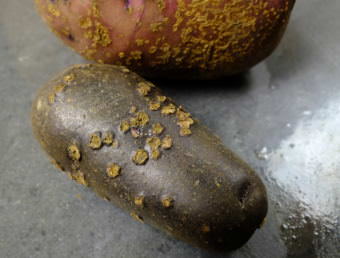
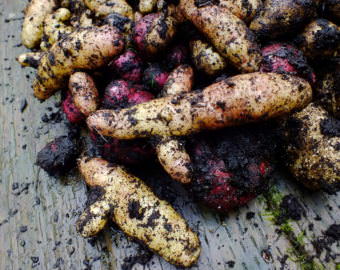
Master Gardener Ed Buyarski harvested these potatoes of the Caribe and Magic Molly varieties which suffered from potato scab. (Photo by Matt Miller/KTOO)

Got scab? You could still salvage this season’s potatoes, but you should peel off the scab and eat the potatoes immediately.

They won’t keep very well in your root cellar.

You also need to be careful about propagating and perpetuating the fungus that causes potato scab.

In this week’s edition of Gardentalk, Master Gardener Ed Buyarski provided some tips and hints for mitigating potato scab, including not planting seed potatoes in the same infested garden plot next year.

Listen to the extended version of the September 22nd segment of Gardentalk:

In the longer podcast version of Gardentalk which you can listen to above, Buyarski explains how to carefully harvest potatoes, techniques to harden or age potatoes before harvest, and setting aside small seed potatoes for next season’s planting.
Gardentalk is a weekly feature that airs every Thursday morning on KTOO’s Morning Edition program during the spring and summer. You can sign up for the podcast or ask your own question for gardening help by going to the Gardentalk archive page.

Gardentalk – Peony division and planting

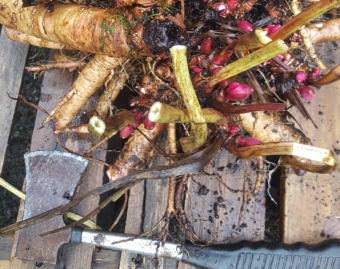
Get the hatchet for dividing peonies. (Photo courtesy of Ed Buyarski)

Peony is a large and tall perennial with fragrant and beautiful blooms. They can live as long as 50 years and are well suited for growing in Alaska’s climate.

In Alaska, peonies usually bloom in early summer, much later than elsewhere in the northern hemisphere. Because of that delay, Master Gardener Ed Buyarski said Alaska’s commercial gardeners have been able to capitalize on demand in the peony market.

White and pink peonies, for example, are very popular for use during weddings, while Buyarski said red peonies are preferred in East Asia.

In this week’s edition of Gardentalk, Buyarski has some tips for dividing and replanting peonies.

“This is the perfect time for planting them, just like with bulbs,” Buyarski said. “We get them planted now and into October before the ground freezes and they start to establish roots.”

For those gardeners who already have peonies growing into large clumps in their yard, Buyarski recommends digging them up, hosing them down to wash off the soil, and using a hatchet to cut and separate each clump’s roots. Divide up the plant so that each tuber or gnarly root section has at least two to five buds.

“Just my normal knives wouldn’t cut them,” Buyarski said.

Buyarski recommends digging holes that are 8 to 10 inches deep, and sprinkling in some fertilizer at the bottom. Plant each newly divided peony so the buds — which will remain dormant over the winter — are right at the soil surface. After filling in most of the hole with soil, you can top with sand or pea gravel to help with drainage.

Listen to the September 14 segment about peonies:

Gardentalk is a weekly feature that airs every Thursday morning on KTOO’s Morning Edition program during the spring and summer. You can sign up for the podcast or ask your own question for gardening help by going to the Gardentalk archive page.

Gardentalk – Stock up on bulbs

Bulbs ready for planting.
Bulbs ready for planting. (Photo by Matt Miller/KTOO)

If you buy any of the bulbs that have recently arrived in Juneau stores, don’t plant them yet.

“If we plant too early, the bulbs can get enough of the cool conditions they need to start sprouting and they may sprout too early,” said Master Gardener Ed Buyarski. He recommends putting bulbs in a cool — but not too cool — dry place like a garage or a basement for a month before it’s time to plant them. Don’t refrigerate them.

Buyarski also said local deer like to munch on tulips and crocus as a tasty treat. He recommends planting them inside a fenced-off area or where deer cannot get to them.

When it’s time for planting, dig a trench or series of holes about 8 inches deep and sprinkle in bulb food or fertilizer. Read the bulb packages for spacing and sun requirements.

Buyarski said you could also layer bulbs vertically in the soil according to their expected sprouting times during the season. For example, small early season bulbs can be planted on top of mid- or late season bulbs like tulips or daffodils.

Listen to the September 7 segment about bulbs:

Gardentalk is a weekly feature that airs every Thursday morning on KTOO’s Morning Edition program during the spring and summer. You can sign up for the podcast or ask your own question for gardening help by going to the Gardentalk archive page.

Site notifications
Update notification options
Subscribe to notifications