Gardentalk

Gardentalk — Your vegetables, flowers thank you for your support

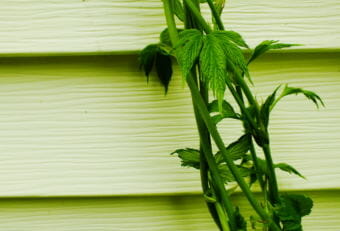
A hops plant winds around and climbs up a portion of a wire trellis in a North Douglas yard. (Photo by Matt Miller/KTOO)
A hops plant climbs up a portion of a wire trellis in a North Douglas yard. (Photo by Matt Miller/KTOO)


Some vegetables and flowers may need a little extra reinforcement as we nurture and care this season.

In the latest edition of Gardentalk, Master Gardener Ed Buyarski suggests creating a trellis to help them reach for the sun and stay dry.

“We have to provide something for them to climb on so they’re not just flopping on the ground, and their fruit or vegetables, whatever parts that we want to eat aren’t instead being eaten by the dreaded slugs,” Buyarski said.

Propping up plants also helps with air circulation, which mitigates mold and mildew issues.
Tomatoes, peas, beans, cucumbers, raspberries and kiwis benefit from a trellis to hold them up or keep them from falling over.

Flowers such as peonies, monkshood and delphiniums also need some support.

“It seems like the timing of opening their blooms and tall flower spikes seems to coincide with rain and a windstorm, and then over they go,” Buyarski said.

A simple trellis might include sinking unstripped alder branches into the ground or running a string or wire between old posts, he said.

Tomato cages found in local retailers can also be used for peas, cucumbers and peonies.

Recycled gill net or seine webbing also can support plants that climb or may have heavy vegetables or flowers.

Buyarski suggests checking with the harbormaster or looking through the recycle bins down at the docks.

However, such netting may trap robins and other unwary birds, he cautions.

Listen to the June 7 edition of Gardentalk about trellis construction:

Gardentalk — When it comes to pollination, some plants need help

A bee gets dusted with pollen in a Ketchikan flower bed.
A bee gets dusted with pollen in a Ketchikan flower bed. (Creative Commons photo by gailhampshire)

Many perennials, vegetables and trees are already blooming.

In this week’s segment of Gardentalk, Master Gardener Ed Buyarski explains some basic pollination concepts and techniques.

“We don’t really care about the carrots having sex,” Buyarski said. “But we really do (care) about the zucchinis, the apples and the cherries.”

For apples, Buyarski said cross-pollination from another variety is best.

“We can’t just plant two yellow transparents,” Buyarski said. “We need two different varieties.”

Buyarski said pie cherry trees are self-fertile, but sweet cherries — like apples — need a different variety for pollination.

For manual pollination of zucchinis and other members of the squash family, Buyarski recommends first identifying the male and female flowers of each plant. Female flowers usually have a small zucchini attached to it.

“Pollen needs to be moved from the male flower over to the female flower,” Buyarski said.

He suggests tearing off a male flower’s petals and dabbing the male stamen with the pollen onto the female flower’s pistols.

Cucumbers and tomatoes are common examples of self-fertile plants that do not need any bees to do the work.

“Just shaking the plant when they are flowering is enough and moves the pollen within itself, within that one flower,” Buyarski said.

He also has tips for identifying kiwi plant gender, which is important for moving pollen from a male kiwi plant to a separate female plant.

Female kiwi plants can be identified by the small white fruitlets forming under the pistol inside the flower while male plants, instead, have yellow stamens and more colorful pink and white leaves.

Listen to the May 31 segment of Gardentalk about pollination:

Gardentalk – Starting saps and sprouts to sculpture and stabilize soggy soil

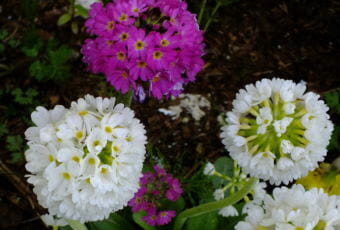
Primrose bloom in a North Douglas flower bed.
Primrose bloom in a North Douglas flower bed. (Photo by Matt Miller/KTOO)

Landscaping in Southeast Alaska’s rainforest might seem downright daunting for novice gardeners or recent transplants who are not used to the nearly year-round precipitation.

Poor drainage can also inhibit the growth of some perennials, bushes, and trees.

“If we can’t drain it away, then let’s plant something in it,” says Master Gardener Ed Buyarski. “To beautify it. To make it look nicer.”

He says there are plenty of varieties that grow well in soggy soil, including wild and Siberian iris.

Ligularia and primrose – especially some of the red, orange, and yellow varieties – are also well-suited to growing in damp conditions.

“A lot of these are later blooming to give us more color longer in the season,” Buyarski says.

Highbush cranberry, red twig and yellow twig dogwoods, cottonwood, and golden willow are common shrubs and trees that can stabilize a stream bank while also pulling in water and drying out an area.

“You take cuttings of these and just stick them in those damp areas and their roots will spread,” Buyarski says.

In most cases, Buyarski says it’s not required to supplement your planting area with gravel or sand to improve drainage. Compost may be all that is necessary.

Listen to the May 24 edition of Gardentalk:

Gardentalk – Mulch it!

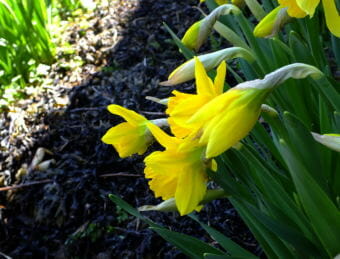
Daffodils bloom in a North Douglas flower bed lined with seaweed mulch.
Daffodils bloom in a North Douglas flower bed lined with seaweed mulch. (Photo by Matt Miller/KTOO)

It’s not just the bulbs and vegetables that are sprouting. Weeds are also making a comeback. One way to slow them down or preclude their growth is by laying down adequate mulch.

Master Gardener Ed Buyarski says several types of mulch can do the trick:

  • Bark or wood chip mulch placed around rhododendrons and other plants release nutrients as they decompose and keeps the soil acidic
  • Layers of recycled newspaper or cardboard can inhibit grass or weed growth for a prospective garden plot or  placement of a planter
  • Seaweed mulch releases nutrients as it decomposes and the salt keeps slugs away
  • Heavy duty landscaping fabric or woven plastic create permanent layers of ground cover
  • Gravel mulch, usually placed on top of landscaping fabric or plastic, is useful for landscaping and lining garden paths

Listen to the May 17 segment of Gardentalk about mulch.

Gardentalk — Mounting best defense against root maggot attack

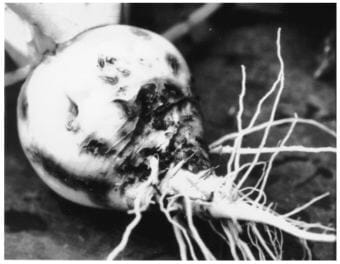
Damage to a turnip caused by root maggot larvae is shown in this image from a UAF Cooperative Extension Service flyer. Note the scars of surface feeding and entrances to feeding tunnels within the root.
A UAF Cooperative Extension Service flier shows damage to a turnip caused by root maggot larvae. Note the scars of surface feeding and entrances to feeding tunnels within the root. (Courtesy UAF Cooperative Extension Service)

A perennial Juneau garden pest is back.

Root maggot larvae are just waiting for this month’s warm weather before worming their way into Juneau gardeners’ vegetables.

Master Gardener Ed Buyarski said the larvae attack the roots of cabbage, radish, kale, rutabaga, cauliflower, broccoli and turnips.

In warm weather, their leaves wilt because their damaged roots cannot pull up enough moisture. Root maggot larvae burrow into the roots and leave tell-tale holes and tracks.

Buyarski said the best way to ward off root maggots is encircling your vegetables with Remay or another landscaping fabric with slits cut to allow a transplant or seedling to grow through while also preventing flies from laying eggs at the base of the plant. Buyarski also is experimenting with human hair clippings.

Listen to the May 10 edition of Gardentalk:

The UAF Cooperative Extension Service has a flier on root maggot which you can read here.

Gardentalk — Practice pruning patience with more resilient species

Hold on! This alder may show some cold damage on the lower portion of its branches, but it is budding with new growth and appears in overall good health.
Hold on! This alder may show some cold damage on the lower portion of its branches, but it is budding with new growth and appears in overall good health. (Photo by Matt Miller/KTOO)

Rhododendrons, and pine and cedar trees may have suffered damage from this winter’s cold temperatures and relatively low snowfall.

Master Gardener Ed Buyarski urges patience before pruning away any apparent damage. Some species are fairly resilient and will likely rebound later this spring.

With frost penetrating so deep into the soil over the winter, some trees and plants had difficulty pulling up moisture.

“Rhododendrons, their leaves will droop and curl (while) trying to conserve moisture,” Buyarski said.

Many rhododendron leaves or spruce needles may look brown and ugly right now

Buyarski advises waiting until end of May to see whether any budding or sprouting occurs. If new buds appear, then gently pull off dead or dying leaves.

Get out the pruning shears when the damage appears to be extensive and permanent.

Listen to the May 3 edition of Gardentalk:

Site notifications
Update notification options
Subscribe to notifications