Gardentalk

Gardentalk – How to protect your veggies from the coming frost

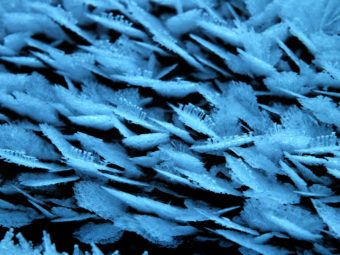
Hoar frost accumulates on grass, leaves and other vegetation in this picture taken on Douglas Island in November 2014.
Hoar frost accumulates on grass, leaves and other vegetation in this picture taken on Douglas Island in November 2014. (Photo by Matt Miller/KTOO)

Overnight temperatures in Juneau this weekend are expected to dip down into the 30s, perhaps even under freezing in wind sheltered areas in the Mendenhall Valley.

Master Gardener Ed Buyarski explained during a recent edition of Gardentalk how gardeners can protect their tender vegetables and plants from the effects of freezing temperatures.

One option includes bringing potted plants into a garage or other protected space.

Alternatives for garden plots include gently covering plants with old blankets or cardboard boxes. That will provide insulation for retaining heat close to the soil.
If you initially started some of your vegetables with hoops and later removed them, then Buyarski advises replacing the hoops before the temperatures drop.

Other option is to place buckets or milk jugs of water in various locations around your garden or in your greenhouse. The water will slow the freezing process.

Buyarski said that’s why orchardists or commercial growers spray water on their trees and plants in the early evening to prevent them from freezing overnight.

He discourages using single layers of plastic to cover vulnerable plants since it doesn’t have any real insulating value.

Listen to the Sept. 6 edition of Gardentalk about frost protection:

Buyarski said carrots, cabbage and potatoes are some of the more hardier vegetables that can either withstand frost or their sugar content will actually increase with cool temperatures. But squash, cucumbers and tomatoes are sensitive to cold.

For annuals like begonias, geraniums and fuchsias, Buyarski said hanging pots may fare better compared to those sitting on the cold ground in the middle of the yard. But the sheltered ground next to the house may offer more warmth and better protection.

Gardentalk – How to collect your own flower and vegetable seeds

Seeds
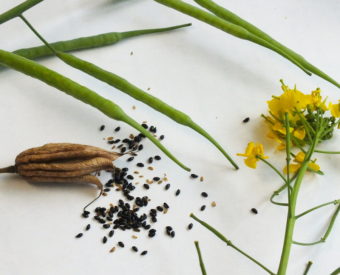
Kale, columbine and mustard seed pods selected from the KTOO Agricultural Test Station and Garden of Science! by Ed Buyarski. (Photo by Matt Miller/KTOO)

Many vegetables and flowers are now releasing their seeds as part of their usual propagation cycle.

In this week’s edition of Gardentalk that airs every Thursday morning on KTOO, Master Gardener Ed Buyarski describes how to create your own seed bank or collecting seeds for your own use.
“Collection time essentially is now,” Buyarski said, noting that some varieties can be collected as late as early fall. “I can collect some as late as October (and) November, like wild iris because the pods hold the seeds very well and they don’t shed out that quickly.”

Using columbine as an example, Buyarski explained that the stems to the seed pod may turn brown before the pod top opens, revealing the seeds inside.

Gardeners also can collect primrose and lupin seeds in a similar fashion.

For gardeners who want more control of the seed release timing, Buyarski recommends bringing the stem indoors and placing it in a vase with water.

As for vegetables, Buyarski said many are biannual and will only flower and go to seed in the second year if they survive the winter.

Buyarski usually plants kale in the late summer so they will drop the seed during the following summer. He also leaves a few spinach plants to ripen and turn brown before he collects the seeds.

Listen to the Aug. 24 edition of Gardentalk about seed collecting:

The Food Festival is from 9 a.m. to 1 p.m. Saturday, Aug. 25, at the JACC in downtown Juneau.  There will be fresh produce, garlic, and jams and jellies for sale. Workshops also will be held on a variety of gardening and preservation topics.

Gardentalk – Great Alaska Slug Hunt: Fight back against invading mollusks

No, thanks. I'll pass.
An invading slug checks out the beer trap, but then moves on without falling for it. The beer may have been diluted or washed out by recent heavy rains. After posing for this photo, the slug was exterminated when it was picked up by a human and dropped into the refreshed beer trap. It didn’t feel any pain. (Photo by Matt Miller/KTOO)

Southeast Alaska’s August rains always seem to signal a spike in the resident slug population, which usually leaves its mark by devastating and devouring the leaves of garden vegetables.

Master Gardener Ed Buyarski, in his annual slug extermination edition of Gardentalk, reminds gardeners that the best measure to prevent a slug onslaught is simply cleaning up the yard and garden.

Remove any dead or dying vegetation and clean up debris, which provides great hiding places for the slugs.

For those slugs that still hanging around and feasting on your leafy greens, various types of slug bait are usually available at hardware or gardening supply retailers.

Depending on the compound’s main ingredients, they may be slow-acting or be very toxic to pets and wildlife.

A diluted ammonia solution will kill slugs while providing an extra fertilizer for plants.

Salt or salt water usually is an effective deterrent.

Beer traps also work well.

Pick up a few cans of mass-produced swill (no craft beer or homebrew unless it’s gone skunky) and pour it into cups set into the garden soil.

The lip of the cup should be even with the soil so that slugs — attracted by the beer — will fall into the cup and die a happy death.

Bottles with a little beer remaining and placed on their side in the garden will also attract and trap slugs.

Protect the traps from any rain that may dilute the beer.

Buyarski actually prefers more practical and immediate methods of exterminating slugs, like squishing them between a pair of bricks.

Listen to the Aug. 9 Gardentalk segment about sacrificing slugs to the gardening gods:

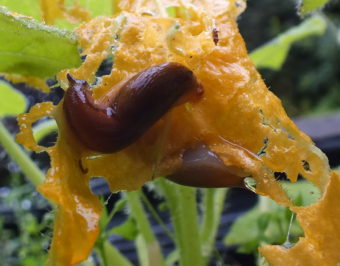
Eew! - A pair of slugs attack a squash blossom during a break in the summer rains. The devastated flower was removed and both slugs died a horrible, horrible death moments after this picture was taken.
Eww! – A pair of slugs attack a squash blossom during a break in the summer rains. The devastated flower was removed and both slugs died a horrible, horrible death moments after this picture was taken. (Photo by Matt Miller/KTOO)

Gardentalk – When home improvement projects require emergency tree and shrub care

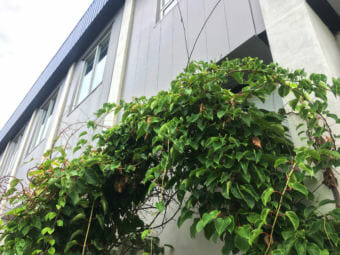
Fortunately, painters could easily work around this kiwi plant at the KTOO Agricultural Test Station and Garden of Science! Otherwise, it would have been cut back.
Fortunately, painters could easily work around this kiwi plant at the KTOO Agricultural Test Station and Garden of Science! Otherwise, it would have been cut back. (Photo by Matt Miller/KTOO)

Things don’t always happen according to plan and sometimes things happen unexpectedly — requiring homeowners to engage in emergency yard care.

In this week’s edition of Gardentalk, Master Gardener Ed Buyarski recalls how two Juneau residents are currently being forced to trim or transplant trees and shrubs to make room for contractors hired for home improvement projects.

Buyarski describes what’s happening and his solution for each dilemma.

In the first instance, a mature apple tree is located on the edge of a property and right inline of a new fence that will be built next week.

Buyarski said he will prune the top branches before digging out the tree.

Next, he’ll trim the roots, dig a new hole for the tree’s new location, and layer compost on top of the root ball during replanting.

The tree should be heavily watered in its new location.

Buyarski said it will also be staked up so that it won’t fall over before the roots regrow and the tree re-establishes itself.

“This is not the ideal time for moving trees,” Buyarski said. “At least it’s not hot and dry like earlier.”

In the second instance, work on a house’s siding and installation of new windows will require the homeowner to either remove or severely trim back bushes so the contractor can gain access to the side of the house. A 9-foot-tall rose bush, for example, was trimmed back to only 18 inches.

“It may end up getting dug up yet because a deck is going to go over it,” Buyarski said.

Other shrubs and small trees close to the house will be temporarily bent or pulled away from the house with ropes until the contractor finishes his work.

A hole may be left in that new deck to allow another bush to continue growing without being transplanted.

For some homeowners, Buyarski warns bushes that climb up the side of a house may accumulate moisture and accelerate rot in wooden siding and the foundation footings.

Listen to the August 17 segment of Gardentalk:

Buyarski also reminds gardeners that the annual Harvest Fair and Farmer’s Market is Saturday, Aug. 16, at the Juneau Community Garden. Judging of vegetables, flowers, and preserves starts at 10:15 a.m.

Gardentalk – Thyme for a deep chive featuring sage advice; homegrown herbs are a big dill for cooks

Even prolific weeds cannot crowd out these chives and prevent them from returning year after year in a North Douglas garden.
Even prolific weeds cannot crowd out these chives and prevent them from returning year after year in a North Douglas garden. (Photo by Matt Miller/KTOO)

What is an Alaskan chef to do if they need fresh herbs for their latest dish?

Harvest from their own garden or check their freezer, of course.

Fresh, homegrown herbs such as sage, rosemary, thyme, cilantro, chives, dill, basil, tarragon and oregano can really add that extra pop to any dish.

In a recent edition of Gardentalk, Master Gardener Ed Buyarski provided a short primer on growing and preserving herbs.

Dill and cilantro are a few herbs that are easy to grow.

But most herbs — like thyme, sage, rosemary and oregano — are very slow to start from seed, and Buyarski suggests buying new plants in the spring or dividing up existing plants.

Listen to the Aug. 8 segment about growing and preserving herbs:

Buyarski notes that some herbs retain their flavor and aroma best depending on whether they are frozen or dried.

“Cilantro loses its flavor when it’s dried,” Buyarski said. “But dill is terrific when it’s dried. Basil, likewise, you almost have to freeze it to keep that.”

Chives and tarragon should be frozen rather than dried to retain their flavor. Oregano, on the other hand, is best fresh and it dries well.

Buyarski recommends growing plants indoors with lights if you want fresh herbs all year-round.

“If you’ve got a light set up, then you can keep them going all winter and you can continue to harvest from them during the winter when it’s more of a challenge to get fresh herbs,” Buyarski said. “That’s a great thing.”

Buyarski has been growing a single rosemary plant indoors in a 5-gallon pot for the past five years.

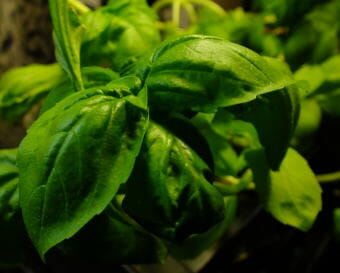
This hydroponically-grown basil plant is still enormously productive even though it was started from seed nearly two years ago.
This hydroponically grown basil plant is still enormously productive even though it was started from seed nearly two years ago. (Photo by Matt Miller/KTOO)

Gardentalk – When too much moisture is a bad thing

Telephone Hill cherries ripen at the KTOO Agricultural Test Station and Garden of Science.
Telephone Hill cherries ripen at the KTOO Agricultural Test Station and Garden of Science. (Photo by Matt Miller/KTOO)

In this week’s edition of Gardentalk, master gardener Ed Buyarski encourages us to check out the latest bulb catalogs and place our orders now before this fall’s bulb season.

When your bulbs arrive, set them aside until you’re ready to plant in September and October.

“Keep them in a cool, dry place in your garage or something like that,” Buyarski said.

Listen to the July 26 edition of Gardentalk about bulbs, garlic and cherries:

For garlic already in the ground and nearing harvest, Buyarski recommends gardeners avoid watering their garlic plants at least two weeks before harvest time.

“Bottom line is quit watering your garlic if you still are,” Buyarski said. “That helps toughen up their skins, kind of like curing potatoes in the ground.”

The garlic plant’s bulbs could also develop a fungus and rotten, thin skins if they get too much moisture or if they’re left in the ground too long.

Buyarki also reminds cherry tree owners to pick their ripe cherries before Juneau’s summer rains start. Otherwise, cherries will crack and split, and quickly become inedible.

“The rains will cause them to almost explode overnight. And then, they get rotten and they’re not good for whatever you want to use your cherries for,” Buyarski said.

It's way too late to eat these split and cracked pie cherries.
They’ve exploded. It’s way too late to eat these split and cracked pie cherries. (Photo by Matt Miller/KTOO)

Are you interested in checking out previous editions of Gardentalk? Perhaps you have a question of your own that you’d like to ask Ed. Just go to the Gardentalk archive page where you can catch up on earlier segments from this season or submit a question that may be answered on a upcoming segment.

Site notifications
Update notification options
Subscribe to notifications