Gardentalk

Gardentalk – Spacing sprouting spud seeds

Sprouting potatoes
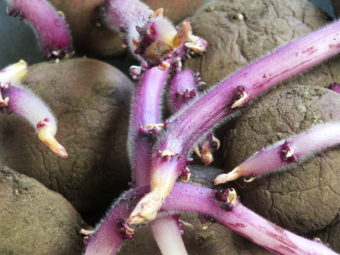
Close up view of potatoes which have already started spouting. (Photo by Matt Miller/KTOO)

Gardeners thinking about a crop of cabbage, broccoli and cauliflower later this season should start them indoors now.
Master Gardener Ed Buyarski said they should be grown under lights or near a bright window.

“Make sure you keep rotating them so they get even light,” Buyarski advised during this week’s edition of Gardentalk.

Spinach, a hardier green, may be planted outside now and will sprout as soon as the soil warms up to 45 to 50 degrees.

“Problem is if you wait too late, it will just sprout and will immediately go to bolting,” said Buyarski, who notes that Juneau’s day length already exceeds 15 hours.

Listen to the April 26th segment about seed potatoes:

Buyarski also has some tips for picking out seed potatoes which are now being sold by Juneau retailers.

“Buy some nice, clean, firm, round potatoes that don’t show any obvious signs of scab or funk in places,” Buyarski said.

If you buy large seed potatoes, don’t cut them up ahead of time. Wait until the day of planting until you cut them up into single eyes.

Plant the seed potatoes with 1- or 2-inch long sprouts in warmer soil.

“We don’t want to bury them too deep and we don’t want to be planting them in this cold, cold, cold soil because they will just sit there and, perhaps, just rot there in the soil,” Buyarski said.

For potatoes which have already developed longer sprouts, Buyarski recommends planting the seed so the sprout lays horizontally and can be covered by a shallow layer of soil.

Do you have a question for Ed about garden and yard care? Then, click here and fill out the question form on the right.

Three different varieties of seed potatoes await getting split up and planted.
Three different varieties of seed potatoes await getting split up and planted. (Photo by Matt Miller/KTOO)

Gardentalk — Prepare the way for perennials, national primrose show

Primroses and daffodils simultaneously bloom in a North Douglas flower bed.
Primroses and daffodils simultaneously bloom in a North Douglas flower bed. (Photo by Matt Miller/KTOO)

Embrace the rain.

The Captial City’s recent rain doesn’t just knocks down the dust and alleviates recent dry conditions, Master Gardener Ed Buyarski said.

It also accelerates the melting of snow still present in some Juneau yards and gardens.

He also recommends removing the plastic or spruce bough covers protecting bulbs and perennials from the winter’s cold temperatures.

Buyarski also gives us a preview of the National Primrose Show and Conference that runs May 4-6 in Juneau. Primrose show viewing at Centennial Hall is free, but there is a fee for admission to lectures, workshops and other conference events.

You can see a schedule and register online (closes April 21) by going to eventbrite.com and search for “Juneau, AK Primrose Show.” There will also be registration at the door.

Buyarski also encourages Juneau gardeners to submit their primroses for the show. He has some quick hints for slowing down or speeding up the blooming process so it peaks during the weekend of the show.

Listen to the April 19 edition of Gardentalk:

You have a gardening question? Go to this page and ask away. We’ll have an answer for you in an upcoming segment.

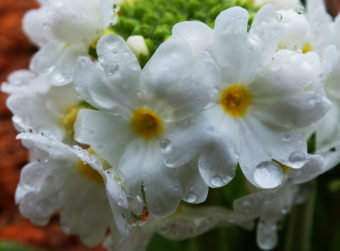
Close-up of tiny Primrose flowers as they bloom in a North Douglas garden.
Close-up of tiny primrose flowers as they bloom in a North Douglas garden. (Photo by Matt Miller/KTOO)

Gardentalk – Attacking greenhouse mold and mildew

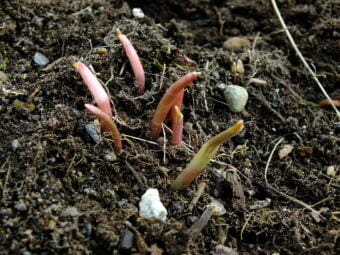
Garlic poke through the soil at the KTOO Agricultural Test Station and Garden of Science in late March 2018.
Garlic poke through the soil at the KTOO Agricultural Test Station and Garden of Science in late March 2018. (Photo by Matt Miller/KTOO)

Before gardeners start moving seedlings into their greenhouse, it might be worthwhile to do little spring cleaning to get rid of any mold and mildew that may have accumulated over the fall and winter.

The fungus can infest and kill your seedlings soon after being put in the greenhouse.

Master Gardener Ed Buyarski said a bleach cleanser would be most effective in eliminating mold and mildew, but peroxide and other household cleaners are much safer.

If you use vinegar, then be careful about spraying it around the greenhouse and wear a mask.

Listen to the April 12 edition about greenhouse cleaning and garlic nurturing:

As for garlic, Buyarski recommends covering garlic beds with plastic or sprinkle some wood chips to accelerate melting of any snow and warm up the soil.

Remove the plastic when the garlic bulbs pop through the soil so they don’t get sunburned.

Once garlic get a several inches tall, spray some liquid fertilizer on the leaves to boost their growth.

And don’t forget to keep weeds under control since garlic and onions do not compete well with them.

Gardentalk — Don’t settle for being medi-okra

A few weeks ago, a friend and former co-worker gave me a set of okra plants that she recently started. She knew that I had tried — and failed miserably — at growing okra from seed a few years ago.

Even with the use of a greenhouse, the semi-tropical plants never really took off beyond the seedling size.

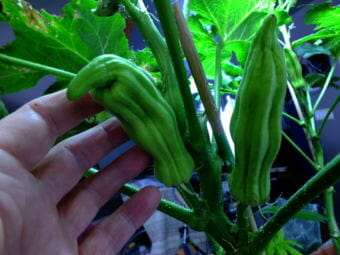
However, these three okra plants that she gave me are huge! They’re nearly 4 feet tall and have okra fruit as long as 6 inches.

In this week’s edition of Gardentalk, which airs during “Morning Edition” on KTOO on Thursdays during growing season, Master Gardener Ed Buyarski helps me out with what he knows about watering, fertilizing,  and harvesting okra.

“Usually, smaller is better,” Buyarski said. He advises harvesting young okra fruit when they are about 2 to 4 inches long. “Tender, young, kind of like zucchinis.”

“The ones you have already (that are 6 inches long) may be a bit big. Maybe fine for something like gumbo,” said Buyarski, who warns the big ones can get tough fairly quickly.

Listen to the April 5 podcast about okra and tools:

Buyarski also provides some tool cleaning and maintenance tips and gives us a preview of a garden tool workshop that’s coming up this from 3 to 5 p.m. Saturday at the Douglas Library. The workshop will cover sharpening and oiling of tools.

“A sharp tool is going to work better, cut better,” Buyarski said. “It’ll be easier on your hands to use those tools.”

This rusty and cracked shovel is in desperate need of TLC or replacement.
This rusty and cracked shovel is in desperate need of TLC or replacement. (Photo by Matt Miller/KTOO)

Do you have a question for Master Gardener Ed Buyarski about gardening or yard care? Then go to our archive page where you can pose your question in the form on the right. You can also browse through previous seasons’ Gardentalk segments.

Gardentalk — Where are the blooming bulbs?

Crocuses bloom at Centennial Hall in late March 2018.
Crocuses bloom at Centennial Hall in late March 2018. (Photo by Matt Miller/KTOO)

Some bulbs have already bloomed, but others may be slow to sprout and bloom in some areas around Juneau.

Master Gardener Ed Buyarski suggests it’s not unprecedented as southern-facing areas lurch into spring, while shaded areas are still covered by mini-glaciers that were created by the recent snow.

In the latest edition of Gardentalk that airs on KTOO’s “Morning Edition” every Thursday in the spring and summer, Buyarski recalled how snowdrops have bloomed at least a month early during the last few years.

Bulbs in south-facing planters or next to a house may already be emerging from the soil and blooming.

Heat leakage from a house’s foundation can also stimulate bulb growth.

But Buyarski said this week’s temperature variability, with overnight lows in 20s and midday highs in the mid-40s, can have a detrimental affect on those early emerging bulbs.

“That can really be the problem where the tops, the new tip, the growing tips that can get hard-frosted and then damaged,” Buysarski said. “The plant tries to heal and keeps growing, but that definitely slows them down. It weakens the plants.”

For those gardeners hoping to slow down their bulbs’ sprouting and blooming, Buyarski suggests layering flower beds with snow from elsewhere to keep the ground cool or partially frozen. That will inhibit the bulbs’ growth until temperatures moderate and the bulbs are strong enough to emerge undamaged.

Listen to the March 29 edition of Gardentalk:

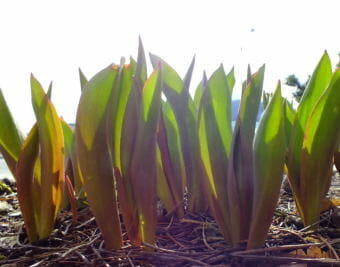
The tulips are up, but haven't bloomed yet at Centennial Hall in late March 2018. (Photo by Matt Miller/KTOO)
The tulips are up, but haven’t bloomed yet at Centennial Hall in late March 2018. (Photo by Matt Miller/KTOO)

Do you have a question for Master Gardener Ed Buyarski about gardening or yard care? Then go to our archive page where you can pose your question in the form on the right. You can also browse through previous seasons’ Gardentalk segments.

Gardentalk — Spring pruning and greenhouse planting

This North Douglas greenhouse, made entirely from discarded and upcycled materials, still needs more preparation for early spring use.
This North Douglas greenhouse, made entirely from discarded and upcycled materials, still needs more preparation for early spring use. (Photo by Matt Miller/KTOO)

For this week’s edition of Gardentalk, we perform some last-minute necessary pruning of bushes and trees, start some vegetables in our greenhouse and answer a listener’s question about moldy seedlings.

Listen to the March 22 edition of Gardentalk:

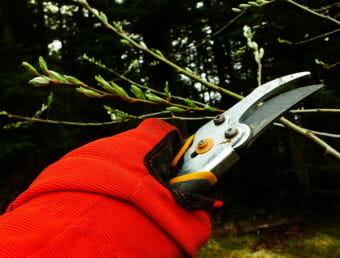
Master Gardener Ed Buyarski said bushes and trees can be pruned in the spring to alter their shape or stimulate fruit and flower production.

It’s the perfect time to prune apple and cherry trees before they break dormancy.

“We’re pruning to open up the tree,” Buysarski said. “Especially cherries. They get really tangled and messy inside.”

“Thinning out the inner branches can let more sun, more light, more air into the tree which can result in better pollination from the bees, better sunshine, better color, more sugar for the fruit,” Buyarski said.

Many Juneau gardeners already may be frustrated and discouraged with the frozen ground and several inches of snow still piled up in their garden patch.

But Buyarski said we can get an early start by sowing spinach, peas, radishes, kale, and early mustards in pots or planting beds in our greenhouse or hoop house.

“They will pop up and surprise us with a fairly early crop,” Buyarski said.

Listener Liz submits a question for Buyarski to answer.

She writes, “Is it uncommon to get mold on seedlings when starting them, and what can I do about it?”

Buyarski said it’s not uncommon at all. It happens to almost everyone.

The key, he said, is cleanliness and using clean, new potting soil for your seedlings. Clean your old pots or seedling trays with warm soapy water with a little bleach to kill a persistent fungus.

As for seedlings, which are falling over after getting attacked by a fungus, Buyarski said they’re likely already dead. There’s little you can do to save them.

Do you have a question for Master Gardener Ed Buyarski about gardening or yard care? Then go to our archive page where you can pose your question in the form on the right. You can also browse through previous seasons’ Gardentalk segments.

Site notifications
Update notification options
Subscribe to notifications