Outdoors

Subsistence fishermen take to the water inspite of closures

Update 10:30 a.m.

The Alaska Department of Fish and Game has decided to allow Southwest Alaska subsistence fishermen to catch chum and sockeye salmon on the lower Kuskokwim River starting Friday.

But the ban on catching king salmon remains in place until the end of the month.

Fish and Game Commissioner Cora Campbell said it appears that there is a low abundance of Chinook salmon. She says that is a concern given the importance of the subsistence fishery.

Original Story:

Subsistence fishing for salmon is happening on the Kuskokwim River even though closures are in place.

Several villages and dozens of boats participated Wednesday.

Yup’ik tribal elders have been meeting with village fishers and telling them that it they should fish for their families. A handful of tribes put out resolutions saying they have the right to fish as sovereign governments. The village of Napaskiak sent theirs all the way to D.C. to Ken Salazar, the U.S. Secretary of the Interior.

That village had about a dozen boats out in the water yesterday afternoon.

In Akiak, about 30 miles upriver of Bethel, the peaceful fishing protest turned to war as one resident called it. Wildlife law enforcement officials arrived in a boat, and cited three fishers and seized their nets.

“Soon as I set, Troopers were waiting right there,” Sam Jackson said.

Jackson was one of those fishers. He was reached by cell phone in his boat.

“What I told them is that we’re not protest fishing but we’re fishing for our people,” Jackson said. “But they still, they would not budge.”

Jackson says one of the nets was cut up in front of them.

The community responded in force. Women and children filled boats and drifted along side fishers supporting their efforts. They held signs that read “feed your families, go fish.”

Sheila Williams, Akiak’s Tribal Administrator, talked with the officers.

“I spoke with them at length and they were asking us to hold off and I told them that at the directions. They’re going to go fishing,” Williams said.

“I’m at the mercy of my elders. The elders say to go fish, they’re going to go fish. And so they’re fishing.”

Law enforcement attempted to land a plane near Akiak, but Jackson said there were too many boats and they flew off. Residents were not sure if they would return, but fishers continued to fish anyway.

The Kuskokwim River has been closed to fishing for over a week in some areas. Fish managers say they plan to open fishing for 3 days, starting Friday for the lowest part of the river. And then they will close it again for an unspecified amount of time.

Low salmon runs around the state have subsistence fishermen worried

This year’s Chinook salmon run on the Yukon is poor, and the Alaska Department of Fish & Game is preparing subsistence closures to meet escapement goals. The closures begin tomorrow, but with so few fish in the river, it’s unknown how long subsistence fishermen will be unable to fish.

Fish & Game worked with the Yukon River Drainage Fisheries Association, a non-profit group of subsistence fishermen and commercial fishing interests, to estimate a king run this year between 109,000 and 146,000 kings.

Steve Hayes, Fish & Game’s summer season manager for the Yukon says that number breaks down to about 50,000 fish in both the U.S. and Canada for escapement, with another 50,000 for subsistence needs in both countries. Even if the run comes in on the higher end of that estimate, Hayes says it still falls short.

By mid-June, only 4,500 kings had passed the Pilot Station Sonar site, about 120 miles from the mouth of the Yukon. Hayes says those numbers should be 10 times bigger, closer to 45,000 kings during an average run, or 12,000 in years with a later run.

To hit escapement targets, and make sure enough king salmon make it upriver to spawning grounds in Canada, Fish & Game is preparing to close subsistence fishing on the lower Yukon as the first pulse of king salmon move upriver. There will be 36 hour closures, one district at a time, amounting to about a 5 day closure. And that could only be the beginning.

Similar closures on fishing on the Kuskokwim this year have met with anger and frustration by subsistence fishermen. While Hayes says no one is happy with the subsistence limits, he says similar weak runs in 2009 and 2011 have helped all involved recognize the importance of conserving the run.

Orville Huntington is the Wildlife and Parks Director for the Tanana Chiefs Conference, a tribal consortium of the 42 villages of Interior Alaska. He’s also a lifelong subsistence hunter and fisherman. As one who catches his kings upriver, he says most people were prepared for a bad year, and are looking at alternatives.

For now, while subsistence fishermen hope for a strong chum run later in the season, Hayes says Fish & Game will continue to monitor the first pulse of Chinook, and is prepared to implement more closures if necessary.

This follows the closing of the Kenai River from the mouth upstream to Skilak Lake to king salmon fishing beginning Friday, June 22. The closure will be in place during the early run of kings through the end of June.

Fish & Game says the early king run on the Kenai looks to be perhaps the lowest on record.

The department says it can’t even justify catch-and-release fishing because of the additional mortality given the low number of kings in the river.

When the king salmon late run begins July 1, bait and scent will be prohibited.


Wildlife viewers crowding bears, congesting traffic

State biologists are concerned about wildlife viewers creating problems with their pursuit of black bears out Glacier Highway.

A couple bears have been spotted feeding near the bypass at Auke Rec and further out near Peterson Creek.

Ryan Scott with the Department of Fish and Game says drivers have been stopping on the highway near the bears. There’s also been at least one report of a vehicle’s occupants feeding bears through a window. Scott notes that it is illegal to feed the bears.

He advises that wildlife viewers to give the bears plenty of space and don’t crowd them, approach them, or chase them. Scott also suggests that drivers park their vehicles safely off the road instead of stopping on the highway. And use binoculars or a long camera lens like a telephoto to view bears or take pictures from a distance.

Scientists search Southeast beaches for tsunami debris

Five NOAA scientists are scouting Southeast Alaska beaches for debris from last year’s Japanese tsunami.

The team left Ketchikan on Friday aboard the 80-foot charter vessel Sumdum, with plans to explore the shoreline along the outer coast.

Jeep Rice, of Juneau’s Auke Bay Lab, calls it a preliminary assessment.

“I guess a part of us hope we find lots of debris and another part of us hope we don’t find any,” Rice says. “That would be just a cool thing if we don’t find any debris.”

But that’s not likely, even without tsunami debris that’s been washing up on West Coast shores for several months now. Rice expects a peak next winter, but estimates it could continue coming ashore for a decade.

The scientists are heading to the southern tip of Baranof Island, where Rice says the Sumdum will take a right turn and go north.

Jacek Maselko, of the Auke Bay Lab, is the chief scientist on the Sumdum. He charted the beaches to be studied from ShoreZone, NOAA Fisheries’ coastal map website.

“This is a visual map along with photos that are supporting of every single kilometer of beach in Southeast Alaska,” Rice says.

Maselko conducted what Rice calls a “pre-survey survey,” virtually “flying” all the beaches on the website.

“And he finds pocket beaches, for example, that may be up to a kilometer long or even 200 to 300 yards long where you could land a zodiac and put a crew of two or three on,” he says. “We’re going to hit a whole bunch of these pocket beaches as they go from south to north.”

The scientists are expected to wrap up the Southeast debris survey on Sunday. Rice says they will conduct similar surveys on other Alaska coastlines this summer and repeat them next year.

The National Oceanic and Atmospheric Administration has 40 years of data from Alaska beaches, but this is the first effort to account for debris from the March 2011 Japanese tsunami.

“We have an idea how the debris has shifted from trawl web back in the ’70s, to all these plastic bottles showing up on shore and of course we saw none of those back in the ’70s or ’80s,” he says. “You know times change and debris changes so now we’re going to have another dramatic change in debris with things coming from Japanese aquaculture farms and debris from cities that were destroyed.”

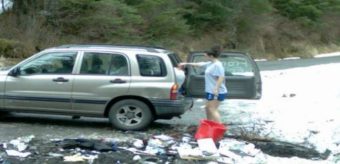
Rice says the scientists will be counting any tsunami-related debris they find, taking pictures then cataloging it. After the data is collected, NOAA will determine whether and how to clean it up.

Site notifications
Update notification options
Subscribe to notifications