CBJ Meeting for Monday, November 4, 2013
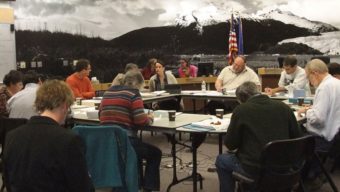
CBJ Assembly Meetings
Assembly adopts Comprehensive Plan update

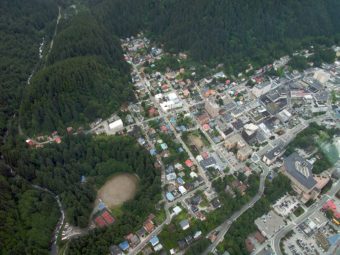
The Juneau Assembly Monday night put its final approval on the Comprehensive Plan for development over the next 20 years, with the clear message that it wants more input at the beginning of the process.
The Assembly has adopted the 2013 update to the 2008 long-range plan. The revisions have been in the works for more than two years. After public meetings throughout the borough and lots of fieldwork, city staff turned the changes over to the Planning Commission, which did more work then held a public hearing and passed the plan in May.
It was August before the Assembly first reviewed the draft. Assembly member Carlton Smith said that’s way too late:
“It’s unfortunate in my view that the Assembly in this process is at the very end of the process. And I really would like to see with the new update that the Assembly possibly meet with the (Planning) Commission on the front end so that we could possibly give that direction.”
The document is more than 300 pages long. Assembly members said it should be condensed so it’d be more workable.
On a motion from Mary Becker, the panel voted 5 to 4 to delete some references that take the plan out 20 years to 2033.
“That’s a long time,” Becker said. “I know we can make changes, but it’s still a long time.”
Becker also called for an update once the city completes a Juneau economic development plan the Assembly wants.
City Attorney Amy Mead said the Assembly can initiate a change to the Comprehensive Plan any time, but the Planning Commission must be involved.
CBJ Community Development Director Hal Hart said the Assembly will be brought into the process sooner next time or when it initiates a review:
“Communication is the name of the game so we have to have good communication especially between the Planning Commission and the Assembly, but also between other groups and the Assembly and Planning Commission as well.”
The Comprehensive Plan update reorganizes some chapters, fixes errors found in the 2008 document, and updates sections on housing, economic development, energy, transportation, land-use maps, and utilities.
Assembly sets annual goals

Resolving Juneau’s solid waste problems tops the list of the Assembly’s goals for the next year.

In a 3 and a half hour retreat Wednesday morning, the nine-member panel prioritized a list of 16 issues the city and borough should tackle.
Some, like housing, economic development, and parking, have been on previous Assembly’s lists.
Mayor Merrill Sanford says the key is moving them off the list and into reality.
“Maybe we can get caught up on a few here and get beyond and get into new goals, you know, starting next year. But this gives us a priority list to go by,” Sanford says.
During the meeting, Assembly member Randy Wanamaker reminded his colleagues that the fewer goals the better because so many are already on the list.
A number of the issues considered priorities are in progress, including measures for creating more housing in Juneau.
Disturbing the peace code would define “unreasonable noise”
Another version of a draft disturbing the peace code went before the CBJ assembly and planning commission during a joint meeting last night, and there are still issues with the ordinance.

Fireworks were brought up by a few assembly members during discussion on the disturbing the peace code. City attorney Amy Mead explained how fireworks fit under the new language on “unreasonable noise”:
“A violation hinges solely on whether the reasonable person would find it unreasonable, so fireworks on the Fourth of July, most people would not find that unreasonable. Fireworks going off on May 2nd – that might be found unreasonable by the majority of people, in which case it would be a citable offense.”
Assembly member Jesse Kiehl asked for the meaning of “pure tones,” which is one of the factors for determining “unreasonable noise.”
“Are they a good thing or a bad thing for purposes of enforcement?” he wondered. “Or do they just need to come out if we’ve got a reasonableness standard anyway?”
Mead said despite not knowing the definition of “pure tones,” the language may become useful for enforcement, “I would hesitate to take it out when it doesn’t change the ordinance in any way. It adds a factor that can be considered. It doesn’t hurt to leave it in.”
“If I don’t know what it does,” Kiehl replied, “I don’t know whether it hurts to leave it in or not.”
Assembly member Jerry Nankervis had a problem with the liability section of the ordinance. He said the owner of the property where noise is coming from is not always the one responsible.
“I go out of town. My 21-year-old is tasked with house-sitting my house. They have a party that makes a lot of noise without my approval, without my consent. The police get called. They come. Am I responsible, am I the one that’s going to get the ticket?” Nakervis asked. “I firmly believe that citing the person responsible for making that noise and that is sometimes not the owner.”
Mead said the liability section of the ordinance is not new language. She said, in the example, the 21-year-old would be responsible and cited. The ordinance assumes that the owner of the property has caused the noise or allowed it to happen, but that assumption can be argued.

“The person who owns the house can come in and prove that they didn’t know, and they didn’t approve, and they didn’t allow it, in which case, they would escape any responsibility,” Mead explained. “But it does give us an avenue if we think that there is some responsibility that should attach to that person.”
While problems were still found with the draft ordinance, planning commission chair Mike Satre said he likes the direction it’s going in. He said the ordinance has a several year history with city staff and planning commissioners, “The recommendation from staff to put it back to the assembly was to go back to the disturbing the peace ordinance, ensure that it was simple and it was going to be enforceable and it was something the community members could rely upon.”
City staff will continue to work on the ordinance before it goes back to the Assembly during committee of the whole.
City and Borough of Juneau ends FY13 with more cash in reserves

The Juneau Assembly will have some flexibility when it comes to spending money during the current fiscal year and setting a budget for the next two years.
The city and borough ended Fiscal Year 2013 with about $9.5 million in fund balance. That’s $1.2 million more than projected.
CBJ Finance Director Bob Bartholomew says city departments have been holding down costs, while taking in more revenue.
“Their operating expenditures were about a million dollars lower than what had been projected,” Bartholomew said. “And then the revenues that they collect directly for services, permits and fees came in about $440,000 higher than we projected.”
Bartholomew says that helped offset some other revenue sources that came in lower than expected last fiscal year. Property and sales tax mostly hit their projections, so did state and federal revenue. But interest income from investments was about $653,000 below what was expected.
But overall, Bartholomew says the financial picture is good for Juneau.
“We have a strong financial position and this just solidifies it,” he said. “So that as we move into FY14, the additional funds just give some flexibility to the Assembly.”
Bartholomew updated the Assembly Finance Committee with the latest numbers Wednesday night.
The city has a biennial budget, so FY14 spending was set in 2012 and revised this spring before the new fiscal year started in July. The Assembly will begin crafting the FY15 and FY16 budgets early next year. Bartholomew says reviewing the actual numbers from last fiscal year is the first step in that process.
Juneau Assembly unanimously confirms support for Project Labor Agreements

Docks and Harbors last month bid the project without a PLA, breaking from a longstanding city policy to use the agreements to the fullest extent of the law. The Assembly on Monday unanimously confirmed that policy.
Randy Wanamaker was in his first stint on the Juneau Assembly in 2008 when the original policy statement supporting Project Labor Agreements was adopted. In fact, he offered the motion then, and says it was meant to apply to all city departments and enterprise boards.
“It comes from the Assembly. It’s not up to them to choose whether or not they wish to follow it,” Wanamaker said at this week’s Juneau Assembly meeting, where Assembly member Karen Crane introduced a motion confirming the PLA policy.
While a Project Labor Agreement does not require the city to hire a union contractor, it does set basic terms for wages, benefits and working conditions. Assemblyman Jesse Kiehl says PLA’s offer certain advantages.
“When you look at our very large projects – our projects over $10 million – the on-time performance of projects with a PLA is dramatically better, it’s night-and-day better than those without,” Kiehl said.
Crane’s motion also requested the Docks and Harbors Department engage with the Juneau Building and Trades Council to resolve any issues that would prevent a PLA on the cruise ship dock project.
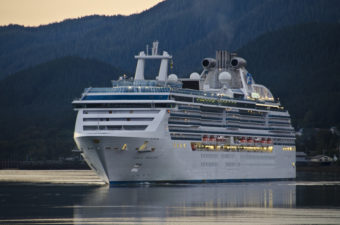
Construction of two floating berths on the downtown waterfront is expected to take two years, and cost the city $54 million. Kiehl says it’s important for it to be done on time.
“We saw this year the impact – and we’ll see it in the budget – of missing cruise ships,” Kiehl noted. “They missed for mechanical reasons; some skipped Southeast communities for weather reasons. And with these dock projects we run the risk, if they are not delivered on time, of self-inflicted financial wounds.”
CBJ Port Director Carl Uchytil previously said a labor agreement was not needed for the cruise ship dock project, because the work is fairly simple and straightforward. He declined to comment Tuesday, saying he was still trying to understand the motion adopted by the Assembly.
Juneau Building and Trades Council President Tom Brice says the message he takes away, is that while CBJ enterprise boards have a lot of autonomy, they still have to follow city policy.
“Just because you’re an enterprise board, doesn’t mean that you don’t have to abide by the rules,” said Brice.
He says other CBJ enterprises, such as Bartlett Regional Hospital and the Juneau Airport, have always included PLAs in major construction projects. He says Docks and Harbors initial decision not to have an agreement for the cruise ship docks doesn’t concern him moving forward.
“No, not at all. I think the folks over at Docks and Harbors haven’t had a lot of major projects come through their store,” said Brice. “So, as they use it, it will be something that they’ll see a great deal of benefit from.”
Wanamaker, who chairs the Assembly’s Public Works and Facilities Committee, says he’ll soon begin work to standardize the city’s PLA review process. Right now it’s up to individual department heads to decide whether a project needs a labor agreement. Wanamaker believes a committee should do that analysis instead.
“So that we provide a group reviewing, rather than one person, where arbitrariness or misunderstanding may occur,” Wanamaker said.
The Assembly has asked City Attorney Amy Mead to come up with a draft review process. Courts have upheld the use of Project Labor Agreements by government entities, as long as they can justify a strong public interest.