CBJ Assembly Meetings

Mixed messages about Juneau parking persist

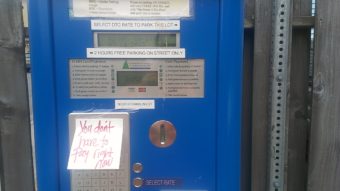
One of the topics the CBJ assembly discussed during the hour-and-a-half executive session was parking. (Photo by Lisa Phu/KTOO)

The Juneau Assembly met behind closed doors Monday night to discuss the city’s parking management.

Earlier in the day, City Manager Kim Kiefer gave an update on the situation. “The parking meters as they are right now, people still need to use them as they’re designed to be used,” she said.

The city has had ongoing issues with the current system run by Aparc Parking Solutions. Information from the parking machines weren’t getting accurately communicated to handheld devices used by the Juneau Police Department.

“We are looking at a variety of different options that you look at when you have a system that isn’t functioning the way you want to,” Kiefer said. “So we’re looking at how can it be improved, can it not be improved, what are our other options, and how can we go forward with each one of those, and what makes the most sense for the city long term.

Parking laws and penalties are “for the most part” being enforced. Community service officers are on the lookout, Keifer said.

“They are ticketing now, so don’t think you can run in and park in a loading zone if you’re not loading, or think that you can park in someplace that’s marked for an hour and think you can spend a couple hours there. …So you need to be aware of where you’re parking and look at the signs.”

During the assembly meeting, member Carlton Smith said he’s heard from different people in the community that parking is one of the city’s main problems. Public perception is that the system may be broken, Smith said.

“One comment was made  in this interim period where we have the issue with the existing system  that it might be advisable to make a public announcement that until further notice, all those parking charges are abated, and I know that’s a financial decision, but it’s also a time when people aren’t certain whether the machines are working or not.”

The assembly discussed the issue during executive session. The city has put more than $400,000 into the current parking system.

Also during the hour-and-a-half closed-door session, the assembly discussed the 2012 incident involving a former Juneau teacher accused of assaulting a teenager at an Oregon football camp.

Related Story:

City will move to ‘pay and display’ downtown parking

Animal control advises against dog breed discrimination

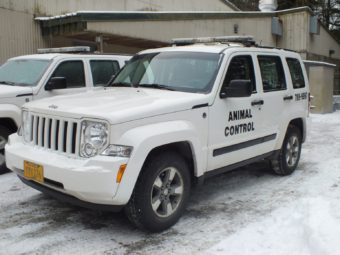
Matt Musslewhite is Director of Animal Control and Protection. (Photo by Lisa Phu/KTOO)

Director of Animal Control and Protection Matt Musslewhite advised the Juneau assembly last night not to pass any ordinances against certain dog breeds.

Musslewhite spoke during public participation in response to two recent dog attacks in Juneau and the media’s coverage. “There’s been discussion in the media focusing on certain breeds of dogs contributing to the majority of bite cases in our community,” he said.

According to Musslewhite, 76 dog bites were reported in 2012 – only 14 percent are from stray and loose pets, while the majority of bites are from the victim’s family pet.

“Juneau’s top three breeds for reported dog bites include Labrador retrievers, shih tzus, and Jack Russell terriers,” said Musslewhite.

Of the 26 breeds on the list of reported dog bites, Musslewhite said pit bulls come in low on the list.
“Based on this information,” he said, “I would strongly urge the assembly not to consider any future ordinance that would place restrictions on a specific breed.”

In the coming months, Musslewhite said animal control will look at updating current Juneau ordinances to improve reporting requirements for dog bites and rabies vaccinations. State law requires health care providers report animal bites inflicted on humans, he explained, but no law requires reporting animal bites inflicted on other animals.

According to Musslewhite, Juneau currently has 14 animals that are classified as “dangerous” or “potentially dangerous.”

Related Stories:

Two people cited for recent dog attacks
Dog attack victim, hero recount their ordeal
Animal Control investigating two dog attacks in Juneau

Assembly committee to hear update on Housing First project for Juneau

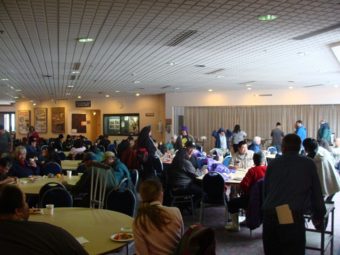
Juneau Project Homeless Connect 2012. Photo by Casey Kelly/KTOO.

The number of homeless people in Juneau is estimated at more than 550.  A  group organized to address some of the problems of homelessness will update the Assembly Monday evening on its progress.

Human Resources Committee chair Jesse Kiehl says the issues should stay on the Assembly’s radar, because the city spends a lot of public money addressing the needs of the homeless inebriate in the least efficient way.  A Housing First project may be an answer.

“Police departments and emergency rooms aren’t designed to address those problems.  So a project like this, if we could get it rolling,   would actually do something toward fixing some of the problems of some of the folks who have real chronic long-term public inebriation problems and homelessness.”

Housing First projects have been started across the U.S.  Kiehl says is many cases just meeting a person’s basic needs helps them transition into becoming more functioning members of a community.

“The basic theory of a Housing First project is that it really addresses a roof over your head first and foremost. So the folks who are brought into a Housing First project generally are folks with chronic alcoholism or drug abuse problems, who have been homeless for a long time,” Kiehl says. “The big difference with the Housing First project is it doesn’t require sobriety to live there.”

Similar housing is available in Anchorage and Fairbanks, where homelessness and public inebriation are also a major issue.

The CBJ Assembly Human Resources Committee meets at 6 p.m. Monday in Assembly chambers at city hall.

Juneau Assembly declines request to reconsider cruise ship dock permit

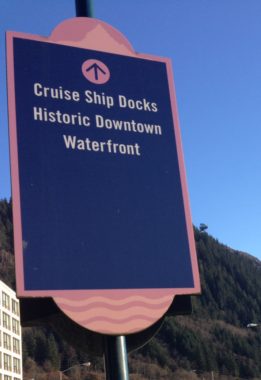
Cruise ship docks historic downtown waterfront
Photo by Casey Kelly/KTOO.

The Juneau Assembly has declined a request to reconsider its nearly year old decision upholding a Planning Commission permit issued for two floating cruise ship berths on the downtown waterfront.

The Alaska Commercial Fishermen’s Memorial asked the Assembly to reconsider the decision last month, after it came to light that the city does not yet own some of the submerged tidelands where the cruise ship docks will be built.

In 2012, the nonprofit memorial intervened in an appeal of a conditional use permit issued for the project by the Juneau Planning Commission. The memorial’s board of directors believes the floating docks will impact the annual Blessing of the Fleet.

The Assembly upheld the permit in January. On Monday, members decided, without discussion, not to revisit that decision.

City Attorney Amy Mead says conditional use permits are issued for planning purposes, and the city’s Docks and Harbors Department was not required to show ownership of the tidelands before applying for one.

“I don’t believe that there was anything related to the tideland conveyance issue that could have changed or would have changed what the ultimate decision from the Planning Commission was,” Mead said.

She says Docks and Harbors will have to show proof of ownership or get an agreement from the property owner before applying for a construction permit.

The State of Alaska issued a preliminary decision last month approving the transfer of nearly 18 acres of submerged tidelands to the city. Juneau Port Director Carl Uchytil has said he expects a final decision this month or next (click here to read Uchytil’s response to the fishermen’s memorial). The Docks and Harbors Department delayed opening bids for the $54 million project until the matter is settled.

Fishermen’s memorial President Bruce Weyhrauch said via email that the nonprofit will not formally pursue reconsideration of the Assembly’s decision.

Related:

Juneau moves forward with new cruise docks despite not owning submerged land
Port officials grilled over cruise ship dock project
Juneau dock bid opening delayed until ownership of submerged tidelands is resolved

Consultant predicts rate increase for CBJ water & sewer

Water and sewer rates will increase after the rate study is done.

Juneau’s water and sewer system will need a $72 million upgrade over the next decade.
A city and borough utility study indicates rates will have to increase and other sources will be required to generate enough revenue to cover system operating, maintenance and updates.

CBJ Public Works Director Kirk Duncan and a consultant explained future revenue requirements to the Juneau Assembly Monday.

“Our current rates allow for operational costs, but do not allow for system replacement and upgrades,” Duncan said.

Across the country, Duncan said, local governments review their utility rate structure every five or ten years. The last CBJ study was in 2003 and rates went up just after. But most utility infrastructure projects were funded from a variety of sources.

Consultant Karyn Johnson of FCS Group worked on the last Juneau water and sewer rate study.

“From a financial accounting reporting perspective, both the water and wastewater utilities are operating at a financial loss. That’s primarily due to the fact that the rate revenues are not set at a level high enough to cover the annual depreciation expense,” Johnson said.

She said industry standards recommend having on hand a minimum of 30 to 45 days operating and maintenance expenses and a reserve fund for emergency repairs. She said rates should cover depreciation.

Johnson described four revenue scenarios for both water and sewer; each one assumes a rate increase.

Duncan said other revenue sources would include a portion of the CBJ 1 percent sales tax, and $8 million from Juneau cruise ship passenger fees, known as the head tax.   That’s because the city provides water to cruise ships during the summer.

“To put things into perspective, we have 275 million dollars’ worth of water and wastewater assets.  We’re recommending a 72-million dollar system upgrade over the next years.  What that represents is 25 percent of the total system would be replaced in the next ten years,  indicating that all the components can last 40 years,” he said.

On Wednesday, Johnson and Duncan will explain the utility system needs to the public, at 7 p.m. in city hall Assembly chambers.

By February, they expect to know how those needs will impact residential and commercial rates.

Once the study is complete, the Assembly will decide how the system will be funded.

Click here to read the study.


Juneau Assembly committee looks to simplify labor agreement resolution

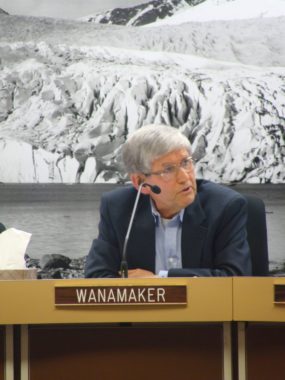
Randy Wanamaker
Assembly member Randy Wanamaker wants a simplified resolution guiding Juneau departments’ decisions on the use of project labor agreements. Photo by Casey Kelly/KTOO.

A Juneau Assembly committee wants to simplify a proposed resolution dealing with Project Labor Agreements.

A Project Labor Agreement is a pre-hire deal between the owner of a project – the city, for example – and contractors, setting terms for things like wages, benefits, and working conditions.

In October, the Juneau Assembly voted unanimously to confirm a policy it adopted in 2008, which says the agreements should be used to the fullest extent of the law.

Assembly members also asked the city attorney for a resolution standardizing the review process city departments should use when deciding whether or not a project needs a labor agreement. A draft of that resolution was described as too wordy and overly complex by members of the Assembly Public Works and Facilities Committee on Monday.

“There are things like, ‘Where the agreement is rationally related to the competitive…'” said Assembly member Karen Crane, quoting from the resolution. “I mean, the word ‘rationally…’ Are we going to have irrational? It just, that word can be taken out and the sentence is the same, and I think there are a bunch of places in here where you could do the same thing.”

City Attorney Amy Mead says some words or phrases are needed to legally justify the city’s use of project labor agreements.

“Some of what has been defined as very wordy comes directly from case law, and there are certain standards in order to justify the use of a PLA that we must meet,” Mead said. “That’s where some of the language that is repeated in this resolution comes from.”

Randy Wanamaker chairs the Public Works committee. He says the Assembly has already made its project labor agreement policy clear. The purpose of the resolution, he says, is to guide department heads making decisions, and he argues it does not need to be so complex.

“I’m a layperson, I’m not an attorney, and I find it difficult to follow the language in there,” Wanamaker said. “I know where we’re going, so I’m able to follow it better than a person looking at it for the first time, but I still think it’s unnecessarily complex and overly cautious.”

The committee will meet with the attorney in a work session next week to review the draft resolution and makes changes.

Opponents of project labor agreements say they unfairly benefit unions. Courts have upheld their use by government entities, as long as they can justify a strong public interest.

Related:
Unions criticize lack of pre-hire labor agreement for Juneau dock project
Juneau Assembly unanimously confirms support for Project Labor Agreements
Non-union contractors blast Juneau’s Project Labor Agreement policy

Site notifications
Update notification options
Subscribe to notifications