CBJ Assembly Meetings
Atlin Drive rezoning to come before Assembly again

The old adage, “the third time’s the charm” didn’t work for Juneau developer Richard Harris, so now he’s working on his fourth attempt to get property he owns on Atlin Drive rezoned.
The Juneau Assembly on Monday afternoon will take up Harris’ appeal of a Planning Commission decision denying a change from residential to light commercial.
The Planning Commission first denied the rezone in 2011, because it doesn’t comport with the city and borough’s comprehensive plan for the area. Harris appealed to the Assembly and won – temporarily. The action was rescinded when the city attorney found it was illegal.
In 2012, he received a CBJ Conditional Use Permit to build 22 residential units on the two-acre parcel, with Duck Creek running through it. Soon after, he asked the city to amend the comprehensive plan for the area, which was rejected.
So Harris went back to the Planning Commission last fall with another request to rezone the parcel to light commercial. Commissioners denied it again, based on the comprehensive plan. Harris appealed to the Assembly.
The Assembly will hear both sides today at 5 p.m. in Assembly chambers at city hall.
Public hearing to be held on CBJ noise law

Noise is the top issue on the agenda at Monday’s regular Assembly meeting.
A rewrite of CBJ’s Disturbing the Peace code has been in the works for years. The version now before the Assembly clarifies the intent of the ordinance, which is to prohibit “unreasonable noise.” It also defines unreasonable noise.
One of those unreasonable noises could be the tunes coming from a vehicle. The proposal makes it illegal for a person to blast any sound, music or vibration from a vehicle that can be heard 30 feet or more from that vehicle – at any time of day or night.
A previous version made the noise unlawful from 10 p.m. to 9 a.m., but the Assembly Committee of the Whole last month removed the time frame.
Here’s member Jerry Nankervis’ argument for keeping the hours in the law:
“I think we need to be consistent with our times,” Nankervis said during the December COW. “If we say you can blast it from your house, the neighbors have to hear that as well, even though I’m not driving by with my house. So in order to maintain consistency, we should leave that in there.”
But member Jesse Kiehl said it’s precisely because a car is on the move that it should be unlawful to play “obnoxious” noises at any time.
“I can go over and talk to my neighbors if the music’s too loud. There was a low-power station when my kids were very little and I would go over and talk to them at 10-something at night about the live drum performances. And you know, it took some neighborly interaction a couple of times, but by-golly we got ’er fixed,” Kiehl said. “I don’t have any way to do that when the car goes rolling bay and shakes the windows and wakes the children. I can’t go say ‘would you mind turning it off’ because they’re gone.”
The Assembly will take public testimony tonight during a hearing on the noise code. The meeting begins at 7 p.m. in Assembly chambers and can be heard live on KTOO-FM.
Juneau Assembly boots two incumbents from Planning Commission

In a split vote Tuesday night, the Juneau Assembly replaced two incumbents on the city Planning Commission.
Juneau’s Planning Commission reviews proposed construction and development projects to make sure they’re consistent with city land use laws and the comprehensive plan. It also makes recommendations for project conditions and any necessary permits.
Jerry Medina served two years on the panel, after being appointed to fill a vacancy in November 2011. Nathan Bishop served one three-year term. Both applied for new terms.
“Let me start out by saying, we had an incredible depth of talent in the applicant pool,” said Jesse Kiehl, chair of the Juneau Assembly Human Resources Committee.
Kiehl was one of four Assembly members on Tuesday, who voted against a slate of Planning Commission candidates that did not include the two incumbents, Medina and Bishop.
“It takes a long time to get up to speed on some of the Planning Commission issues,” Kiehl said. “So my biggest issue really had to do with returning some of those folks who’d been serving for years and were doing a good job, even if they didn’t always vote the way I wanted.”
Bishop, a self-employed general contractor, declined to comment on Wednesday.
Medina, an administrator for the Inside Passage Electric Cooperative, said he was disappointed.
“I spent considerable time reviewing my packet and was prepared for each meeting,” Medina said in an email late Wednesday night. “I based my findings on sound judgment citing specific sections within the Land Use Code and Comprehensive Plan. My attendance record was very high and I missed very few meetings.”
Medina said he felt his experience merited at least another year on the commission.
Bishop and Medina were replaced on the commission by former Juneau School Board member and Assembly candidate Bill Peters and consultant Gordon Jackson – a former educator and administrator for Alaska Native corporations and tribes. The Assembly also appointed Architect Paul Voelckers to fill out the remainder of former commissioner Marsha Bennett’s term, and reappointed electrical engineering consultant Ben Haight to his seat.
Assembly members Kate Troll, Loren Jones and Karen Crane joined Kiehl in voting against the candidates.
“I don’t think that these appointments will radicalize the commission or anything,” Kiehl admitted. “We have some very strong folks who will be joining the commission.”
Assembly member Jerry Nankervis voted with the majority to appoint the candidates. Nankervis currently serves as the Assembly’s liaison to the Planning Commission.
“My opinion on the four that I voted for on the slate,” Nankervis said. “Was that they each bring something a little different that I think will fit in good on the Planning Commission.”
Nankervis says he likes the experience Peters brings from serving on the school board. He notes that Jackson has a vast planning background from his time running Native corporations. He says Haight really does his homework, and Voelckers brings experience developing large projects, especially with schools.
“Service on the Planning Commission requires a lot of time,” Nankervis said. “And the volumes of stuff that they’ve got to read and go through before their meetings, I have not been to a committee, a commission, or a board that has that kind of volume of work in front of it. And I’m appreciative. I’m appreciative of Jerry’s service on the Planning Commission and Nathan’s.”
In the past two years several Planning Commission decisions have been appealed to the Assembly. Both Kiehl and Nankervis say the number of appeals did not affect their votes on appointments. Nankervis says the commission is dealing with a lot more projects than it has in the past.
“Particularly in the building industry,” Nankervis said. “We had that downturn in the economy that stopped growth – new homes, subdivisions, things like that, we just haven’t had for a number of years. And I think that anytime you have more going on, you will have more opportunity and probably more appeals.”
There were 13 applicants for the four vacancies on the Planning Commission.
Peters, Jackson and Haight will serve three-year terms starting January 1st. Voelckers’ term will expire December 31, 2014.
(Note: This story has been updated with comments from Jerry Medina, who was out of town and initially unavailable.)
45-unit housing envisioned for Juneau’s homeless

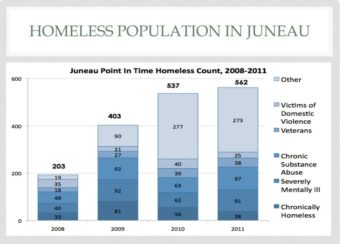
The Juneau Assembly Human Resources Committee heard an update Monday night on Juneau’s need for a housing unit for homeless. Alaska Mental Health Board Planner Scott Ciambor says a Housing First project in Juneau was developing quickly before the Alaska Council on the Homeless changed a crucial grant.
“The status of this project is it went really fast really quick, and so once we hit that snag in May of the guiding light of the Special Needs Housing Grant paving the way, things have kind of tempered down a little. But when we were talking prior to that, the size was 45 units, with the idea that 30 would be straight off the street because we have more than enough capacity of folks needing that type of housing,” explains Ciambor.

Ciambor says the Special Needs Housing Grant was the pathway for Anchorage and Fairbanks to get housing for homeless. With none in Juneau, Ciambor says the chronic homeless often use the emergency room, department of corrections, and Rainforest Recovery Center for housing. The concept of a Housing First model addresses the need of getting homeless into housing without a prerequisite for sobriety.
“You take a person who needs housing and shelter. You get them out of the streets and into someplace where they can be safe first and then you surround them with the services so that they can make that next step,” Ciambor says.
Human Resources Committee Chairman Jesse Kiehl asked Ciambor to give the assembly an outline of project costs.
CBJ Meeting 12/16/13
Live from the Assembly Chambers, Monday, December 16, 2013