CBJ Assembly Meetings

Utility study recommends rate increase

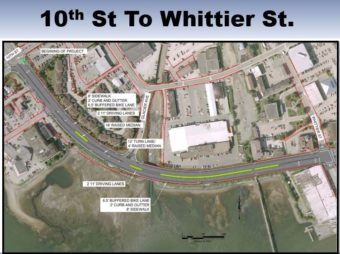
DOT map shows a section of the work to be done in 2015 from Main St. to 10th St. CBJ will also install a new water main.

The Alaska Department of Transportation will resurface Egan Drive from Main Street to 10th Street next year.

It’s a good time to put a new water main along the same route.

The Main Street water main, a Glacier Highway pressurized main, and a sewer lift station are the first of a decade’s worth of water and sewer improvements Juneau needs.

CBJ Public Works Director Kirk Duncan says about a quarter of the city and borough’s water and wastewater system will be replaced over the next ten years.

“We have (about) 275 million dollars in assets for water and wastewater in the city and borough of Juneau.  A lot of them were installed in the 80s using federal money from Clean Water Act and the Drinking Water Act and those assets are coming due.  We’re estimating it’s going to take about 72 million dollars over the next ten years to bring the assets back into good working order,” Duncan says.

A CBJ utility rate study, underway for several months, recommends paying for that work with CBJ sales tax revenue, cruise ship passenger fees, a revenue bond, and a customer rate increase.

“The rates would go up 9 and a half percent each year for the next five years for both water and wastewater and then 5 percent per year for the last five years of the rate study,” Duncan says.

The current study covers the city and borough’s utility needs through 2024.  Customers rates would go up July 1 of this year.

Duncan and a consultant from Seattle-area Financial Consulting Solutions Group will present the funding suggestions Monday at a meeting of the Juneau Assembly’s Committee of the Whole in Assembly chambers at 6 p.m.

On Tuesday, the public can weigh in on rate study proposals at a meeting from 6 to 8 p.m. at Mendenhall Valley Library, and on Wednesday at Hangar Ballroom in Merchants’ Wharf, from 7 to 9 p.m.

(Note of full disclosure:  Kirk Duncan is also a member of the KTOO Board of Directors).

Former Bartlett CEO offered severance packages without board approval

The Juneau Assembly met with the hospital board to discuss the severance packages of former hospital officials. (Photo by Lisa Phu/KTOO)

Bartlett Regional Hospital Board of Directors did not know about the severance packages of the former chief financial officer and personnel director until two weeks after the agreements were already signed. That’s what the board told the Juneau Assembly Wednesday night during a special joint meeting.

“The CEO indicated that the contracts were developed with an attorney and we did not see the contracts, we did not see the separation agreements until after they were approved by our CEO,” says board member Linda Thomas, who recently finished serving as president.

Former CEO Chris Harff approved the severance packages of former personnel director Norma Adams and former CFO Ken Brough on Aug. 9, one day after results of a personnel investigation into senior management had been discussed with Harff.

Resignations soon followed. Adams announced hers in mid-September. When Harff announced her resignation Sept. 24 and left in mid-October, Brough stepped in as acting CEO. He announced his resignation in mid-November and left Dec. 31.

As the Juneau Empire reported in January, close to $300,000 in severance pay went to these top hospital officials.

Thomas says the separation agreement for Harff was approved by the hospital board and went through CBJ Law and Human Resources departments. According to city attorney Amy Mead, the agreement called for Harff to stay on the job longer than she wanted to provide for a smooth transition.

Thomas says Brough also stayed on longer than he wanted to finish projects that were financially important for the hospital. One was a settlement agreement with Medicaid.

“Mr. Brough was in the final stages of negotiating that and that resulted in a considerable amount of money and much more than was paid in retention. I guess the question comes on, could somebody else have done that? Possibly so, but we made the business decision. He had been the one doing the negotiations and it was very close to being finished,” Thomas explains.

Mead says it is within a CEO’s responsibilities to handle personnel matters, like severance agreements. Thomas says the board is working on establishing more oversight.

“The interim CEO is working with CBJ Law and Risk Management on developing procedures regarding any contractual relationships and we’re developing the tree of decision-making and helping to set those parameters in advance. That’s a work in progress,” she says.

During the special joint meeting, the Assembly learned that Harff had approved another severance agreement with a former Bartlett employee, the details of which were discussed in executive session.

Juneau Assembly halts cell phone towers until plan in place

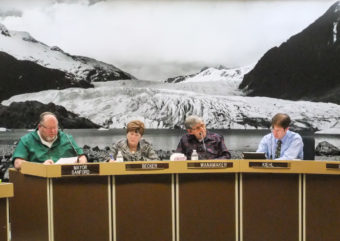
Noting the photo behind Assembly members, North Douglas resident Gene Randall compared a cellphone tower on Spuhn Island to a fictitious one at the Mendenhall Glacier. (Photo by Rosemarie Alexander/KTOO)

The Juneau Assembly has placed a moratorium on cell phone towers while it works on a wireless communications master plan.
The moratorium is prompted by complaints from North Douglas Highway and Fritz Cove Road residents who say a cell phone tower on Spuhn Island keeps them awake at night and is blight on Juneau views. The 300-foot tower within the airport flight path has a flashing red light at the top of the tower and two steady red lights lower down at night, and a flashing strobe during the day.

North Douglas resident Gene Randall brought his concerns to the Assembly nearly five months ago, and says he’s still waiting for a reply.

“Imagine, if you will, a strobing, 155-foot cell tower on the signature view of the Mendenhall Glacier. It would be unacceptable. Juneau has a huge vested interest and financial interest in protecting view shed.”

The tower was approved by the Juneau Planning Commission in 2012. Deputy city manager Rob Steedle told the Assembly their options are limited, short of moving the tower.

“We have no standing, the appeal period is over, we don’t have any options at this time.”

Jon and Lesley Lyman live at the end of Fritz Cove Road, closest to the Sphun Island tower. Jon Lyman said he also doubts the city has any recourse, but said CBJ should be prepared for Verizon Wireless, which has moved into Alaska. He noted the Verizon television ads that pinpoint its network across the U.S.

“It’s like a bloodstain across the Lower 48.”

Lyman said his research indicates Verizon’s plans for Juneau call for 51 cell phone towers.

“Fifty-one. If we don’t have either a moratorium or a program in the city to site these things properly and see to it that people are well-noticed and know what’s going on, then you’re going to have a replication of this over and over again.”

Assembly member Kate Troll seized the idea of a moratorium and Karen Crane put it into a motion.

“That we do not consider any further cellphone applications while we are engaged in developing an ordinance and revising a master plan, so that we’re looking at least until May before we would consider any other cell phone applications. Unless as Miss Troll indicated, they dealt with a health, life, safety issue.”

The vote on Crane’s motion was 5 to 4, with Assembly members Jerry Nankervis, Carlton Smith, Randy Wanamaker, and Mayor Merrill Sanford voting against it.

Nankervis said he didn’t want to close the door on businesses coming into Juneau.

City Attorney Amy Mead said she thought such a moratorium would withstand a challenge in court, because it is short and the CBJ is developing a communications plan.

Beginning this week, the Community Development Department is working on a Wireless Communications Ordinance and Plan. CDD Director Hal Hart said a draft will go before the Planning Commission next month and the Assembly will be voting on an ordinance in late May. He promised there would be plenty of opportunities for public input.

The Assembly also directed the city manager to come up with options for the controversial Spuhn Island tower.

Juneau Assembly to vote on bid award for cruise ship docks

Site plan for Juneau's proposed $55 million floating cruise ship berths. Image courtesy City and Borough of Juneau.
Site plan for Juneau’s proposed $55 million floating cruise ship berths. Image courtesy City and Borough of Juneau.

The bids are in for Juneau’s massive cruise ship dock expansion project, and Seattle-based Manson Construction is expected to get the job.

The company’s $53.7 million bid was the lowest of two accepted by the city. Pacific Pile and Marine – also out of Seattle – bid $58.2 million. Two other companies, Kiewit and Orion Construction, were eliminated for failing to meet the minimum bid requirements.

The city estimated the cost of the project at about $55.4 million to be paid for entirely with state cruise ship passenger fees. It involves replacing the old docks downtown with new floating berths in Gastineau Channel.

Juneau’s Docks and Harbors Board recommended the bid award go to Manson at a special meeting on Thursday. The Juneau Assembly is scheduled to vote on the award at its regular meeting Monday night.

Port Director Carl Uchytil says work on the project won’t get underway until September 2015.

“The way we’ve got it arranged, they start after the last cruise ship leaves in 2015 and they have to have the south berth completed by May 1st, 2016,” Uchytil said. “Then they’ll demobilize and then they’ll come back in September 2016 and complete the north berth in May of 2017.”

Uchytil says the reason for the delay between bid award and project start is the availability of materials, namely the concrete floats used for the berths. He says all the contractors that make those floats are busy with the 520 floating bridge replacement project in the Seattle area.

Juneau’s project has been in the works for almost four years, and has cleared a number of hurdles. The nonprofit Alaska Commercial Fishermen’s Memorial continues to oppose the new docks. The group believes they will negatively affect the annual Blessing of the Fleet.

Also on the agenda for Monday’s Juneau Assembly meeting is a bid award for the Eaglecrest Learning Center. North Pacific Erectors had the low bid to build the new facility at the city-owned ski area. The company’s offer came in just below the city’s estimate of $2.7 million. Construction is being funded by the city’s one-percent project tax on the sale of goods and services in Juneau.

Project labor agreement review process on the agenda

The Juneau Assembly on Monday will vote on a resolution establishing a review process for project labor agreements.

The process was developed the Assembly Public Works and Facilities Committee and would be used to determine if such agreements are warranted on major construction projects undertaken by the city.

A project labor agreement is a pre-hire deal between a developer and contractors, setting basic terms for things like wages, benefits, and working conditions.

While project labor agreement opponents say they unfairly benefit unions, courts have upheld their use by governments, as long as the deal is shown to be in the public’s interest. The Juneau Assembly has adopted a city policy of using the agreements to the fullest extent allowed by law.

The proposed process for determining if an agreement can be used by Juneau departments would put the decision in the hands of a review team led by the City Engineer. Other members of the team would include the head of the department building the project, and someone from the City Manager’s office.

If the team can’t determine whether an agreement is warranted, it can refer the project to the Assembly public works committee.

Juneau Assembly, legislative delegation talk session priorities

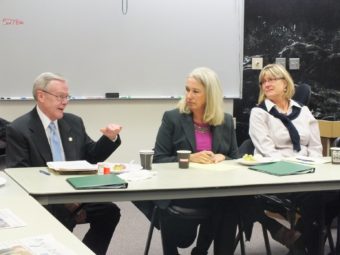
Juneau's legislative delegation, Sen. Dennis Egan, Rep. Cathy Munoz, and Rep. Beth Kerttula discuss the 2014 legislative session with the Juneau Assembly. Photo by Casey Kelly/KTOO.
Juneau’s legislative delegation, Sen. Dennis Egan, Rep. Cathy Munoz, and Rep. Beth Kerttula discuss the 2014 legislative session with the Juneau Assembly. Photo by Casey Kelly/KTOO.

Education funding and the state’s unfunded public employee retirement obligation topped the list of topics discussed by the Juneau Assembly and the Capital City’s legislative delegation on Wednesday.

Assembly members also bid farewell to Representative Beth Kerttula, who announced her resignation Tuesday after accepting a position at Stanford University.

The Juneau School District’s most recent budget forecast includes a $4.5 million deficit, meaning possible cuts to 35 full time positions. Mayor Merrill Sanford says the Assembly wants legislators to increase the state’s foundation formula, which gives money to local districts for each student enrolled during a particular school year. The amount has not gone up since 2011.

“That’s one of our big goals this year is to support increased school funding,” Sanford said.

Mendenhall Valley Representative Cathy Munoz and Senator Dennis Egan will be it for Juneau’s legislative delegation until a replacement can be named for Kerttula. Both support increasing the state’s foundation formula. Munoz says comprehensive education funding proposals are expected to be on the table during the 2014 legislative session.

“I do think that education funding will be a key issue, and I think the details of an educational package will not become really clear until the last probably two to three weeks of the session,” Munoz said.

Governor Sean Parnell wants to put $3 billion from state savings toward paying down Alaska’s unfunded public employee pension liability. Munoz and Egan both support that measure as well. Munoz says an infusion of cash now could save the state millions of dollars later as it seeks to pay down its public employee retirement system debt.

This year Juneau is expected to receive about $22 million in state support for its public employee retirement obligations, according to the city Finance Department.

Congress could include PILT funding in farm bill

A major source of federal money for Alaska communities has become a political bargaining chip in Washington, D.C., says a lobbyist working for the City and Borough of Juneau.

Congress established the Payment in Lieu of Taxes program, or PILT, in 1976 to compensate local governments for lost taxes on federal land within their boundaries. The program expired last year and was not renewed in the recently passed $1.1 trillion dollar omnibus budget bill.

Juneau’s federal lobbyist Katie Ketchel says some western lawmakers, including Alaska’s Congressional delegation, only voted for the budget after being assured PILT would be included in the federal farm bill.

“It just shows you how important that program is,” Ketchel said. “It could have started another federal government shutdown if those members didn’t vote for the omnibus bill.”

Ketchel says the farm bill is expected to be reauthorized soon. She’s in Juneau this week meeting with city officials and spoke to the Juneau Assembly on Wednesday.

Juneau received about $1.2 million in PILT payments during the 2013 fiscal year. The money was not factored into this year’s budget, because the program expired.

Site notifications
Update notification options
Subscribe to notifications