CBJ Assembly Meetings

Juneau Assembly narrowly OKs zone change for Atlin Drive property

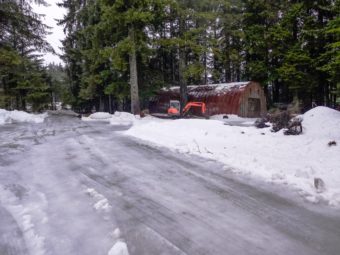
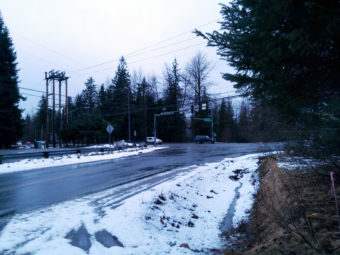
The view of the Mendenhall Loop and Atlin Drive intersection from the property's driveway. (Photo by Heather Bryant/KTOO)
The view of the Mendenhall Loop and Atlin Drive intersection from the property’s driveway. (Photo by Heather Bryant/KTOO)

After nearly three years, the Juneau Assembly has granted a local developer’s wish to use his lot in a mostly residential Mendenhall Valley neighborhood for commercial purposes.

In a split 5-4 decision, assembly members last night approved Richard Harris’ request to have his 2-acre parcel on Atlin Drive rezoned from residential to light commercial. The change contradicts the recommendations of the Juneau Planning Commission, which had voted three separate times since 2011 to deny Harris’ rezone requests. It also goes against the desires of several nearby homeowners, who say commercial activity does not belong in their neighborhood.

But Assemblyman Jerry Nankervis, who served as presiding officer for Harris’ latest appeal, says allowing commercial activity on the property makes sense, because it’s near the busy intersection with Mendenhall Loop Road.

“We were looking at the maps and looking at what we thought was appropriate to do, and this group – the majority of this group – thought that that was appropriate to do that,” Nankervis said.

He says assembly members who voted for the zone change also felt it would allow for higher density housing to be developed.

The four members who voted against the change were Jesse Kiehl, Karen Crane, Loren Jones, and Kate Troll. They wrote a dissenting opinion to the decision issued by their colleagues.

Kiehl says the housing argument cited in the majority opinion doesn’t hold water, because Harris has said he would build fewer units under commercial zoning than under residential. Besides that, Kiehl says the decision completely discounts the work of the planning commission.

“Medium density residential has different uses than light commercial,” said Kiehl. “And the planning commission analyzed that thoroughly. They looked to the laws the assembly has passed and the plans the assembly has adopted. They made a very strong decision. It was not close.”

Harris has not said what he plans to build on the property other than that it would be good for some sort of mixed-use housing and commercial development. Under light commercial zoning he’ll be allowed to build anything from retail shops to a bar to used car lots.

Opponents of the rezone have 30 days to appeal the assembly’s decision in Juneau Superior Court.

Related stories:
Juneau Assembly set to grant Atlin Drive commercial rezone
Juneau Assembly hears latest Atlin rezone appeal
Atlin Drive rezone denied again

Juneau Assembly set to grant Atlin Drive commercial rezone

The Juneau Assembly on Monday will consider a draft decision allowing this 2 acre parcel in a residential neighborhood on Atlin Drive to be developed for commercial uses. (Photo by Rosemarie Alexander/KTOO)
The Juneau Assembly on Monday will consider a draft decision allowing this 2-acre parcel in a residential neighborhood on Atlin Drive to be developed for commercial uses. (Photo by Rosemarie Alexander/KTOO)

The Juneau Assembly is poised to grant a local developer more flexibility with his Mendenhall Valley property, over the Juneau Planning Commission’s recommendations and neighborhood residents’ concerns.

If the assembly approves the draft decision on Monday, Richard Harris could use his lot at the corner of Atlin Drive and Mendenhall Loop Road for commercial purposes. Harris purchased the 2-acre parcel from the U.S. Forest Service in 2010. He first applied for it to be zoned light commercial a year later.

“We’re pleased with the decision and we can now look at beginning to plan with more certainty what we may be able to do with the parcel,” said Harris, who’s developed several valley properties through his company, RH Development.

Nearby homeowners say the property should continue to be zoned for residential use, which is the case for most of the surrounding neighborhood. The Juneau Community Development Department and planning commission have agreed, denying three requests by Harris to have the lot rezoned.

Tim Banaszak lives in the neighborhood and is a vocal opponent of Harris’ rezone request.

“Essentially they’re negating all the recommendations of the neighborhood, the planning commission, and all the parties concerned,” Banaszak said of the draft decision before the assembly. “Really the only one in favor is the actual property owner.”

The draft decision says the planning commission failed to consider the “highest and best use” of Harris’ lot. It says the commission did not place any weight on the need for affordable housing in Juneau. Commercial zoning allows higher density housing than residential zoning.

Banaszak says the neighbors are not opposed to additional housing. The problem is that Harris has not revealed what he plans to build on the property. Commercial zoning could mean everything from housing to offices to restaurants, retail stores, even car lots.

“Once the property is converted to light commercial, it opens it up to all kinds of purposes in our residential neighborhood,” Banaszak said.

While Harris won’t reveal specific plans, he says the property is perfect for mixed-use development, which he argues is more compatible with commercial zoning.

“Flat land in Juneau, buildable land is hard to find. And it should be taken advantage of and maximized, not limited and obstructed,” Harris said. “It’s foolish to put a few small homes on a nice flat larger parcel, and especially not alongside a main thoroughfare. It’s common sense to put commercial in a visible area.”

Assembly members reached on Friday declined to comment, because their deliberations on the decision were held in executive session.

City Attorney Amy Mead wrote the draft decision. She expects assembly members to discuss the decision before voting.

The Atlin rezone request is one of several emotionally charged land use appeals to come before the assembly in recent years. If the assembly approves the draft decision, opponents of the new zone would have 30 days to appeal in Juneau Superior Court.

The Juneau Assembly meets at 7 p.m. You can listen live on KTOO-FM.

Juneau starts to map out its future

The McDowell Group's Jim Calvin presented a number of statistics on Juneau's economy during Thursday's Juneau of Chamber Roundtable Lunch. (Courtesy of Jim Calvin, McDowell Group)
The McDowell Group’s Jim Calvin presented a number of statistics on Juneau’s economy during Thursday’s Juneau of Chamber Roundtable Lunch. (Courtesy of Jim Calvin/McDowell Group)

Where should Juneau be in 10 years? That’s the big question prompting the development of the Juneau Economic Plan, which will lay out the capital city’s economic future. Jim Calvin of the McDowell Group explained during last week’s Chamber of Commerce Roundtable Lunch how he and his team will figure out the answer.

Jim Calvin, economic analyst for the McDowell Group. (Photo by Lisa Phu/KTOO)

Economic analyst Jim Calvin says in order to plan for the future, you need to know where you are today.

“You need to understand what forces are at work, what trends are shaping things as we go forward. We need to understand that left to its own devices, where are we headed? If we don’t try and be proactive, if we don’t try and control to a degree what we can control in our economy, where are we likely to end up?”

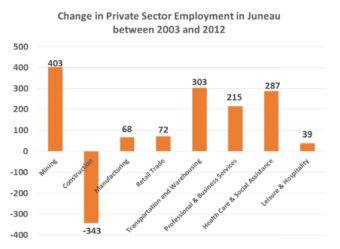
Based on preliminary analysis, Calvin says employment has grown less than one percent each year in the last decade. Between 2003 and 2012, Juneau gained 1,300 new private sector jobs, but lost 400 government jobs.

Of those new jobs, a third of them are in mining.

“The lion’s share of growth in the private sector in Juneau over the last decade has been in the mining sector. These are $90,000, $100,000 a year jobs. That’s good news,” Calvin says. 

Juneau also gained 300 new jobs in health care, but lost 300 construction jobs. Calvin says there will likely be an uptick in that sector with construction of the State Library, Archives & Museum project and the Walter Soboleff Center.

The local workforce has seen a decline of participation from Juneau residents and a growth of nonresident participation. Numbers show that in the past decade wages to those living outside of Juneau have gone up $70 million.

“Obviously nonresident labor is going to be an important part of our labor force no matter what because we have a fairly significant seasonality in our economy and local residents want to work year-round so they’re less inclined to take seasonal jobs. But still, $70 million of money leaking out of the economy is something we have to look at as we think about long-term economic development planning. What can we do to get more residents to earn some of that income?” Calvin says. 

Working with Sheinberg Associates, McDowell Group plans to engage with the community as much as possible when developing the plan.

“We really need to understand what’s important to us as a community. What are we trying to accomplish with this effort? What metrics are we going to use to measure progress. It is important that we start thinking about where we want to be in 10 years,” Calvin says.

Since Juneau has more older people compared to the rest of the state, Calvin says we need to consider the aging population. Ten percent of Juneau residents are age 65 and older. That percentage will double in ten years.

“What can we do as our population ages? What do we need to do in terms of senior services to keep more of that retirement income in the community instead of having it leak out as people go to Arizona or wherever else people decide to retire?” Calvin asks. 

And despite having fewer younger people, Calvin says they will reach out through social media for input from the youth as well.

“We’re actually going to be in the high schools doing some student surveys to get a perspective of young people. After all, this really is a lot about the kind of community that we want our kids to grow up in, so we need to hear from young people,” he says. 

The Juneau Assembly set aside $100,000 for the economic plan, which is scheduled for completion in December. Assemblyman Loren Jones says it’s critical for the assembly to have an economic road map.

“And then we as a city have to look at what can we do to enhance that, what do we need to be careful about in terms of either our taxing policies or our regulatory policies, and what the community wants us to do. But it also points to what the private sector needs to do in the way of helping us and helping the economy of Juneau,” Jones explains.

For Jones, he wants to see a Juneau where families don’t have to struggle to live, recreate and thrive.

What about you? Where do you want to see Juneau in 10 years?

(Editor’s note: This story has been updated to correct the increase in the amount of wages going to nonresidents. The amount is $70 million, not $7 million.)

Juneau faces declining revenues

Juneau City Manager Kim Kiefer and Finance Director Bob Bartholomew
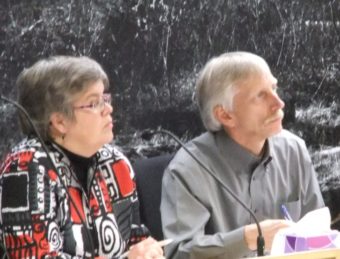
City Manager Kim Kiefer and Finance Director Bob Bartholomew deliver bad revenue news to the Juneau Assembly Committee of the Whole. (Photo by Rosemarie Alexander/KTOO)

The City and Borough of Juneau needs nearly $5 million to balance its budget over the next two years.

Finance Director Bob Bartholomew says federal, state and local revenue sources are down. He told the Assembly Monday night the figures are still preliminary, but members should be prepared for more fiscal challenges as they start their budget work next week.

Bartholomew said the city will lose two federal grants, and a projected 2 percent to 3 percent increase in property and sales taxes did not materialize.

“We’re still seeing slight increases in property tax and sales tax is projected to be flat year to year,” Bartholomew said. “So we backed  off our projections for (fiscal years) ’15 and ’16, and that’s why there’s not a lot of new revenue from our existing programs.”

Bartholomew said CBJ also forecast $800,000 a year in ambulance billings, but federal and local reimbursements have declined.

Despite the flat revenues, he said Juneau is coming out of the economic downturn that had a big impact in the Lower 48.

“We’ve gone through a 3 to 4-year period where a lot of pressure has been kept on the operating budget to hold the line, keep positions vacant, only essential services,” he said. “I think that was a successful approach to helping us get through that national economic downturn that affected Alaska in (fiscal years) ’09, ’10, ’11.”

Since several funding sources will be off the mark, City Manager Kim Kiefer said the city will be looking for ways to enhance revenue and reduce spending.

Bartholomew and Kiefer will present the proposed budget to Assembly members on March 19.  During the budget process, the Assembly will work as a Finance Committee of the Whole to determine the spending plan for fiscal years 2015 and 2016.

Assembly drops Spuhn Island cell tower study

The Spuhn Island cell tower has a constant flashing red light at night and a white strobe during the day. (Photo courtesy Jon Lyman)

The case of the Spuhn Island cellphone tower is closed.

The Juneau Assembly Monday night called off a search for a solution to the 155-foot tower and the flashing lights that have disturbed area residents for more than a year.

The Assembly in January asked city staff to look for ways to mitigate the visual impact of the cell tower lights. At the time, Deputy City Manager Rob Steedle said there were no options. But when pressed, he found six.

“I was wrong. I should have said that CBJ has no good options,” he told the Assembly Committee of the Whole.

He admitted none of his assumptions had been tested. He called the cost of each option “very rough.”

The price tags range from a high of more than $500,000 to relocate the tower, to a low of $175,000 for a dialogue with the Federal Aviation Administration about less intense lighting. Steedle said that could take ten years and he rated the actual chance of conversation very low.

But that was the type of alternative Assembly members seemed to be looking for when they called for the study. Kate Troll said it clearly is time for conversation.

“Have a discussion with the regulatory agencies or the tower and property owners, realizing we can’t compel them to a solution,” Troll said.  “But maybe out of their desire to be a good neighbor, they would modify the blinking light.”

The Spuhn Island tower is within the airport flight path. It has a flashing red light at the top and two lower, but steady red lights at night; a white strobe flashes throughout the day. The tower was properly permitted in 2012.

Atlas Tower LLC, of Colorado, owns the tower. It sits on land leased from Spuhn Island Development, a Juneau company. Atlas Tower is in the midst of its first five-year lease, with five, five-year renewals remaining. Verizon is the cellphone carrier.

CBJ Community Development Planning Manager Travis Goddard said the flashing red warning light provides significant information to pilots.

“And the purpose of that flashing light is to help them figure out the three-dimensional aspect of that tower and where those lights are,” Goddard said.

Mayor Merrill Sanford said the FAA regulations are clear and the city should just drop its study.

“This isn’t just for Juneau, this is across the nation,” he said.

City staff assigned to the project did not talk to the FAA, the tower company, or property owners. They’d been asked to consider community mediation – getting all the parties in the same room to talk through the issues and possible solutions. In a memo to the Assembly, Steedle said the approach made no sense in the case of the Spuhn Island tower; he doubted Atlas would be interested in coming to the table.

That annoyed Assembly member Jesse Kiehl.

“I have never heard a response to, for instance, a request that the Assembly try and start a conversation, or that management start a conversation, like the one in this memo, which simply says, ‘well, we don’t have a hammer, so there’s no point in having the conversation. There’s no point in inviting them to talk. The tone and the approach remain an issue of great concern for me.”

For more than a year, Gene and Sue Ann Randall have been asking the city to help broker a solution. Their North Douglas home faces the flashing tower. They were in Assembly chambers for Monday’s discussion and asked to make a statement, but public testimony is never taken at Committee of the Whole meetings.

After the meeting, Randall said Steedle’s options were shortsighted.

“He suggests that community mediation would be of no value, and this is just shameful to dismiss the value of open discussion on an issue that affects the community this much,” Randall said.

While the case of the Spuhn Island cell tower seems to be closed, the city is in the midst of developing a master plan to regulate the placement, design and permitting process of future  towers. That process promises neighborhood meetings and public hearings before the plan is adopted.

Firefighters stretched while responding to Lemon Creek emergencies

Downtown Juneau fire station (Photo by Matt Miller/KTOO)

City officials want to build a new fire station in the Lemon Creek area.

It’s now the busiest area for medical and fire calls with 550 mobile homes located there and several multi-family units planned for the area.

“We want to do everything we can to make sure that if someone is having a really bad day, that we’re there to make it a little bit better as quick as possible,” said Fire Chief Rich Etheridge of Capital City Fire and Rescue.

While CCF&R already serves Lemon Creek with crews dispatched from either the downtown or airport stations, Etheridge said it really takes too long for them to get to the scene.

“People in Lemon Creek are kind of in the middle. They’re at the far end of both districts,” Etheridge said.

For instance, to go from the downtown fire station into the Churchill Trailer Court area, it takes about eight minutes of driving time. In an emergency, that’s a huge amount of time. Some of the rules of thumb are (that) a fire doubles in size every minute. So, if you figure if there’s eight minutes of just driving to the scene, the fire could be very well entrenched by the time we get there. And if somebody is not breathing, you start having brain damage occurring in four to six minutes and no oxygen.”

Etheridge said the industry standard calls for getting emergency medical technicians or firefighters out of a station within a minute. Drive time to the scene should take no more than four minutes.

Juneau has got a lot of challenges because we’re very long and linear. Most communities are more square-shaped so it’s easier to distribute stations. To get that drive-time down, we would need to have some stations in between, where some communities wouldn’t.”

 (Photo by Matt Miller/KTOO)
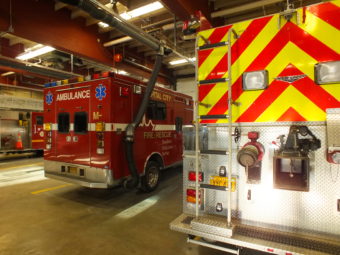
An aerial ladder like Truck #12, shown here inside the downtown Juneau fire station, would likely be stationed at a new fire station in Lemon Creek. (Photo by Matt Miller/KTOO)

Etheridge said a Lemon Creek fire station would have an ambulance with EMTs and a truck company with an aerial ladder truck to allow firefighters to get onto the roof of multi-story structures. Such an apparatus also would carry more rescue tools and equipment than other engines.

The new fire station has been identified as a department priority for fiscal year 2015 in the CBJ capital improvement plan. Total cost is estimated at $10.5 million. City officials have already asked Juneau’s legislative delegation for $900,000 state funding for station planning and design.

Etheridge said a shovel-ready design would allow the fire department to qualify for federal grants to offset construction costs.

He said the city owns several parcels of land in the area that could be used for a station. His preference is a facility on Glacier Highway near the new Public Works vehicle shops, the Juneau Police Department, or a similar location that would provide safe and quick access to a main thoroughfare.

Apparatus inside downtown Juneau fire station (Photo by Matt Miller/KTOO)
Site notifications
Update notification options
Subscribe to notifications