CBJ Assembly Meetings

Juneau Assembly sets school funding floor

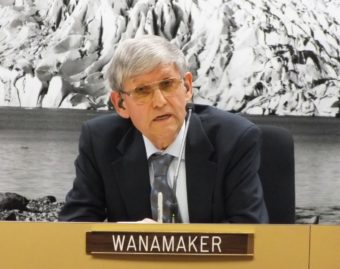
Randy Wanamaker
Assemblyman Randy Wanamaker wants to cut local funding for the Juneau School District next year as the city seeks to deal with an estimated $12 million budget shortfall over the next two years. (Photo by Casey Kelly/KTOO)

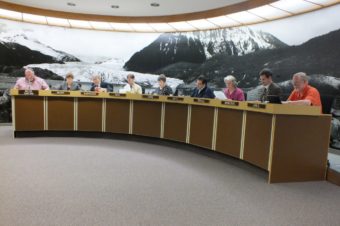
The Juneau Assembly on Wednesday voted to provide no less than $24.1 million in local funding to schools next year. That’s the same amount the city gave the Juneau School District this year, but two assembly members argued for a lower amount.

In order to ensure school funding is relatively equal across the state, Alaska limits the amount of local money communities can put toward education. For years, the assembly has given the school district the maximum allowed under state law, known as funding to the cap.

We have a reputation of funding to the cap, of being fully supportive of education. I, for one, want to maintain that level,” said Assemblywoman Kate Troll at special meeting on the topic Wednesday evening.

While the cap is set to go up next year, the city won’t know the exact amount until the Alaska Legislature passes an education funding bill that’s still being debated as part of this year’s extended session.

In the meantime, the assembly is required to let the district know the minimum amount of local funding to be provided. Until the cap is set, City Manager Kim Kiefer and Finance Director Bob Bartholomew recommended setting next year’s minimum at this year’s cap of $24.1 million. Bartholomew said the assembly could adjust the amount later depending on the new cap.

“We’re proposing something that’s slightly below the cap and recommending that that be the floor for funding for this year,” Bartholomew explained “And then you can change it upwards from there if you want, or if the state comes in and there’s a change in how much is required, we have flexibility to adjust to that.”

The city also routinely gives the district money for things like activities and transportation, which are considered to be outside the cap. The administration’s proposed budget would cut that funding by $200,000 next year, a 5 percent reduction.

In light of an estimated $12 million budget shortfall over the next two years, Assemblyman Randy Wanamaker said the district should have to give up more.

This school district has enjoyed the benefit of many, many years of outstanding support from the assembly, because the assembly believed that it could do that at those times,” Wanamaker said. “And I was one of those that helped support it. But I believe it’s time for them to join in the cost reductions that we have to go through.”

Jesse Kiehl
Juneau Assemblyman Jesse Kiehl says cutting local money provided to the Juneau School District would exacerbate already deep cuts the district has made due to stagnant state funding. (Photo by Casey Kelly/KTOO)

Wanamaker proposed setting the minimum funding amount for the district under the cap at $23 million.

Assemblyman Jerry Nankervis said he’d take it down to $12 million, the minimum required under state law. Though he admitted he would never actually vote for that small an amount of school funding.

“But we’re painting ourselves into a corner because we’re obligated to paint ourselves into a corner,” Nankervis said.

Assemblyman Jesse Kiehl pointed out that the school district has been cutting its budget for three or four years as the state’s education funding formula has remained flat.

“And it’s coming out of our kids. It’s coming out of our classrooms,” Kiehl said.

Wanamaker and Nankervis were the only assembly members to vote against the administration’s recommended minimum school contribution.

School Board President Sally Saddler, who attended the meeting, said afterward that the district has cut nearly 100 employees in the last four years. But she said the city also has had to cut.

“So, I don’t want to get into who feels the pain the most, because I think we all feel it together as a community,” Saddler said.

The assembly continues to work on the city’s two-year budget. A public hearing on the proposed city operating budget and the Juneau School District budget will be held next Monday.

Juneau’s efforts to redraw flood maps produces results

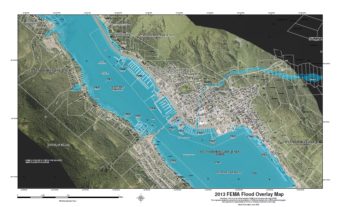
Downtown and West Juneau FEMA flood maps 2013
FEMA’s flood map for downtown and West Juneau. The city has been working with property owners and the federal agency to correct problems with the maps that erroneously included some properties in flood zones. (Image courtesy City and Borough of Juneau)

Since the Juneau Assembly adopted new flood maps last summer, boundaries have been redrawn to remove about 60 homes from areas considered flood prone.

City officials and residents say the maps, drawn by the Federal Emergency Management Agency, are flawed. But the assembly had to adopt them so residents could remain in the National Flood Insurance Program. For months, the city has been working with property owners and FEMA to correct the maps.

“There’s an ongoing effort in our flood program to reach out to the community and work with them, and we have worked with 50 map amendments to date,” CBJ Community Development Director Hal Hart told the assembly on Monday.

Hart says the map amendments will save homeowners thousands of dollars in flood insurance payments.

He also says the U.S. Geological Survey has approved the city’s own LIDAR mapping data. Hart says FEMA and other federal agencies were not allowed to recognize Juneau’s maps until USGS gave its approval.

Juneau Assembly could tap capital projects to address shortfall

Juneau Assembly
The Juneau Assembly listens to City Manager Kim Kiefer deliver an overview of her two-year budget proposal at a finance committee meeting on April 2, 2014. The assembly is looking to tap capital projects to make up a nearly $12 million budget shortfall. (Photo by Casey Kelly/KTOO)

The Juneau Assembly may use money currently earmarked for capital projects to address a multi-million dollar budget shortfall over the next two years.

For more than 30 years, Juneau voters have approved setting aside 1 percent of the city’s 5 percent sales tax for capital projects like new libraries, swimming pools, and infrastructure.

At a finance committee meeting last week, Assemblywoman Kate Troll requested a list of projects that could be put on hold next year with the least amount of disruption to fully fund the Juneau School District.

“I’m not interested in trying to reign in horses, projects that are already out to bid, and bring those horses back in. I’m not interested in that,” Troll said.

Other assembly members want to keep the doors open at Augustus Brown Swimming Pool, which would be mothballed under City Manager Kim Kiefer’s proposed budget.

Overall, the assembly asked for a list of projects that could be deferred or scaled back to free up about $850,000 next fiscal year.

A portion of sales tax outside the 1 percent is also dedicated to the city’s capital budget. That’s the money the assembly would like to tap for the projected deficit. Engineering Director Rorie Watt says the proposed budget includes about 20 projects worth an estimated $8.6 million that are not funded by the voter-approved 1 percent tax.

“They’re basically facility maintenance and road and utility maintenance,” Watt said.

While he’s making a list of the projects most feasible to delay or downsize, Watt has a word of caution for the assembly.

Using capital money, it’s a one-year fix,” he said. “So if we’re talking about operating cost problems that are going to recur every year, the sustainable fixes are things like increased property taxes, or increased user fees, or enduring ways to get more money.”

Not all assembly members are in favor of using capital project funds to pay for city operations. Mayor Merrill Sanford said construction workers rely on city projects to make a living, and Assemblyman Randy Wanamaker said he’s wary of putting off too many projects.

“There are things that simply can’t wait any longer for repairs, upgrades and maintenance,” Wanamaker said.

The city has other options for reducing its budget shortfall, including nearly $20 million in savings. In the long-term, some assembly members want to look for new ways of raising revenue, such as a seasonal sales tax or elimination of certain tax exemptions.

The assembly finance committee holds another meeting on the manager’s proposed budget on Wednesday. On the agenda are presentations from the Juneau Affordable Housing Commission, the Juneau Economic Development Council, Eaglecrest Ski Area and the Juneau Airport.

Is Juneau’s budget shortfall as bad as it seems?

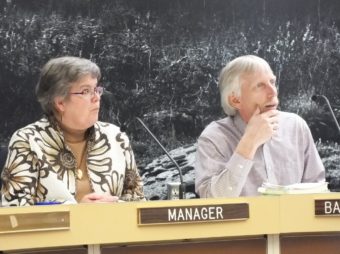
City Manager Kim Kiefer and Finance Director Bob Bartholomew
City Manager Kim Kiefer and Finance Director Bob Bartholomew present the administration’s proposed budget to the Juneau Assembly on April 2, 2014. (Photo by Casey Kelly/KTOO)

Facing an estimated $12 million shortfall over the next two years, the Juneau Assembly will dive into City Manager Kim Kiefer’s budget proposal Wednesday evening at the first finance committee meeting since the spending plan was introduced.

While $12 million may sound dire, the assembly has nearly $20 million in savings to work with.
The money is in two separate funds maintained by the city for unexpected shortfalls and emergencies. One of those is known as the fund balance, which accumulates when the city spends less money than it receives in revenue.

“We do have a central treasury, and that money that’s carried forward from prior years is cash, sitting in the CBJ’s bank accounts,” says Bob Bartholomew, CBJ Finance Director.

Bartholomew says the city will have about $8.1 million in fund balance available on July 1, the start of the new fiscal year. Juneau also has a budget reserve, expected to be about $11.8 million in July, for a total of about $19.9 million the assembly could use to balance the budget.

“Juneau is a financially healthy and stable community,” Bartholomew says. “We just got to a point where, our current operating budget, when we lost some significant revenues [and] had some cost increases, we found ourselves with a shortfall. But I think we have lots of resources for the assembly to take a look at over the next seven weeks to decide how to balance it.”

Fund Balance Graphic2bThere are strings attached to the city’s savings accounts. The budget reserve is only to be used in emergencies, and currently it falls short of the amount the assembly wants on hand. As for the fund balance, Juneau does not have a policy for how much to keep. But Bartholomew says the administration wants to maintain between $3 million and $4 million to address unexpected cost increases or declines in revenue.

“In talking with the city manager we decided it would be better to propose some other alternatives that did keep some fund balance available at the end of the two-year budget cycle, so that if other unforeseen issues arose we could still deal with them,” he says.

The assembly has already approved using $3.1 million in fund balance over the next two years to pay for negotiated wage and benefit increases for city workers. City Manager Kim Kiefer’s proposed budget calls for using another $1.3 million in fund balance to address the estimated shortfall.

Historically, Bartholomew says, the city has used some fund balance to make its budget pencil out every year. In the past four years the city has spent significantly less than the amount budgeted. Bartholomew says that’s definitely been the long-term trend as well.

“In good years we haven’t needed it. And in years where our revenues didn’t come through or we had one time expenditure increases − say, bad snow years − we would then spend out of fund balance,” Bartholomew says.

In addition to savings, the proposed budget calls for $3.6 million in cuts to programs and services over the next two years, including a controversial plan to close the Augustus Brown Swimming Pool for at least a year and a half.

The administration is also asking the assembly to raise property taxes to bring in an additional $1.9 million in revenue each year. Bartholomew says the owner of a $300,000 home would pay an extra $132 a year if the tax increase is approved.

Assemblywoman Karen Crane says the administration’s budget is a good starting place for the assembly, which ultimately shapes the final spending plan.

“There are nine ideas about what to do,” she says. “So we will just have to work it out and see if we can come to some consensus.”

Crane, who chairs the finance committee, says all options are still on the table for balancing the budget. While there are savings available, she says the assembly wants to avoid using the budget reserve.

“I think we are in fairly good shape,” Crane says. “It doesn’t seem like it at the moment, but we do have savings. I think we’re going to get some additional money from federal sources next year. I also think revenues are going to go up. But we need to be conservative with the public’s money and how we look at this and what the decisions are.”

Crane says the city budget will also be affected by decisions currently being made by the Alaska Legislature, namely school funding and public employee retirement system contributions by municipalities.

The assembly finance committee is scheduled to meet weekly through May 7 to hear presentations on specific aspects of the budget. Additional meetings will be scheduled after that.

The final budget must be adopted by June 15.

Assembly nixes boat size limits on Auke Lake

Auke Lake boating season usually begins with the first warm weather in May. For the second year, the CBJ Parks and Recreation will collect data on lake activities. (Photo by Alaskan Librarian/Flickr CC)
Auke Lake boating season begins with the first warm weather in May. For the second year, CBJ Parks and Recreation will collect data on lake activities. (Photo by Alaskan Librarian/Flickr CC)

Size restrictions on motor boats using Auke Lake have been lifted.

The Juneau Assembly Monday night eliminated a 16-foot limit on boats that has been in place since the 1990s. At the same time, members voted to prohibit the flushing or rinsing of boat engines in the fresh water lake.

Like so many Assembly votes, the panel voted five to four on the ordinance to amend Auke Lake regulations – and voted against a recommendation of its own Lands Committee.

The committee last month opposed doing away with the boat size limit, but agreed with the engine flushing ban.

Assembly members voting to relax boat size restrictions were Jerry Nankervis, Randy Wanamaker, Carlton Smith, Mary Becker, and Mayor Merrill Sanford. Both Smith and Becker are on the Lands Committee. Jesse Kiehl and Loren Jones are also on that committee, but on Monday they stuck to their original vote to retain the size limit. They were joined by Karen Crane and Kate Troll.

Auke Lake is owned by the state of Alaska and managed by the city. Following a fatal accident two years ago, the Assembly asked the Parks and Recreation Department to re-evaluate the management plan.

The Parks and Recreation Advisory Committee last year recommended a new plan that would replace vessel size regulations with a 10-horse power limit, and restrict towing. The Assembly refused to consider the proposal, asking instead for more information on lake activities.

CBJ Parks Superintendent George Schaaf told the Assembly that last summer’s  data showed jet skis violated regulations more often than bigger boats.

“We broke it down by personal watercraft as defined by the National Personal Watercraft Association, so jet skis, and then anything other than a jet ski that was a powered vessel,” Schaaf said. “And the personal watercraft were responsible for more observed violations last summer than the other vessels were.”

The study will continue through the upcoming summer, according to Parks and Recreation Director Brent Fischer. That will give the department two boating seasons of data.

“We’re going to continue collecting what type of vessels, numbers, days of high population, just general usage, whether it’s a summer day, rainy day; any violations of the ordinance, whether it has to do with no wake zones, or no vessel zones or anything like that,” Fischer said.

He said once the data is analyzed, the information will be presented to the Assembly, and members will be asked to review the proposed management plan again.

Site notifications
Update notification options
Subscribe to notifications