CBJ Assembly Meetings

Assembly ignores budget comments on school funding and ice arena

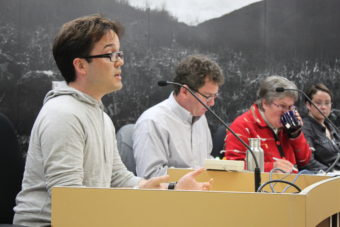
Brendan Sullivan was one of several members of the public to urge against proposed cuts to Treadwell Ice Arena. (Photo by Lisa Phu/KTOO)
Brendan Sullivan was one of several members of the public urging against proposed cuts to Treadwell Ice Arena. (Photo by Lisa Phu/KTOO)

The City and Borough of Juneau Assembly approved an almost $309 million operating budget for FY15 that cuts 12 full-time employees, reduces services and doesn’t fund the school district at the highest level.

Several members of the public were upset about potentially losing ice time at Treadwell Ice Arena and turning the full time positions there into 10-month positions.

“When you don’t have employment for two months of the year or you lose your insurance because you’re not a full-time employee, that certainly impacts how you’re able to function and it certainly might make us lose a valuable employee who’s actually got an understanding of not just the figure skating program but also the hockey program,” said Liz Balstad at Monday night’s regular assembly meeting.

The approved budget closes the ice arena for two months starting next summer and imposes the staffing changes. Ice time will be negotiable.

Major cuts to the operating budget come from phasing out 14 city positions, or the equivalent of 12 full-time employees. Aside from cuts to Treadwell, this includes reduced public library and city museum hours, and reduced city bus service.

In previous discussions, the assembly decided to keep the downtown Augustus Brown Swimming Pool open. Mt. Jumbo Gym will stay open for FY15, but be up for discussion the following year.

Assembly member Kate Troll attempted to amend the proposed budget by restoring $52,000 for downtown parking passes for city employees, a budget cut made during an assembly finance committee meeting earlier this month.

“We have employees that work in the valley that get their parking free, employees downtown would be penalized, so we were setting up different classes of employees,” Troll said.

Assembly member Jesse Kiehl said he doesn’t consider employee parking a high budget priority.

“I understand that there are folks who work for our city who are looking at pulling another $600 out of their pockets every year potentially. There are also folks who work for our city who are looking at a pink slip, quite a few of them in fact,” Kiehl said.

Troll’s budget amendment failed, although later in the meeting, the assembly authorized the city manager to continue paying for the employee parking passes if it can be done within the budget.

How did they vote?

Assembly votes on the operating budget, school district budget and mill rate all resulted in a 7 to 2 split.

  • On the ordinance appropriating $308,849,500 for the City and Borough of Juneau’s FY15 operating budget:

7 yays – Jerry Nankervis, Carlton Smith, Kate Troll, Mary Becker, Karen Crane, Loren Jones & Merrill Sanford
2 nays – Jesse Kiehl & Randy Wanamaker

  • On the ordinance appropriating to the school district an FY15 operating budget of $158,373,800, includes local funding of $24,904,400:

7 yays – Jerry Nankervis, Carlton Smith, Mary Becker, Karen Crane, Loren Jones, Jesse Kiehl & Merrill Sanford
2 nays – Kate Troll & Randy Wanamaker

  • On the ordinance adopting a total mill levy of 10.76, 9.26 mills for operations and 1.50 mills for debt service:

7 yays – Carlton Smith, Randy Wanamaker, Mary Becker, Karen Crane, Loren Jones, Jerry Nankervis & Merrill Sanford
2 nays – Kate Troll & Jesse Kiehl

Troll was able to make one budget change – restore $3,500 to the Small Business Development Center.

Aside from cuts to city staff and services, the city will draw more than $2.5 million from the fund balance and reduce the amount of money going to capital improvement projects by about $1 million.

The assembly is giving close to $25 million to the Juneau School District, which is less than the maximum amount allowed by state law. Several members of the public urged the assembly for more funding and Kiehl made a motion to add about $390,000. This, he said, would prevent elementary class sizes from getting any bigger.

“Our class sizes have been rising and they are set to rise again this year at all grade levels, including where student learning is absolutely the most sensitive to class size and that’s in elementary school,” Kiehl said.

A couple assembly members pointed out it’s the assembly’s job to give funding and the school district’s job to decide what to do with it.

Assembly member Randy Wanamaker said the district already had the opportunity to keep class sizes small.

“They’re choosing to buy stuff instead of fully supporting staff and students as their budget task force recommended. So I can’t support this. We have done our duty by this community in terms of education,” he said.

Kiehl’s motion to raise the city’s contribution to schools failed on a 5 to 4 vote with assembly members Karen Crane, Jerry Nankervis, Carlton Smith, Wanamaker and Mayor Merrill Sanford voting no.

The assembly decided to approve a total mill rate of 10.76, which will not bring the city any additional property tax revenue. Originally, the city manager had proposed property tax increases that would have amounted to roughly $2 million, but the assembly nixed it.

Troll said it’s shortsighted to keep the mill levy flat.

“We have done our part on the cut side of the ledger to build us toward a sustainable budget and we have not been willing to look modestly at the revenue side of the ledger, vis-à-vis the mill levy,” Troll said.

In total, the city reduced its budget by $6 million for the fiscal year that begins July 1. Next year, it plans to cut an additional $9 million.

(Editor’s note: Information on how the assembly voted on different agenda items has been added.)

Cell tower proposal before Planning Commission

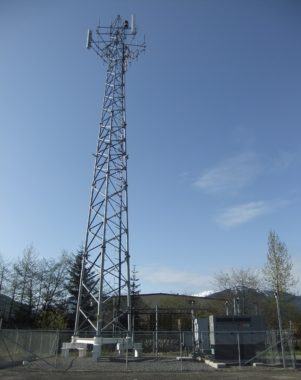
Communications tower in the Mendenhall Valley. (Photo by Rosemarie Alexander)
Communications tower in the Mendenhall Valley. (Photo by Rosemarie Alexander/KTOO)

The city is proposing regulations to require cellphone companies to locate new antennas on existing towers, or conceal them.

The Juneau Planning Commission considers the ordinance Thursday in a special work session. On Monday the Assembly took an initial look at the bill.

It comes after several recent public hearings and lots of citizen angst over cellphone towers this year.

Many of the public comments are based on complaints about how towers look as well as continuous flashing lights – like the infamous one on Spuhn Island.

A number of telecommunication providers are atop that 155-foot pole, including Verizon.

The company is the latest to enter the Alaska wireless market, currently offering data packages in Juneau, Anchorage, the MatSu and Fairbanks. Voice will be available within the year, according to Demian Voiles, vice president of Verizon Wireless in Alaska.

Verizon has 13 sites in Juneau and Voiles doesn’t expect anymore.

“A majority of those sites are what are called co-locations, meaning they were cell sites that were already here, structures that were already here” Voiles said. “We just simply added our antennas to those sites. That includes two rooftop sites.”

Verizon leases space on the roof of the KTOO building for a cell site.

The CBJ draft ordinance requires a new antenna be installed on an existing structure and if it can’t the company must give the city a detailed justification.

Under the ordinance, antennas and towers could be concealed, though it’s silent on methods.

City Attorney Amy Mead told the Assembly Monday that details would be left mainly to the communications company.

“They can conceal them in structures that make them look like steeples, or make them look like trees. There’s only a certain world of possibilities with respect to concealment techniques and so the recommendation was not to limit the concealment techniques, but to make clear what the objective was so that the providers can use whatever methods are available to them to meet the goals,” she said.

Wireless facilities should not “significantly affect scenic corridors or view sheds,” according to the proposed law, but “significant” isn’t defined.

Mead said that would be left up to the CBJ Community Development Department, which would issue the permit for the tower.

“It’s the director’s determination as to what substantially impacts, not the wireless communication providers,” she said. 

Travis Goddard is the planning manager for Community Development and has been working on the master plan and proposed ordinance, which will implement the long-term policies.

Goddard called it a work in progress, but a good ordinance.

“I would not be surprised if it ends up being the best ordinance in Alaska for wireless communication facilities.”

A consulting firm has been involved with the project for several years and helped draft the various versions of the master plan and proposed regulations. The city also used cell tower laws from other communities as models. Goddard said that helped planners present the complicated issues in a well-organized ordinance.

He said the city also worked with providers and believes the plan is business-friendly while addressing the Planning Commission’s and assembly’s concerns.

Earlier this year, the city imposed a moratorium on cell tower permits until the master plan and regulations are adopted.

Water and sewer fees poised to increase 31 percent

water spigot
(Photo by Fedi/Pixabay)

The municipal fees we pay for clean tap water and sanitary sewage disposal are poised to sharply increase.

In a 5-4 vote Monday, a Juneau Assembly committee backed a plan to hike up sewer and water fees about 31 percent over the next three years. If the full Assembly approves the committee’s plan, then monthly fees for typical residents would go from about $90 now to $118 in fiscal year 2017.

“At one point in time, the mayor … made the statement that we have — that the Assembly has funded everything that the utilities had asked for,” said Public Works Director Kirk Duncan (Disclosure: Duncan is also a member of the KTOO board of directors). “He was correct. And what I should have said is, we didn’t ask for enough. We are now asking for what we think we need.”

The proposed fee hikes would partially commit the city to a 10-year Public Works plan. The department wants to turn around the two utilities’ deficits and bank a lot of cash. Through 2024, Public Works anticipates spending roughly $90 million on 175 water and sewer projects. They range from $20,000 pavement and pipe improvements all over the city, to $16 million to build a new facility that would address Juneau’s partially processed sewage problem.

The committee vote was split for a several reasons. One major division was whether the Assembly should look short or commit to the long-term plan.

Mayor Merrill Sanford said he was wary of further burdening the community based off of engineers and planners’ guesses about the future.

 “If you look at wastewater capital improvement projects when you start getting out there in 2018, 19, 20, and on up, you’re looking at guesstimates. And estimates that are based on a yearly thing,” Sanford said. “But when you start going out more than 3 years, you’re — we’re guessing. We’re all guessing. Might be a good guess, but it’s a guess.”

How’d they vote?
The Juneau Assembly’s Committee of the Whole forwarded a proposal to raise water and sewer fees by 9.5 percent in fiscal years 2015, 2016 and 2017. The Public Works Department wants to double the fees by 2024 to pay for roughly $90 million in water and sewer projects.
Loren Jones, Jerry Nankervis, Carlton Smith and Kate Troll voted yes.
Jesse Kiehl, Randy Wanamaker, Mary Becker and Merrill Sanford voted no.
The Assembly’s next meeting is May 19.

Assemblyman Loren Jones took the opposite tack.

“I could see getting into some pattern, that, instead of doing some steady funding and some forward thinking and putting the money in the bank, and trying to decide while it’s there, we get into this bounce up and down based on capital projects and I — I don’t think you like to plan that way, and I certainly would like not to plan that way,” Jones said.

Jones made the motion to commit to the first three years of fee hikes in the 10-year plan.

Assemblyman Jesse Kiehl sided with Jones, “Because it’s always very easy for a future Assembly to come in and say, ‘You know, we’re doing great. The grants are really flowing in, or the infrastructure is really lasting well, let’s reduce this.’ But it’s very painful to come in and say, ‘Golly, we’re short again. And I know we told you all we were going to start funding our depreciation, but we only kind of half-way did it, cause we got this one-time thing.’”

But Kiehl ended up voting no for two reasons. He wanted a longer commitment to give the community more predictability, and he wanted to offset the first few years’ fee hikes with an incoming grant from the state capital budget.

Kiehl said he may offer amendments when the full Assembly takes up the water and sewer fees.

School funding tops Juneau Assembly committee agenda

Class sizes in the capital city will grow next year, unless the Juneau Assembly can muster another $769,000 for schools.

That’s according to Juneau School Board President Sally Saddler in a written appeal to the Assembly. An Assembly committee is reviewing the request Monday.

For years, the city has spent as much as state law allows it to on education. Part of an education bill the governor is expected to sign into law will raise the upcoming budget year’s local contribution cap. The school board’s request falls within the new cap.

The Assembly committee’s other business on Monday includes:

The Juneau Assembly’s Committee of the Whole meets at 6 p.m. Monday at City Hall.

Bartlett board defends salary for new CEO Chuck Bill

Kristen Bomengen and Bob Storer
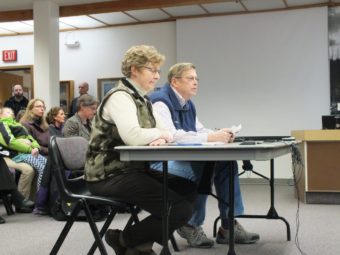
Bartlett Regional Hospital board president Kristen Bomengen and vice president Bob Storer met with the Juneau Assembly on Wednesday to defend the compensation package the board offered new CEO Chuck Bill. (Photo by Casey Kelly/KTOO)

The Bartlett Regional Hospital board of directors is defending the compensation package it offered new CEO Chuck Bill.

Board president Kristen Bomengen and vice president Bob Storer met with the Juneau Assembly on Wednesday to discuss the issue at the request of Assemblyman Randy Wanamaker. They said Bill’s salary of $315,000 and two signing bonuses worth a total of $63,000 were developed with input from board members and Human Resources Director Mila Cosgrove.

Storer said discussions about compensation started with the search committee, which included two doctors and two public members.

“So we used all of that in developing what I would call broad guidelines,” Storer said.

The city-owned hospital also hired a consultant, which made a recommendation based on the average salary of non-profit hospital CEOs nationwide. Bomengen said Bill’s salary is between the 50th and the 75th percentile of that average.

“In fact, the analysis that we were provided with encouraged us around the 65th level,” Bomengen said. “So we feel we fell within that range very comfortably.”

She said a $31,500 signing bonus and a relocation fee for the same amount were added during negotiations with Bill.

Previous Bartlett CEO Chris Harff’s annual salary was $262,000.

Wanamaker provided a list of written questions, but said he had more. He said he only learned about Bill’s compensation through media reports.

“But before even the media released it, members of the public were contacting me to let me know that they had learned about it, and they were not pleased with it,” Wanamaker said.

Bomengen and Storer said the board attempted to contact each assembly member before the news was announced. Assembly members Loren Jones, Jesse Kiehl and Karen Crane said they were notified.

Bartlett board members are appointed by the Juneau Assembly.

Site notifications
Update notification options
Subscribe to notifications