The regular meeting of the CBJ Assembly.
CBJ Assembly Meetings

Why a proposed ordinance could cripple some secondhand stores

The Juneau Assembly this week is taking comment on a proposed ordinance that would regulate secondhand stores and require they report transactions of high-value items like pawn shops.
The Human Resources Committee is considering the measure before sending it back to the full Assembly.
The ordinance is at the request of Juneau Police Department officials who say that car riflings and home burglaries are tied to Juneau’s drug problem. Those looking for a fix will try to raise cash by fencing stolen firearms, tools, precious metals, jewelry and electronics like stereos and cell phones.
Lt. Kris Sell said they’d like stores to keep an electronic searchable record that’s sent to the police department, and hold onto property for 30 days to slow down its potential shipment out of town.
“When burglaries happen, people often lose things that are very important to them (that are) far in excess of the actual retail value of that item,” Sell said. “It can be a grandmother’s necklace or a dad’s gun. Even if we can make a case and that person is compensated, you can’t make them whole once that item is gone.”
Some owners of secondhand stores say the proposed ordinance is overly broad and could cripple their business.
Suzanne Hudson of Nana’s Attic said she has some coin and costume jewelry in addition to vintage items at her downtown shop. Most items are purchased at flea markets, thrift stores, and garage and estate sales. She’s picky about buying from people who walk into her store.
“We cannot electronically keep track of everything because those systems cost a lot of money,” Hudson said. “I cannot store stuff for 30 days and not have it on my shelves because, if I run out of something, I have empty shelves. I may as well be out of business. I don’t have anything to offer.”
Across Seward Street and up a few doors is Mad Hatter’s Emporium. Owner Jayk Kent deals with some coins and jewelry amidst the comic books, vinyl LPs, beer paraphernalia, and baseball cards. He buys most of their stuff at out-of-town thrift and antique stores. But he worries that ordinance’s reporting requirements will scare away most of his Juneau walk-ins.
“We don’t do a lot of buying, but occasionally we do,” Kent said.
“But if this ordinance goes through, there’s no way that we buy from people that come in, honest people that want to get rid of their stuff. They will have to go to the dishonest people then that are still in business.”
Also downtown, Bill Young of the Jewel Box said they’ve accommodated former, known clients who want to trade up or upgrade a particular piece of jewelry. But he said he doesn’t want to sell pre-owned pieces.
“My policy is I do not promote and I do not encourage secondhand purchasing or trading secondhand products,” Young said.
The operators of Lemon Creek Treasures Thrift Store say they really don’t know how the ordinance will affect them. Karla Babcock said they’re trying to help the community, not make a ton of money. They largely sell clothing, kitchen goods, a few DVDs and electronic game cartridges. Babcock said they rarely deal with jewelry. Most of their goods — including electronics — are donated to the shop.
Babcock said that if possible burglary victims or the police wanted to let them know about possible stolen items turned into our shop, “then we’d be happy to look through our stuff. But I don’t believe that people are going to be giving stolen items away.”
Dylan Hammons of Gold & Silver Exchange in the Nugget Mall readily acknowledges that the ordinance is aimed at his business. He declined to participate in a recorded interview, even immediately after explaining at length — off-tape — why he thought the ordinance was a bad idea. Hammons said that he provides a service, paying as much as 90-percent of market value for gold and less for damaged gold jewelry. And, he said, he already documents his purchases from walk-ins. Officers can come down and check if they wanted to do the legwork.
Assemblyman Jesse Kiehl, chairman of the Human Resources Committee, said the state’s pawn shop rules are the model for the ordinance.
“It’s still a draft,” Kiehl said.
“We’re really looking for suggestions from people who have been victims of crime and business owners to make it better.”
Based on comments already submitted, Kiehl said stores that sell secondhand furniture, clothing, antiques, camping gear and sporting goods may be exempt. Another possible provision includes a “hold” placed on an item for sale that a police officer may recognize as stolen property.
“The Chamber (of Commerce) worked really hard on making sure that the probable cause rules applied very clearly in all those cases, and that those holds had to be lifted quickly and property released as soon as it’s no longer part of a criminal investigation.”
The Human Resources Committee will take public comment on the ordinance July 17th at 5:30 p.m. in the Assembly Chambers at City Hall. It may also include a demonstration by the police department on the reporting system used by businesses.
Juneau Assembly debates parking or housing for downtown lot

The Juneau Assembly has authorized the CBJ Lands Department to negotiate terms of sale for a city-owned parking lot to a group of local investors.
Juneau Legacy Properties wants to turn the North Franklin lot across the street from the Baranof Hotel into an apartment complex for seasonal workers.
The group’s proposal is forcing the assembly to consider if the city needs more parking or housing downtown.

Juneau Legacy Properties submitted the only proposal for the North Franklin lot during a month-long solicitation that ended in early May. In a report to the assembly last Monday, City Lands Director Greg Chaney described the group’s plan as mixed-use.
“Twenty-nine units of workforce housing, 990-square foot commercial space and 22 parking spaces on the ground floor,” Chaney said.
The building would include six two-bedroom apartments, 15 one-bedroom apartments and eight efficiency units. Chaney said parking would be for apartment residents only. The 25 public spaces on the lot now would be displaced.
Baranof Hotel Manager Steve Hamilton urged members of the assembly’s Lands Committee to keep the parking lot, according to minutes from the panel’s June 2nd meeting. Hamilton said the lot is used by hotel guests and employees.
Parking is also a big concern for some assembly members.
I know a lot of small businesses and people downtown who use those spaces,” said Assemblywoman Karen Crane. “So I’m having a real problem with the parking.”
Mayor Merrill Sanford said Juneau Legacy Properties’ plan doesn’t do enough to address the city’s housing shortage. Chaney said the lot can support up to 60 units − more than twice what the group proposed. Sanford wondered if there was a way for the city to facilitate a larger development.
“Doing 29 apartments and one floor or two floors of parking, we’ve kind of lost out on the ability of what that lot can provide for us,” Sanford said.
The assembly directed Chaney to get a more detailed proposal from the group, and at a minimum draw up terms of sale for what they’ve already submitted. The proposal would have to go through the Planning Commission then back to the assembly for final approval.
Juneau Legacy Properties partner Steve Soenksen says financial considerations played into the group’s decision to propose a smaller building.
“We wanted to keep the proposal small and doable,” Soenksen said. “So once you get above a three-story building, it goes into a different building type. We’d have a steel-framed structure most likely, instead of wood frame.”
The city bought the property in 2003 when it held an office building and 11-unit apartment complex.
Soenksen believes housing makes more sense for the lot than parking.
Our first goal is to try and help replace some of the housing that’s gone out of service in the last 20 years,” Soenksen said. “And this is designed to address the needs of people that want to live and work downtown.”
The Juneau Legacy Properties partnership also includes Jill Ramiel and Ken Alper, owners of the Silverbow Inn, as well as Evelyn Rousso. Both Soenksen and Rousso are architects.
Assemblyman Jesse Kiehl has considered joining the partnership. He’s recused himself from assembly discussions about selling the property.
An appraisal of the lot paid for by the city says it’s worth $530,000. City code requires municipal land be sold at fair market value. Soenksen says the appraisal gives both sides a good starting price.
Sewer and water fees going up in 2015
Municipal water and sewer fees in Juneau are set to increase with the new year.
Beginning Jan. 1, water utility fees will increase by 6.5 percent and wastewater fees by 8 percent under the ordinance the Juneau Assembly adopted Monday. New rate hikes will continue every July through 2018.
It isn’t the three years of 9.5 percent hikes originally proposed, but the net effect will be about the same.
Scott Willis headed up the advisory board that recommended the increases.
“We know no one likes a rate increase, but we also know that sometimes they are necessary,” he said.
Right now, typical residents pay about $90 a month in combined water and sewer fees. By the fifth rate increase in 2018, they’ll pay about $130.
The hikes partially commit the city to a 10-year Public Works plan to turn around utilities deficits and to pay for sewer and water capital projects. Cruise ship passenger fees and municipal sales taxes will also contribute to the capital projects.
At the Assembly meeting, Juneau Chamber of Commerce representative Lorene Palmer and Alaskan Brewing Co. founder Geoff Larson acknowledged the need for sewer and water infrastructure. But they also urged the Assembly to consider the hardships that the short notice imposes on local businesses’ budgets.
“Many of the small businesses … that are part of the Chamber and part of our community have already budgeted for 2014. And now, on Sept. 1 … this proposal adds a new expense to them that they were not anticipating.” Palmer said.

After their testimony, the Assembly amended the ordinance so the first fee hike takes effect in January instead of September. It also amended the ordinance so five smaller fee hikes were spread over four years, instead of three years of sharper hikes.
The Assembly passed the amended ordinance in a 6-3 vote.
Mayor Merrill Sanford said he would prefer smaller 3 percent hikes.
“I just can’t walk down this path of creating a big account in wastewater and sewer when we don’t need that right now,” Sanford said.
The mayor, Mary Becker and Randy Wanamaker voted against the fee hikes.
Cell phone tower ordinance to be reworked, again

Last night, the Juneau Assembly sent back to committee its long-awaited ordinance to regulate what cell phone towers look like and where they can be put.
The Assembly had the ordinance slated for final vote but that went awry after what could have been the ordinance’s final public hearing.
SueAnn Randall of North Douglas wore a green hat to the Assembly meeting with a spoon attached to it just above her forehead. On the crown of the hat, there was a stand of trees dwarfed by a wireframe tower pointing to the ceiling. The tower was topped with a little red light.
It’s a dig at the cell phone tower on Spuhn Island, which her home on North Douglas Highway faces.
“Since Friday, Sept. 6, 2013, it has been challenging to find respite from the unrelenting flashing light in my home, my gardens and my bed,” she told the Assembly.
That’s when the light on the Spuhn Island tower first went on. That tower and all other existing towers in Juneau would have been grandfathered in under the ordinance the Assembly considered.
Here’s Mary Irvine, another North Douglas Highway resident who’s been following the ordinance.
“The planning commission talked about, ‘Do we give them 1 year to come into compliance? 3 years? 10 years?’ They really delved into it,” Irvine said. “And then, based on one redrafting of the plan … it comes back and the existing cell towers are simply grandfathered in. They never have to come up to conformance to the standards in this plan. It’s astonishing to me.”
Grandfathering was one of several issues that drove the ordinance back to committee. There were also legal technicalities, industry objections to specific rules for being overly broad, and wordsmithing suggestions to better align language with intent.
Kim Allen, a lawyer representing AT&T, noted a few specific parts of the proposed ordinance that imposed great costs to industry. For example, a requirement to mail notices to all property owners within 3 miles of every proposed tower.
Allen said demand for wireless services was up 50,000 percent since 2006.
“We want to bring that service to your community and we want to do it with as little visual impact as humanely possible,” Allen said. “But we also would like a fair and efficient process to do it.”
There was also objection over a recent change on how to communicate what a proposed tower will look like. The latest version requires before and after photo mockups of a given site from multiple points of view. An earlier version instead required flying a bright balloon at the height of the proposed tower in its location for 72 hours.
Allen said the photo route is easier, more accurate and follows what other Pacific Northwest communities are doing.
Community members asked, why not do both?
After about half an hour of critical public testimony, Assemblyman Jerry Nankervis said it was clear the ordinance wasn’t ready for adoption and needed to go back to committee for more work.
Mayor Merrill Sanford chided the Assembly to be better prepared to make changes in committee and for missing past opportunities to do so.
“So we don’t continue things on forever and ever here,” he said.
City officials have been working on a comprehensive cell phone tower plan on and off since about 2009.
Housing tops Juneau’s economic concerns
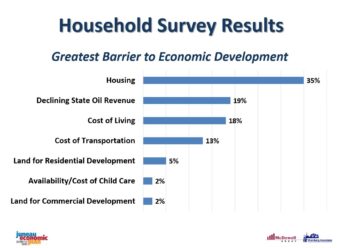
Respondents to a household telephone poll and an open online survey of local businesses identified housing as the greatest barrier to economic development in Juneau.
“Housing, housing, housing is the message,” said Jim Calvin, president of the McDowell Group, speaking to a Juneau Assembly committee Monday.

The Assembly hired the research firm for $100,000 to develop an economic plan due to be complete in December. The surveys were part of establishing a baseline to plan and measure against.
Calvin also presented analysis of economic data identifying many 10-year trends.
“Our economy is growing in terms of jobs, in terms of sales, in terms of population. Yet, our tax base has not been keeping pace with that growth,” he said.
Property tax revenue is keeping pace with inflation, but sales tax income is not. There are several reasons, including an aging overall population taking advantage of the city’s senior sales tax exemption, and a $375 cap on the sales tax due on a single transaction that hasn’t been adjusted for some years.
Calvin reiterated other 10-year trends he had highlighted for the Juneau Chamber of Commerce in March; Juneau’s getting grayer, the private sector is growing while the government sector is shrinking, and nonresidents are filling more and more of Juneau’s jobs.
The Assembly plans to hold an in-depth work session with Calvin in July to set priorities for the remainder of the plan, including identifying economic development strategies.
“Part of what we’re doing with this plan is looking at some return on investment, cost-benefit kind of things,” he said.
“Where can you get the biggest bang for your buck whether you invest in economic development infrastructure or initiatives, where can you get the most year-round jobs or the greatest tax revenue? … What steps enhance our housing market most?”
More reports and information about the Juneau Economic Plan are available at juneaueconomicplan.org.