CBJ Assembly Meetings

Assembly adopts ordinance to curb fencing of stolen goods

Jayk Kent
Jayk Kent, owner of Mad Hatters Emporium, says the new electronic record keeping requirements on secondhand coins and jewelry will be too cumbersome for him to comply with. He says he’ll have to shut down. (Photo by Jeremy Hsieh/KTOO)

The Juneau Assembly adopted a measure last night intended to help authorities track and recover stolen goods moving through legitimate businesses.

Police Lt. David Campbell described property crimes as a “massive” problem in Juneau.

“Big enough to the point where at the police department, we have five detectives. And three of them were assigned to property crimes and two of them were assigned to people crimes. So it’s a big enough issue that 60 percent of detectives were working just on property,” Campbell said.

Assemblyman Loren Jones, who served on the committee that worked on the ordinance, cited some numbers:

“JPD statistics over the last three years: (There) has been almost 3,000 thefts and close to 400 what they’re calling burglaries,” Jones said.

The ordinance targets shops that buy and sell secondhand goods. Those are different from pawn shops, which have special licenses and already are covered by similar requirements in state law. Because of those rules, Campbell said pawn shops aren’t much of a problem when it comes to stolen goods.

Juneau’s new ordinance requires secondhand dealers hold certain goods they traffic in for 30 days. It also requires secondhand shopkeepers electronically record and submit records of their transactions to police every week.

Mad Hatters Emporium-coins
Secondhand coins and jewelry make up a lot of the inventory at Mad Hatters Emporium. (Photo by Jeremy Hsieh/KTOO)

The ordinance applies specifically to electronics and tools worth at least $50,precious metals and gems, coins or bullion, and firearms.

Police say thieves frequently target these items.

One of stiffest objections to the ordinance came from Ray Cox, owner of Rayco Sales. Cox buys and sells used firearms, as well as other outdoors gear at his shop. He said record keeping and storage alone would be costly.

“Plus I’m going to sit on that merchandise for 30 days. That’s 30 days of interest that I’ve got to pay for the money that I’m paying for that merchandise,” Cox said.

Again, that’s a big difference from pawn shops, where holding onto someone else’s stuff is part of the business model. At pawn shops, goods can be sold outright, or used to secure short-term loans. When the loan is repaid plus interest, the items are returned.

Assemblyman Jerry Nankervis said he sympathized with the intent of the ordinance, but felt the 30-day holding period, modeled after pawn shop statutes, was a bad fit. He also had concerns about civil liberties.

“I don’t believe that just because a business takes in something secondhand that the bar ought to be lower for them on what the police can and cannot tell them to do. I believe if you believe it’s a stolen item, and you believe who has it, you go see the judge and you get a search warrant to go confiscate that item,” Nankervis said.

The Assembly’s vote was 7-2, with Mayor Merrill Sanford joining Nankervis in dissent. Sanford didn’t speak to his vote.

The ordinance takes effect next month.

As budget deficit looms, Juneau Assembly eyes tax breaks

Gladi Kulp senior sales tax exemption
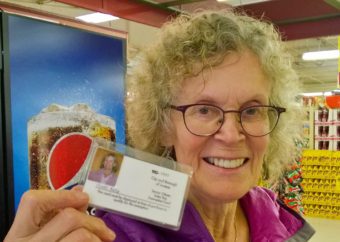
Gladi Kulp shows her senior tax exemption card at IGA. She says she normally doesn’t use it for small purchases, but her cashier knows her and prompted her for the card number. She saved about 85 cents this trip. (Photo by Jeremy Hsieh/KTOO)

With another year of multimillion dollar budget deficits on the horizon for the City and Borough of Juneau, an Assembly committee is reviewing the city’s 37 sales and property tax exemptions.

The committee will recommend which ones to keep, adjust or throw out.

Through sales tax exemptions in 2013, the city gave up nearly $78 million in revenue that could have paid for city services like education, libraries, police and fire protection, road maintenance and parks.

Assembly members on the committee are well aware that this is the hard part of being in elected office.

“If we make any changes that are going to cost anybody any more money, they’re not going to be popular,” Assemblyman Jerry Nankervis said at the committee’s first meeting last week.

After a long pause, Assemblywoman Kate Troll pointed out, “This is not a popularity committee,” which lead to hearty laughter from the committee.

With no changes, the city predicts it will be about $7 million short in the next budget year. The committee and city finance staff agreed that tightening exemptions on big-ticket goods and services is a good idea. Right now, the sales tax paid on a single good or service is typically capped at $375.

“Well, I definitely agree the cap is a good one,” said Sales Tax Administrator Clinton Singletary. “It hasn’t been adjusted since ’91, so it’s been awhile.”

Those caps saved taxpayers more than $5 million last year.

The senior citizens’ sales tax exemption is also under review and bound to be more controversial.

Assemblywoman Kate Troll says she’s interested in scaling it back so wealthier seniors no longer qualify. She also wants to create a new exemption on unprepared foods.

“That would benefit a larger cross section of Juneau. And, actually, people that probably are more deserving or needing of that exemption on food than some of our well paid seniors,” Troll said.

Senior citizens saved almost $2.9 million through the tax break last year.

Both the number of senior sales tax exemption cards issued and the dollar value of untaxed sales have grown steadily since at least 2006, according to finance department figures.

That lines up with a graying trend in Juneau demographics. The Alaska Department of Labor & Workforce Development projects Juneau’s 65 and older population will grow much faster than the overall population in the coming decades.

The tax exemption review committee meets again Aug. 7. Its report is due to the full Assembly by the new year. Similar tax exemption reviews were last completed in 2005 and 2006.

Secondhand dealers ordinance getting reworked

Jewelry
Nana’s Attic sells costume jewelry. (Photo by Matt Miller/KTOO)

The Assembly is delaying consideration of an ordinance regulating secondhand dealers so it can be tweaked further. It was earlier scheduled for a public hearing during the regular Assembly meeting on Monday, July 21st.

Human Resources Committee chairman Jesse Kiehl announced during a special meeting Thursday, July 17th that they plan to address dealers’ comments and concerns in the next draft version. The measure would require secondhand dealers to record purchases of certain used items, and hold the items for 30 days before selling. Thrift stores and non-profit 501(c) organizations would be exempt from the ordinance.

Juneau Police Lt. Kris Sell said secondhand dealers could use point-of-sale system — at no cost — that is identical or the same as used by pawn shops. The latest draft ordinance limits reporting requirements to purchases of used firearms, coins and bullion, precious gems, precious metals, tools and electronic equipment worth over $50.

“If someone has stolen it, then it has no money into it,” Sell said. “They can go sell it to any person for much less than it’s worth and then get a quick sale out of that to turn that around. They can also be shipped out of town quickly with like a cash-for-gold type of service.

Angela Hull of Aardvark’s Armory commented during Thursday night’s meeting that she is a federally licensed firearms dealer that can do background checks. They normally buy used weapons from a limited circle of people that they already know. But she called the ordinance “too onerous” and she worried that holding and storing firearms in a secure area for 30 days could hobble her business if she decides to expand.

“I get what we’re trying to do and I’m 100 percent in support of that,” Hull said. “But this will change the way I’m able to do business. Firearm selling between individuals is completely legal.”

Other shop owners objected to other provisions of the draft ordinance and noted that it does not prevent someone from selling stolen goods on eBay, Craigslist, Facebook’s Juneau Buy Sell Trade page or listing items on KINY radio’s Problem Corner program.

Dylan Hammons of the Gold & Silver Exchange, also known as the “Gold Buyer”, said the new ordinance targeted his business specifically.

“So, all you guys worried about your business getting shut down, just relax,” said Hammons in comments directed at other shop owners in the audience.

Hammons said Juneau was setting a precedent in Alaska with the proposed regulation of gold buyers, secondhand dealers and consignment shops.

“This is not something that we can rush through and just copy and paste from the pawn shop statutes,” Hammons said.

Gwen Place, manager of Alaskan Dames consignment shop, said it may be a burden to store used jewelry for 30 days, but she believed that the ordinance is necessary.

“There’s a big theft problem in Juneau. A big one,” Place said. “Sometimes thieves get stuck with stuff and they don’t want to be caught with it. So, I do think that sometimes thieves unload.”

Place also suggested that it’s not just drug addicted burglars that commit the thefts. Sometimes, it’s as simple as kids stealing money for a video game or stereo system.

The ordinance is scheduled to come back before the Human Resources Committee on July 31st, and then a public hearing during the Aug. 11 regular Assembly meeting.

Assembly approves aquatics board; delays plan to place ice rink under ski area board

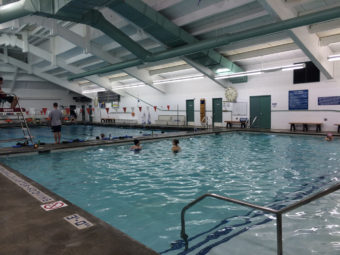
The Augustus Brown facility includes two pools, a sauna and an exercise area. (Photo by Aaron Russell)
The Augustus Brown Swimming Pool and Dimond Park Aquatic Center could be managed by a single board, under a proposal before the Juneau Assembly. (Photo by Aaron Russell)

Juneau voters will be asked in October if an empowered board should be created to run both city-owned swimming pools.

The Assembly Monday approved a ballot proposition to establish such a board in the City and Borough charter.

The idea has been around several years — since the inception of the Dimond Park Aquatic Center — but got new life in April when the city was cutting the budget and suggested shutting down the Augustus Brown pool.

Both pools are run by the CBJ Department of Parks and Recreation. A volunteer Aquatic Facilities Advisory Board offers advice.

“We on the advisory board believe the empowered board is a superior model to the advisory board,” said vice chair Bob Storer.

Storer said such an operating board would have the ability to raise revenue outside of city taxes and user fees, and decisions would be made in a more public process.

“The users would come; they would have the opportunity to hear the conflicts of users and budget and things like that, and it would be in a public arena,” he said.

Glacier Swim Club Board President Patty Ray told the Assembly that an empowered board could run the pools better than the city.

“As a user group our experience has been one of increased user fees every year, reduced pool time, reduced access and I understand that those things are necessary given our budget considerations, but I also think an empowered board will have a bit better ability to efficiently run our pools,” Ray said.

Eaglecrest Ski Area has become the model for the proposed aquatics board. An Eaglecrest board of directors sets operating policy and hires the manager. While Eaglecrest has reached about 70 percent cost recovery, it will always have city general fund support.

That means the Assembly can tinker with its budget.

Assembly member Jesse Kiehl said the board model doesn’t really protect an enterprise from budget cuts.

“In a tough budget situation this year we took a highly successful board that’s met its operating budget cost-recovery targets for several years and we whacked their operating budget. And then we went ahead and whacked their capital budget, too. So if anyone finds themselves under the impression that the pools are protected by an enterprise board, I encourage you to look at our recent history,” Kiehl said.

Though the empowered aquatics board got the Assembly’s support, Kiehl and other members said they don’t have enough information to tell voters whether or not it’s a good idea. As Finance chair Karen Crane said, “The devil’s in the details.”

The issue will be on the October 7th municipal election ballot. Voters will be asked if the city charter should be amended to allow the Assembly to actually create to new aquatics board.

Meanwhile, the Assembly decided to hold off on a proposal to put Treadwell Arena under the Eaglecrest board.

Both the Parks and Recreation Advisory Board and the Eaglecrest board said the idea was too vague.

Mike Stanley is chairman of the Eaglecrest board.

“There’s too many issues, too many questions about what this would all mean. Not only for Eaglecrest, but also for Treadwell,” Stanley said.

In a letter to the Assembly, the board laid out numerous questions, just the beginning of those that would need to be answered before the ski area board could assume control of the ice arena.

The Assembly decided to create a task force to come up with the answers and a report  by February. The Assembly plans to address the issue again next March as it begins working on the CBJ budget.

Assembly to discuss empowered board for Juneau swimming pools

The Augustus Brown facility includes two pools, a sauna and an exercise area. (Photo by Aaron Russell)
The Augustus Brown Swimming Pool and Dimond Park Aquatic Center could be managed by a single board, under a proposal before the Juneau Assembly. (Photo by Aaron Russell)

The Juneau Assembly on Monday will take up an ordinance to create one board to run both city-owned swimming pools.

The idea was first floated by the city’s Aquatic Facilities Advisory Board and Glacier Swim Club when the city proposed closing the downtown Augustus Brown pool to save money. Supporters say a single empowered board could operate Augustus Brown and the Dimond Park Aquatic Center more efficiently and cheaply.

The empowered aquatic facilities board would be similar to the Docks and Harbors and the Airport boards. It would have to be established in the City and Borough’s Home Rule Charter, which requires voter approval.

Voters also may have a chance to authorize the Eaglecrest Ski Area Board of Directors to oversee Treadwell Arena.

A proposed ordinance before the Assembly would put a charter amendment on the October municipal ballot giving the Eaglecrest board authority to manage the city ice rink. Eaglecrest already manages the non-profit Wells Fargo Dimond Park Field House.

Both ordinances require approval of at least six of the nine Assembly members.

The Assembly meets at 7 p.m. in city hall chambers and can be heard live on KTOO Radio.

Site notifications
Update notification options
Subscribe to notifications