CBJ Assembly Meetings

Should e-cigarette vapors be treated like tobacco smoke?

e-cigarette closeup
Robert Rodman, owner of Percy’s Liquor Store, shows how an e-cigarette works. (Photo by Jeremy Hsieh/KTOO)

The Juneau Assembly is considering a ban on e-cigarette vapors in nearly all indoor public spaces.

The local chapter of the National Council on Alcoholism and Drug Dependence led the push at an Assembly Committee meeting Monday. Kristin Cox, a naturopathic doctor and the council’s tobacco prevention program coordinator, argued that the new tobacco alternative is being marketed to youths and misrepresented as harmless.

“So e-cigarettes: They’re new, they’re blue, but will they still kill you?” Cox asked.

She didn’t exactly say yes – the research world is playing catch-up with the products as more parties enter the marketplace and innovate – but Cox did warn that the widespread claims that e-cigarette vapors are harmless and an effective way to help someone quit smoking are both scientifically unproven, and may be entirely wrong.

Researchers at the University of California, San Francisco, recently published a review of 84 e-cigarette studies in a peer-reviewed journal of the American Heart Association. They found a chaotic marketplace filled with a range of unsubstantiated claims and quality control issues with the products themselves.

Results of trials comparing the toxicity of various e-cigarette vapors to traditional tobacco smoke varied wildly. For example, one study of a particular brand discovered toxic metals at levels higher than in regular cigarette smoke, likely coming from the e-cigarette’s metal heating elements. Other studies bore out claims that e-cigarette vapors were less harmful than tobacco smoke, but not harmless.

“You know, middle school kids think they’re harmless. They’re using these devices, they think they’re really harmless. There’s harmless water vapor is what their inhaling. And that’s not the case.”

Cox says big tobacco companies have been pumping a lot of money into buying e-cigarette companies and beefing up their advertising campaigns with youths in mind. E-cigarette juice, vaping liquid or e-liquid, is being made in candy and fruit flavors.

Cox says it’s an initiation tool to introduce youths to nicotine addiction and tobacco use.

“This is a really, really serious issue. It’s re-normalizing cigarette smoking in public. Little kids can’t distinguish between what’s a traditional cigarette and what’s an e-cigarette,” she said.

Under the ordinance the Assembly is considering, the vapors would be treated the same as tobacco smoke, which Juneau banned from virtually all indoor public spaces in 2008.

If the Assembly adopts the ordinance, Cox said, “It’s going to signal to people that these are dangerous, they’re not harmless.”

A few blocks away from City Hall, Robert Rodman has sold e-cigarette products for about a year in his store, Percy’s Liquor.

Robert Rodman
Percy’s Liquor Store owner Robert Rodman has been selling e-cigarette products for about a year. (Photo by Jeremy Hsieh/KTOO)

He’s more or less indifferent about the possible ban.

“I don’t think it’s a huge issue one way or the other,” he said.

Rodman keeps an e-cigarette for himself in the shop to demonstrate how it’s used. His looks like a fat pen. One end houses a battery and heating element. The other end has a vial with the e-liquid in it. The liquid he uses has no nicotine.

“Yeah, I’m not a smoker. I have no interest in nicotine,” Rodman said.

Then, Rodman used one of the lines Cox was worried about.

“It’s just flavored water, basically,” Rodman said. “You know, in that case, you know, there’s no harm.”

In fact, the base in most e-liquids is a common food additive the Food and Drug Administration says is safe to eat, though researchers warn drawing it into your lungs as an aerosol isn’t the same and can cause respiratory problems.

Rodman pushed a button and breathed in. A moment later, he puffed out wisps of a white, scented vapor that hung in the air a few moments before dissipating.

“You’re not really inhaling it. So, I dunno, it’s just a pleasurable sensation,” Rodman said. “You know, you get a little bit of mouth feel with it, you know, in your throat. And with the flavors, you know, you get some taste. I mean, this is coffee. You know, it’s kind of a cool thing.”

The Assembly will hold a public hearing on the e-cigarette vapor ordinance at its next meeting, June 30.

Police propose big hikes to traffic, animal control fines

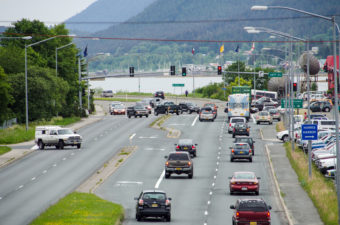
Traffic fines could be going up in Juneau.  (Photo by Heather Bryant/KTOO)
Traffic fines could be going up in Juneau. (Photo by Heather Bryant/KTOO)

If you run a red light in Juneau and a state trooper fines you for it, you could be hit with a $150 ticket.

If the officer worked for the Juneau Police Department instead, the most you’d be fined is $55.

That fine is one of dozens for municipal traffic and animal control violations that the Juneau Police Department wants to raise. Some of the proposed increases double, triple or nearly quadruple existing fines.

“We tried to be reasonable, we’re not proposing any of them that are higher than – we won’t be setting new ground above what other jurisdictions are doing,” said Police Chief Bryce Johnson.

Johnson was briefing a Juneau Assembly committee about the ordinance proposing the changes on Wednesday. He said it’s not intended to bring in more revenue, but to make sure the fines keep their sting and deter bad or unsafe behavior.

“The goal is to have fines match what will deter people from violating those traffic ordinances,” Johnson said.

Johnson said the proposal will modernize the fine schedule, and the figures are in line with peer jurisdictions. Most of Juneau’s current fines fall far below what Anchorage, Fairbanks, and Ketchikan charge, as well as the state of Alaska and Washington, according to figures the police department compiled.

Johnson’s briefing only solicited one comment from the committee. The full Assembly is expected to hold a public hearing and final vote on the ordinance June 30.

Mayor proclaims June LGBT celebration month

At its meeting Monday night, the Juneau Assembly recognized the LGBT community, approved a major rezoning of Pederson Hill, failed to approve a smaller one on an Atlin Drive lot and doubled its filing fees for appeals.
Supporters pose with Mayor Merrill Sanford after he read a proclamation declaring June 2014 as Juneau Pride 2014. It's a celebration of LGBT people and their contributions. (Photo by Jeremy Hsieh/KTOO)
Supporters pose with Mayor Merrill Sanford after he read a proclamation declaring June 2014 as Juneau Pride 2014. It’s a celebration of LGBT people and their contributions. (Photo by Jeremy Hsieh/KTOO)

Mayor Merrill Sanford got a little choked up Monday night proclaiming this month Juneau Pride 2014. It’s a celebration of lesbian, gay, bisexual and transgender people and their contributions.

With a microphone and proclamation in hand, and a quaver in his voice, he read: “On behalf of the City and Borough Assembly, (I) do hereby proclaim June 2014 as Juneau Pride 2014 and encourage the Juneau community to celebrate the diversity of Alaskans.”

Local LGBT groups plan to hold a week of cultural events beginning next Monday.

Pederson Hill rezoned

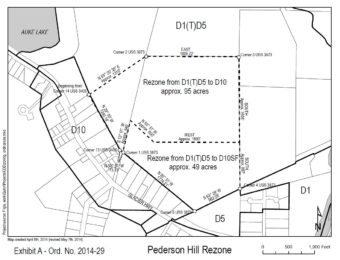
The Assembly unanimously approved a major rezoning of 152 acres of city-owned land near Auke Lake that could, eventually, lead to hundreds of new homes. The rezoning of Pederson Hill is about a tenfold increase in density. Officials hope it will relieve some of the demand and high costs in Juneau’s tight housing market.

Nearby resident Dave Hanna was the only person to speak during the public hearing before the vote. He said he supported the change.

“I say it with kind of the heavy heart, because I used to roam around in those woods when I was a kid, and, you know, you always hate to see those places go away, so to speak,” Hanna said. “But on the other hand, this does serve a need that the community has.”

Absence stalls Atlin Drive rezone

Assemblyman Jerry Nankervis’ absence from Monday’s meeting meant a controversial rezoning of a 2-acre lot on Atlin Drive was short a vote.

Owner Richard Harris wants the property rezoned from a residential designation to light industrial, which would give him more flexibility. He has not disclosed his plans for the property.

The lot has been through more than three years of vetting and appeals through the Planing Commission and Assembly. The Planning Commission denied the rezoning, but the Assembly narrowly reversed that decision on appeal in March, 5-4. Monday’s vote to rezone the property should have been a formality, but with only four yeas, it failed.

Opponents say putting light industry in the area is a bad fit, conflicts with long term planning documents and conflicts with efforts to promote affordable housing.

Mayor Sanford, who voted yes, said the failed vote is temporary; through a procedural action, the rezoning measure will be resurrected at the Assembly’s next meeting.

Filing fee for appeals double

It’s been 18 years since the cost of filing an appeal to a city board or commission’s decision has gone up. Monday, the Assembly approved doubling the $250 filing fee.

“It costs anywheres from $350 to $1,600 — estimate — just in copying for most appeals,” Sanford said. ” We should be recouping our expenses, too.”

Karen Crane and Jesse Kiehl were the no votes in the 5-2 vote.

Crane said raising the fee would discourage appeals, which she could justify if the city had a problem with a frivolous cases. But it doesn’t.

“I think we’re just making it more difficult for people to interact with local government by doing that,” Crane said.

Kiehl said the appeals process shouldn’t be thought of as a business.

“It seems that the $250 level we have now is  enough to beat back the oh-why-not-give-it-a-shot appeals, when you consider that we’re, we’re never going to recoup our costs for this.”

Final vote on Pederson Hill rezone before Assembly

A map of the proposed Pederson Hill rezoning. The change could lead to hundreds of new homes. (Courtesy CBJ)

Update | June 9 at 2 p.m.

Lee Kadinger, The Walter Soboleff Center’s project manager with Sealaska Heritage Institute, says it will delay its appeal. Kadinger says he thinks most of the issues can be resolved through discussions with the assessor’s office.

Original Post | June 9 at 12 p.m.

The Juneau Assembly is expected tonight to take its final vote on a major rezoning that could lead to hundreds of new homes near Auke Lake.

The rezoning of Pederson Hill is about a tenfold increase to the density of homes that could be built on 152 acres of city-owned land.

The Assembly also plans to decide whether or not to hear an appeal from Sealaska Heritage Institute about the property tax status of The Walter Soboleff Center. The nonprofit institute thinks its Front Street building should be 100 percent exempt, while the city assessor maintains it should only be partially exempt because it will not be exclusively used for charitable and educational purposes.

The Assembly will also consider doubling the $250 filing fee for appealing city board and commission decisions and $1.2 million contract award to North Pacific Erectors for Centennial Hall renovations.

The long agenda calls for the introduction of 17 new ordinances. Some of the items of interest include

  • water and sewer utility fee increases,
  • a slew of increases to city fines for traffic and animal control violations,
  • cell phone tower regulations,
  • extending the city’s smoking ban to e-cigarettes,
  • and a $22 million appropriation of mostly federal money for airport runway rehabilitation.

If none of the Assembly members object, the new ordinances will be referred to committees.

The Assembly meets at 7 p.m. Monday at City Hall. The meeting is broadcast live on KTOO.

Site notifications
Update notification options
Subscribe to notifications