CBJ Assembly Meetings

Kiefer offers plan for addressing Juneau’s budget shortfall

Kim Kiefer
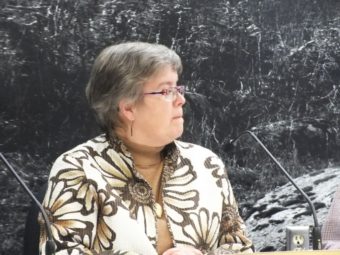
City Manager Kim Kiefer listens as members of the Juneau Assembly discuss her budget proposal. (Photo by Casey Kelly/KTOO)

City Manager Kim Kiefer wants to balance Juneau’s budget with a combination of savings, spending reductions and property tax increases.

With the city facing a projected $12 million shortfall, Kiefer last night presented her proposed budget for the next two fiscal years beginning in July. In the first year, the spending plan would be about $321 million, down 0.4 percent from this year. It would be reduced even more the following year, to nearly $317 million.

That amount covers everything from general government operations to the Juneau School District to city-owned enterprises like Bartlett Regional Hospital and Eaglecrest Ski Area.

Kiefer says coming up with the final budget will be a fluid process.

“But this right now as of tonight, with the scenario in front of you, we are providing a balanced budget,” she said. “It’s a place for us to start the discussions that we’ll have over the next 8-10 weeks.”

Kiefer’s plan calls for $3.6 million in cuts to programs and services over the next two years. That includes laying off as many as 11 full-time employees and eliminating 12 already vacant positions. Bus service and library hours would be reduced, and two major Parks and Recreation facilities would close. As reported on Wednesday, one of those would be the Augustus Brown Swimming Pool downtown. The other would be Mt. Jumbo Gym in Douglas.

The proposed property tax increase would raise about $3.8 million in additional revenue over two years. Finance Director Bob Bartholomew said the increase on a $300,000 home would be about $132 a year.

The plan also calls for using about $4.4 million not spent in previous years to balance the budget in upcoming years, as well as $1.6 million from the city’s budget reserve and $1 million currently earmarked for capital projects.

In perhaps a preview of what’s to come during the assembly’s budget meetings, Assemblyman Randy Wanamaker said there are other ways to balance the budget.

“And that is to reduce spending even further, so that you don’t need a mill rate increase for the operational budget, and you don’t need to tap into the budget reserve,” Wanamaker said.

Assemblywoman Kate Troll said she wants to look at capital projects slated for funding in the coming year to see if the money for any of them can be tapped to help fund general government operations. The manager’s plan only calls for doing that in the second year of the proposed budget.

“When I was just glancing through the list – mind you I didn’t have the expertise of the public works committee or the Engineering Department or anything like that – but I kinda go, ‘Is this really necessary? Is this necessary?’ And my question marks total up to $1.5 million,” Troll said.

The final budget is also dependent on a number of factors outside the city’s control. Among them, state funding for education and how much the Alaska Legislature wants municipalities to contribute toward paying down the state’s Public Employee Retirement System debt.

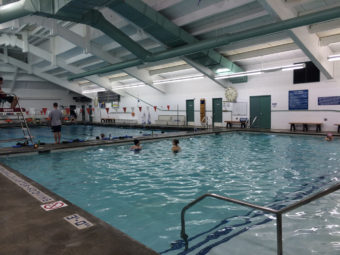
Proposed budget cuts would close Augustus Brown Swimming Pool

The Augustus Brown facility includes two pools, a sauna and an exercise area. (Photo by Aaron Russell)

Juneau City Manager Kim Kiefer is expected to detail her proposed budget cuts to the Assembly Finance Committee on Wednesday, as the city faces a $12 million shortfall over the next two budget years.

On Tuesday, Kiefer told the city’s Aquatics Facilities Advisory Board she would recommend temporarily mothballing the Augustus Brown Swimming Pool downtown. According advisory board member Tom Rutecki, the pool would close Nov. 4 this year through either the mid-2015 or mid-2016. During the closure the city would assess the cost of renovating the facility.

Rutecki says the manager did not mention how the plan would impact employees. He says hours would be extended at the Dimond Park Aquatic Center in the Mendenhall Valley.

Kiefer was unavailable for comment.

Rutecki says closing the pool would affect many Juneau residents, including students taking water safety courses, seniors in water aerobics classes and members of the Glacier Swim Club.

“There’s a pretty strong clientele that goes down there, especially people right now—legislators use it and state office workers at noon. And in the morning the place is packed, if you go to the 6 o’clock lap swim it’s like 3 to 4 people to a lane,” Rutecki says.

He says he suggested to the manager that the city lease or rent the pool to the Glacier Swim Club, which has a wait list for people wanting to join.

Kiefer told the committee that there would be cuts to other Parks and Recreation programs discussed in the finance committee meeting.

City readies for Douglas Highway extension

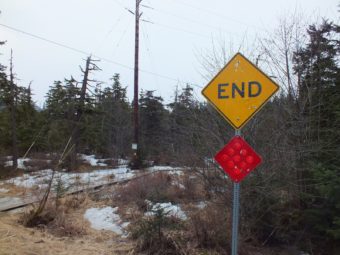
The end of Douglas Highway
Juneau officials are preparing to apply for permits to extend Douglas Highway 3 miles to open up development on the west side of Douglas Island. (Photo by Casey Kelly/KTOO)

City officials are moving forward with one of the Juneau Assembly’s top priorities: Development of the back side of Douglas Island.
As soon as this summer, Engineering Director Rorie Watt says the city will be ready to apply for permits to build a pioneer road at the end of North Douglas Highway. While it would be several years before any development takes place, Watt says the road would allow for more activity in the area called West Douglas.
“We want to make the land more accessible for exploration for development,” Watt told the assembly’s Committee of the Whole on Monday. “And by exploration I mean, make it easier for surveyors and engineers and geologists, biologists and prospective developers.”

The city has about $3.2 million for the road, mostly in the form of a state grant. The assembly has long talked about West Douglas as a possible site for future housing and commercial development.

Watt is recommending a 3-mile, one-lane gravel road, with periodic pullouts to allow vehicles to pass one another. He says a narrower road can be built farther than a more developed, two-lane street. Initially he says the road would be gated to prevent illegal dumping and other unwanted activities.

“In the short run, there’d be a fair amount of public recreational use,” Watt said. “And that might just be dog walking or mountain biking or hunting, winter skiing or some things like that.”

The entire road would be on city land, but allow access to property owned by Goldbelt Inc., Juneau’s urban village Native corporation. Over the years the city and Goldbelt have worked together on numerous proposals to develop West Douglas. Watt says that would still be the case.

“Goldbelt would certainly be involved. A lot of the development contemplated was on Goldbelt land,” Watt said. “Generally, Goldbelt’s view is they have a lot of shareholders and not a lot of land and they want to be really careful with the decisions that they make.”

While the road would span some tributaries of Peterson Creek, Watt doesn’t believe any of them are salmon-spawning streams.

The assembly generally seemed supportive of the proposal to build a one-lane pioneer road. Assemblyman Jesse Kiehl said it could be improved once the area is ready for development.

Kiehl also said he supports keeping part of West Douglas open to recreational activities.

“There’s a great deal of CBJ land back there on that side of Douglas,” Kiehl said. “The federal land gets pretty steep pretty fast, and the private land, trespass permits are not available. So, recreational access to the land on the backside of Douglas is really best accomplished through access to CBJ land.”

Watt says the most important permit needed will come from the Army Corps of Engineers. He says the corps can take six months to a year or more to issue the type of permit needed.

The assembly will hear an update on the project before the city applies for any permits.

After-school program asks Assembly for $48,500 funding

It’s 4 o’ clock in the afternoon and 12-year-old John Barresi’s school day ended an hour ago. But the sixth grader is still hanging out at Dzantik’i Heeni Middle School working on a project with seven of his classmates.

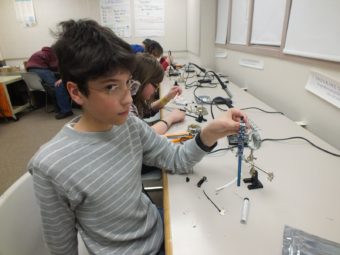
They’re turning a pencil into an electronic noisemaker called a drawdio. By attaching a small speaker and some electronic components to a circuit board, then attaching the whole thing to a pencil, Barresi and his friends can make noise while they draw.

“You put your finger on one end and then you, like, get really close by touching the tip to the lead, and then you keep going farther and it will generate different sounds,” says Barresi, imitating the noise by making a high-pitched squeak.

The drawdio class is one of several activities geared toward middle school students offered by the Juneau Afterschool Coalition. If he wasn’t in the class, Barresi says he’d probably be at home doing homework.

Former city manager and coalition member Kevin Ritchie says after-school programs are one of the best ways communities can keep kids out of trouble.

“In the United States, the crime rate in the first hour after school is over is three times any other time of the day,” Ritchie told the Juneau Assembly Committee of the Whole on Monday. “Youth not in after-school programs are three times more likely to experiment with drugs, alcohol, cigarettes and so on, bad things.”

Ritchie says a recent survey conducted by the Association of Alaska School Boards showed 25 percent of Juneau students in grades six through eight had used alcohol or drugs.

The coalition did its own survey to see what the typical after-school activities were for students at Juneau’s two middle schools.

“Two out of three reported that they hang out at home or hang out with friends three to five days a week after school,” Ritchie says.

About half of all Juneau middle school students surveyed said they were with an adult in some capacity after school two days a week or less.

The coalition formed in 2010 to address a shortage of childcare options in Juneau. It began offering an activity program two years ago. The program is called B.A.M., for body and mind. Some of the activities include arts and crafts, Junior Police Academy, archery and baby-sitting classes. Ritchie says about a third of Juneau middle schoolers have taken part in at least one activity.

The after-school coalition is asking the Juneau Assembly for $48,500 — about half the money needed to keep the program going next school year.

“We want to integrate better with the school curriculum,” Ritchie says. “One of the ways we’re doing that is working with the Juneau Economic Development Council’s Science, Technology, Engineering and Math program. We’ve had some great activities, STEM activities, and we hope to have considerably more next year.”

Bernadette Rosano with JEDC’s STEM program teaches the drawdio class.

“I’m hoping we can expand a little bit into animation, because I know kids really like working on computers and Minecraft is a really big thing,” Rosano says.

The afterschool coalition’s funding request is 5 percent less than it received from the city this year. The assembly is trying to close a $12 million shortfall in the city’s next two-year budget. The group’s request will be taken up during the assembly’s budget meetings over the next two and a half months.

Juneau budget woes worse than originally expected

Juneau City Hall sunny winter day
Juneau City Hall. (Photo by Casey Kelly/KTOO)

After hearing more bad news about the budget, the Juneau Assembly says all options are on the table for reducing spending and increasing revenue.

Finance Director Bob Bartholomew and City Manager Kim Kiefer on Wednesday said the expected shortfall for the next two years will be about $12 million. That’s $7 million more than the administration reported last week.

Bartholomew said two things are driving the shortfall. First, he’s expecting the city to have less money left over each year to be spent in future years – a term called fund balance. Second, the city’s major revenue sources are either going down or staying flat.

“When you have your major programs going from a growth curve to flat, it’s basically helped lead to where we need to find other options for balancing the budget,” Bartholomew told the Assembly Finance Committee.

Bartholomew and Kiefer presented four preliminary proposals for balancing the budget. Right now the city has about $8 million in fund balance and another $11.2 million in savings, both of which could be partially tapped to cover the deficit. Other options include increasing property taxes and reducing programs and services by millions of dollars over the next two years.

Kiefer said she has not decided which programs and services to cut, but said they would touch every department.

“We can’t take little pieces. We’ve been little piecing since 2009, and we don’t have any little pieces left,” Kiefer said.

Assemblywoman Karen Crane, who chairs the finance committee, said the administration should consider all options, including cuts to the Juneau School District and mostly autonomous city enterprise activities like Eaglecrest Ski Area, docks and harbors and Bartlett Regional Hospital.

“I don’t know what we’ll do with that, but we have to factor that information into everything else that we’re receiving,” Crane said. “So as far as I’m concerned everything is on the table at this point.”

Other members discussed options for increasing revenue, including a seasonal sales tax and elimination of certain local tax credits.

The city manager will present her proposed budget to the assembly on April 2. The final budget must be adopted by June 15.

Supporters raise $1 million for new Mendenhall Valley library

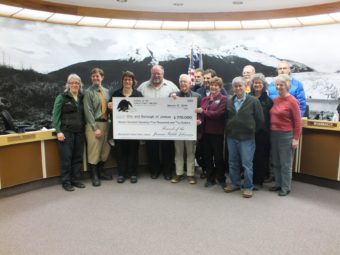
Members of the Juneau Assembly were all smiles last night while accepting an oversize check for $775,000 from Friends of the Juneau Public Libraries.

The nonprofit has now given the city $1 million for construction of a new Mendenhall Valley library. Last year the group gave the city a check for $225,000.

“This is so much fun to give away a million dollars,” said Paul Berans, president of the friends of the libraries board of directors.

The group raised most of the money by selling used books at its Amazing Bookstore.

“Can you imagine how many books at a nickel, a dime, a quarter and a dollar it takes?” Berans asked.

He gave credit to the dozens of volunteers who donate their time at the store and library events.

Planning and design are nearly complete for the new Mendenhall Valley library.

With the $1 million from the friends group, the city will pay for less than half of the nearly $14 million project. In 2012, Juneau voters approved a sales tax measure to provide some of the financing. The rest will come from a $7 million state grant.

The new library will be built at Dimond Park and replace the current branch located in the Mendenhall Mall.

Site notifications
Update notification options
Subscribe to notifications