He says Juneau also ranks high nationally, “Our water is so clean that it’s cleaner than the stuff you buy out of a plastic jug. We’ve got a wonderful health infrastructure around here for our size. Our hospital is an amazing hospital even with a target population regionally of 50,000, so it’s the reason why we’re so well rated by national surveys in terms of health.”
Felix says part of the report’s goal is to give community health planners an indication of how to make a community healthier, so the report also focuses on Juneau’s weaknesses.
“The primary ones are drug and alcohol abuse and all the diseases associated with those two things. And there were two surveys done in Juneau – one in 2005, the Compass Survey, and another, the McDowell Survey in 2010 – and people in the community identified alcohol and drug abuse as the main issues, too, so the community is aware,” Felix says.
According to the report, Southeast Alaska is the heaviest drinking region in the state and one of the highest consuming regions in the nation.
Felix says Juneau also has a high rate of Hepatitis C, similar to the rest of the state, and a high rate of sexually transmitted diseases.
The Healthy Indicators report also shows that Juneau’s population is rapidly aging, says Felix:
“We are one of the fastest – if not the fastest – communities in the United States in terms of our aging population. That’s going to impact our healthcare system here tremendously both financially and in terms of special kinds of care that we’re going to need.”
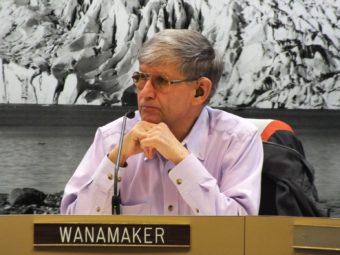
Assemblyman Randy Wanamaker chairs the Juneau Assembly Public Works and Facilities Committee, which endorsed a city Project Labor Agreement review process on Monday. Photo by Casey Kelly/KTOO.
A Juneau Assembly committee has endorsed a proposed review process for determining when municipal construction projects warrant a Project Labor Agreement.
The Assembly Public Works and Facilities Committee on Monday voted unanimously to send a resolution establishing the procedure to the full Assembly with a “do pass” recommendation.
Rorie Watt is the City Engineer, who would chair the review team.
“The biggest effect is it broadens decision making within the city beyond either just myself, or the Airport manager, or the Bartlett manager, or the Port Director,” Watt said.
A Project Labor Agreement is a pre-hire deal that sets basic terms for things like wages, benefits, and working conditions.
Courts have upheld the use of Project Labor Agreements by governments as long as they demonstrate a clear public benefit. The proposed review procedure lists such benefits as timely and efficient completion of city projects, and ensuring labor peace and stability.
Critics of Project Labor Agreements have charged they unfairly benefit unions.
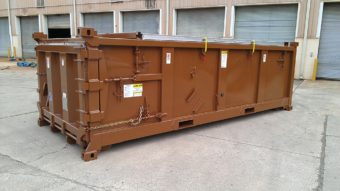
One of the city’s five watertight shipping containers it purchased last year. The city is buying 40 more to transport sewage sludge. They cost about $20,000 each. (Photo courtesy CBJ Public Works Department)
The proposed deal calls for Juneau landfill operator Waste Management to continue shipping the city’s processed sewage sludge to the Lower 48. In the meantime, Juneau Public Works Director Kirk Duncan says city officials will investigate a long term solution for what to do with the stuff, sometimes called biosolids.
“The contract has no minimum,” Duncan told the Juneau Assembly Public Works and Facilities Committee on Monday. “So as we come to the final solution of biosolids – which may take us five years or it may take us three years or it may take us two years to implement – we do have the option to haul for the next five years.”
Waste Management has been hauling Juneau’s sludge to a disposal site in Oregon for more than a year. Its current contract runs through March. Duncan says the city and the company have resolved issues with the containers used during shipping that led to odor and leakage problems.
The city has batted around various ideas for what to do with its processed sewage since 2010, when its sludge incinerator went offline. One option involves about $3 million in upgrades to the Mendenhall Valley Wastewater Treatment Plant that would allow the city to turn the stuff into fill or fertilizer.
Assemblyman Randy Wanamaker says he’d like to see a long term solution sooner rather than later.
“If I’ve heard one thing all winter long, it’s we have got to fix this,” Wanamaker said. “It doesn’t matter whether I’m talking to my dentist or somebody at the coffee shop. It’s all over the place. It’s just one of those things, and people want us to have a long term solution.”
Duncan said the monetary terms of the new agreement with Waste Management are still being finalized.
Fecal cliff is a term coined by a DJ at KVOK in Kodiak, which faced a similar problem of what to do with its municipal sewage waste in 2012.
Full disclosure: Kirk Duncan is a member of the KTOO Board of Directors.
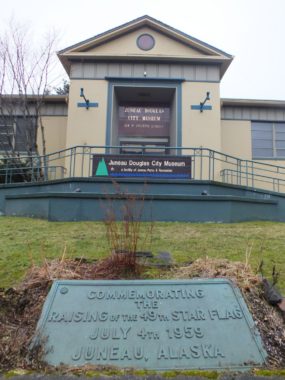
City Library Director Robert Barr told the Assembly Human Resources Committee that the move makes sense from an operational perspective.
“We see opportunity for staff to collaborate more where our missions intersect,” Barr said. “The museum and the library share some common efforts in terms of curation and collections, programming efforts.”
Barr also said there could be a financial benefit in terms of helping the city secure grants.
“The primary federal granting organization for libraries and museums is the IMLS – the Institute for Museum and Library Services,” said Barr. “And there are granting opportunities that come up from time to time that we would be better positioned for applying for jointly.”
Of course, he says, that won’t always be the case. So the museum and library would maintain their own separate accounting operations.
The move is not expected to impact the overall city budget. The museum has four full time employees and a budget this year of $419,100.
An ordinance making it official is expected to be introduced at the next Juneau Assembly meeting, January 27th. It would then come up for a public hearing and vote in February.
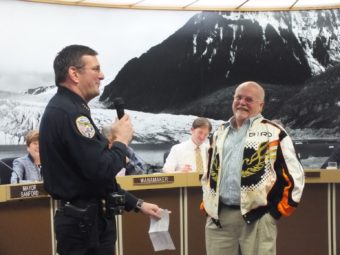
Juneau Police Chief Bryce Johnson jokes with longtime JPD mechanic Scott Phillips about his retirement after 30 years with the city. Photo by Casey Kelly/KTOO.
About a dozen Juneau police officers packed City Hall Assembly Chambers Monday night for the start of the first assembly meeting of 2014.
They weren’t there to arrest anyone or quell a riot, but rather to celebrate the career of longtime Juneau Police Department mechanic Scott Phillips, who just retired after 30 years with the city.
Police Chief Bryce Johnson said Phillips started with the Public Works Department in 1984, and joined JPD’s auto shop 10 years later.
“By my count that’s seven police chiefs since you started,” Johnson said.
Every time JPD bought new vehicles, Johnson said Phillips was responsible for maintaining them and keeping officers safe behind the wheel.
“We went from Dodges to Chevys to Fords, am I missing any of them?” Johnson laughed. “We got all those. And then all the unmarked cars, probably a Toyota or two. But he would have to re-learn how to maintain each car each time we would change cars, and he maintained all those cars for a tremendous amount of time.”
Mayor Merrill Sanford presented Phillips with a certificate of appreciation.
Phillips said he doesn’t have big plans for retirement, just spending more time with family.
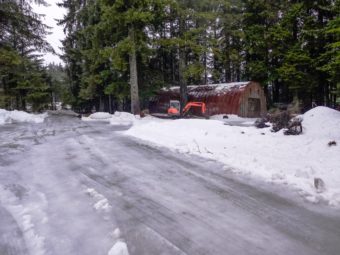
The Atlin Drive property developer Richard Harris wants rezoned from residential to light commercial. Photo by Rosemarie Alexander/KTOO.
Developer Richard Harris was back before the Juneau Assembly on Monday asking the panel to rezone a property he owns in the Mendenhall Valley.
Three times Harris has been to the Juneau Planning Commission asking for the two-acre parcel at the corner of Atlin Drive and Mendenhall Loop Road to be zoned light commercial, rather than its current medium density residential. And three times the Planning Commission has rejected Harris’ request, citing the city’s Comprehensive Plan.
After one of those attempts, the Assembly reversed the commission’s decision – but only temporarily. The action was rescinded when the city attorney found it illegal.
The Assembly heard Harris’ latest appeal at a hearing Monday night, where the developer argued the Comprehensive Plan actually supports his request.
“It’s just hard to believe that anybody could look at this site and say, you know, that’s probably better residential than commercial,” Harris said. “Just look at the site, the project, what it is, where it is, and say, it looks like commercial. Most people can’t believe it’s not commercial.”
Harris bought the property from the U.S. Forest Service more than three years ago. It’s currently occupied by a stand of trees and an old World War II Quonset hut. Duck Creek runs through the parcel.
Neighbors along Atlin Drive and nearby Teslin Street have opposed the switch to light commercial over fears of what kind of development would be allowed under that zoning.
Harris has not proposed a specific project, other than to say he wants it to be mixed use. Some mixed use is allowed with a conditional use permit under the current residential zoning, but he says it’s not enough for what he wants to build there.
Senior City Planner Beth McKibben told the Assembly that the Planning Commission’s decision to reject the rezone was based on her analysis of the most compatible uses for the area, according to the Comprehensive Plan.
“The staff analysis was that light commercial is not consistent with medium density residential and the Planning Commission agreed,” said McKibben. “But Mr. Harris’ interpretation is different.”
The Assembly listened to arguments from both Harris and McKibben for about an hour before its regular meeting. Members went into closed door deliberations after the meeting. The Assembly has 45 days from the date of the hearing to issue a proposed decision in the case.
Assembly unanimously passes ordinances
The Juneau Assembly last night (Monday) voted unanimously to amend the city’s disturbing the peace code.
Assembly member Kate Troll sought to clarify it even further. She acknowledged that some people have criticized the city’s noise law for not specifically mentioning common problems, such as fireworks. But Troll argued the ordinance can be applied to fireworks under certain circumstances.
“While this amendment does not specifically address the use of fireworks, I believe it does adequately protect our residents by making it a citable offense to create an unreasonable noise disturbance, which would include the use of fireworks in residential neighborhoods, except during those times of the year, such as July 4th, that most people would find the noise acceptable,” Troll said.
There was no public comment on the noise ordinance during the meeting, but the Assembly did receive three comments by email.
The Assembly also passed an ordinance creating a separate Human Resources and Risk Management Department. Previously HR had been a division within the city manager’s office. The move comes as the department takes on an expanded role, offering more services to the city-owned Bartlett Regional Hospital as well as the Juneau School District.
The Assembly also transferred $150,000 to the Last Chance Basin well field rehabilitation project. The money was from the city’s Water Utility fund balance. The transfer makes a total of $300,000 available for design work on the project, which aims to make improvements to the aging Last Chance Basin well system.