CBJ Assembly Meetings

City manager gets a raise

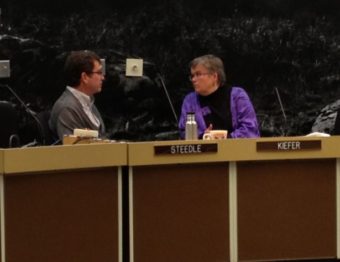
Kim Kiefer has been city manager since April 2012. (Photo by Lisa Phu/KTOO)

In a 7-2 vote, the CBJ assembly approved a three percent pay increase for city manager Kim Kiefer. That means Kiefer will be getting an annual salary of $149,350 with benefits retroactively effective April 1, 2013.

The merit increase was put forward by the city manager evaluation subcommittee made up of Mayor Merrill Sanford and assembly members Karen Crane and Carlton Smith.

Part of the committee’s recommendation is based on an evaluation process conducted by the CBJ human resources department.

“A 360-degree leadership evaluation allows the person being evaluated to see themselves from a variety of different angles,” explained human resources director Mila Cosgrove.

She said CBJ department directors, other city employees who directly report to the city manager, several community members outside city government who deal with the city manager, and assembly members were invited to anonymously fill out a survey.

It touched on five broad categories – professional competence, personal effectiveness, results orientation, interpersonal effectiveness, and organizational effectiveness. Examples of survey questions include how well Kiefer sets clear direction that aligns her team with the city’s strategy, and how well Kiefer fosters energy, enthusiasm, and commitment. Ratings were based on a 1-5 scale, 1 being poor, 5 outstanding.

Cosgrove said Kiefer also filled out the evaluation.

“The survey itself, you can take a look at and you can slice and dice it and you can say, ‘Well, here’s an overall rating of everybody who answered this question. Here’s how you rated yourself, here’s how your direct reports related to you in relationship to that question, etc.,’ so you get to see how different people view you.”

Cosgrove said the 360-degree survey is just part of the process to evaluate the city manager. The assembly also discussed the evaluation with Kiefer during executive session last month.

“It’s not only a look back but ideally an evaluation is a look forward, a chance to set goals and objectives and talk about what worked well last year, what might be tweaked, and how can everybody work most effectively moving forward.”

The evaluation process was one of three reasons cited by assembly member Randy Wanamaker for objecting to the merit pay increase.

“The evaluation process was flawed. There were issues identified in the evaluation that are not satisfactorily addressed by the suggestions for an improvement plan, and the improvement plan itself is so unclear, that it is neither fair to the citizens of the community, the assembly, or to the city manager,” he said.

Assembly member Jerry Nankervis also objected, but would not discuss his reasons in public.

Kiefer has been CBJ city manager since April 2012. Before that, she served seven years as deputy city manager and was acting manager for six months in 2009.

As city manager, Kiefer serves at the pleasure of the assembly and does not have a contract.

CBJ noise ordinance still in the works

Floatplanes are often the source of loud noise downtown near Marine Park. (Photo by Lisa Phu/KTOO)

The assembly is not happy with the draft noise ordinance that would amend the disturbing the peace code.

“It is still in my opinion way too cumbersome and I would argue almost unenforceable the way it’s written, and unrealistic,” said assembly member Jerry Nankervis.

The latest version dictates what times are considered ‘day-time’ hours versus ‘night-time’ hours.

It also defines noise level in terms of decibels, which CBJ attorney Amy Mead says is hard to enforce. She recommends keeping the current code standard, which is defined as a “reasonable person of normal sensitivity.”
“There’s a long and continuous noise that’s going on at 3 am and it’s woken up six neighbors and the officer stands on the street corner and can hear it very loudly coming from this particular house. That’s something that the court and jury can easily understand. You don’t have to prove that this device was tracking the sound properly at the time that the officer wielded it and the officer wielded it properly,” Mead explained.

Assembly member Jesse Kiehl said it’s worthwhile to have an objective standard to go with the “reasonable” standard.

“The increase above ambient noise would be the best approach because it keys off what’s going on in the neighborhood. If you live right next to the highway, the increase above ambient noise is going to be louder than if you bought a place on Sleepy Court, which is ably named.”

Kiehl said this will protect neighborhoods at night.

Assembly member Loren Jones wanted to know how an ordinance without decibel levels would define what’s “reasonable” in residential areas with construction noise. He used the example of improvements at Statter Harbor.

“Does this ordinance the way it’s written or the way you’re proposing to write it make a difference in the way the condo association can argue about construction noise versus what the planning commission might do in terms of construction noise?” he asked.

Mead says it’s up to the assembly, “We can define what the standards to be considered when we’re defining what’s unreasonable in any way that we choose to do so.”

But Mead also made it clear when the assembly has little power over certain activities; for example, in the case of barges.

“We have very limited ability to be able to dictate when they can come in and how loud they can be. We just don’t have the authority to do that. We can’t set decibel levels that are different than would be authorized under the very specific and large federal regulatory scheme.”

Mead will make changes to the current disturbing the peace code before bringing it back to the committee of the whole. She says she’ll add a clear objective to the ordinance, which is to prohibit unreasonable noise. Other changes include outlining standards considered “unreasonable”, and adding “ambient noise” as an objective standard.

Closed door meetings planned to hear report on personnel investigation

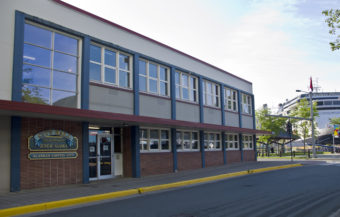
Juneau City Hall
CBJ assembly will hold a special meeting to hear a report on the city’s investigation into hospital personnel issues. (Photo by Heather Bryant/KTOO)

The CBJ assembly and hospital board hold separate executive sessions today to discuss a confidential personnel investigation at Bartlett Regional Hospital regarding allegations of a hostile work environment.

CBJ attorney Amy Mead says the hospital board approached the law department at the end of May.

“They were aware of some stories that were going on and complaints. They wanted to look into that and I recommended that they do an investigation.”

The city hired Deborah Schorr of Schorr Advocacy & Investigative Service in early June to conduct an investigation.

CBJ’s human resources director Mila Cosgrove says Schorr has been interviewing hospital employees. “I believe she is just about done with the interviews that she’s been asked to do so we’ll make a report out to the Bartlett board of directors.”

Schorr is still on contract with the CBJ. Cosgrove says it’s uncertain if the investigation is complete.

“It may or may not be depending on what the board decides they wanted to do with the information, or if they would like us to gather more information. That decision has yet to be determined.”

Hospital board officers meet at noon today and plan to go into executive session to hear Schorr’s report.

This evening, it’s the assembly’s turn to hear the report on the investigation, also behind closed doors.

AJ Mine compact renewal stands — without a public hearing

Despite a public outcry on a recent AJ Mine resolution, the Juneau Assembly Monday refused to reconsider a vote and discuss the issue.

The Assembly two weeks ago approved Resolution 2656, renewing a 1979 compact for property owners CBJ and AJT to act as a single entity for future mine exploration and development.

Before it appeared on the July 16 agenda, the resolution had not gone through an Assembly committee, nor had a public hearing.  Attempts by three members failed to table the resolution or send it to the Committee of the Whole. At the end of that  meeting, member Jesse Kiehl called for reconsideration of his vote, vowing to bring up the issue again.

The public beat him to it.  Several residents came before the panel on Monday, asking members to reconsider, including Juneau resident Bob Sylvester.

“I think that democracy, for lack of a better word, is time consuming and inefficient. I know people would like to get on with this project (re-opening the mine). But I believe the public has the right to be heard in a thorough public process,” Sylvester said.

The city and borough owns two-thirds of the AJ Mine property and one-third of the Treadwell Mine in Douglas. AJT Mining Properties, a sister company to Alaska Electric Light and Power, owns the rest. The 34-year-old compact joins the property.  City Manager Kim Kiefer previously called the compact update a “housekeeping” measure that only demonstrates the commitment of CBJ and AJT to make the property available for mining development.

In the two weeks since the Assembly approved Resolution 2656, members have received on online petition with 140 signatures as well as numerous emails asking that it be brought up again. They’ve have been stopped on the street by constituents, and criticized in letters to the editor.

Kiehl said he’s had personal conversations with ardent mine supporters and critics, all saying the resolution should have a public hearing.

“What I’ve heard overwhelmingly in those comments  from the public is that they still don’t know what it does, and they’re not sure if it’s a good idea and they’d like us to hash it out a little more and to do so in public,” Kiehl said.

Guy Archibald, of the Southeast Alaska Conservation Council, was one of those reminding the Assembly that re-opening the old mine has been one of the most divisive issues to ever come before the town.

“There cannot be any Assembly action on the AJ Mine that’s dismissed as either routine or just processing paperwork without also dismissing the very strong feelings and emotions from a large portion of this community,” Archibald said.

When Kiehl called for reconsideration of the resolution, his motion failed on a six to three vote.   Only Kiehl, Karen Crane and Loren Jones voted to hear the issue again.  Mayor Merrill Sanford, and members Carlton Smith, Randy Wanamaker, Mary Becker, Jerry Nankervis, and Johan Dybdahl voted against reconsideration.

Thane Road resident Larri Spengler was surprised that no members explained why they would not allow a public hearing on the resolution.

“I think it would have lost nothing to have a meeting, talk about it in public and then have the vote. And if the Assembly still thought it was a good idea they could still do it, but people would have been brought along, and that’s really the key,” she said.

The question before the Assembly was simply whether to talk about the AJ Mine compact update in public.  It was not a question of the merits of the compact .

Juneau’s main source of water comes from Last Chance Basin, which sits atop, adjacent to and beneath the ore body, just above downtown.

Cellphone tower planned for Eaglecrest

GCI plans to lease a spot at Eaglecrest Ski Area for a cellphone tower.

The company wants a 20-foot by 20-foot parcel of land near Porcupine Chairlift to install a 50-foot high wooden pole with cellular equipment.

Cellphone coverage at Eaglecrest is spotty at best and non-existent in some places, especially at the base of the mountain.

CBJ Lands Manager Greg Chaney told the Assembly Lands Committee Monday that reliable communications would improve Eaglecrest customer service and skier safety as well as bring the city-owned operation more revenue.

“It’s going to be in the order of 500 to 600 dollars a month.  We’re still negotiating the final amount, but we’re hoping to have a 3 percent increase-per-year provision.  That’s what we’ve done on other towers and that’s kind of the industry standard right now, so for about a five-year period we’ll have that little bit of escalation,” Chaney said.

Chaney said the tower won’t spoil skiers’ and snowboarders’ view, or hinder their way down the bunny slope.

He said GCI plans to string fiber optic cable all the way up Fish Creek Road to the Eaglecrest Lodge.

The Eaglecrest Board of Directors has already approved a draft lease, but it must yet come before the CBJ Planning Commission.

Site notifications
Update notification options
Subscribe to notifications