CBJ Assembly Meetings

CBJ adopts new FEMA floodmaps

The Juneau Assembly has adopted new flood maps for the city and borough.

After about two years of study and some consternation from home owners, the maps indicate flood-prone areas, so residents can remain in the National Flood Insurance Program. The Federal Emergency Management Agency requires flood insurance be carried for buildings in those areas if they are financed by a loan or mortgage.

When the agency first presented its version of Juneau flood zones, a number of citizens were surprised to find they lived in a zone.

CBJ Community Development staff has been working with the agency and the public to amend the maps.  And City Manager Kim Kiefer says the quest continues to map the entire property and not just the building.

“And if any of it touches the flood zone, then they consider that being part of the flood zone. But most properties around here aren’t level so we want to make sure that we look at the topography so that people can do map adjustments and say they is really where the house is and here is really where the flood line is, so it’s outside of it.”

Kiefer says the biggest change required by the new flood regulations is the requirement that new or renovated waterfront structures – called Velocity zones—be elevated on pilings instead of fill material.

During public hearing, two Juneau residents expressed concerns. Mayor Merrill Sanford instructed them to work directly with Community Development.

“There’s a list of properties who are in – some new properties; in fact most of the 220 properties – in the new flood zone areas and those we are dedicated to working with the property owners to try to figure out a way to make sure we delineate their properties properly for the flood insurance. That’s our goal.”

The city plans to utilize a hydrologist to further understand flood zone areas.

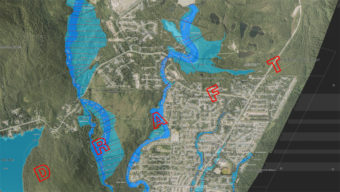
The 2013 Draft Flood Maps

Assembly updates agreement with AJT Mining Properties

Jesse Kiehl
Assembly member Jesse Kiehl. Photo by Casey Kelly/KTOO.

The Juneau Assembly has dusted off the 34-year-old agreement between the city and borough and AJT Mining Properties.

The panel last night approved a resolution updating the compact signed in 1979 that allows CBJ and AJT to act as a single entity for future exploration and development.

Juneau owns two-thirds of the AJ Mine property and one-third of the Treadwell Mine in Douglas. AJT, a sister company to Alaska Electric Light and Power, owns the rest. Engineering director Rorie Watt says the purpose of the agreement is to join the property together to find an interested party.

The AJ Mine near downtown closed in 1944 and an effort to re-open it in the 1990s failed. The Assembly in 2011 created a task force to study the circumstances under which it should promote mine development. While the work of the task force is done, a review of the CBJ and AJT agreement has been a goal of the current Assembly.

City Manager Kim Kiefer calls the changes “housekeeping.”

“It’s got a three-year agreement that it’s good for then it will have to be reviewed again at that point. The other piece is both AJT and CBJ have to agree on anybody looking at the records that they have.”

The Alaska State Library owns all the maps, reports and other exploration and mining records for the AJ and Treadwell properties. Those records are sealed from public review until 2025, so any mining company that wants to look at the records would have to have the approval of both entities.

According to Kiefer, the resolution only demonstrates the commitment of CBJ and AJT to make the property available for responsible development.

During assembly discussion, a motion was made to pass the resolution, but assembly member Karen Crane said there was a shortage of information.

“It lists particular areas and sections of Juneau and Douglas. I have no maps to refer back to those. There’s been no discussion at the assembly level that I know of and I’d like to see this referred back to the committee of the whole.”

Members Loren Jones and Jesse Kiehl agreed with Crane.

Kiehl also had several questions for city staff, including one on Section 5 of the resolution. It says the assembly may appoint a committee of its members that would have the same authority and duties of the assembly. Kiehl worries the subcommittee could appropriate money as stated in the unitizing agreement, which conflicts with city charter.

City attorney Amy Mead said the language in the agreement and resolution has been in place for a long time and conforms with city charter and code, which Kiehl questioned.

“That is in a resolution that has already been adopted. The resolution that adopted the two prior agreements – that’s where that language came from,” Mead said.

“Do we have a copy of that in our packet tonight?” asked Kiehl.

“No,” she replied.

“Do we have a copy of the prior agreements repealed by these agreements in our packets tonight?” Kiehl continued, to which Mayor Merrill Sanford said, “No.”

“Have we provided any of this to the public at all?” Kiehl asked.

Again, Mayor Sanford said, “No”

Kiehl made a motion to table the resolution until the next assembly meeting, which failed.

The original motion to pass the resolution carried, with Crane, Kiehl and Jones voting no.

Juneau’s major water source is Last Chance Basin, which sits atop, adjacent to and beneath the ore body. Protecting the water supply was the AJ Mine Advisory Committee’s top priority.

CBJ, AWARE to return state funds for new extended stay shelter

The Juneau Assembly will return an $850,000 dollar grant to the State of Alaska on Monday.

The money was awarded to the city as part of the state’s Community Development Block Grant program. It was intended to support AWARE’s construction of a new extended stay shelter for battered spouses and abused children.

AWARE and the city completed a required environmental review in March of this year. Although the site of the new shelter had been previously evaluated, the review revealed significant issues that made the project financially unfeasible.

Community Development Block Grant funds can’t be transferred to a project at a new site without submitting a new grant application to the state.

A resolution returning the money is on the agenda for Monday’s regular Assembly meeting. Doing so will allow the city to reapply for a community development grant during the next application cycle.

AWARE stands for Aiding Women in Abuse and Rape Emergencies. The extended stay shelter was to be built adjacent to the nonprofit’s existing emergency shelter.

Low voter turnout renews interest in elections by mail

Chances are, if you’re registered to vote in Juneau, you didn’t the last time school board seats, candidates for the Assembly, municipal debt or sales tax extensions were on the ballot.

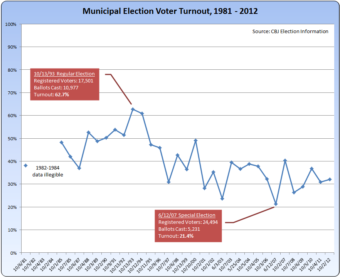
In the last municipal election in October, less than a third of the people registered to vote in Juneau actually cast a ballot, and that’s not unusual.

Voter turnout in municipal elections peaked in 1993 at nearly 63 percent, and bottomed out in 2007 at about 21 percent.
(Graphic by Jeremy Hsieh/KTOO)

“It’s election after election, and, you know, there’s definitely a way to improve it. We just have to find the right way,” said Assemblyman Randy Wanamaker.

He thinks voting by mail could improve turnout. Ballots would be mailed directly to registered voters and cast by mail, like in Oregon or with Native corporations’ shareholder elections. There wouldn’t be any polling places.

City Clerk Laurie Sica, whose duties include running municipal elections, was the impetus behind a 2007 ordinance that empowered the Assembly to hold local elections by mail. All it takes is a simple majority vote, though it’s never been done.

Sica was jazzed about the possibility of holding elections by mail in 2007, especially for special elections when there’s less notice to hire poll workers. But now, Sica says she prefers the status quo, so that Juneau stays consistent with the state’s election practices.

“In terms municipal elections, I think anything we can do to improve voter turnout — once people start voting I think they’ll continue voting, and that’s what we want to do.  And if we can make it easier for them to participate, then I think it’s worth the cost,” Wanamaker said.

Cost estimates Sica put together in 2007 suggested that increased ballot printing and mailing costs would far outweigh savings in election workers’ pay. In 2007, she estimated it cost $41,800 to hold a traditional election, but $59,800 to hold it by mail.

Today, the cost difference between holding an election by mail may be even greater because of higher postage rates, and the possible need for signature recognition software. Sica says she has more research to do.

Coincidentally, 2007 was also the three-decade low for voter turnout. In that year’s June special election, only 5,231 ballots were cast out of 24,494 registered voters, about 21 percent. Ballot propositions in that election were the last in a series of multimillion dollar decisions put to voters related to the construction of Thunder Mountain High School.

Proposition 2 passed with a 70 vote margin. In terms of turnout, that’s less than one-third of 1 percent, or about a sixth of Juneau-Douglas High School’s 2007 senior class. If Proposition 2 had gone the other way, Thunder Mountain High School might not have a track and artificial turf field today, and taxpayers would have $5 million less in debt to repay.

When Wanamaker brought up vote-by-mail at the Assembly’s last regular meeting, City Manager Kim Keifer said she would put some information together for the Assembly to review at an upcoming meeting.

Juneau’s municipal elections are held the first Tuesday in October. Three seats on the Assembly and two seats on the Juneau School Board are up. Candidates can file to run beginning Aug. 2. Information about running for local office is available at http://www.juneau.org/clerk/elections/.

City plans to build sea walk extension this winter

Juneau residents may see a thousand-foot extension to the sea walk being built as soon as this winter. During last night’s Committee of the Whole meeting, the Assembly gave Director of Engineering Rorie Watt approval to move forward with the project.

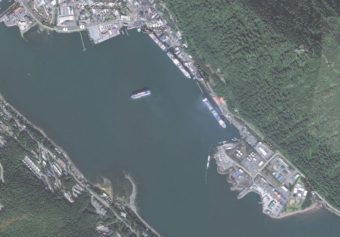
The planned extension would go south from the Miner’s Cove building past the South Franklin Dock to the edge of the rock dump.

Watts says the project will extend the sea walk along the waterfront.

“It’s a good project for the users of the Princess Dock because it will widen out their staging area, it will allow the separation of passengers getting on and off busses and pedestrians that are just walking through the area, and it’s ready.”

Watts says the engineering staff has reached a land deal with representatives from Princess Cruises and AJT to secure an easement to build the extension.

“We have all the land issues resolved. All of it is permitted. The engineering and design is done. It’s been to the planning commission. It’s a complete project and with the assembly consent, we could put that project out to bid and build it this winter.”

Watt says the cost of the 1000-foot extension would be $4 million, which would come out of the $15 million that the city has secured for sea walk projects.


View Downtown Juneau waterfront in a larger map

Site notifications
Update notification options
Subscribe to notifications