CBJ Assembly Meetings

Juneau police report a drop in overall crime, violent crime

Juneau Police Chief Bryce Johnson (left) and Deputy Chief Ed Mercer (right). File photo.

The number of reported crimes in Juneau dropped nearly 20 percent from 2011 to 2012, and the number of violent crimes recorded over the same period was down about 13 percent.

That’s according to the Juneau Police Department’s Annual Report, presented to the CBJ Assembly on Monday.

Violent crimes include homicides, rapes, robberies, assaults, burglaries and thefts. Last year was the second straight year without a murder in Juneau. The number of reported rapes dropped from 14 to 9, and there were nearly 150 fewer assaults and 100 fewer thefts.

Police Chief Bryce Johnson, who took over the top spot at JPD in May following the retirement of Greg Browning, called the drop in overall and violent crime rates “a shared community achievement.”

“And the Juneau Police Department is very proud to play our part in this community effort to drive down these crime rates,” Johnson said.

Lieutenant Kris Sell leads JPD’s Special Operations Unit. She says officers know there are still some crimes that go unreported, but she said it’s still quite an accomplishment to see a decrease in reported crimes.

Sell says the department is especially proud of a 23 percent increase in drug seizures last year.

“We consider this a very high priority,” Sell said. “Because the people who are abusing drugs are also committing burglaries to pay for those. They’re also committing assaults because of drug debts and the various politics that goes on within that subculture in the community. So drug work is criminal work.”

The total street value of illegal drugs seized in Juneau last year was over $1.1 million, up from about $895,000 in 2011. That’s in addition to a $6,000 increase in drug money seized, from $23,000 to $29,000.

Sell credits the spike in drug seizures to a more active partnership with the U.S. Postal Service, which allowed Postal inspectors to come to Juneau more frequently than in the past.

Bear ordinance changes approved, sludge contract awarded

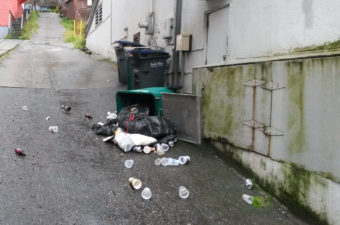
Trash can raided by a bear
Trash can raided by a bear. (Courtesy photo)

The Juneau Assembly put more teeth into the city’s bear ordinance on Monday.

The stricter rules make clear that if a bear gets into a garbage container more than three times in a 30-day period, it is a bear attraction nuisance. The amended ordinance also gives Juneau police expanded authority to fine businesses and residents that violate the rules.

The vote to strengthen the ordinance was 8-1, with Assembly member Jerry Nankervis casting the lone no vote.

The Assembly also approved a bid award to Bicknell, Inc. for disposal of the city’s sewage sludge.

The five year contract is worth more than $1.6 million per year. That’s almost twice what the city has been paying landfill operator Waste Management under its current sludge disposal contract.

Sludge is the end product of the wastewater treatment process, and is also called biosolids.

Since 2011, Waste Management has been dumping the stuff either in the Lemon Creek landfill or at a facility in Arlington, Oregon.

Bicknell, Inc. submitted the only valid bid under the city’s project specifications. The city plans to cover the increased cost of disposal in the first year of the contract by tapping the wastewater reserve fund. After that the cost will likely be covered by a rate increase.

The contract was approved with no discussion as part of the Assembly’s consent agenda. However, some Assembly members said at the end of the meeting that they wanted to hear more about possible rate increases.

Sewage sludge disposal costs on the rise

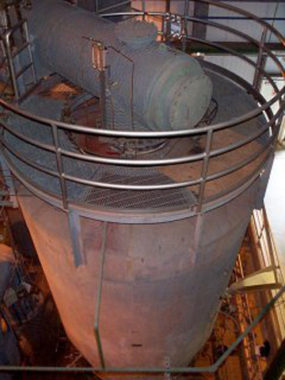
The Biosolids Incinerator (located at the Juneau-Douglas Facility) is used to burn the solid waste matter produced in the wastewater treatment processes at both the Juneau-Douglas and Mendenhall facilities.
The Biosolids Incinerator (located at the Juneau-Douglas Facility) is used to burn the solid waste matter produced in the wastewater treatment processes at both the Juneau-Douglas and Mendenhall facilities. (Photo courtesy CBJ website)

Juneau’s poop is getting expensive.

Bidding closed last week on a 5-year contract for municipal sewage sludge disposal with only one viable bid.
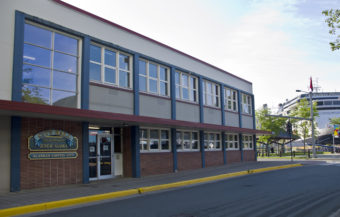
Bicknell Inc., a Juneau home building and paving company, has proposed a cost of about $1.6 million per year.

That’s roughly 40 percent more than the city pays for disposal between in-house costs and under the contract that expires at the end of the year with Waste Management. Homeowners and businesses bear that cost, among others, through wastewater utility fees, which have been about $64 a month for most addresses since July 2011. A city-commissioned study to inform potential rate changes is due in May.

The new contract may be the long-term solution that Juneau officials have sought for years. Or it may be the latest stopgap since the city’s sludge incinerator went offline in 2010.

The sludge is a form of treated sewage, also known as biosolids. It’s the product of Juneau’s wastewater treatment facilities.

Bicknell’s contract award will come before the Juneau Assembly on Monday. If approved, Bicknell may still have to wade through local zoning and permitting issues before the operation gets the green light.

Public Works Director Kirk Duncan declined to comment on the pending contract. And Bicknell owner and president, Spike Bicknell, declined to comment until a contract is in place.

However, his bidding documents offer clues about his plan. It is clear Bicknell plans to dispose of the sludge locally, but not specifically how or where.

Waste Management’s Lemon Creek landfill is the only site permitted for sewage sludge disposal, according to the state Department of Environmental Conservation. That suggests Bicknell plans to incinerate the sludge itself, or do additional treatment so it can be recycled as fertilizer or in other beneficial uses; those are the only alternatives to landfill disposal under the Environmental Protection Agency’s rules.

Price differences in the transport costs of moving the sludge to the undisclosed disposal site offer another clue about its location. Bicknell’s bidding documents quote the cost of one round-trip from the Mendenhall Valley treatment plant at half that of a round-trip from the Juneau-Douglas plant; suggesting the site is closer to the valley than downtown.

Waste Management also bid on the new contract, but was undercut by about $90,000. Its bid required the city treat the sludge to the EPA’s minimum standard for recycling. That caveat invalidated the bid, according to the city purchasing office.

Public Works Director Kirk Duncan says managing sewage sludge has been a longstanding local issue common in many communities.

“It’s interesting to note that back in 1985, the two priorities of the Assembly were biosolids and landfill,” Duncan said. “And we’re still sort of in that situation, so. Communities just struggle with what they do with biosolids.”

(Full disclosure: Duncan is a member of the KTOO Board of Directors.)

The contract has a 5-year renewal option.

How we got here

In late 2010, the city’s 20-year-old sewage sludge incinerator at the Juneau-Douglas Treatment Plant off Thane Road went offline. City officials initially sought repairs and a replacement, but ultimately decided replacing it was too expensive; the capital cost was estimated in the tens of millions, plus high operating and maintenance costs.

Every month, Juneau produced hundreds of tons of sludge that used to be burnt into vapors and ash.

The city bought time by signing a short-term contract with Waste Management to take the sludge. At first, Waste Management put all of the sludge in its Lemon Creek landfill. It’s got a strong odor, unlike more thoroughly treated, fertilizer-quality sludge.

Eric Vance, Waste Management’s local manager, said he curbed the odor by mixing sludge with garbage and burying it. But eventually, he ran out of places to put it.

To avoid violating nuisance laws, Waste Management began shipping some sludge in the summer of 2011 to a bigger landfill it operates in Arlington, Oregon. As odor-fighting capacity at Lemon Creek fell, the ratio shipped south rose. And so did costs. The per-ton cost of disposal in Oregon was regularly 30 percent or more than the local rate.

This year, almost all of the sludge has been shipped out of town.

Shipping had other unintended costs, too. Odor and sanitation problems with the sludge pending and during shipping led the city to spend $101,000 in 2012 on five special containers specifically for transporting biosolids.

Duncan said those containers were just an experiment. Shipping all of Juneau’s sludge requires upward of 40 containers in constant rotation.

Meanwhile, a $32,000 study released in April identified several disposal alternatives.

Oct. 22, 2013, Correction: An earlier version of this story understated current sludge disposal costs and overstated the cost increase under Bicknell’s proposal. Disposal costs would not double, but increase by about 40 percent.

Juneau advertises for a new lobbyist

The city and borough of Juneau is advertising for a new lobbyist to replace Clark Gruening who retired at the end of July.

The assembly previously discussed a short list of potential candidates. Assembly member Carlton Smith says the assembly decided to issue a solicitation of interest instead to broaden the selection. Carlton sits on the lobbyist selection subcommittee.

“The solicitation is designed to identify any persons of interest that have a commitment to work with Juneau and an interest in this role and we just weren’t certain if there were folks that were interested who were not on that initial list,” he says.

Smith anticipates the capital budget would be the biggest priority for a new CBJ lobbyist.

“The governor has made preliminary suggestions that the capital budget is going to be a very challenging thing to come up with really much in the way of extra funds at all for municipalities to work with,” he says.

The subcommittee will review submissions when it meets next Monday and make recommendations to the assembly on candidates to interview.

Smith does not know how much the city will pay a new lobbyist.

“In the past, the city lobbyist position, that role, has been in the $60,000 range. I’m not sure if that includes expenses. I think those were just direct fees, and that’s been a pretty conservative number, in our judgment, considering what some of the numbers look like today. So what we’re doing is we’re asking the new applicants, those that are considering this role, to give us a proposed fee schedule of their own,” explains Smith.

CBJ issued the solicitation yesterday. Letters of interest, resumes, and fee proposals are due to the city manager by Friday.

City considering additional regulations for bear-proofing garbage

Trash can raided by a bear
(Courtesy photo)

A potential change to Juneau’s bear laws would encourage business owners and residents to better secure their garbage.

Currently, city law states that trash must be stored in a container which requires hands or tools to open, is secured by a bear resistant device, or located behind barriers.

Community services officer Bob Dilley says bears are still getting into containers and structures considered “bear-proof.”

“There’s bear calls coming in every day. It’s been a pretty busy season for bears. They’re kind of spread out all over town. We get residential complaints. We get commercial complaints.”

Dilley says having bear resistant devices or structures is no longer enough if bears are still getting into them.

“If somebody had a large apt building that has metal bear lids on their dumpster and they have cables but the residents are keeping the cables fastened, so the bear keeps getting into it, then they would have to go to something like a gravity latch or a different type of system that automatically keeps the dumpster locked up so bears can’t get into it.”

CBJ assembly member Jesse Kiehl says some housing developments are successful in keeping bears away either by dumpster structures or making sure the lid is properly closed. But, he says, people at other housing developments aren’t making the same effort.

“At some point here, those people have to take responsibility too. And if that means the landlord has to build three walls around it and put a gate up in the front, then that’s what that has to mean. Or if it means that they have to get a better garbage can holder, that’s what it has to mean.”

Ryan Scott is a wildlife management biologist for the Department of Fish and Game. He says the proposed ordinance is a good start.

“It’s certainly not going to be a fix all, but at the same time if we run up against these situations where we have an attractant that just continues to be a concern and a problem without seeing any progress made, this might be the tool to turn the tide on that.”

Officer Dilley says if a bear gets into a garbage container more than three times in a 30-day period, it would be deemed a bear attraction nuisance, according to the ordinance, and a ticket would be issued.

The fine for the first offense is $50. A second offense within two years is $100. A third offense is $300.

CBJ looks for a new lobbyist

The city and borough of Juneau is in the market for a new legislative lobbyist.

Long-time lobbyist Clark Gruening retired at the end of July after more than 25 years with the CBJ.
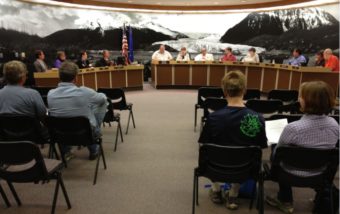
Mayor Merrill Sanford says Gruening helped Juneau on many important projects. “He was integral working on those different ways of combating the capital move issue, and that was three or four times, so those were all big, big important things for the city and borough of Juneau.”

The CBJ assembly Monday night was given a list of nine potential candidates. The “shortlist” was selected from a 61-page 2013 Lobbyist Directory put out by the Alaska Public Offices Commission.

The top four candidates are Linda Anderson from Fairbanks, Wendy Chamberlain from Juneau, Mark Hickey from Juneau, and Douglas resident Raymond Matiashowski.

City manager Kim Kiefer says the candidates have multiple municipal clients. “In discussion with the mayor, we thought they have experience already working with municipal clients, and so we looked at those that had more than one municipal client, and that’s how we came up with those four. And I have asked them if they’re interested and all four of them are interested.”

A subcommittee of assembly members Jesse Kiehl, Carlton Smith, and Randy Wanamaker will meet Friday morning and work with city manager Kiefer to decide how to move forward. For a professional service contract, the city will issue a request for proposals.

Sanford says the hope is to get a new CBJ legislative lobbyist on board within the next two months.

In his most recent contract with the city, lobbyist Clark Gruening was making $60,000 annually.


Assembly encourages housing development with property tax deferral

CBJ assembly passes an ordinance deferring property tax on subdivided property. (Photo by Lisa Phu/KTOO)

In an effort to spur more housing development, the CBJ assembly adopted an ordinance that would allow the city to defer property taxes if land is subdivided into three or more lots.

City manager Kim Kiefer says the ordinance was a priority of the housing committee.

“Say you have a 10 acre parcel and you create five different 2-acre lots, you can ask the city to not pay that additional property tax that would be charged for those five lots and defer them for up to five years.”

Prior to the five years coming up, tax deferral for each lot would also end once ownership is transferred or when a certificate of occupancy is issued.

The hope, says Keifer, is to open up more properties for housing development

“What it allows developers to do that have big parcels is to subdivide it and they don’t have to have the funding right up front to pay for those additional properties and the improvements to, say, get water and sewer to those properties. It allows them to push it to the end of the project instead of the front end.”

During public hearing of the ordinance, Alaska Renovators owner Alan Wilson said the motivating rationale behind the concept is to get lots on the market.

“Developers that sit on large tracks of land have historically in Juneau – by the time you get a subdivision developed and lots ready to go on the market, the market conditions have changed. You can’t sell your lots. The next thing you know, those lots get foreclosed upon and you end up losing your subdivision. West Juneau is a prime example. So the deferral is an attempt to keep that scenario from happening and repeating itself,” Wilson explained.

The ordinance is based on state legislation which went into effect July 2012. Keifer says, so far, only Fairbanks has the ordinance in place.

Site notifications
Update notification options
Subscribe to notifications