Assembly member Ruth Danner says her skill set doesn’t match assembly service, so she won’t seek reelection. (Photo by Casey Kelly/KTOO)
After one term on the Juneau Assembly, Ruth Danner says she won’t seek reelection this fall.
Danner says she came to realize over the last year that assembly service doesn’t match her skill set.
“I’ve learned a lot and I’m happy about that and I hope to take what I’ve learned and use it for helping our community grow in other ways,” Danner says.
Specifically, she plans to stay involved in the Juneau Homeless Coalition and housing issues in general. She also says she’d be willing to serve on other municipal advisory boards or commissions.
Since joining the assembly, Danner has been involved in a pair of very public spats with other members and city staff. In April, she was very nearly censured for accusing the city’s Law Department of lying to the Planning Commission. This month, she’s been embroiled in a back-and-forth with Port Director Carl Uchytil over the use of a new boat lift at two different harbor facilities.
Danner has been criticized in some circles for not clearly understanding how city government operates. But she says she won’t apologize for how she’s handled the controversies.
“I suspect that I am always going to be Ruth Danner,” she says. “When I ran for office in the first place, I said right up front I was nobody’s politician. I’m no politician. I’m just not.”
Danner says she’s encouraging as many people as she can to run for her seat. She says at least one potential candidate has contacted her to express interest.
The filing period for the municipal election opens August 3rd and closes ten days later. Election day is October 2nd.
The Douglas Indian Association yesterday (Tuesday) held a blessing ceremony at Gastineau Community School for human remains found during a renovation project.
Last month, the City and Borough of Juneau halted construction after workers digging in front of the building unearthed remains and a headstone for Sam Goldstein, a Chilkat man from Klukwan who died in 1927.
It turns out the remains did not belong to Goldstein, whose body is still missing. At the request of Douglas Indian Association officials, the city brought in archeologists from Northern Land Use Research in Fairbanks. They correctly identified the remains found near Goldstein’s headstone as those of a young woman in her early to mid-20s.
Deputy City Manager Rob Steedle says they also used ground-penetrating radar to scan the construction area.
“They were able to identify six probable sites for graves, and four possible sites, as well as a number of other sites where they just couldn’t tell what was going on, but they thought they were unlikely to be graves,” Steedle says.
He confirms additional human remains were found, but declined to give an exact number. He says Anthropologist Joel Irish with University of Alaska Fairbanks was brought in last Wednesday.
“He helped complete the uninterment of these individuals, identify them to the best of his ability as to sex and age, and then on Friday we re-interred these individuals at the school site in an area that won’t be disturbed,” says Steedle.
He says construction will resume at the school this week, and the city is reasonably confident no other burial sites will be disturbed. He also says the city will work with Douglas Indian Association to investigate how the sites went unnoticed for several decades. Gastineau Community School was built in 1957.
“The records are scant, but we will be doing research to understand just what was visible on that site in the late 1950s when Gastineau School was built,” Steedle says.
Members of the Juneau Assembly and School Board attended Tuesday’s blessing ceremony as guests of Douglas Indian Association. But Steedle says DIA officials requested that it not be noticed to the public in order to keep the gathering small and private.
Douglas Indian Association officials could not be reached for comment before news time.
The Juneau Assembly last night (Monday) appropriated nearly $23.5-million for runway safety area improvements at Juneau International Airport.
Most of the funding will be provided by a $17-million grant from the Federal Aviation Administration. The Alaska Department of Transportation and the city-owned airport will split the rest.
But Airport Manager Jeannie Johnson says the city’s contribution will be in the form of fill material provided to the FAA for project, which the airport already has on hand.
“The fill is the fill that came out of the bottom of the float pond, and FAA is paying us for that,” Johnson explained to the Assembly. “So, really it’s an in kind match. So, we aren’t buying any more material. The material’s already been removed from the float pond, actually, and placed. It’s just the method of how FAA has to pay us for it.”
The airport had the float pond dredged early in the runway safety area improvement project, which has been ongoing since at least 2009.
This new phase is for installation of FAA facilities.
The Assembly last night also awarded SECON a $12.3-million contract for another phase of the project. SECON will relocate the thresholds for two runways and move two taxiways. Once again, funding for the work is largely being provided by the FAA.
Once again, the Fisherman’s Memorial on Juneau’s downtown waterfront is likely staying put.
Assembly member Ruth Danner last night (Monday) suggested revisiting the idea of moving the memorial as the city pushes forward with plans for a floating Panamax cruise ship dock in front of it.
Danner said she had renewed concerns after receiving a letter from the Southeast Alaska Fisherman’s Alliance, raising questions about the dock’s impact on the annual Blessing of the Fleet and the view from the memorial. She spoke up as the Assembly was considering a bid award for Phase I of the project — an uplands staging area and sea walk extension near the Mt. Roberts Tram building.
“I’m a little uneasy about this particular action, because of the letter that we received, because it says that right now is fishing season,” Danner said. “And that it’s not possible for the fishing community to have anyone here to represent their interests.”
Danner ended up voting with the rest of the Assembly in a unanimous decision to award the bid to Trucano Construction for $1.9-million. But only after Port Director Carl Uchytil assured her Phase I would have no impact on the memorial.
During assembly comments later in the meeting, Mayor Bruce Botelho informally asked if any other assembly members wanted to revisit the idea of moving the memorial. Only Danner and Assemblyman Jesse Kiehl raised their hands.
Assemblyman Johan Dybdahl, participating by telephone, said the issue had already been decided.
“As far as I know, we made the decision to leave the memorial where it’s at, and I think that’s not changed,” said Dybdahl. “And I certainly don’t see how we’re going to do any stopping or backing up on 16-B [the Panamax cruise ship dock project].”
The Assembly authorized the Docks and Harbors department to move forward with the project in 2009. Last August, the Assembly meeting as Committee of the Whole voted to leave the Fisherman’s Memorial where it is.
Juneau police are recommending three Juneau teens be charged in connection with throwing rocks Sunday at vehicles in the Mendenhall Valley, injuring at least one person.
Police say they received several calls about rocks being thrown in the area of Stephen Richards Drive and Mendenhall Loop Road. When they investigated, police found two juvenile boys and an 18-year-old hiding in the bushes, and one had rocks in his hands. Police questioned the boys and released them to their parents.
Then they learned a 6-year-old boy had been cut by flying debris when a rock smashed through the rear window of the vehicle in which he was riding. His mother stopped the vehicle and called 911. The boy was taken to the hospital by ambulance, where he was treated for a severe laceration to his cheek.
Now police say the boys who were allegedly throwing the rocks may be charged with assault, criminal mischief, false information to law enforcement and minor consuming.
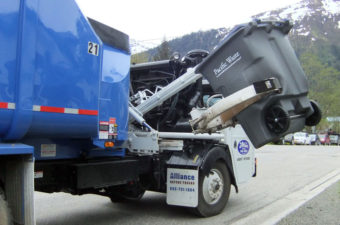
Juneau Police are not currently citing residents for violating the city’s bear ordinance when a crafty bruin pops the lid on one of those new garbage cans provided by Arrow Refuse.
As we reported earlier this week, city officials are trying to get the word out that the roll carts are not bear resistant.
Police and wildlife officials say bears are especially active right now, and the new trash bins are providing an easy source of food.
A dozen years ago, the city faced a similar problem, leading to the CBJ bear ordinance, which prohibits leaving garbage cans out except after 4 a.m. on pickup day.
KTOO’s Casey Kelly looks at how the current issue compares.
Photographer Pat Costello served on Juneau’s ad hoc Urban Bear Committee from 2000 to 2001. Former Mayor Sally Smith formed the committee after five bears were shot in the Capital City in one year. Costello says the problem then, as now, had to do with trash. Dumpsters around town had been fitted with flimsy plastic lids.
“And the dumpsters, of course, were sitting out 24-7,” Costello says. “So, we saw a huge spike in activity with bears. And a whole generation of bears was educated on the whole garbage thing.”
The solution then was to replace the plastic lids with metal ones. And to have the Juneau Assembly pass an ordinance making it illegal to keep smelly garbage sitting out in a non-bear resistant container.
Costello says some residents are assuming the new garbage cans are okay to leave out.
“People think that they’re bear proof,” he says. “And they definitely aren’t.”
Juneau Police Community Service Officer Bob Dilley is trying to change that perception. He says police are responding to reports all over town of bears getting into the new cans.
“What we’re finding is the bears either bounce up and down on top of them, or stand on top of them and get the lid to pop a little bit and they can use their claws to open them up,” Dilley says. “So, if you’re leaving those out in your yard, the bear is likely to get into them.”
Wildlife Biologist Ryan Scott with the Alaska Department of Fish and Game says it doesn’t take long for bears to identify a readily available source of food.
“In the past, with the bear proof or the bear resistant cans, we might get a bear that gets into a can, and if we can get that remedied, we seem to have pretty good success getting the animal to move on,” Scott says. “This year we are seeing where bears are going from can to can to can.”
Scott says the best solution is for people to follow the bear ordinance, and not leave garbage cans out, especially when they’re full of dinner scraps.
“Everybody who lives in Juneau knows we have great bear habitat and even if we remove a bear, we’re probably just making a hole for a new bear if the food source is still out there,” says Scott.
Dilley says police are using this time to educate the public about the bear ordinance, but eventually will begin writing tickets again. He says the new containers do meet the city’s regulations, so long as they’re kept in a bear resistant structure except on garbage day. And yes, he’s heard from people who built bruin-proof enclosures that are too small for the new cans.
“If you took the time to build a structure like that and it’s been effective at keeping a bear out, you can still keep your garbage and your old cans in that enclosure,” says Dilley. “And then come garbage day you can dump it in your new can and haul that out to the curb.”
A dozen years ago, Costello’s website featuring some of his nature photography, included a number of shots capturing Juneau’s garbage bears. He says the issues then were much more pervasive than they are now.
“As long as people keep their garbage enclosed as they should under the law, hopefully this won’t turn into the same kind of situation,” says Costello.
The current law has been on the books since 2004, and calls for fines up to $300.
Close
Update notification options
Subscribe to notifications
Subscribe
Get notifications about news related to the topics you care about. You can unsubscribe anytime.