Government

With Western Alaska salmon runs weak, managers set limits on the pollock fleet’s chum bycatch

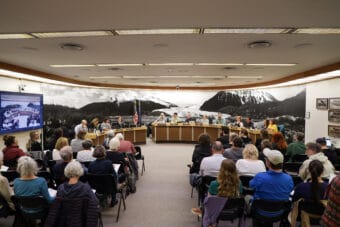
Audience listens to testimony Feb. 9, 2026, at the North Pacific Fishery Management Council meeting in Anchorage. Subsistence fishers from the Yukon and Kuskokwim river basins were among those attenting the meeting and giving public testimony about bycatch of chum salmon in the Bering Sea pollock fishery. Also attending the meeting were people involved in the pollock industry. Public testimony on the issue to the full council stretched over four days. (Photo by Yereth Rosen/Alaska Beacon)

Federal fishery managers have approved the first-ever mandatory caps on at-sea interception of chum salmon, a fish species critical to Indigenous communities along Alaska’s river systems.

The North Pacific Fishery Management Council on Wednesday voted in favor of new limits for the pollock fleet to reduce the amount of chum salmon accidentally caught in trawl nets, a phenomenon known as bycatch.

North Pacific Fishery Management Council member Nate Pamplin, Diana Evans, the council’s executive director, and council chair Angel Drobnica listen to testimony on Feb. 7, 2026, at the February meeting in Anchorage. (Photo by Yereth Rosen/Alaska Beacon)

The compromise, approved at the end of a 10-day council meeting, addresses a yearslong conflict that pitted the in-river salmon fishermen and their Indigenous cultures against the economically important harvesters of Alaska pollock, the top-volume U.S. commercial seafood.

Achieving effective safeguards for Western Alaska chum salmon while balancing needs of all parties amid environmental factors that are out of managers’ control was difficult, Angel Drobnica, the council’s chair, said just before the vote was taken.

“This is the most challenging issue I’ve worked on during my time in this process,” she said, referring to her three years on the full council and six years on the group’s advisory panel. “I believe this motion is durable and enforceable and reflective of input from both sides and has maintained a clear focus on Western Alaska salmon.”

Salmon bycatch is a hot-button issue in Alaska fisheries. Total amounts of chum salmon accidentally caught in the trawl nets used by the pollock fleet can number in the hundreds of thousands — though the vast majority of the chum salmon intercepted in the Bering Sea in this manner is not of Alaska origin, according to council data.

While bycatch limits have been in place for several years for Chinook salmon, this is the first time managers have imposed limits for chum salmon. Both Pacific salmon species are important to the Yukon and Kuskokwim river system communities, and both have collapsed in recent years, at times prompting complete fishing closures all the way into Canada’s Yukon Territory.

A list of people signed up to testify at the February meeting of the North Pacific Fishery Management Council is taped to a William A. Egan Civic and Convention Center room door on Feb. 9, 2026, The room, down the hall from the rooms where the council was convened, was reserved and used for the duration of the meeting by tribal oroganizations, including the Kuskokwim River Inter-Tribal Fish Commission and the Tanana Chiefs Conference. (Photo by Yereth Rosen/Alaska Beacon)

The measure imposing chum bycatch limits, years in the making, included several elements:

  • It sets an annual bycatch cap of 45,000 Western Alaska chum salmon.
  • It apportions the cap among the different pollock-fishing sectors: at-sea processors, catcher ships that deliver to onshore plants, catcher vessels that deliver to “motherships,” which are vessels that collects harvests; and Community Development Quota organizations, which represent rural and Indigenous communities have invested in the fisheries and are assigned shares of annual groundfish harvests.
  • It applies the cap to corridors in the Bering Sea that are known to be used by migrating Western Alaska chum salmon and to the summer months when bycatch of Western Alaska chum is concentrated, then when Alaskans are most affected. The use of corridors is intended to address the fact that the vast majority of chum salmon netted as bycatch in the Bering Sea are fish from Asian hatcheries rather than fish that swim though and spawn in Alaska rivers.
  • The approved measure contains triggers that would enforce area-specific pollock trawling shutdowns if bycatch levels are reached.
  • The approved measure mandates the use of bycatch-reduction technology and practices that are currently voluntary in the industry. Those include employment of salmon-excluding devices that allow salmon to swim free of nets holding pollock and enhanced communication and record-keeping to broaden knowledge among the fleet, tribal organiziation and members and the general public about potential bycatch hotspots and how to avoid them.
Signs seen Feb. 7, 2026, at a room in the William A. Egan Civic and Convention Center used by tribal organizations attending the North Pacific Fishery Management Council meeting. (Photo by Yereth Rosen/Alaska Beacon)

The measure is set to go into effect in 2028.

Managers approved it by an 8-3 vote. One of the dissenters, Seattle-based Jamie Goen, executive director of Alaska Bering Sea Crabbers, said the cap was too high.

“This motion is a license to kill 45,000 Western Alaska chum when we have information showing that every salmon that comes back to Western Alaska rivers counts,” she said Wednesday just before the vote was taken. “Every female salmon holds the potential to release thousands of eggs that can grow exponentially to feed in-river communities and keep their cultures alive.”

The reduction in pollock harvesting that would result from a lower cap would be “negligible,” compared to the losses suffered by river communities, she said.

Goen’s comments mirrored a slogan imprinted on wristbands, buttons and other items distributed by tribal groups attending the meeting: “Every Salmon Counts.”

Council member Jon Kurland, who is also director of the National Oceanic and Atmospheric Administration’s Alaska fisheries service, said that while the salmon crash has had “devastating effects” in Western Alaska with details that are “heartbreaking,” the socioeconomic benefits of the pollock harvests also need to be considered.

Wristbands and buttons bearing the slogan “EVERY SALMON COUNTS” are displayed on a table on Feb. 9, 2026. The wristbands and buttons were being distributed by tribal organizations attenting the North Pacific Fishery Management Council meeting in Anchorage. The slogan references the argument that every salmon that avoids bycatch and is able to swim to river spawning grounds is important to the population and to the people who depend on salmon runs. (Photo by Yereth Rosen/Alaska Beacon)

Those include “the family businesses that operate catcher boats, the seafood processing capacity in many remote areas that really needs a steady flow of pollock to process other species for smaller-scale fisheries and the ways that the community development quotas improve people’s lives in 65 Bering Sea communities,” he said.

After the vote, tribal representatives attending the meeting had mixed reactions to the council’s action. In some ways, it was a positive movement, they said.

“It’s a start,” said Charlie Wright, secretary and treasurer of the Tanana Chiefs Conference.

“The pressure is on,” said Eva Burk of Nenana, a tribal representative on the council’s advisory panel.

But Wright, from the Yukon River village of Rampart, and Burk said they were disappointed that the numerical cap was not lower and that the geographic area to which it will apply was not broader.

An organization representing the pollock industry said the council’s action was fair, decision was fair, even though it puts some more burden on pollock harvesters.

“The Council’s decision reflects the seriousness of the challenges facing Western Alaska chum salmon and the complexity of managing a dynamic fishery,” said a statement released by the Alaska Pollock Fishery Alliance. “The pollock industry respects the Council process and remains committed to working within this new framework while continuing to invest in science-based, real-time avoidance tools that have already delivered meaningful reductions in Western Alaska chum bycatch.”

Alaska pollock, shown here from a harvest, make up the nation’s top-volume single-species commercial seafood catch. Each December, the North Pacific Fishery Management Council sets the next year’s harvest levels for pollock and other groundfish. Those decisions are based on scientific analysis that could be compromised this year by the federal government shutdown. (Photo provided by the National Oceanic and Atmospheric Administration)

Wednesday’s vote came after four days of often impassioned public testimony sessions that started on Saturday and ran through Tuesday afternoon. An estimated 170 people attending the meeting addressed the council during those days. They included subsistence fishers and leaders of tribal originations along the Yukon and Kuskokwim basins, small-scale pollock harvesters, representatives of fishing companies, Indigenous organizations with investments in the pollock fishery and others.

One of the tribal leaders testifying was Brian Ridley, chief executive of the Tanana Chiefs Conference, an organization of Interior Alaska Athabascan tribal government. TCC and other tribal groups have been seeking the strictest limits possible, he told the council.

For Yukon River communities, salmon fishing closures over the past years have resulted in “food insecurity, starvation, diabetes, cancer and cultural loss,” he said in testimony Saturday.

“Let me be clear: We’re not asking to shut down the pollock fishery. We’re asking for the first real step in sharing the burden of conservation, the same step Yukon fishers began taking decades ago. Our communities have carried the burden alone for more than 20 years. Today, we’re asking the pollock fleet to finally share the burden,” Ridley said.

There were more personal accounts, like one delivered Saturday by Julia Dorris of Kalskag, a village on the middle section of the Kuskokwim River.

“My dad had a dog team. Because of less chum and the restrictions, he no longer had his team. And had to get rid of all the dogs. It was heartbreaking to see a strong person quietly fading,” Dorris said.

The pollock trawl fleet had its defenders as well.

Those included Frank Kelty, a former mayor of Unalaska, and Victor Tutiakoff Sr., the Aleutian Island city’s current mayor. Tutiakoff mentioned that he himself is a subsistence fisher, so he understands subsistence needs. Kelty mentioned the Community Development Quota groups that, under a program established in 1992, comprise villages in different Western Alaska regions that have banded together to invest in Bering Sea and Aleutian Islands fisheries.

“The pollock fishery, as we all know, is the economic engine of Unalaska and other fishery-dependent communities in the Bering Sea region, including the six CDQ groups. A closed or reduced pollock season is devastating,” Kelty told the council.

Unalaska is “a one-horse town” completely dependent on commercial fishing, with the local government highly dependent on fishing-related taxes, he said. “If you have reduced or closed seasons, you see impacts throughout the community. The population reduces, employment at the plants goes away, the school population drops, clinic — it’s just a bad situation,” Kelty said.

Defenders of the pollock industry included Native organizations. One was the Qawalangin Tribe of Unalaska, which presented a recently passed resolution warning that hard caps on chum bycatch could cause “significant economic risk for Tribal members and for fishery-dependent communities.”

Although they sometimes disagreed about the role of bycatch, speakers on both sides of the debate agreed that the problems facing Western Alaska chum salmon, as well as the faltering runs of Chinook salmon, are myriad.

Climate change, with effects in both the ocean and in freshwater systems, is a major factor, speakers said. For example, Jacob Ivanoff of Unalakleet, representing the Nome Eskimo Community tribal government, described the masses of fish found dead of heat stroke in rivers in 2019, along with water temperatures that ranged up to 85 degrees during that year’s marine heatwave.

The growing presence of Asian hatchery chum salmon in the Bering Sea is a complicating factor. The flood of new fish, aside from competing with Alaska fish for food and potentially crowding Alaska fish out of the habitat, are dominant in the bycatch numbers.

In past years, genetic testing shows that only about a fifth of the chum salmon netted as bycatch by the Bering Sea pollock fleet has been from Western Alaska, council members said. Most of the rest is from Asian hatcheries, including hatcheries in Russia, though a small portion has also been composed of chum salmon from the state’s more southern Gulf of Alaska waters or from the Pacific Northwest region even farther south.

The total chum salmon bycatch in the pollock fishery in 2025 was about 151,000 fish, according to a report presented to the council early in the meeting. Most of that was hatchery fish. The percentage of bycatch that was fish from Western Alaska rivers was low, but it fluctuates from year to year and even from week to week during harvest seasons, according to genetics information presented by the Bristol Bay Science and Research Institute.

Bycatch concerns go beyond salmon. The term refers to any accidental netting, hooking, entaglement or crushing of an untargeted species. Several types of fish, birds and marine mammals are killed or injured through bycatch in different fisheries. NOAA keeps track of annual bycatch totals.

Eva Burk, Jessica and Rory Black, Ariella Bradley, Fatima Lord-Minano and Charlie Wright cut salmon during an August 2025 cultural camp held in Nenana. The youth and adults in the camp were able to harvest and process a few chum salmon in 2025, for the first time in several years. Burk, who is from Nenana, is a tribal representative on the North Pacific Fishery Management Council’s advisory panel. Wright is secretary and treasurer of the Tanana Chiefs Council. Both have argued for tighter restrictions on at-sea interception of Western Alaska chum salmon. (Photo provided by Eva Burk)

Alaska lawmakers go for a redo on vetoed corporate income tax bill

A legislative staffer waits outside the Alaska State Capitol in Juneau on March 20, 2025.
A legislative staffer waits outside the Alaska State Capitol in Juneau on March 20, 2025. (Eric Stone/Alaska Public Media)

Alaska lawmakers are going for round two on a bill Gov. Mike Dunleavy vetoed last year. The bill would change the way corporate income taxes are calculated, bringing in tens of millions of dollars in new revenue.

Lawmakers failed to override Dunleavy’s veto of the bill at the beginning of this year’s session.

Backers of the bill say it’s necessary with a tight state budget, and it’s similar to a proposal Gov. Mike Dunleavy included in his fiscal plan.

Rep. Calvin Schrage, an Anchorage independent who co-chairs the House Finance Committee, said at the bill’s first hearing on Friday that it’s an effort to bring the state’s tax laws into the digital age.

“Currently, there is a loophole in Alaska’s corporate income tax structure, and that loophole is that if you’re a highly digital business that doesn’t have a physical presence here in the state, you are not paying taxes to the state of Alaska. You’re paying those taxes to other states,” Schrage said.

The bill would make two substantial changes to corporate income taxes in an effort to attribute more of Lower 48 companies’ income to Alaska.

The first implements what’s known as “market-based sourcing.” That essentially means that large businesses would pay taxes based on where their customers are, rather than where the company does its work. It’s a change dozens of other states have made and one the governor included in his fiscal plan.

The second component would change the tax rules for so-called “highly digitized businesses.” That’s an effort to extract more tax revenue from companies like Netflix, eBay and others that do most of their business over the internet but don’t have a presence in the state. That change is not a part of the governor’s plan.

Last year, the state Department of Revenue estimated the bill would raise between $25 and $65 million each year.

Rep. Will Stapp, a Fairbanks Republican in the minority who voted for the bill last year but voted against overriding Dunleavy’s veto, said he’d like to see some technical changes. For one thing, he’d rather not make the bill retroactive to the start of this year. But Stapp said he’s open to supporting it after a few tweaks.

“No change in tax structure is perfect,” he said in an interview. “But there are impacts that we should actually understand, that the public’s going to expect us to kind of understand so we can articulate it.”

Even though the bill is similar to an element of Dunleavy’s fiscal plan, it’s not clear the governor would sign the bill if passed. His office declined to comment on the new bill. But Dunleavy has said repeatedly he opposes new revenue measures without stricter limits on how state money can be spent.

The Alaska House’s draft budget has no PFD. Here’s what that means.

Rep. Andy Josephson, center, speaks during a House Finance Committee meeting alongside co-chairs Rep. Neal Foster, D-Nome, left, and Rep. Calvin Schrage, I-Anchorage, right, on Feb. 13, 2026.
Rep. Andy Josephson, D-Anchorage, center, speaks during a House Finance Committee meeting alongside co-chairs Rep. Neal Foster, D-Nome, left, and Rep. Calvin Schrage, I-Anchorage, right, on Feb. 13, 2026. (Eric Stone/Alaska Public Media)

The Alaska House Finance Committee adopted its first draft of the state’s budget. It makes a variety of smallish changes from the governor’s proposal, and one really big one: it removes the Permanent Fund dividend.

The change has attracted a lot of attention. So what does it mean?

Committee co-chair Rep. Andy Josephson, an Anchorage Democrat, said Alaskans shouldn’t panic — there will be a dividend this year.

The House’s first draft strips out everything new in the governor’s budget and represents essentially the status quo, minus the PFD. That provides a starting point for lawmakers to work from, he said.

But putting any PFD number into the budget right now could give Alaskans the wrong impression of what their legislators support and what a realistic dividend could be, Josephson said.

“Perhaps it’s counterintuitive, but sometimes starting at zero — because we are going to have a dividend — is the more honest place to start,” he said.

It’s also fairly typical, he said. House lawmakers have taken this approach for five of the past eight years, according to Josephson’s office. Members of the bipartisan House majority who control the committee approved the new draft in a caucus-line 6-5 vote.

Lawmakers on both sides have said they see Gov. Mike Dunleavy’s proposal to pay a roughly $3,600 dividend as unrealistic with low oil prices and a tight state budget.

But minority Republicans say they see removing the dividend from the budget at this stage as a worrisome sign. House Minority Leader Rep. DeLena Johnson, a Palmer Republican, said dropping the dividend from the working draft reduces pressure on lawmakers to cut spending and hold down expenses.

“If we don’t have some kind of PFD, then we’re just going to spend it, and we’re going to continue to spend, and then we are going to continue to spend into savings,” Johnson said at a news conference on Thursday.

Economists told lawmakers earlier this year that reducing the PFD to cover a deficit is akin to a regressive tax and hits low-income Alaskans the hardest.

Removing the PFD from this early budget draft also helps the majority avoid an uncomfortable vote that threatened to hold up progress on the budget last year. During the last legislative session, the budget briefly stalled when lawmakers were unable to muster the votes to reduce the PFD in a later draft.

The upper house of the Legislature is taking a different approach. The first-draft budget in the Senate includes everything the governor asked for, including the PFD. (There is one exception, Dunleavy’s proposal to create a Department of Agriculture, which is the subject of an ongoing lawsuit.)

Both the Senate and House are controlled by Democrat-heavy bipartisan coalitions.

How much the dividend will ultimately be is up in the air for now, but some key lawmakers have said they don’t expect much change from last year’s $1,000 PFD.

“My best guess is between $750 and $1,400,” Josephson said. “Personally, based on what happened last year, I think it’s going to be around $1,000, but it’s way downstream.”

The state operating budget officially sets the dividend, and it’s typically one of the last bills to pass before the end of the regular session in May.

Residents can weigh in on Juneau’s multimillion-dollar budget hole at upcoming workshops

Cars drive past City Hall in downtown Juneau on Thursday, Jan. 22, 2026. (Photo by Clarise Larson/KTOO)

Juneau residents will have a chance to weigh in on what they’d like the city to prioritize during its upcoming budget process as it faces a multimillion-dollar budget hole. 

The city will host the first of three public workshops on the topic on Wednesday at 5:30 p.m. at the Filipino Community Hall downtown. The workshop is filled up – the city capped participation at 25 people – but people can join a waitlist. 

During last fall’s municipal election, Juneau voters approved municipal tax cuts that will lower the city’s revenue by an estimated $10 to 12 million. At the upcoming workshops, city officials will break down what services are at stake. Residents will have a chance to share their thoughts and work through different scenarios to balance the budget. Those could include cuts to city services or increases in local sales taxes.

The upcoming workshops come after a city survey that asked residents to pick what city programs and services are most important to fund and to pick what services to reduce funding for. The list includes programs like libraries and museums, trails and parks, and homelessness services. 

The survey also asked what residents want the Assembly to prioritize, like whether to keep taxes low, continue to support local businesses year-round, or fund affordable housing projects. The survey closed earlier this week and the results have yet to be shared with the public. 

City officials say the survey and the public workshops will help inform the Assembly in the coming months as it decides how to move forward with the budget. 

Two other workshops are slated in the coming weeks at the Mendenhall Valley Library on Feb.  24 and Douglas Library on March 3. Both are also full, but people can join a waitlist for potential future workshops. The Assembly will also host a listening session for the public to weigh in on the process on April 15.

Procedural objections almost stop Alaska Legislature from extending disaster declaration

The Alaska State Capitol is seen behind other buildings on Tuesday, Feb. 10, 2026, in downtown Juneau.
The Alaska State Capitol is seen behind other buildings on Tuesday, Feb. 10, 2026, in downtown Juneau. (James Brooks/Alaska Beacon)

The Alaska Legislature on Wednesday approved a 30-day extension for the state of disaster covering the fall 2025 storms that battered the state’s west coast.

The extension allows the state to continue spending money from its disaster response fund as it continues cleanup and repair efforts from two storms in October. Hundreds of Alaskans were displaced by the disasters, which devastated coastal communities.

The Alaska Senate approved the extension in a 19-0 vote on Monday, but the extension nearly failed in the Alaska House after members of the House’s Republican minority caucus raised procedural issues on Wednesday and said members of the majority were not following state law.

The extension was included in Senate Concurrent Resolution 12, which retroactively approves extensions issued since October and allows the governor to spend more from the state’s disaster response fund.

“Doing this as a resolution is dangerous, I think it’s a mistake, and I’m not even certain that it’s legal,” said House Minority Leader DeLena Johnson, R-Palmer.

Johnson and other Republicans said that under their interpretation of state law, legislators would need to approve the spending via a bill, not a resolution.

A legislative attorney, writing in a Feb. 2 memo to Speaker of the House Bryce Edgmon, I-Dillingham, said, “when the legislature means to take action having a binding effect on those outside the legislature, including extending a disaster declaration, the legislature must enact a bill in a special or regular session rather than using the less formal resolution process.”

Johnson was rebutted by House Rules Chair Louise Stutes, R-Kodiak and a member of the House’s majority coalition.

“This is not new money,” she said. “This is money that has been (in the fund) and is being allowed to be appropriated out. … it’s been agreed upon that maybe this wasn’t the optimum way. Nothing’s perfect. We’re moving forward. We are trying to do the best we can as quickly as we can. Time is of the essence, so I ask you to ask yourself: Do you want to be right in how it is done, or do you want to do the right thing when there’s a question?”

The House vote was 22-18, with Rep. Will Stapp, R-Fairbanks, joining the 21 members of the House’s coalition majority in support. All other members of the House Republican minority voted against the resolution.

As debate opened, Rep. Nellie Unangiq Jimmie, D-Toksook Bay, became choked up as she described the disaster, which devastated her district and resulted in the largest peacetime evacuation in state history.

“Today, months later, 340 of our neighbors remain without permanent houses. Mr. Speaker, we are Yup’ik. Our people have lived in this delta for thousands of years. We know storms. We know water. We know loss,” she said. “We have lived on this coast for thousands of years, and we’ve survived ice ages, epidemics, colonization. We’ve survived by adapting, sharing, by refusing to abandon our homes, but you can’t really live when your home floats 10 miles out to sea, when your fuel tanks that heat your home in winter are submerged in salt water.”

On Jan. 28, Gov. Mike Dunleavy requested permission to spend $20.5 million from the disaster response fund, up $5.5 million from a prior request.

When federal money is added to that tally, the total amount is $39.25 million.

More spending is expected.

Last week, the director of the Alaska Division of Homeland Security and Emergency Management said that the Federal Emergency Management Agency has estimated at least $125 million in state and federal costs related to the storm disaster.

“The declaration allows state agencies to continue their emergency response and to extend state funds as needed,” said Rep. Andy Josephson, D-Anchorage and co-chair of the House Finance Committee.

Rep. Justin Ruffridge, R-Soldotna, took issue with the fact that after Dunleavy declared a state of disaster in October, the Speaker of the House and Senate President approved subsequent 30-day extensions without consulting legislators.

“I think we should have called ourselves in (to special session), or the third floor should have called us in (to special session) to take up this very important issue,” Ruffridge said.

“What precedent does this set for the presiding officers to make the decisions before us on our behalf?” he asked. “What power do we give the executive by allowing disaster declarations to continue without (the House) or the (Senate) taking up that order of business?”

Rep. Dan Saddler, R-Eagle River, said he worries that failing to follow proper procedure could leave disaster relief vulnerable to legal challenge.

“We put the reliability of that relief at question if this is not done right,” he said.

The day after the vote, Ruffridge said members of the minority have drafted a bill that would fix the problems they see, and that bill is being reviewed by legislative attorneys.

House Majority Leader Chuck Kopp, R-Anchorage, said legislative attorneys have reviewed the majority’s plan.

“We have had our legal department tell us that this passes muster,” he said during the debate.

After the vote, Kopp’s office was unable to provide a legal memo to that effect but said he had received verbal advice.

Josephson, wrapping up debate, said the majority was working in good faith with Dunleavy to get the money out the door quickly.

“Given the urgency of the matter, we’re trying to cooperate with the executive branch,” he said.

Alaska delegation split on bill requiring voters to prove citizenship at registration

Congressman Nick Begich in his Washington, D.C. office, a few hours after the House passed the budget reconciliation bill
Congressman Nick Begich in his Washington, D.C. office last year. (Liz Ruskin/Alaska Public Media)

WASHINGTON — Alaska Congressman Nick Begich said it’s just common sense to require a photo ID to vote and to make sure that only citizens can register.

“For years, there have been questions levied, on both sides of the aisle, about the integrity of elections,” he said in an interview Tuesday. “We can’t have that. That’s not healthy for our democratic republic to be questioning the nature of elections.”

The SAVE America bill will restore trust in election integrity, he said.

The U.S. House passed it on Wednesday. It requires people to show proof of citizenship to register to vote and to show photo ID to get a ballot.

Begich signed on as a co-sponsor Monday, though the bill’s requirements for proving citizenship asks more of voters than he first thought.

Also called the SAVE Act, the legislation is a huge priority for Republicans. President Trump, Elon Musk and a host of right-wing influencers are pressuring the Senate to pass it. They say the survival of American democracy depends on ensuring that non-Americans don’t cast ballots.

Many surveys and audits show illegal voting by noncitizens is rare. Democrats say what the SAVE Act will really do is prevent millions of eligible people from voting.

Begich cites polling that shows more than 80% of Americans want to require photo identification at the polls. The bill won’t be hard to comply with, he said.

To vote, he said, Alaskans could just show their REAL ID card at their polling place, or another type of photo identification listed in the bill.

Where a person would have to prove citizenship is when they register. Begich said that requirement, too, is as simple as showing a REAL ID.

“The REAL ID was acquired in a manner that is demonstrative of your citizenship status,” he said in an interview Tuesday.

But that’s not correct, as a Begich staffer acknowledged in an email after the interview. States issue REAL ID cards to noncitizens, such as green card holders, who are not allowed to vote.

If the SAVE bill becomes law, a person would have to bring other documentation of citizenship, like a passport or a birth certificate, with them when they register to vote. Technically, the bill doesn’t end registration by mail or online, but the applicant would still have to present documents “in person to the office of the appropriate election official” before the registration deadline.

“The Congressman’s view is that for most Americans, including most Alaskans, this is documentation they already possess and use for other routine purposes (employment verification, travel, obtaining a REAL ID, applying for benefits, etc.),” the email from Begich’s office says.

Voting advocates say the bill imposes several requirements that will discourage people from participating in elections, like requiring that mailed ballots include a photocopy of the voter’s ID card.

“This is creating incredible barriers to voting,” said Michelle Sparck, director of Get Out the Native Vote.

It would be especially hard on communities off Alaska’s road system and those that are far from government services, she said.

“It’s just asking way too much of a lot of demographics and pockets in the state,” she said.

Sen. Lisa Murkowski calls the bill federal overreach. The Constitution gives states the authority to determine the “times, places and manner” of federal elections, and Murkowski said states know best the on-the-ground realities.

“I’m not saying you shouldn’t have identification,” she said. “I’m saying that it is left to the states to determine how you provide that proof.”

Begich and other sponsors of the SAVE Act say the Elections Clause in the Constitution leaves a lot of authority to the states but not everything.

“It continues,” Begich said, reading the end of the clause. “‘… But the Congress may at any time, by law, make or alter such regulations.'”

That, Begich said, gives Congress the power to impose the SAVE Act.

The bill, so far, does not have the 60 votes it needs to pass the Senate.

Fortyeight Republicans are co-sponsors, including Sen. Dan Sullivan. He did not respond to an interview request. His office sent a statement saying the bill wouldn’t disenfranchise Alaskans.

Site notifications
Update notification options
Subscribe to notifications