Politics

Alaska House and Senate leaders name committee chairs, talk priorities

The Alaska State Capitol on March 25, 2024. (Eric Stone/Alaska Public Media)

The bipartisan caucuses who will control the Alaska House and Senate have announced their committee chairs. The biggest changes will come in the House as it flips from a Republican-led coalition to one predominantly made up of Democrats and independents.

In its announcement, the multiparty House coalition made up of two Republicans, five independents and 14 Democrats spotlights a few committees especially critical to its agenda.

The House Education Committee will be co-chaired by two Southeast Alaskans with a background in the field, including retired teacher Rebecca Himschoot, I-Sitka.

“The caucus priority is also our priority, in terms of getting more of a stabilized funding stream to our schools,” Himschoot said. “The sooner we can do that, the better.”

Himschoot said passing a long-term education funding boost early in the session would allow school districts to avoid last-minute budget maneuvering — the kind that often requires school districts to temporarily lay off teachers and staff, some of whom do not return.

That was the idea last session, too. The House and Senate passed a bill with a nearly $700 boost to per-student funding early on — but Gov. Mike Dunleavy refused to sign it, and lawmakers fell one vote short of overriding his veto. Lawmakers eventually settled for an equivalent one-year boost in the state operating budget, but it wasn’t approved until the last day of the session in mid-May.

Lawmakers would have to raise the so-called base student allocation by at least $680 to match the current funding level. Himschoot said it’s not yet clear exactly what figure they’ll be aiming for.

“We also have to be aware that the price of oil is not not helpful right now, so it’s going to be a lot of negotiation to arrive at a number, but I think that there’s a lot of focus on getting to that number quickly,” she said.

Himschoot said another focus for helping the state’s struggling schools is improving the retirement system for public employees. Many members of the majority campaigned on returning to a pension system from the current defined contribution system that’s akin to a 401(k) account.

Himschoot will share the House Education Committee gavel with Rep. Andi Story, D-Juneau, a former school board member. Story said she shares Himschoot’s urgency to pass an education funding increase early on.

“I certainly know it’s a priority for the House and the Senate, so I think everyone wants to just get to work on that right away, getting a bill out there, so our partners and parents and people can comment on it and keep it moving through the process,” Story said.

Leaders say the majority is also focused on cutting energy costs. Key to that effort will be the co-chairs of the House Resources Committee, which for the first time in at least 30 years — maybe ever — will be two Alaska Native women, including Rep.-elect Robyn Niayuq Burke, D-Utqiagvik.

“I anticipate that oil and gas in Cook Inlet is still going to be a huge topic moving forward into this next session,” Burke said. “It’s not typical for Democrats to be pro-resource development, but I think that you can’t be a Democrat on the North Slope without being pro-resource development.”

Burke said concerns with the Biden administration’s restrictions on oil and gas drilling on federal land were a big part of why villages in the region shifted markedly towards Trump.

Burke said she’s opposed to importing liquefied natural gas to supplement the dwindling supplies in Cook Inlet, saying she’d rather lawmakers look closely at what they can do to support the construction of a long-dreamed natural gas pipeline from the North Slope. And she said she’ll prioritize consultation with tribal leaders on resource projects.

Burke will share the Resources chair with a fellow pro-development Democrat, Rep. Maxine Dibert of Fairbanks.

“We are a resource state, and Alaskans own these resources,” Dibert said. “They want them developed, albeit responsibly.”

Two Anchorage members — Democrat Donna Mears and independent Ky Holland — will chair the House Special Committee on Energy.

And the all-important House Finance Committee will have three co-chairs: Andy Josephson, D-Anchorage, will tackle the state’s ongoing expenses in the operating budget, Calvin Schrage, I-Anchorage, will take on infrastructure projects in the capital budget, and Neal Foster, D-Nome, will handle non-budget bills.

Other House committee chairs include:

  • State Affairs: Ashley Carrick, D-Fairbanks
  • Health and Social Services: Genevieve Mina, D-Anchorage
  • Labor and Commerce: Zack Fields and Carolyn Hall, both D-Anchorage
  • Committee and Regional Affairs: Donna Mears, D-Anchorage and Rebecca Himschoot, I-Sitka
  • Judiciary: Andrew Gray, D-Anchorage
  • Transportation: Ted Eischeid, D-Anchorage, and Ashley Carrick, D-Fairbanks
  • Military and Veteran Affairs: Ted Eischeid, D-Anchorage
  • Joint Armed Services Committee: Andrew Gray, D-Anchorage
  • Fisheries: Louise Stutes, R-Kodiak
  • Tribal Affairs: Bryce Edgmon, I-Dillingham, and Maxine Dibert, D-Fairbanks

The House majority, according to the press release announcing the chairs of more than a dozen committees, stands at a fragile 21 — exactly as much as they need for control of the 40-member chamber.

Leaders say they’d like to attract some more support from across the aisle — and the failure of the ranked choice/open primary repeal blunts the threat of crossover Republicans being primaried from the right. But that hasn’t happened so far.

In the Senate, where the current bipartisan majority will maintain control, leaders say many committee chairs will remain unchanged. But the minority may be a bit bigger this time around — the Senate’s announcement lists 14 members, notably without prior coalition member Anchorage Republican Sen. James Kaufman. Sens.-elect Mike Cronk, R-Tok, and Robert Yundt, R-Wasilla, are also absent from the list.

There are some other notable modifications, too — including the revival of the Senate Special Committee on Arctic Affairs, co-chaired by Senate President Gary Stevens, R-Kodiak, and Majority Leader Cathy Giessel, R-Anchorage.

Other committee chairs will include:

  • Finance: Lyman Hoffman (operating budget), D-Bethel, Bert Stedman (capital budget), R-Sitka, and Donny Olson (other bills), D-Golovin
  • Legislative Budget and Audit: Elvi Gray-Jackson, D-Anchorage
  • Community & Regional Affairs: Kelly Merrick, R-Eagle River
  • Education: Löki Tobin, D-Anchorage
  • Health & Social Services: Forrest Dunbar, D-Anchorage
  • Judiciary: Matt Claman, D-Anchorage
  • Labor & Commerce: Jesse Bjorkman, R-Nikiski
  • Resources: Cathy Giessel, R-Anchorage
  • State Affairs: Scott Kawasaki, D-Fairbanks
  • Transportation: Jesse Bjorkman, R-Nikiski
  • Legislative Council vice chair: Gary Stevens, R-Kodiak
  • Joint Armed Services co-chair: Sen. Scott Kawasaki, D-Fairbanks
  • Special Committee on World Trade: Sen. Gary Stevens, R-Kodiak, and Sen. Cathy Giessel, R-Anchorage

Dunleavy says he plans to stay governor, ending speculation about possible Trump appointment

Gov. Mike Dunleavy speaks with reporters on May 1, 2024. (Eric Stone/Alaska Public Media)

Gov. Mike Dunleavy says he’s planning to serve out the remainder of his term, blunting speculation that he might leave for a job in the Trump administration.

Dunleavy told conservative talk radio host Mike Porcaro Monday that he’s planning to stay put.

“Yes, Mike, I’m staying for the next two years,” he said. “I know there has been some talk, but the president and I have not had a discussion about a job. I really enjoy the job I have, and I look forward to helping Alaskans over the next two years.”

Dunleavy was seen as a possible candidate to head the Interior or Energy Department under Trump. In an interview just after Trump’s election, Dunleavy said he was open to talking with Trump about roles in the administration.

Dunleavy even outlined some priorities that an Interior secretary might address, like lifting restrictions on development in the National Petroleum Reserve — Alaska and the Tongass National Forest.

But Trump ultimately went with North Dakota Gov. Doug Burgum for Interior and fracking company executive Chris Wright to lead the Energy Department. Trump finished naming the heads of the 15 federal executive departments over the weekend.

During the interview with Porcaro, Dunleavy said he was excited for what Trump’s return to the White House would mean for Alaska.

“Quite honestly, the next four years, I think, are going to be some of the most interesting we’ve ever, this country will ever experience,” Dunleavy said. “I’m very optimistic.”

Dunleavy’s second and final term as governor ends in 2026.

Alaska Republican Party hires a Trump lawyer to watch recount of ranked choice repeal measure

A sample ballot from the 2022 special election. (Liz Ruskin/Alaska Public Media)

The state and the Alaska Republican Party are gearing up for a recount of Ballot Measure 2. The initiative to repeal Alaska’s open primary and ranked choice voting failed by just 664 votes in the Nov. 5 election

State Party Chair Carmela Warfield announced that the party is assembling a legal team for the recount and has hired attorney Harmeet Dhillon. Dhillon is a frequent guest on Fox News and has represented President-elect Donald Trump in election cases.

Warfield did not respond to an interview request but said in a social media post this weekend that the party would make its recount request once the election is certified, which is slated for Nov. 30.

Anchorage attorney Scott Kendall, the architect of Alaska’s voting system, is confident the results will hold up.

“It’s clear to me that Alaskans voted to keep open primaries and ranked choice, including the tens of thousands of voters who both voted for President Trump, voted for Rep-elect Begich, but also voted no on 2,” said Kendall, who expects to participate in the recount on behalf of Alaskans who oppose repeal.

Kendall said he doesn’t know of any statewide recount that has changed a margin this large. He recalled the recount four years ago of the measure that established the Alaska voting method.

“In 2020 they did not only a recount, they did a hand audit of the election,” he said. “And ultimately, the outcome in that hand audit was 31 votes different from the original outcome.”

Discrepancies are typically due to stray ink marks on a ballot or ovals that a voter didn’t fill in completely, he said.

Lt. Gov. Nancy Dahlstrom announced Monday that the state is preparing for a recount. Since the results are so close, less than half of a percentage point, the state will pay for it.

She also said a recount opens the door for more absentee ballots to be counted. The deadline for absentee ballots to arrive was 10 days after Election Day, or 15 days for ballots mailed from other countries. But state law says that a recount extends that deadline, so any absentee ballots that were postmarked by Election Day but arrived late will be counted until the recount is complete.

Separately, the Division of Elections says the State Review Board has finished its post-election audit. During that process, officials hand-count ballots from a random precinct in each state House district, to ensure that the human count matches the machine count. A discrepancy of more than 1% would require a hand-count of all ballots in the district. Elections director Carol Beecher said by email that no discrepancy of that size was found. She didn’t say if the hand-counts revealed any discrepancies.

Alaska’s ranked choice repeal measure fails by 664 votes

Supporters for and against Ballot Measure 2 waive signs in Anchorage on the lead up to election night, Nov. 5, 2024. (Matt Faubion/Alaska Public Media)

A ballot measure that would repeal Alaska’s ranked choice voting and open primary system has very narrowly failed, according to final unofficial results released Wednesday by the Division of Elections.

The final margin for Ballot Measure 2, pending certification, is 664 out of 340,110 votes, with “No” outpacing “Yes” 50.1% to 49.9%.

The No on 2 campaign said the failure of the ballot measure was “a win by Alaskans, for Alaskans, which will benefit our state for generations to come.”

“We are thrilled that Alaskans from all over the state with diverse views and different backgrounds came together to preserve the system that empowers voters to elect representatives that will put Alaska first,” No on 2 Executive Director Juli Lucky and Campaign Chair Lesil McGuire said in a statement emailed to reporters.

Loading…

“Yes” on Ballot Measure 2 led at the end of election night counting, but its margin shrank little by little as absentee, questioned and early ballots were counted. “No” overtook “Yes” on Monday by a razor-thin margin as election officials continued to tally ballots.

Former Lt. Gov. Loren Leman, an advocate for repeal, said he hopes the Legislature will pass a law getting rid of the voting system, but if that doesn’t happen, another repeal initiative is possible.

“I would say half of Alaskan voters were influenced, at least in part, and maybe in large part, by big money from outside the state,” he said by phone. “And ours was a grassroots, homebody campaign.”

The No on 2 campaign attracted nearly $14 million in contributions, largely from outside the state, and outspent the Yes on 2 campaign by a 100-to-one margin.

The race is likely headed to a recount. Alaska law allows candidates and campaigns to request recounts, and the state must pay for them in races won by less than 0.5%. Recounts are not automatic except in races that end in a tie.

Phil Izon, who led the campaign in support of the ballot measure, said he planned to submit a recount request once the election is certified, though he said he was “not optimistic” it would change the outcome.

Izon also said he plans to submit a petition to place a similar ballot measure before voters in 2026. He said he was encouraged by the failure of ballot measures in other states this year that would have implemented election reforms similar to Alaska’s system.

“Against all odds and with just a fraction of the resources, we stood toe-to-toe with the giants [who] outfunded us 100-to-one and came within a whisper of victory,” he said by phone. “With renewed energy and a belief in our cause, we can turn that razor-thin loss into a decisive win.”

Before considering a recount, Leman said he wanted to look into some allegations of “irregularities” in which ballots were deemed qualified. He said in a few cases he thought the call might be questionable. But he said he has no reason to suspect fraud and the number of ballots was relatively small.

“I would say it’s more than a dozen, maybe two dozen, and that wouldn’t make the difference on this ballot measure,” he said.

Vote counting concluded Wednesday, the final day for absentee ballots to arrive from U.S. citizens living abroad. The results will remain unofficial until they’re certified by the Division of Elections. The estimated date for that is Nov. 30.

This story has been updated. 

The results are in: Nick Begich III has won Alaska’s U.S. House race

Republican U.S. House candidate Nick Begich helps wave campaign signs with supporters in Anchorage on Monday, Nov. 4, 2024. (Matt Faubion/Alaska Public Media)

Republican Nick Begich III has won election to Congress.

That’s according to the unofficial final vote count completed Wednesday, and the tabulation of ranked choice ballots.

Begich prevailed over incumbent Democrat Mary Peltola with 48.4% of first-choice votes. The minor congressional candidates — John Wayne Howe of the Alaska Independence Party and a federal inmate, Eric Hafner, who filed as a Democrat — took only 5% of the vote, and the tabulation of those ballots increased Begich’s lead. After ranked choice tabulation, Begich had 51.3% of the vote to Peltola’s 48.7%.

Begich posted a statement on Facebook saying there was much work ahead to improve the lives of Alaskans.

“I’d like to thank Congresswoman Mary Peltola for her service to the state and nation in what is an exceptionally challenging role during an exceptionally challenging moment in our national history,” he said.

Begich’s win flips a seat from Democrat to Republican, adding to the GOP’s slim majority in the House. With three seats still undecided, the Republicans now have 219 members in their majority. The Democratic minority is 213.

Peltola said serving as Alaska’s congresswoman “has been the honor of my life.”

“Nick, I’m rooting for you,” she said in a statement once the results came out. “Please don’t forget when D.C. people keep telling you that you are one of three (members of the state congressional delegation) you are actually one of more than seven hundred thousand Alaskans who are ready to fight for our state, myself included.”

U.S. Congresswoman Mary Peltola. (Matt Faubion/Alaska Public Media)

Peltola, a former state legislator, is the only Alaska Native person ever elected to Congress, and the first person elected under Alaska’s system of open primaries and ranked choice voting.

In 2022, she ran on a campaign theme of “fish, family, freedom.” One of her priorities was to rein in the Bering Sea trawl fleet, which is widely blamed, particularly in western Alaska, for poor salmon returns.

Despite low name recognition outside of her home region in Bethel, she finished fourth in a special primary election, when hers was one of 49 names on the ballot. That was enough to get her a spot on the special general election ballot, with Begich and former Gov. Sarah Palin.

Peltola finished first on election night in 2022. When ranked choices were tallied, Palin gained votes from Begich’s ballots, but not enough to catch Peltola. It was a similar story months later, when Peltola won in the regular 2022 election.

In Congress she joined bipartisan groups, spoke up for gun-owners’ rights and tried to put some distance between herself and the Democratic administration.

Begich, a tech entrepreneur and business investor from Chugiak, has never held elected office. He will be sworn in on Jan. 3, 2025, to Alaska’s sole seat in the U.S. House.

His grandfather, also named Nick Begich, was Alaska’s Congressman from 1971 until he disappeared on a chartered flight from Anchorage to Juneau in October 1972.

Begich is the nephew of former U.S. Sen. Mark Begich and former state Sen. Tom Begich. Unlike the new congressman-elect, the other Begich family members to hold public office were Democrats.

Alaska’s elected leaders issued statements of congratulations to Begich. Gov. Mike Dunleavy’s celebrated the Republican victory.

“With President Trump returning to office, Alaska’s future looks bright once again,” he said. “I am confident that the Biden-Harris policies, which have worked to strangle our economy and undermine our Alaskan way of life over the past four years, are thankfully nearing an end.”

U.S. Sen. Dan Sullivan also highlighted Trump’s return to office in his congratulatory message to Begich posted on X.

“I’m looking forward to working with you to unlock Alaska’s energy potential, protect Alaskans’ way of life, enact President Trump’s agenda and put America—and Alaska—back on track,” he said. “And thank you, @Rep_Peltola, for your service to Alaska in the House—I wish you the very best in the future.”

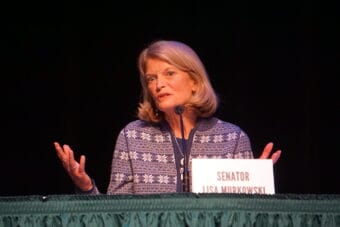
U.S. Sen. Lisa Murkowski said she looked forward to working with Begich. And she called Peltola, whom she served with in the state Legislature, a friend.

“You have represented Alaskans well throughout your short tenure, and navigated this journey while facing unimaginable personal tragedy with grace, humility, and determination,” Murkowski said in a statement. “Alaska has been made better with your service in Congress.”

Peltola’s husband, Gene, died in a plane crash a year after she was sworn in.

The results announced Wednesday will remain unofficial until the Division of Elections certifies the vote at the end of the month.

This story has been updated. 

Watch Alaska’s ranked choice tabulation

The Alaska Division of Elections is set to announce its final unofficial vote count Wednesday before tabulating voters’ ranked choices to determine the winners of races where no candidate got a majority of the vote in the first round.

Gavel Alaska will livestream the tabulation process from the Division of Elections in Juneau. The broadcast is scheduled to start at 5 p.m. You can watch the process live at the video above, on KTOO 360TV, or on Gavel Alaska’s YouTube channel.

The final count and the results of tabulation will determine the winners — pending certification — in several key races, including the race for U.S. House and eight legislative contests.

Republican Nick Begich III has already declared victory in the U.S. House race. He leads Congresswoman Mary Peltola, a Democrat, by roughly two percentage points, but is short of the majority necessary to give him a first-round victory. Second choice votes from the 5% of voters who chose minor candidates in the first round are not expected to give Peltola the lead. We’ll find out who those voters chose as their second choice during this evening’s tabulation.

In the tabulation process, if no candidate receives more than 50% of first-choice votes, the candidate with the fewest votes is eliminated. Those voters’ second choices are then redistributed to the remaining candidates.

This process continues until one candidate secures a majority of votes or only two candidates remain, at which point the candidate with the most votes wins.

The results will remain unofficial until they’re certified by the Division of Elections. The estimated date for that is Nov. 30.

Here are the eight legislative races that will be decided during tabulation:

  • Senate District D, a northern and central Kenai Peninsula race that includes incumbent Sen. Jesse Bjorkman and conservative challenger Ben Carpenter, both Republicans, and Democrat Tina Wegener
  • Senate District F on the Anchorage Hillside, where incumbent Republican Sen. James Kaufman faces Democrat Janice Park and Republican Harold Borbridge
  • Senate District L in Chugiak-Eagle River, where incumbent Republican Sen. Kelly Merrick faces conservative Republican challenger Jared Goecker and Democrat Lee Hammermeister
  • House District 6, including Homer and the southern Kenai Peninsula, where incumbent Republican Rep. Sarah Vance faces independent Brent Johnson and Republican Dawson Slaughter
  • House District 28, an all-Republican race for open seat in Wasilla that includes Elexie Moore, Steve Menard and Jessica Wright
  • House District 36, a wide swath of the Interior stretching from Glennallen to Delta Junction to the Yukon River drainage, where Republican Rebecca Schwanke, Democrat Brandon Putuuqti Kowalski, Republican Pamela Goode and Libertarian James Fields are competing for an open seat
  • House District 38, the Lower Kuskokwim, where Democrat Nellie Unangik Jimmie faces incumbent Democratic Rep. CJ McCormick, Veterans Party candidate Willy Keppel and Democrat Victoria Sosa
  • House District 40, the North Slope and Northwest Arctic, where Democrats Robyn Niayuq Burke and Saima Ikrik Chase face Republican-turned-independent Rep. Thomas Ikaaq Baker
Site notifications
Update notification options
Subscribe to notifications