Politics

Dunleavy wants quick action by Trump to revoke Biden’s Alaska environmental policies

An aerial view of ANWR's coastal plane and the Canning River
The Canning River, seen here in 2018, flows from the Brooks Range into the Beaufort Sea along the western edge of the Arctic National Wildlife Refuge. The sole tract that Regenerate Alaska acquired in the 2021 lease sale — and has now relinquished, lies along the Canning River. (Photo by Lisa Hupp/U.S. Fish and Wildlife Service)

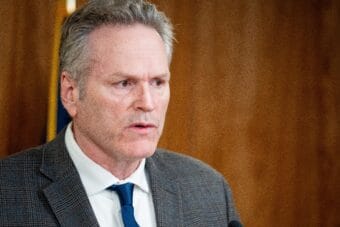
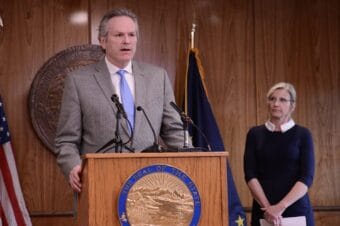
Gov. Mike Dunleavy is asking President-elect Donald Trump to immediately reverse the Biden administration’s Alaska environmental and tribal lands policies, claiming those policies hurt the state’s economy.

“Your election will hail in a new era of optimism and opportunity, and Alaska stands ready to and is eager to work with you to repair this damage wrought by the previous administration, and to set both Alaska and America on a course to prosperity,” Dunleavy said in a cover letter sent on Nov. 15, along with a 27-page document detailing his desired Alaska policy changes, which was publicly released on Monday.

Dunleavy’s policy document said that Trump, as soon as he returns to the White House, should issue an Alaska-focused executive order that removes restrictions on oil development in the Arctic National Wildlife Refuge and the National Petroleum Reserve. In addition, the document urged Trump to reinstate federal support for a controversial road stretching more than 200 miles through the Brook Range foothills to the isolated Ambler mining district and reverse the ban on new roads in Southeast Alaska’s Tongass National Forest, among other policy changes.

“It is essential that the Alaska specific Executive Order be issued as soon as President Trump takes office. The Biden Administration’s assault on Alaska was carried out through a multitude of official agency actions; reversal of these actions must comply with time-consuming administrative procedures,” said Dunleavy’s policy document, titled “Alaska priorities for federal transition.”

Additionally, Dunleavy wants Trump to create a cabinet-level task force and six new oversight positions to make sure that various federal agencies adhere to the pro-resource-extraction policy mandates. The newly hired officials would oversee the Department of the Interior, Department of the Army, Department of Commerce, Environmental Protection Agency and the Office of Management and Budget.

In his cover letter, Dunleavy accuses the Biden administration of “destroying economic opportunity” in Alaska.

However, Alaska’s economy grew during Biden’s term and shrank during the first Trump term, as measured by gross domestic product. It grew at an annual rate of 3.3%, adjusted for the federal inflation rate, in the first three and a half years of Biden’s presidency. It shrank by an inflation-adjusted annual rate of 1.8% in the four years of Trump’s first term, according to statistics from the Federal Reserve Bank of St. Louis.

Jeff Turner, Dunleavy’s communications director, said Biden’s presidency harmed Alaska, nonetheless. “The dozens of sanctions it has placed on Alaska are strangling future economic growth and denying the state the ability to support itself with revenue and jobs created by developing our natural resources,” Turner said by email.

Dunleavy’s transition plan was sent to the Trump team a month ago, along with the cover letter, Turner said.

A representative of one environmental group vowed to fight against Dunleavy’s priorities for the new Trump administration.

“We’re definitely going to be providing pushback to the wish list,” said Matt Jackson, Alaska state senior manager for The Wilderness Society.

The actions that Dunleavy wants Trump to take may not be legal, Jackson said.

“Legality is not necessarily a top priority for either of these leaders. We may be seeing more and more illegal rollbacks, law be damned,” Jackson said. “We’re prepared.”

In at least two cases, the Biden administration has taken action on items that Dunleavy lists as Alaska priorities.


Dunleavy asked the Trump team to schedule a second Arctic National Wildlife Refuge lease sale, to follow the 2021 sale that failed to result in any exploration. The Biden administration has scheduled that lease sale for Jan. 9, though with restrictions that Dunleavy and other Alaska politicians oppose.

Dunleavy also asked the incoming administration to resurrect a controversial land trade proposal that would allow a road to be built in the Izembek National Wildlife Refuge; the Biden administration has already done that, recommending a trade in a supplemental environmental impact statement released a month ago. Public comments are now being solicited on that land trade plan.

Land into trust

Beyond removing limits on resource extraction in federal lands, Dunleavy wants the new Trump administration to abandon the current Interior policy in favor of putting some lands into trust for the benefit of Native tribes.

The issue has been a subject of dispute for several years. Advocates for putting land into trust say it is important to tribal sovereignty, but the idea has drawn opposition from the state. Tribes argue that they are entitled to control of some land, while the state has argued that the 1971 Alaska Native Land Claims Settlement Act put an end to such land transfers by giving lands and subsurface mineral rights to for-profit Native corporations rather than to tribes.

The Biden administration and the Obama administration before it supported the tribes’ trust lands aspiration, while the Republican administration, both under Trump’s previous term and under that of George W. Bush, opposed them.

The latest dispute over land-in-trust concerns a parcel in downtown Juneau that the Central Council of Tlingit and Haida Indian Tribes is seeking to be put into trust status. U.S. District Court Judge Sharon Gleason ruled in June that Interior does have the right to grant trust status for land parcels, though she said the process used by Tlingit and Haida had flaws and that the application should be resubmitted. The state appealed that ruling.

The Biden administration’s position favoring land-in-trust designations is dangerous to the state’s interest, Dunleavy said in his transition report. Because of that, “there is a risk that for the first time Alaska will have casino gambling thrust upon it by the federal government,” it said.

An attorney representing the tribes criticized Dunleavy’s proposal for an end to federal support for Alaska lands-in-trust transactions.

“We were disappointed to see Governor Dunleavy’s requests to the incoming Administration. Alaska Tribes should be treated the same as all other federally recognized Tribes, full stop,” attorney Erin Dougherty Lynch, managing attorney at the Native American Rights Fund’s Alaska office, said by email.

“This issue has been the subject of decades of litigation, including pending litigation that the Governor initiated. Alaskans would be better served if the Governor chose to work cooperatively with Tribal governments to protect our collective health, safety, and welfare. Other states have successfully navigated these issues and have built strong relationships with Tribal governments. Alaska should do the same,” Dougherty Lynch said.

Dunleavy, though an ardent Trump supporter, has not been selected for any position in the new administration. North Dakota Gov. Doug Burgum was Trump’s pick to head the Department of the Interior.

Alaska’s three electors cast their votes for Donald Trump at Anchorage ceremony

Alaska’s three presidential electors — from left, Ron Johnson, Eileen Becker and Rick Whitbeck — sign certificates as they cast their votes for President-elect Donald Trump at the Dena’ina Center in Anchorage on Tuesday, Dec. 17, 2024. (Photo courtesy of Alaska Division of Elections)

Alaska’s three presidential electors cast their votes for Donald Trump Tuesday at a ceremony in Anchorage.

The three electors, selected by the Alaska Republican Party, were Rick Whitbeck, Ron Johnson and Eileen Becker. Lt. Gov. Nancy Dahlstrom, who oversees elections, introduced them during the brief gathering at the Dena’ina Center.

“Our three electoral votes are modest, but they symbolize the votes and the aspiration and the voice of all Alaskans, from the biggest communities to the smallest villages and most remote places that we have in Alaska,” she said. “These votes remind us that every state, every individual, has a stake in the direction of our nation.”

Though the electors typically cast their votes in Juneau, they met in Anchorage this year to make travel easier, according to the Division of Elections.

The electors signed certificates that will be shipped to Washington, D.C. where they’ll be counted by the next Congress on Jan. 6. The count will be overseen by Trump’s opponent in the presidential race, Vice President Kamala Harris.

Similar scenes took place across the country Tuesday as 535 other electors voted for their state’s chosen candidate. Trump defeated Harris with 312 electoral votes after winning all seven swing states in the Nov. 5 election.

Trump returns to office Jan. 20.

Recount of ranked choice repeal ballot measure gets underway in Juneau

Attorneys and observers watch in the adjudication room as Division of Election Director Carol Beecher determines how ambiguously-marked ballots should be counted during a recount in Juneau on Dec. 4, 2024. (Eric Stone/Alaska Public Media)

A recount is underway in Juneau on the closely contested ballot measure that would have repealed Alaska’s open primaries and ranked choice voting. The recount began Wednesday.

Official results certified on Saturday have Ballot Measure 2 failing by 737 votes, just about two tenths of one percent of all votes cast. The Alaska Republican Party requested the recount, which is being performed at the state’s expense since the final margin was less than half a percentage point.

During the recount, Division of Elections employees will rescan the more than 340,000 votes cast across the state. Roughly 45,000 were scanned by 3 p.m. Wednesday afternoon, said division director Carol Beecher.

“We take the ballots out of the different envelopes, each scanner is programmed a certain way, and we start scanning all of the ballots, and then they go onto a server, and then from the server, they’re fed into these computers that we have in the what we’re calling the adjudication room,” Beecher said in an interview.

In the adjudication room, big-screen TVs display scans of ballots that might be ambiguous.

The observers, including lawyers for the Republican Party and the No On 2 campaign, then have the opportunity to challenge Beecher’s ruling. Those ballot images are flagged and set aside for possible court challenges.

The ballots that are adjudicated are themselves a small fraction of the overall total, and Beecher says the challenged ballots are an even smaller slice of that sum.

“There are very few that are challenged. It’s usually something where the person has marked both ovals and has done some kind of a mark on it, and then we’ve tried to discern what the intent of the voter was,” Beecher said. “Did they want that one to count because they extra-marked it or didn’t want to? Sometimes they initial it. Sometimes they say no. It’s a variety.”

Advocates both for and against the ballot measure watching the recount said that while it’s early in the process, they have not yet seen significant differences that might change the final result.

The state has 10 days to complete the recount, though Beecher says they hope to finish sooner. Until then, election officials will continue scanning ballots 12 hours a day, 8 a.m. to 8 p.m.

Slight increase in Alaska’s minimum wage coming ahead of larger, voter-approved increase

A sign at a Carl’s Jr. restaurant in Midtown Anchorage, seen on Wednesday, advertises for workers and cites a starting wage of $15 an hour. Alaska’s minimum wage will rise to $11.91 an hour starting Jan. 1, six months before the first increase approved by voters through this year’s Ballot Measure 1 start to take effect. Under terms of the ballot measure, Alaska’s minimum wage will reach $15 an hour in mid-2027. (Photo by Yereth Rosen/Alaska Beacon)

Alaska’s minimum wage workers will get a tiny bump in pay starting on Jan. 1 before a larger increase becomes effective six months later.

The state’s minimum wage will increase by 18 cents to $11.91 an hour at the start of the new year, the result of a ballot measure passed 10 years ago, the Alaska Department of Labor and Workforce Development said on Wednesday.

The bigger increase will be on July 1, when the minimum wage is set to rise to $13 an hour, the result of a ballot measure approved by voters this year. The minimum wage is set to increase again in 2026 to $14 an hour, to $15 an hour in 2027 and in subsequent years, increase to adjust for inflation.

The 2014 ballot initiative also included an inflation adjuster. The upcoming 18-cent-an-hour increase was calculated according to that adjuster, the department said. The calculation used the consumer price index for the Anchorage metropolitan area, which increased by 1.5% in 2023, the department said.

Alaska’s minimum wage also applies, indirectly, to salaried employees, under state law. The relevant statute requires salaried employees to be paid at least twice the amount that minimum-wage workers would earn for a full workweek. Starting Jan. 1, that minimum pay for salaried workers will rise from $938.40 to $952.80 for a 40-hour workweek, the department said.

This year’s Ballot Measure 1, in addition to increasing the minimum wage, mandates a system of paid sick leave, with leave days to be accrued over time by workers, and bars employers from requiring employees to attend political or religious meetings unrelated to their job duties.

Supporters of this year’s ballot measure said the wage increases and other benefits were overdue in Alaska and would benefit the economy.

Even at the $13-an-hour rate to start on July 1, Alaska will continue to have the lowest minimum wage of all U.S. West Coast states, according to statistics from the U.S. Department of Labor.

Opponents, including trade groups representing restaurant and bar owners, tourism companies and oilfield-service companies, campaigned against the ballot measure, arguing that it would harm businesses.

Alaska election results are official: Here are 5 takeaways

“I voted” stickers are seen on display in the headquarters offices of the Alaska Division of Elections in Juneau on Tuesday, Nov. 12, 2024. (Photo by James Brooks/Alaska Beacon)

Alaska’s election results were made official on Saturday, after the state review board finished certifying the results. Here are five takeaways from the final results:

There were no changes in the outcomes, but the margin defeating ranked choice repeal grew

The margin between the votes rejecting the repeal of the state’s open primary and ranked choice voting system and those in favor of it grew. There were 737 more votes against Ballot Measure 2 than for it, an increase of 73 votes compared with the margin when the unofficial count was completed on Nov. 20.

Republican U.S. Rep.-elect Nick Begich’s 7,876-vote margin of victory over U.S. Rep. Mary Peltola, D-Alaska, after ranked choice tabulation was slightly smaller than the unofficial results.

In the state Senate, five Democrats and five Republicans won, leaving the partisan makeup of the chamber unchanged, at 11 Republicans and nine Democrats.

In the Alaska House, 21 Republicans, 14 Democrats and five independents were elected. That’s one fewer Republican and one more Democrat than the outgoing Legislature.

Voters passed Ballot Measure 1 by nearly 16 percentage points. The measure will increase the minimum wage in three steps over the next two and a half years, reaching $15 per hour in July 2027. It also mandates paid sick leave for all Alaska workers, and bars employers from requiring workers to attend meetings on political and religious issues.

Trump won Alaska by a bigger margin than 2020, but the state is trending away from Republicans compared with other states

President-elect Donald Trump won Alaska by a 13.13-percentage point margin, more than 3 points better than in 2020. Trump’s margin was 11.58 points more than his national popular vote margin, which currently stands at 1.55 percentage points.

It’s the 15th consecutive time that the Republican candidate won Alaska’s three Electoral College votes for president.

But while Alaska remains a red state, it’s less Republican compared with the rest of the country than it has been in a long time. The Republican margin over the Democrats ranked 22nd among the states — that is, Trump defeated Kamala Harris by a bigger margin in 21 other states.

That’s the lowest-ranking performance for a Republican in Alaska relative to other states since Richard Nixon in 1972. Since George W. Bush’s margin in Alaska was the fourth-highest among the states in 2000, Alaska has been drifting away from being one of the more Republican states: In 2004, Alaska had the eighth-biggest Republican margin; in 2008, with Gov. Sarah Palin on the ballot, it was sixth; in 2012, 16th; in 2016, 19th; and in 2020, 20th.

Turnout was down compared with four years ago, especially in rural Alaska

There were 340,981 ballots cast in Alaska this year, which is more than 20,000 fewer than four years ago, when 361,400 Alaskans voted.

Because there were more than 15,000 more people registered in the state, the turnout percentage drop was relatively steep, from 60.67% in 2020 to 55.8% this year. However, the number of registered voters is actually higher than the number of voting eligible people in the state, since voter registration is nearly universal, while legal requirements mean it can take years for voters who leave the state to be removed from the rolls if they don’t notify the Division of Elections.

Turnout declined in the four northern and western state House districts more than the state as a whole, after a similar decline in 2022. For example, House District 40, which covers the North Slope and Northwest Arctic boroughs, has the same boundaries as four years ago, but saw the number of ballots cast drop 4,677 to 3,362, a 28% decline. Direct comparisons are harder for the other rural districts, since some precincts were moved to House District 36 in the Interior. But the drop in rural voting was consistently greater than the statewide decline.

The parties’ geographic strengths shifted

For decades, Republicans were strong in South Anchorage, while Democrats excelled in rural Alaska. This year, that balance of power shifted, with Harris winning three of the six Anchorage districts that are mostly south of Dowling Road on her way to winning more votes than Trump across the city.

But Trump performed relatively strongly in rural northern and western areas, winning House District 40 by nearly 10 percentage points after losing it to President Joe Biden in 2020, and cutting the margins in the traditionally Democratic strongholds in the Bering Strait and Yukon-Kuskokwim Delta regions.

In Southeast Alaska, House District 1, which includes Ketchikan, voted more Republican than four years earlier, while Juneau’s Mendenhall Valley continued to move toward the Democrats.

The Kenai Peninsula and Matanuska-Susitna boroughs remain the mainstays of Republican statewide wins.

In the Interior, the congressional and legislative Democrats outperformed Harris in Fairbanks.

Both conservatives and progressives have things to cheer about

For Alaska Republicans, Trump’s win means the White House will be more likely to approve resource development projects than it was under Biden.

Begich’s defeat of Peltola returns the state to the all-Republican congressional delegation it has had since 1981, with the exception of Peltola’s two-plus years in the U.S. House and Begich’s uncle Mark Begich’s six years as a U.S. senator, from 2009 to 2015.

In the state Senate, more-conservative Republicans will be a part of an official caucus for the first time in two years. While the caucus breakdown isn’t finalized, it looks like the Senate minority is doubling in size, from three to six senators. Senate caucuses must have five members to be officially recognized under legislative rules. That means minority-caucus senators will again sit on committees.

For Alaska Democrats, Peltola’s win in 2022 was historic, and her defeat this year is a disappointment.

However, the Legislature is positioned to have two mostly Democratic majority caucuses – albeit in bipartisan or multipartisan coalitions. The currently announced House majority has all of the 14 House Democrats and five independents, as well as two Republicans. The currently announced Senate majority has all nine Democratic senators and five of the 11 Republicans.

If most Democrats are in the majorities it both chambers, it would be for the first time in nearly 44 years, since June 1981. All four caucuses are still trying to woo members, so there is still time for changes ahead of the scheduled Jan. 21, 2025, start to the 34th Alaska Legislature.

And both ballot measure outcomes were victories for progressives, who supported the labor-backed Ballot Measure 1 and tended to oppose the Ballot Measure 2 repeal of ranked choice voting.

America’s first Arctic ambassador was just confirmed weeks ago. Now he could be out of a job.

Mike Sfraga, then chair of the U.S. Arctic Research Commission, speaks on April 10, 2024, at the Arctic Encounter Symposium in Anchorage. He later became U.S. ambassador-at-large for Arctic Affairs. (Photo by Yereth Rosen/Alaska Beacon)

Earlier this month, a crowd gathered at a Fairbanks venue to celebrate the confirmation of U.S. Ambassador-at-Large for Arctic Affairs Mike Sfraga — an Alaskan and the first-ever person to hold the newly created position.

Sfraga’s confirmation was a priority of Republican U.S. Sen. Lisa Murkowski, who pushed for the creation of the Arctic ambassador post and was seen personally lobbying her colleagues on the Senate floor during the vote.

It took more than a year after Sfraga’s nomination for the U.S. Senate to confirm him, amid opposition from some Republicans. But now, not even three months in, he may soon be out of a job.

Sfraga was appointed by President Joe Biden, and it’s typical for politically appointed ambassadors to resign their posts during presidential transitions; others, like those serving as ambassadors to Kenya and South Africa, have already announced their departures.

Sfraga, a geographer who has also worked at a think tank and University of Alaska Fairbanks, has not publicly made such an announcement.

A spokesperson for Sfraga declined to comment, as did a spokesperson for Murkowski.

Republican U.S. Sen. Dan Sullivan said in a brief interview that Sfraga’s fate is likely up to Donald Trump.

“The tradition is, when a new administration comes in, most ambassadors, they just resign or step down,” said Sullivan, who missed Sfraga’s confirmation vote due to a trip to the United Nations. “But I have no idea. I truly don’t.”

Sfraga’s nomination faced close scrutiny from some Republicans, who criticized his links to Russia and China.

Republican U.S. Sen. James Risch of Idaho, the ranking member of the Senate Committee on Foreign Relations, said Sfraga had spoken at one Russian government-sponsored conference headlined by Vladimir Putin and also at a panel sponsored by a “sanctioned, state-owned Russian energy company.”

Sfraga, at a Senate hearing, called Russia “half of the Arctic” and said that because the region is a small community, “you must engage.”

“Indeed, at one of those conferences, President Putin did provide a keynote address,” he said. “But I had no interaction with President Putin at all.”

Among those voting against Sfraga’s confirmation was the man who would be his new boss, Republican U.S. Sen. Marco Rubio of Florida, whom Trump has chosen to be the new Secretary of State.

Many of Sfraga’s friends and allies are hoping to see him remain on the job. Fran Ulmer, a former Alaska lieutenant governor who served with Sfraga on the U.S. Arctic Research Commission, said Sfraga has spent many years working on Arctic issues and science, and establishing relationships with officials from other nations.

“He has a kind of credibility with them that would help the U.S. when it comes to pursuing a particular Arctic agenda,” she said. “Those relationships matter, and those relationships don’t happen overnight — they happen over years. So, it would be to the next administration’s advantage to have someone in there who has that kind of credibility but also those connections.”

Another friend of Sfraga’s, Mark Myers, a federal government veteran who is a former head of the U.S. Geological Survey, said that “if you were to bet, the bet would be against him.”

“But has some strong support,” added Myers.

Myers said the Fairbanks celebration of Sfraga’s confirmation drew dozens of people, including some from Alaska’s university system and the military and even Murkowski, who teleconferenced in.

“At his core, he is our neighbor, our friend — and he is just so important,” Murkowski told the audience, according to the Fairbanks Daily News-Miner.

Nathaniel Herz welcomes tips at natherz@gmail.com or (907) 793-0312This article was originally published in Northern Journal, a newsletter from Herz. Subscribe at this link.

Site notifications
Update notification options
Subscribe to notifications