Politics

Alaska Gov. Dunleavy forces early vote on education veto override with special session in August

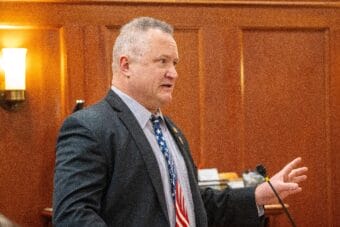
Alaska Gov. Mike Dunleavy speaks to reporters on Thursday, April 17, 2025, with Deena Bishop, commissioner of the Alaska Department of Education and Early Development, looking on in the background. (Photo by James Brooks/Alaska Beacon)

Alaska Gov. Mike Dunleavy issued a proclamation for a special session on Wednesday, calling Legislators back to Juneau in August to pass legislation on education reform and his executive order creating a new Department of Agriculture.

The special session also means that lawmakers cannot wait until January to vote on overrides to the governor’s budget vetoes and his vetoes on several policy bills. They must vote in the first five days of the special session.

That’s significant, because 45 votes are needed to override a budget veto, and while there were 46 votes in favor of a prior veto override this spring, at least one legislator who voted in favor of that override will be unavailable in August.

The 30-day special session is scheduled to begin 10 a.m. August 2 in Juneau.

Agriculture is currently overseen by a division within the Department of Natural Resources.

​​“Enacting a few necessary reforms to our public education system can elevate those children struggling in Alaska’s school system,” said Dunleavy in an email statement with the announcement. “As elected officials we must do all we can to put the next generation on the path to a successful and prosperous future, and that starts with a solid public education. Splitting the Division of Agriculture away from DNR into a department will elevate food security and support our hard-working farmers while growing the agricultural sector.”

The announcement comes in the wake of a historic veto override vote, 46-14, by the Legislature rejecting Dunleavy’s veto of an education funding bill, House Bill 57, raising the core of the state’s education formula by  $700 per student. Dunleavy then made a budget veto of part of the funding for schools, pushing it down to $500 per student, and House and Senate leadership have promised to override that veto in the next session.

Senate President Gary Stevens, R-Kodiak, said he was surprised by the announcement and learned about it from reporters calling him for comment.

The special session will force lawmakers to vote early on veto overrides for education funding and a variety of other bills, he said. Legislative attorneys have told lawmakers that with the governor’s proclamation, they cannot defer those votes until the regular session begins in January.

That’s a problem for supporters of an education veto override, because 45 of 60 legislators are needed for that vote to succeed. This spring, a policy veto override garnered 46 votes, but Sen. Forrest Dunbar, D-Anchorage, is in Poland on a National Guard deployment and is expected to be unavailable in August.

Other legislators may also be unavailable, Stevens said.

And supporters of an override have questioned whether all of the votes from the previous override vote will hold for a budget override.

In May, lawmakers voted 32-28 to deny an executive order by Dunleavy to create a new Department of Agriculture, citing the proposal’s costs as well as creation through an executive order rather than as legislation, with public input.

This is a developing story and may be updated.

After Supreme Court ruling, some Alaskans could be denied or lose U.S. citizenship

Hundreds gather outside the U.S. Supreme Court on Thursday, May 15, 2025, to protest the Trump administration’s effort to strip birthright citizenship from the Constitution.
Hundreds gather outside the U.S. Supreme Court on Thursday, May 15, 2025, to protest the Trump administration’s effort to strip birthright citizenship from the Constitution. (Ashley Murray/States Newsroom)

A Friday ruling by the U.S. Supreme Court, coupled with an executive order by President Donald Trump, has created doubt about the future of American citizenship for Alaskans who are the children of immigrants.

In a 6-3 decision, the court ruled that U.S. District Court judges cannot issue nationwide preliminary injunctions.

In January, President Donald Trump issued an executive order declaring that the federal government would end birthright citizenship — the awarding of American citizenship to every person born in the United States — for the children of non-citizen immigrants.

The new Supreme Court decision has significant implications for Alaska in particular, because it is not among the states that have legal challenges against Trump’s executive order.

Since 1898, the Fourteenth Amendment has been interpreted by courts as offering birthright citizenship to the children of all American residents, regardless of immigration status.

Trump’s order would change the federal government’s interpretation. It declares that citizenship would be limited to the children of citizens and lawful permanent residents, which would exclude refugees, and other people in the United States temporarily, as well as undocumented immigrants.

That change has been blocked nationwide since January by numerous district court judges.

Friday’s ruling by the U.S. Supreme Court means that those judges can no longer block the order nationwide; they can only block it in states whose district courts are considering lawsuits that challenge the Trump order.

As of Friday, 22 states have legal challenges against the Trump order.

Twenty-eight states, including Alaska, have not. In those states, the Trump administration can start, in 30 days, to begin implementing the executive order, the court said.

The court did not rule on the constitutionality of the Trump administration’s executive order, which could be overturned at a later date.

Neither the office of Gov. Mike Dunleavy nor Attorney General Treg Taylor answered emailed questions asking whether they intend to file a lawsuit in order to protect newborn Alaskans’ citizenship.

Mara Kimmel, the executive director of the Alaska chapter of the American Civil Liberties Union, said by email that her organization “anticipates this decision could have devastating impacts in Alaska and we are monitoring this very closely as we determine a path forward to protect Alaskan families.”

Meghan Barker, communications and engagement director for the ACLU of Alaska, said that the ACLU nationally has already filed a class-action lawsuit seeking to represent people nationwide, including Alaskans.

“We’re closely following the situation and litigation to ensure that no Alaskans lose their citizenship,” she said.

Annual cross-border race draws fewer cyclists – and some Canadians who won’t enter the U.S.

A solo rider crests the summit during a previous Kluane Chilkat International Bike Relay. (Jillian Rogers/KHNS)

More than 900 cyclists are set to participate this weekend in an annual 150-mile cross-border race that starts in Canada and ends in Haines. But this year’s competition could look a little different amid ongoing political tensions between the neighboring countries.

The Kluane Chilkat International Bike Relay has been happening for decades — and it has a particular legacy.

“It’s all about the goodwill between Americans and Canadians,” said Richard Clement, the relay race board’s vice president.

Clement said the race is capped at 1,200 people, and that most years, it sells out in about two weeks. This time around, that didn’t happen. Roughly 930 people registered.

“We suspect it was Canadians who just didn’t want to come to the US,” he said. “But you know, there’s other factors too, like the exchange rate. It’s unbelievably bad for Canadians to come down and change to American dollars these days.”

Still, the vast majority of this year’s registered participants — around 85% — are Canadian, according to race organizers.

The race has been around since 1993 and has only been cancelled a few times — once for snow, and three times during the Covid-19 pandemic. Teams and solo cyclists start in Haines Junction, about an hour drive north of the Canadian border, and ride on the highway from there to Haines.

Clement says race organizers also heard from a small number of Canadian teams — about a dozen — who did register and plan to race. But they’re choosing not to finish because they don’t want to cross the border into the U.S.

It’s the latest example of the increasingly fraught relationship between Canada and the U.S. amid President Donald Trump’s global trade war and repeated comments about making the neighboring country the 51st state. In response, some Canadians have boycotted visiting or spending money in Alaska border towns.

In response to teams that won’t cross the border, race organizers posted a new policy posted to the race website on June 13. It says cyclists must travel southbound only, and that those who do not plan to cross the border into Alaska must withdraw from the race no later than Checkpoint 6.

At that point, or sooner, cyclists must get into their team vehicles and drive home rather than ride back toward Haines Junction.

“For safety considerations, we tried to explain to them, don’t turn around and try to ride your bike home. Because we cover people going to Haines. We don’t cover people going the other way.”

The policy adds that teams who withdraw early will be marked as DNF — or “Did Not Finish.”

After federal funding cut, Alaska Legislature asks Congress to help rural schools

Rep. Jeremy Bynum, R-Ketchikan, speaks Feb. 21, 2025, on the floor of the Alaska House of Representatives. (Photo by James Brooks/Alaska Beacon)

A group of Alaska’s rural school districts are asking for help after the federal government failed to renew a program that sends grant money to logging-dependent areas.

On Monday, the Alaska Legislature joined the call for help by passing House Joint Resolution 5, which asks Congress to reauthorize the Secure Rural Schools and Community Self-Determination Act of 2000.

That act sent $12.6 million to Alaska schools in federal fiscal year 2023, but Congress has thus far failed to reauthorize the program.

The state Senate passed HJR 5 by a 19-1 vote on May 9 after modifying a version originally written by Rep. Jeremy Bynum, R-Ketchikan. The House agreed with the changes, 37-3, on Monday.

The votes against the resolution came from conservative Republicans who generally oppose federal spending.

The Secure Rural Schools Act, as it is commonly known, was designed to compensate rural school districts for tax revenue lost as the federal government began to restrict logging in the 1990s.

In 2023, the law provided more than $250 million to districts nationwide, with about 5% of the funding coming to Alaska.

For some of Southeast Alaska’s rural school districts, the money was a big part of the local budget. Yakutat, for example, received more than $6,500 per student. Wrangell had almost $3,500, and the money was worth $584 for each of Ketchikan’s 2,045 students.

HJR 5, which will be sent to every member of Congress, asks for retroactive funding and for a permanent funding source to pay for the bill.

It also encourages Congress to open more federal land to timber cutting “in a manner that supports rural economic revitalization, conserves habitat, and promotes forest health.”

Trump backs Begich for reelection to Alaska’s U.S. House seat in 2026

Republican U.S. House candidate Nick Begich and his supporters wave campaign signs at the corner of the Seward Highway and Northern Lights Boulevard on Nov. 4, 2024, the day before Election Day. (Photo by Yereth Rosen/Alaska Beacon)

President Donald Trump has endorsed incumbent Rep. Nick Begich III, R-Alaska, for reelection.

In a social media post Thursday afternoon, Trump said Begich “is doing an incredible job representing the Great People of Alaska, a State I love, and WON BIG THREE TIMES, in 2016, 2020, and 2024!”

Begich responded by posting a social media message of his own, thanking Trump for his support.

“Together we are working to Unlock Alaska’s FULL potential!” Begich wrote.

In the 2024 U.S. House election, Begich was Trump’s second choice. He initially supported Lt. Gov. Nancy Dahlstrom, but when Dahlstrom withdrew from the race after finishing third in the primary election, Trump switched to Begich.

In 2024, Begich defeated incumbent Rep. Mary Peltola, D-Alaska, by 7,876 votes out of 321,846 counted, or 2.44 percentage points.

Begich is the only candidate who has formally indicated his intent to run for Alaska’s seat in the 2026 election so far.

The national Democratic Party has named Alaska as one of its top targets for the 2026 election, but no candidates have yet signed up to challenge Begich.

Campaign finance documents published by the Federal Elections Commission show Peltola as a candidate, but that is incorrect; Peltola has $20,794.30 remaining from her 2024 election run.

Begich raised more than $800,000 during the first quarter of 2025 for his reelection campaign, with much of the money coming from Republican-aligned political committees. Jeffery Hildebrand, the billionaire owner of oil and gas firm Hilcorp, also was a major contributor.

The National Republican Congressional Committee, which is supporting Begich’s reelection, said in a statement that the Trump endorsement and Begich’s fundraising shows his “growing momentum” for 2026.

Under Alaska’s elections system, all candidates run in the same primary election, and the top four vote-getters advance to the general election, where a winner is chosen by ranked choice voting.

Alaska Legislature rejects call for Canada as 51st state, opposes ‘restrictive trade measures’

Marker for the U.S.-Canadian border between Skagway, Alaska, and Stikine Region, British Columbia.

Both chambers of the Alaska Legislature have approved a resolution stating its support for Canadian independence and opposing “restrictive trade measures or tolls” that would affect commerce between Alaska and Canada.

House Joint Resolution 11, which would be sent to President Donald Trump, Canadian Prime Minister Mark Carney and other top officials in both countries, implicitly rejects Trump’s call to make Canada the 51st state in the United States.

“Alaska recognizes the importance of a strong and sovereign nation of Canada and firmly supports Canada’s right to self-determination, national security, and economic independence,” the resolution states in part.

The Alaska Senate approved that language in a 13-6 vote on Monday with one lawmaker excused absent. The state House voted 33-4 on March 24 to approve a slightly different version.

Resolutions are statements of opinion by the Legislature and not subject to a governor’s veto.

The resolution will return to the House for a concurrence vote before becoming final.

Rep. Chuck Kopp, R-Anchorage and the resolution’s sponsor, said he believes there is good support in the House for the amended language.

The Senate’s vote came a day before Trump met Carney at the White House and declined to back down from claims that Canada should be “the 51st state.”

The Trump administration has prepared a large number of tariffs against Canadian imports, and the Canadian government has preemptively enacted retaliatory measures.

In British Columbia, the government has introduced legislation that could lead to tolls on traffic traveling between Alaska and the Lower 48.

In floor debate, Senate Majority Leader Cathy Giessel, R-Anchorage, noted the amount of trade that goes across the border between Alaska and Canada.

“The purpose of HJR 11 is to remind Alaskans that we have an important relationship with Canadians, those shared values of Arctic partners, our relationship as good neighbors, and keeping our partnership with Canada alive isn’t just good policy, it’s critical to the way we live,” she said.

Parts of Alaska are unconnected to each other without a trip through Canada. Fresh produce, dairy products and other perishable goods are shipped to Alaska via Canada.

Alaska Natives and Canadian First Nations are connected across the border, the resolution notes, and even the region’s sports teams compete together. The resolution observes that curling teams in Whitehorse and Fairbanks have been playing against each other for decades.

All of the votes against the resolution came from members of the Senate’s Republican minority caucus.

Senate Minority Leader Mike Shower, R-Wasilla, alleged that the resolution is more about speaking against Trump than speaking in support of Canada. The resolution “is kind of a slap in a certain direction,” he said.

He suggested that if Alaska is serious about improving relations with Canada, it should consider reviving the state’s liaison program, which used to have an Alaska delegate communicating with Canada and a Canadian in Alaska to work on cross-border issues.

Sen. Mike Cronk, R-Tok, represents a broad district that abuts the Canadian border along the Alaska Highway. He supports Trump and opposed the resolution.

“This really doesn’t change anything,” he said of the resolution. “We still respect each other, we still support each other, and the resolution is not going to change that.”

“It’s just poking at Trump,” said Sen. James Kaufman, R-Anchorage, after the vote.

He said Canada isn’t pulling its weight in NATO, and that’s reason for concern.

“If you look at their contributions to defense, they’re lagging way behind,” he said.

Sen. Jesse Kiehl, D-Juneau, represents northern Southeast Alaska, including the towns of Skagway and Haines, which are connected by road to Canada but not to the rest of Alaska.

“My constituents are asking for it,” he said of the resolution.

“When there are conflicts going on, when someone else has issues, and it starts to impact the relationships we do have, have long had, it’s worth it for us to reaffirm those relationships, to reach back out and say the close ties we’ve always had are good. We should continue them, because there’s real damage going on right now,” he said.

He gave an example: Over the winter, a restaurant in Haines burned down. Its owner later told Kiehl that they had good news from their insurance company and would get a full payout.

“I said, ‘Wonderful. Are you going to rebuild?’ And the answer was, ‘No.’” Kiehl said.

The owner said that customers from Canada had represented a significant portion of their income, and with Canadians shunning Alaska, it wasn’t worth reopening.

Sen. Bert Stedman, R-Sitka, represents the town of Hyder, which is almost split in two by the Canadian border. Hyder’s children go to school in Stewart, British Columbia. Its residents shop in Stewart.

He voted in support of the resolution and said that “the boys in Washington, D.C.,” might be seeing problems with Canada, but he’s not.

“We’re not having problems with our border here,” he said.

In an emailed statement, Yukon Premier Ranj Pillai congratulated the Alaska Legislature for its action.

“The Yukon and Alaska benefit from strong people-to-people connections, close economic ties, and a shared appreciation for the realities of life in the North. Yukoners appreciate the efforts by the Alaska legislature to ensure that these important cross-border connections are understood by federal leaders on both sides of the Canada-US border,” he wrote.

“While Canadians will always stand up for our sovereignty, our economy, and our way of life, we hope that Americans will continue to come visit the Yukon and experience all that our incredible territory has to offer.”

Murray Lundberg, a Yukon resident and member of the Order of Yukon, is an outspoken critic of Trump on social media and said the resolution is unlikely to help matters because Canadians remain scared of their treatment by American border guards.

“It’s not a minority opinion, and I don’t know why it’s not being mentioned more. People are soft-pedaling around this, and it’s a big issue,” he said.

In March, a Yukon-born woman was imprisoned by Immigration and Customs Enforcement for two weeks in squalid facilities before being released with no charges filed.

“I love visiting Skagway and Haines, but you know, it’s just not going to happen,” Lundberg said.

“Friends do not convince friends to put themselves in a dangerous situation. So I really object to (messages like the resolution) because that’s what it is. That’s not what a friend would do.”

Site notifications
Update notification options
Subscribe to notifications