Retired Anchorage podiatrist Matt Heilala filed to join the 2026 Alaska governor’s race Friday. So far, he’s the sixth Republican to join the field.
Heilala, born in Anchorage and raised on the Kenai Peninsula, has never held elected office. But in an interview, the 55-year-old said his experience as a doctor and business owner make him well-suited for the top job in state government.
“The more I get to know candidates and other people that are in office, as much as I admire them, I think I have something unique to offer to help with a lot of the divisiveness without having to compromise on critical principles,” he said.
Heilala said he’s especially adept at working with people with whom he disagrees, an approach he said would lend itself well to collaborating with lawmakers.
“When’s the last time we had an overwhelming majority in our Legislature in Alaska?” he said. “It’s always kind of razor-thin, back and forth, and you become stymied and dysfunctional when people aren’t able to get through the contempt and recognize and align that with common goals.”
For decades, Heilala has donated tens of thousands of dollars to Republican candidates, including Gov. Mike Dunleavy, Congressman Nick Begich and U.S. Sen. Dan Sullivan, according to campaign finance data aggregator OpenSecrets.
Heilala, though, cast himself as straddling political fault lines.
For example, Heilala said he’d like to expand school choice options like charter schools and homeschool — priorities that Republicans, including Dunleavy, have emphasized — but Heilala also emphasized the state’s obligation to ordinary neighborhood public schools. The government is obligated to “defend the defenseless and care for those in need,” Heilala said, adding that he’d like to expand opportunities for businesses to create jobs.
Like Alaska politicians on both sides of the political aisle, Heilala says he’d like to expand resource development in the state.
As the state faces a budget crunch, Heilala said the state government has a “spending problem.” He said he’d like to make the state’s spending more transparent in an effort to build trust with the public. That, he said, could help lawmakers find a compromise on annual Permanent Fund dividends the state can afford.
“You can’t sustain $2 billion deficits every year,” Heilala said. “That just compounds problems.”
Heilala’s most recent experience in government comes as a Dunleavy appointee to the State Medical Board, which made headlines this spring when it asked the Legislature to restrict gender-affirming care for minors. Lawmakers did not act on the request.
Heilala joins a field of six Republicans running for governor in 2026, so far. No Democrats or independents have filed to join the race. Dunleavy cannot run for a third term.
Jim Parkin smiles for a photo in Angoon in 2017. (Photo by Emily Russell/KCAW)
A retired school teacher and principal from the small Southeast Alaska City of Angoon entered Alaska’s 2026 governor’s race earlier this month.
James Parkin filed a letter of intent to run for governor on July 1. He is one of six Republican candidates who have filed, including Lt. Gov. Nancy Dahlstrom, former state Sen. Click Bishop and Mat-Su Borough Mayor Edna DeVries. Retired Anchorage podiatrist Matt Heilala and Conservative activist Bernadette Wilson are also in the running.
This is Parkin’s first campaign for public office.
In an interview on Monday, Parkin said he is a supporter of large Permanent Fund dividends, increased state funding to school districts and the revival of a pension plan for state employees. He also wants to eliminate homelessness.
He said, if elected, he believes he can lead the state to achieve all of those priorities while still cutting back state spending.
“I think what we need to do is work on efficiency — and I think that the state has been doing some good things in that direction — I’d just like to push us forward a little bit more,” he said. “I have some other ideas I think that will be helpful to move us towards a budget that’s more sustainable.”
The state would need to make severe cuts to services or dramatically increase its revenue to pay for a full statutory dividend. Its expenses would also increase if there’s a significant boost in funding to schools. While he said he has a few ideas to cut down on spending, it doesn’t include implementing a state income tax.
Parkin has lived in Alaska for more than 30 years, living in different parts of the state before settling in Angoon. Parkin is a retired teacher and principal at Angoon’s Chatham School District. He now works for Coeur Alaska’s Kensington mine near Juneau.
He said Alaska voters should choose him over the other Republican candidates because he intends to work with the Alaska State Legislature — not against it — to make changes constituents have been asking for.
“It’s a cooperative and collaborative thing — the governor and the legislature and the departments,” he said. “We’ve all got to work together to come up with some ideas — some new ideas, some fresh ideas — that are going to eliminate the waste, that are going to increase the efficiency.”
No registered Democratic candidates have entered the 2026 governor’s race so far. Current Republican Gov. Mike Dunleavy is terming out and cannot seek reelection. The deadline to file is June 1, 2026.
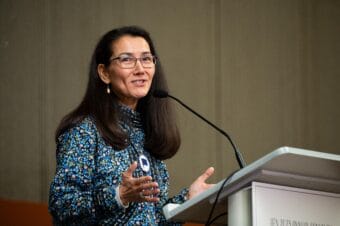
Mary Peltola speaks at a community celebration last year, Founder’s Day, in the Indigenous community of Metlakatla, south of Ketchikan. (Nathaniel Herz/Northern Journal)
Democrat Mary Peltola, who was Alaska’s sole member of the U.S. House, lost her re-election bid last year.
But her margin of defeat of less than three percentage points, in a state that Donald Trump won by double-digits, showed that Peltola remains a formidable candidate.
And that means “every national Democrat is salivating” at the idea that Peltola could challenge incumbent Republican U.S. Sen. Dan Sullivan next year, said Jim Lottsfeldt, a longtime Anchorage political consultant.
“I’ve been asked by some famous ones, by some less famous ones, ‘What can you do to convince her?’” Lottsfeldt said.
But many Democrats inside Alaska see Peltola as the party’s strongest candidate for governor next year, when Republican incumbent Mike Dunleavy is barred by term limits from seeking re-election. And they’re waiting to see which race she enters.
“If she chooses to run for either U.S. House or U.S. Senate, I will absolutely run for governor,” said Tom Begich, the Democratic former state senator from Anchorage. “If she doesn’t choose to do that, but chooses to run for governor, then I’ll be supporting her.”
As for the potential candidate herself?
She’s biding her time.
Peltola, who declined to comment, earlier this year took a job with a national law and lobbying firm, Holland & Hart, where she works with her former chief of staff, Anton McParland.
Peltola has not made up her mind about whether to run for governor, U.S. Senate or U.S. House, said Elisa Rios, a former campaign manager for Peltola who still speaks with her regularly.
“It’s really just where she can make the greatest impact for Alaskans,” Rios said. “She is going to make that decision on her own time.”
While some operatives and prospective candidates may be impatient for Peltola to make up her mind, the filing deadline for the 2026 elections isn’t until June 1. And she can afford to wait, said Joelle Hall, president of the Alaska AFL-CIO, the state’s largest organized labor group.
One poll earlier this year found that Peltola had higher favorability ratings than all three members of the Alaska congressional delegation, as well as Dunleavy.
“She’s Mary Peltola — she has 100% name ID, and she will raise money,” Hall said. “Is waiting, in any way, a problem for Mary? Absolutely not. She can decide on her own terms.”
Alaskans elected Peltola to the U.S. House two times, in quick succession, in special and regular elections in 2022 after the death of Republican Don Young, who held the seat for a half-century.
Peltola, a former member of the Alaska House, defeated Republican former Gov. Sarah Palin in both elections; she quickly became a star in national Democratic circles as the first Alaska Native woman elected to Congress.
In the U.S. House, Peltola established herself with a brand of centrist politics unique to her state: supporting abortion rights, crusading against factory fishing and salmon bycatch while also endorsing large-scale mining and oil projects.
Her term, however, was marked by the death of her husband Buzzy Peltola, who was killed when the small plane he was piloting crashed in September 2023.
Mary Peltola ran for re-election last year but lost to Republican Nick Begich III. Begich, a nephew of Tom Begich, won by a final margin of 2.5 percentage points after two other candidates’ support was redistributed in Alaska’s count of ranked choice votes.
Peltola has largely kept a low profile since her loss. But in recent days, she has emerged publicly. On July 1, the same day Sullivan voted in favor of President Donald Trump’s “One Big Beautiful Bill,” Peltola made her first post to social media in nearly five months.
“We can not secure Alaska’s future by increasing healthcare and energy costs for regular Alaskans, so millionaires, like many of my former colleagues in Congress, and their billionaire donors, can get even richer,” Peltola said.
Peltola also served as grand marshall at Anchorage’s Pride parade last month, sporting a rainbow scarf and flag as she told an enthusiastic crowd that it was “so good to be here with all these people who are pro-love.”
Officials with the Senate Democrats’ recruitment and campaigning arm, the Democratic Senatorial Campaign Committee, did not respond to requests for comment.
But Jessica Taylor, who tracks U.S. Senate races for the nonpartisan Cook Political Report, said that if Peltola decides to challenge Sullivan, she would “put that seat into play.”
“I think Sullivan would certainly not want to run against her, because she’s won statewide before,” Taylor said.
A spokesman for Sullivan’s campaign declined to comment.
Winning a U.S. Senate race would net Peltola a six-year term — two more years than she’d get by winning a gubernatorial race.
She has also proven to be a formidable fundraiser in federal elections, bringing in more than $12 million total for her campaign in 2023 and 2024.
But political observers say there are also reasons that a U.S. Senate campaign might be less attractive for Peltola.
If elected, she’d have to resume a 3,300-mile commute to Washington. She’d likely face millions of dollars in attack ads from conservative groups.
A U.S. Senate campaign could also complicate her job at Holland & Hart, the law and lobbying firm.
While Peltola is barred from lobbying Congress for a year after leaving office, the the firm, whose clients include oil and gas companies, mining businesses and pharmaceutical giant Bayer, does have contact with members of Congress.
That includes Sullivan, who Peltola would be running against. McParland, Peltola’s former chief of staff, has visited Sullivan’s office in his new role at the law firm, according to a person with knowledge of the visit.
In a bid for governor, meanwhile, Peltola would not have to face an incumbent. Of the multiple Republicans who have announced campaigns so far, only Lt. Gov. Nancy Dahlstrom has held statewide office.
“When she enters, it’s going to be Snow White versus the seven dwarfs,” said Lottsfeldt, the consultant. “The governor’s race is just wide open for her.”
Lottsfeldt, citing the state’s economic woes, said he wants Peltola to run for governor — even though he often earns substantial sums as a local consultant for national Democratic groups when high-profile candidates like her run for congressional races.
“It would be a crazy amount of money. And, you know, I suspect I would do very well — you can quote me,” he said. “But I live in Alaska. The state is failing. The need for a governor is our highest priority right now. And so we have to focus on that.”
Rep. Nick Begich III, R-Alaska, speaks to the Alaska Legislature on Thursday, Feb. 20, 2025. At background are Senate President Gary Stevens, R-Kodiak (left) and Speaker of the House Bryce Edgmon, I-Dillingham (right). (Photo by James Brooks/Alaska Beacon)
Alaska’s lone member of the U.S. House of Representatives said Thursday that he had “no doubt” that he was going to vote for the Republican-drafted budget bill that passed the House on a 218-214 vote Thursday.
In a phone call after the vote Rep. Nick Begich III, R-Alaska, said he was pleased that it provides additional opportunities for oil drilling in the Arctic National Wildlife Refuge, the National Petroleum Reserve in Alaska, and Cook Inlet.
“I think the bill has some incredible provisions for Alaska. We have been trying for decades to unlock the energy potential of our state, and this bill does that,” Begich said. “There’s 30 million acres mandated as a minimum lease sale amount in ANWR, NPR-A and the Cook Inlet that gives us the oil and gas that we need to refill our our state coffers, ensure that the Permanent Fund is well funded into the future, that we can continue to pay PFDs well into the future.”
Begich had proposed that 90% of federal revenue from federal leases in those areas be returned to the state. The final version of the bill will send 70%, starting in 2034.
Current state law distributes money from the existing 50-50 split to the state general fund, primarily for use in North Slope communities. The new split increases the amount of money available for those uses.
In an interview with reporters on Wednesday, Sen. Dan Sullivan, R-Alaska, said he believes no state fared better than Alaska in the negotiations around the bill.
“I think it is true when you look at just the pure acreage (available for oil leasing). Just on this one provision alone, Alaska stands to gain tremendously,” Begich said.
Most criticism of the bill has focused on its effects on Medicaid and the Supplemental Nutrition Assistance Program, better known as food stamps.
The Center on Budget and Policy Priorities, a progressive think tank opposed to the bill, estimated that 35,000 Alaskans would lose health insurance if the bill becomes law, both from Medicaid cuts and from scaled-back tax credits used to pay for individual policies.
In a town hall meeting Wednesday night, State Rep. Genevieve Mina, D-Anchorage, said she estimates the bill will add $100 million to $200 million in Medicaid costs to the state, and SNAP changes will require the state to pay up to $50 million per year within a few years.
The bill increases the size of a rural hospital fund, which will send $200 million to $300 million to Alaska, Sens. Sullivan and Lisa Murkowski, R-Alaska, said on Tuesday.
“There’s a lot of uncertainty with a new program,” Mina said, “whereas Medicaid has reliably funded our rural areas and supported our communities and has been a fabric of our health care economy for so long.”
She also pointed out that the bill creates a work requirement for Medicaid.
“Given the fact that we already know so many Alaskans who are behind on their SNAP and Medicaid benefits for months, this is going to add more paperwork and bureaucracy for our state, but then also for people on the ground, they’re going to be kicked off of Medicaid because of additional paperwork, even though folks are working,” she said.
Asked whether he thinks Alaska will be entirely shielded from the effects of those cuts, Begich implied that the answer is no, but he believes “we have significant runway that’s been provided for Alaska” via various sections of the bill.
“Traditional recipients of Medicaid will continue to receive the same benefits that they deserve to receive. There are no changes to the traditional Medicaid system,” Begich said.
When it comes to the work requirement, there are “exclusions for folks who are caregivers to family members, for folks who are looking for work but haven’t found it yet, for folks who are in counties or boroughs with more than one and a half times the national average unemployment rate. It has exclusions for people who volunteer 20 hours a week.”
“If someone is able to work or contribute in some way, even volunteer, they should do that. And I think that’s a smart provision. It’s a provision that’s really targeted, and it’s been designed just for that sub-population of folks who could be helping and are not currently doing so,” he said.
During his campaign for U.S. House in 2024, Begich told the Fairbanks Chamber of Commerce that Alaskans should expect him to seek less federal spending because he is concerned about the size of the national debt.
The Congressional Budget Office expects the new budget bill to increase the federal debt by more than $3.4 trillion over the next 10 years.
“Well, I think I would dispute that,” Begich said, explaining that he believes the CBO is underestimating economic growth that will take place because of the tax cuts within the bill.
“We’re on the cusp of an AI revolution, a robotics revolution, tremendous gains are on the horizon for labor productivity. We’re seeing the labor market remain strong. … I think the challenge with the CBO and some of the other models is that they’re scoring the assumptive growth rate exceptionally low.”
The 2017 federal tax cuts being extended by the new bill have thus far failed to create growth necessary to balance the deficits they created.
Begich said he’s been a strong supporter of the budget bill since even before it was proposed at the start of the new Congress.
“There was no doubt I was going to vote for this bill,” he said. “I started working on this bill before I was even sworn into Congress. I approached leadership when it looked like we were going to win this seat. And I told them, budget reconciliation is around the corner.”
Begich said that House leaders tried to reassure him that ANWR drilling provisions would be in the bill, but he advocated more drilling, in NPR-A and Cook Inlet, and additional provisions to support mining and logging.
“So when this bill came back from the Senate, I was enthusiastically supporting it, and I told others in the House that this is an important priority for us, certainly, but it’s really important for the rest of the nation,” Begich said.
Alaska U.S. Sen. Lisa Murkowski in 2023. (Jeff Chen/Alaska Public Media)
Shortly after the U.S. House passed the Republican megabill, continuing tax breaks and cutting Medicaid, about two dozen protesters gathered on the street outside the Anchorage offices of Alaska’s congressional delegation.
Kim Anderson said she was devastated, especial by Sen. Lisa Murkowski’s vote.
“I flew all the way to D.C. I talked to Murkowski personally,” said Anderson, a caregiver who has relied on Medicaid for the therapy needs of the former foster children she adopted. “She said she understood, that she was going to fight for us.”
Alaska is in a special position in the budget reconciliation bill that cleared Congress Thursday without a vote to spare. Murkowski was the pivotal vote in the Senate, and she voted for it only after extracting special concessions for her state. But the bill is predicted to leave nearly 12 million Americans without health insurance, and many Alaskans don’t like the bargain Murkowski struck.
Congressman Nick Begich called the bill “a transformative victory” for Alaska. He issued a statement lauding the bill’s mandate to offer millions of federal acres in the Arctic and Cook Inlet for oil and gas lease sales.
Sen. Dan Sullivan also spoke of it as an Alaska success, with, among other things, substantial funding for the Coast Guard and 16 icebreakers.
“I think it’s safe to say that no state fared better from this bill than our state,” he told Alaska reporters.
The bill is a top priority for President Donald Trump, too. Among its approximately 1,000 pages are large sums for defense and border security as well as tax breaks and spending cuts that disproportionally benefit wealthier households.
Murkowski is the only one of Alaska’s congressional delegation who expressed substantial uncertainty about the bill. She said she made a bad bill better for Alaska
“I tried to take care of Alaska’s interests,” she said after the Senate vote Tuesday. “But I know … that in many parts of the country there are Americans that are not going to be advantaged by this bill. I don’t like that.”
State Rep. Genevieve Mina, an Anchorage Democrat who chairs the House Health and Social Services Committee, said it’s a national misconception that the concessions Murkowski won make the bill a net-positive for Alaska.
“There’s a lot of talk about how there’s Alaska carveouts or a Kodiak kickback or a polar bear provision. These were not good deals for the state either,” she said. “They’re provisions that would risk so much to the rest of the nation.”
Alaska Rep. Genevieve Mina, D-Anchorage, spoke July 3, 2025 at a small protest outside the Anchorage offices of Alaska’s U.S. senators. (James Oh/Alaska Public Media)
Nationally, the bill would reduce Medicaid spending by more than $1 trillion over a decade. It would also shift some of the cost of food assistance to the states. Murkowski got a two-year delay in some of that burden-shifting.
Mina said she didn’t think that would solve Alaska’s longstanding challenges processing Medicaid and food assistance applications. The bill will require the state to take on even more administrative work by verifying eligibility more often and tracking that beneficiaries meet new work requirements or have waivers.
Maybe the biggest win Murkowski got was boosting a fund for rural health care to $50 billion.
” I don’t want to sound ungrateful, because that’s better than the alternative,” said Jared Kosin, president of the Alaska Hospital and Health Care Association.
It’s impossible to know how much of that $50 billion Alaska will get, Kosin said, after studying the bill’s requirements.
“The State of Alaska is going to have to have an application approved by the federal government by Dec. 31 of this year, and it’s got to be a ‘detailed rural health transformation plan,'” Kosin said.
Then, hospitals and clinics would apply to the state, not knowing how much they’ll get.
Meanwhile, Kosin said, thousands of Alaskans are going to lose Medicaid coverage and will be forced to use hospital emergency rooms — either for primary care at essentially the highest cost to Alaskans as a whole, or because they are in crisis for lack of primary care.
“They’re going to show up in our facilities, and we’re going to do our best to take care of them,” he said. “But at the end of the day, that is a terrible model of health care in our state and any other state, regardless of how much money is flowing in.”
Rev. Elizabeth Schultz, who works for the regional Presbyterian organization, was among thousands of Alaskans who urged Murkowski to reject the bill.
She felt “deep disappointment and anger” when Murkowski helped the Senate pass it.
Schultz said she does not doubt that many groups in Alaska will benefit from the tax breaks and the special carveouts Murkowski won.
“And I don’t disparage that, but I’m not sure it was worth what it will mean for the rest of the country,” she said. “And I think when you’re in a position of that much power that she had at that moment, she could have used it for the benefit of the country.”
Other Alaskans are singing Murkowski’s praises. Ann Brown, former chair of the Alaska Republican Party, wrote an op-ed for the Anchorage Daily News saying Murkowski was an artful negotiator.
“Alaska owes her gratitude for delivering a good deal,” Brown wrote. “Those complaining in other states should start delivering for their own voters.”
Murkowski’s willingness to defy Trump has often alienated her from the Alaska Republican Party. Now it’s another bloc she’s relied on for support — the middle and left — who feel betrayed. Hundreds of angry Alaskans have posted on social media, vowing to never vote for Murkowski again.
Gov. Mike Dunleavy speaks to reporters during a news conference on May 19, 2025. (Eric Stone/Alaska Public Media)
Gov. Mike Dunleavy asked Republican lawmakers in the state House on Wednesday not to show up for the beginning of a special session he called for next month, to prevent his vetoes from being overridden.
Dunleavy made the request in a meeting with House minority members Wednesday. Officially, the Republican governor called the special session, set for Aug. 2, to address education reform and the creation of a state agriculture department.
“Governor Dunleavy asked House minority members to not show up for the first five days of session because like any governor, he does not want his vetoes overturned,” Dunleavy spokesperson Jeff Turner said in a statement.
Turner said arriving on the sixth day of the session would allow lawmakers to begin with a “clean slate for conversations on public education reform policies.”
In June, Dunleavy struck $150 million in general funds from the state budget using his line-item veto power, including more than $50 million lawmakers set aside for public schools. The vetoes also included $25 million for school maintenance and nearly $27 million for wildland firefighting.
The state Constitution requires lawmakers to consider veto overrides within five days of the start of their next session. Large, bipartisan majorities approved much of what Dunleavy vetoed, and if House Republicans decline to attend the beginning of the session, that would make it nearly impossible for lawmakers to override him.
Turner said Dunleavy was willing to “reinstate” the funding he vetoed “if he and lawmakers can reach an agreement on the education bill he will introduce next month.”
The leaders of the state House and Senate’s bipartisan majority caucuses said they were shocked at the governor’s request that lawmakers not attend the start of the session he called.
“You’ve got to be kidding me,” House Speaker Bryce Edgmon, a Dillingham independent, said in an interview.
“Really, a governor would do that? Call a special session and then inform some members not to show up? How bizarre is that?” Edgmon said. “I have to tell you that from every appearance, it would seem like the special session is, at least in some way, compromised before it even begins.”
“That is just absurd, really,” said Senate President Gary Stevens, a Kodiak Republican. “I think it’s honestly unconscionable to the governor to call a special session and tell a minority not to show up.”
Neither leader said they could recall a similar move from a governor in their decades-long careers in state politics.
Dunleavy declined an interview request.
Big Lake Republican Kevin McCabe, though, said he thought the governor’s move was fair game — just one of many political maneuvers used by both parties to get their way using any tool at their disposal.
“Should it work like this? No. In a perfect world, it never would work like this,” McCabe said. “But we don’t live in a perfect world.”
McCabe compared Dunleavy’s request to a vote House leaders called to reduce the Permanent Fund dividend this year, leveraging the absence of three Republicans to overcome internal divisions that threatened to derail progress on the state budget.
McCabe blamed the Senate’s bipartisan, Democrat-heavy majority caucus for not compromising with the governor on policies that Dunleavy argues would boost the state’s bottom-of-the-nation test scores.
McCabe suggested that a generation of Alaska children would suffer “because the Senate doesn’t like the governor.”
“He has no other political agenda — he’s a lame duck governor, right? — other than to get his policy changes through,” McCabe said.
Stevens, the Senate president, said his requests to meet with the governor to find common ground had been repeatedly rebuffed.
Several House minority Republican lawmakers said in interviews Thursday they did not plan to heed the governor’s request to stay away from the Capitol during the first five days of the special session, including Soldotna Republican Rep. Justin Ruffridge.
“It struck me as being asked to not represent my district, and I think that’s a request that I don’t intend to honor,” he said. “I don’t think that the people of my district would appreciate very much their representative not showing up to do the work when the work is being called to be done.”
Rep. Jeremy Bynum, a Ketchikan Republican, said he, too, planned to be in Juneau for the start of the special session, as did Fairbanks Republican Rep. Will Stapp. All three have said on multiple occasions that they’re willing to override vetoes from Dunleavy, subject to a few caveats.
“I signed up to be in the House of Representatives. That includes special sessions,” said Rep. Bill Elam, Republican of Soldotna. “I’m going to do my job, and I’m going to be where I need to be for the work, so my plan right now would be to be down in Juneau.”
Elam voted to override Dunleavy’s veto of the key bill that raised the amount schools are supposed to get from the state under its public school funding formula, House Bill 57. But asked whether he’d support a vote that would restore the education funding Dunleavy cut, Elam said he was undecided.
Rep. Sarah Vance, a Homer Republican, said the request was “unusual” but said she did not plan to attend the start of the session unless her constituents asked her to.
“I agree with (Dunleavy) in that I believe we should be focusing on (education) policy right now,” she said. “Since I will be a no vote, my absence also counts as a no vote, and it will save Alaskans money by my presence not being there until day six, when I’m ready to work.”
McCabe, who has consistently opposed the education funding increases that have won over some of his fellow minority Republican caucus members, said he would not attend the start of the session. He said he’d be in Coeur d’Alene, Idaho at the conference of a pro-life nonprofit group.
“It would be helpful if our team stayed together, but we haven’t proven that we’re very good at that through the last year,” McCabe said. “Everybody’s got their own agenda. Typical Republicans.”
Lawmakers raised the foundation of the funding formula, the base student allocation, by $700 per student in a 46-14 vote in May, overriding a veto from Dunleavy to do so. But Dunleavy vetoed roughly 30% of the funding necessary for the increase.
Even if every minority Republican attends the session, it’s unclear whether lawmakers would have the 45 votes necessary to undo Dunleavy’s line-item veto. One, Democratic Anchorage Sen. Forrest Dunbar, is abroad on a National Guard deployment.
Stevens said he did not anticipate making significant progress on the governor’s two listed priorities during the special session. He said he expected lawmakers would gavel in as scheduled, consider one or more veto overrides, and gavel out in time for lawmakers to make the evening flight out of Juneau that same day.
Stevens said hoped enough lawmakers would attend in order to override the governor’s line-item veto of education funding. If the effort failed, Stevens said lawmakers would seek to address the issue when they return for the regular session in Juneau. But he warned that minority Republicans could face backlash from their constituents if they follow the governor’s request.
“If they stay away and we only meet for one day, and education funding fails because they’re not there, I don’t think that bodes well for them in future elections,” he said.
Republican Nikiski Sen. Jesse Bjorkman said the episode did not bode well for the future of Dunleavy’s legislative priorities.
“Unfortunately, what this means is it’ll be really hard for him to get anything done further,” he said.
KDLL’s Ashlyn O’Hara contributed reporting.
Correction: An earlier version of this story incorrectly said that a House vote reduced the Permanent Fund dividend to $1,000. That particular vote cut it to roughly $1,400.
Close
Update notification options
Subscribe to notifications
Subscribe
Get notifications about news related to the topics you care about. You can unsubscribe anytime.