State Government

State gets support in its fight against Roadless Rule

The Juneau Chamber of Commerce and 13 other Southeast businesses and organizations will join in the state’s lawsuit against a federal rule that prevents road construction in certain areas of the Tongass National Forest.

The Parnell administration in June appealed a federal district court decision setting aside an eight-year-old policy that exempted the Tongass from the so-called Roadless Rule. The organizations plan to file as interveners in the case next week in federal district court in Washington, D.C.

The conservation policy was implemented in 2001, as President Clinton was leaving office. Then Gov. Tony Knowles sued the federal government. The state argued that the 1980 Alaska National Interest Land Conservation Act – which preserved 115-million acres – also decreed that no more land could be protected in the state.

Two years later, the Murkowski administration negotiated an out-of-court settlement.

Jim Clark was Gov. Frank Murkowski’s chief of staff. He says under the settlement the Tongass was exempt from application of the roadless policy via a 2003 interim rule, with a final rule to come at some point after that.

Clark is now the attorney for the group that will file as interveners in the Parnell lawsuit.

He told the Juneau Chamber of Commerce yesterday (Thursday) the rule could prevent development of hydroelectric and other renewable energy projects, as well as mining and timber in Southeast Alaska, and even the proposed Lynn Canal Highway out of Juneau.

A number of utility companies have joined the case, including Alaska Electric Light and Power, Alaska Power and Telephone and Inside Passage Electric Cooperative.

“There’s no mention in the Tongass portion of the Roadless Rule about the impact that prohibiting road or reconstruction in the inventoried roadless areas would have on hydro power construction, transmission line construction from hydro sites to communities, or the maintenance of either one,” Clark says.  “All that’s said is existing authorized uses would be allowed to maintain and operate within the parameters of their current authorization, including any provisions regarding access.”

Federal District Court Judge John Sedwick in May approved a list of energy and mining projects already underway as not subject to the Roadless Rule. Clark says all the projects are important, but he can find no authority in the rule that exempts them.

Environmental attorneys read the law differently. Buck Lindekugel of the Southeast Alaska Conservation Council says the rule does not prevent other projects from going forward. SEACC and the U.S. Forest Service helped negotiate the list with the Justice Department. Lindekugel says it doesn’t need to be comprehensive.

“If you read the rule, the rule does not prohibit mining in roadless areas,” Lindekugel says. “It does not prohibit renewable energy development. And the court made that very clear when it issued its proposed order. And the reason we listed the projects in that proposed order was to clarify the flexibility of the rule.

Lindekugel calls the interveners’ argument “a lot of scare tactics.”

But First Things First Alaska Foundation President Neil MacKinnon says organizations that join the lawsuit are “trying to right the roadless wrong.”

“We see this Roadless Rule as probably the biggest economic impediment to the future of Southeast and it’s got to change or we don’t have a future,” MacKinnon says.

The foundation donated $5,000 to the litigation fund and is asking for other contributions. First Things First is a non-profit formed in 2009 to support resource development in Alaska.

Other companies joining the state’s case include Alaska Marine Lines, Southeast Stevedoring, Alaska Miners and Northwest Miners associations.

Clark, the interveners’ attorney, expects it will take 12 to 18 months before a decision comes from the federal court.

9th Circuit denies state’s Juneau Access appeal

The full US 9th Circuit Court of Appeals will not take up the State of Alaska’s latest petition in the Juneau Access case.

In May, a three-judge panel of the 9th Circuit upheld a lower court’s order for a new Environmental Impact Statement for the road project. The state petitioned to have all 11 members of the appeals court hear the case, but not one judge asked for a hearing.

In light of this latest defeat, Alaska Department of Transportation Spokeswoman Brenda Hewitt says the state is looking at its options.

“We’ll be meeting with the Federal Highway Administration, because they’re actually key in this,” said Hewitt. “So, we’ll be meeting with them and discussing alternatives. So, we’re not giving up.”

In 2006, the highway administration issued a record of decision approving the project. But in 2009, the federal agency declined to participate in the state’s appeal over the EIS decision.

Juneau Access would extend the road north of the Capital City to a ferry terminal at the Katzehin River, where a boat would shuttle passengers the rest of the way to Skagway.

A citizens group is already urging the state to appeal to the US Supreme Court. Citizens Pro Road Chairman Dick Knapp says the project has been studied enough, and a new environmental impact statement would be a waste of time and money.

“Let’s be realistic. You’re going to go back and do a supplemental EIS, okay? That takes time, probably more time – running through the hoops again – than it would take to go to the Supreme Court,” Knapp said. “Not only that, we’ve been at this now, for what? Twenty years. What do you think has been happening to the cost of construction with all the delays?”

The Southeast Alaska Conservation Council challenged the original EIS, saying it didn’t adequately consider improvements to existing Lynn Canal ferry service. SEACC Communications Director Dan Lesh says if the state wants to move the project forward it should do another EIS.

“What we want is investment in the ferry system. But if the state thinks the road needs further study and wants to a full Environmental Impact Statement that looks at all the options, that’s fine with us. I think it’ll show that ferries are a cheaper and better way of moving things around in Lynn Canal and throughout Southeast Alaska,” Lesh said.

The latest estimates put the project cost at 500-million dollars. It’s been a regional transportation priority of the past three state administrations.

Murkowski aide resigns, plans to plead guilty to fishing violation

Arne Fuglvog
Alaska Senator Lisa Murkowski's former fisheries aide Arne Fuglvog (Photo courtesy Alaska Sea Grant)

A former congressional aide may spend as much as ten months in prison for a fishing violation while was a member of the North Pacific Fishery Management Council.

Arne Fuglvog submitted his resignation Sunday as fisheries aide to Senator Lisa Murkowski. In a statement, Murkowski thanked Fuglvog for his years of service and said he has cooperated fully with the authorities, taken responsibility for his actions and accepted the consequences.

On Monday, federal prosecutors filed a single charge of violating the Lacey Act against Fuglvog and announced a plea deal that had been in the works since last April.

Prosecutors say Fuglvog falsely reported locations of his sablefish catches between 2001 and 2006. From 2003 until he was hired by Senator Murkowski in 2006, Fuglvog also served on the North Pacific Fishery Management Council, the panel that’s responsible for managing sablefish and other species in federal waters off Alaska.

Prosecutors single out the 2005 season in which Fuglvog allegedly caught twice his quota of sablefish in the Western Yakutat area. He allegedly covered up his illegal fishing by falsely claiming that the other half of the catch, about thirty-thousand pounds, was caught in the Central Gulf. The violations occurred when Fuglvog was owner and operator of the fishing vessel Kamilar.

Fuglvog was charged with violating the Lacey Act because the fish was valued at about $100,000 and transported as part of interstate commerce.

He’s expected to plead guilty during arraignment scheduled for August 9th in U.S. District Court in Anchorage. He declined to comment on Tuesday. Prosecutors have declined to comment until after next Tuesday’s court hearing.

As outlined in the plea agreement, the possible sentence includes a $50,000 fine in addition to ten months in prison. He must also pay $100,000 to the National Fish and Wildlife Foundation for enhancing fish habitat along the Gulf of Alaska coast. He must also have an announcement acknowledging his wrongdoing published in National Fisherman Magazine.

Fuglvog grew up fishing in Petersburg and was named Highliner of the year by National Fisherman’s Magazine in 2003. He also worked as president of the Petersburg Vessel Owners Association and served on the North Pacific Council’s advisory panel for nine years before his appointment as a full member. He was also a candidate to head up the National Marine Fisheries Service, but he withdrew from consideration in 2009.

State releases first batch of Palin e-mails

The State of Alaska today (Friday) released thousands of pages of e-mails Sarah Palin sent and received during her time as governor. The national media descended on Juneau earlier this week in anticipation of the release, which comes nearly three years after the initial public records request. KTOO’s Casey Kelly has more.

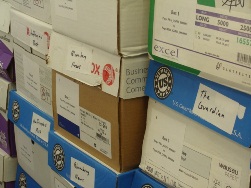
Boxes of former Governor Sarah Palin's emails sit in a Juneau office building waiting for the national and international press corp to pick them up. (Photo by Casey Kelly/KTOO)

Reporters, camera men and bloggers from nearly every major national news organization crammed into the third floor hallway of the Court Plaza Building – known in Juneau as the Spam Cam. About a dozen dollies lined the hall, piled five feet high with boxes of documents.

When the time came, Governor Sean Parnell’s Spokeswoman Sharon Leighow released them to the media.

“It’s all yours, let ‘er rip,” Leighow said.

Each set of six boxes contained more than 24-thousand pages of Palin’s e-mails. Leighow – who also worked for Palin – says the documents were culled from the state accounts of 55 current and former Alaska officials, whom Palin emailed using her private Yahoo account.

“Employees who had frequent communication with the governor. For instance, the lieutenant governor, the chief of staff, deputy chief of staff, her press people, special assistants.” said Leighow.

The state is charging $725 for a complete copy of the records to cover the cost of printing. Governor Parnell’s office will only make one public review copy available throughout the entire state. That frustrates Republican Activist and Palin critic Andree McLeod, who says the state should have made the records available electronically.

“It would have lowered the barriers of the access for information, which technology does. It democratizes information. But the Parnell administration has not caught up with that yet, and I don’t believe they’re interested in doing so,” McLeod said.

Some state lawmakers have ordered copies that will be available to the public in Anchorage, Fairbanks and Kenai. And many of the news organizations that paid for the documents have already posted them online.

MSNBC.com, working with a team of Juneau volunteers, has hired electronics investigation company Crivella West to sort through the records. Co-founder and CEO Arthur Crivella says within minutes of them being posted on the web, they’re sent to computers at the company’s headquarters in Pittsburgh. The computers then study the e-mails for language that may be interesting to Crivella’s trained researchers.

“Essentially we’re looking for personal language, we’re looking for emotional language,” says Crivella. “Where anybody in their administration is emotional about something, alarmed, the language of deception.”

MSNBC.com Investigative Reporter Bill Dedman admits the document dump could be complete waste of time. But he says someone has to vet Palin with her profile as a national political figure.

“Some of what we get out of public records like this is not some blockbuster scandal. I don’t think it’s about that at all,” said Dedman. “I do think that you get some sense of tone, of character.”

The documents were first requested in 2008 by news organizations following Palin’s vice presidential bid. Palin resigned in July 2009 after 966 days in office. It took 997 days to fulfill the records request.

Site notifications
Update notification options
Subscribe to notifications