State Government

Backers of new Alaska ballot measure seek to permit ‘magic mushrooms’ and other hallucinogens

“I voted” stickers are seen on display in the headquarters offices of the Alaska Division of Elections in Juneau on Tuesday, Nov. 12, 2024. (Photo by James Brooks/Alaska Beacon)

A draft ballot measure proposal under review by the Alaska Department of Law would decriminalize “magic mushrooms” and similar psychedelics, allowing home cultivation and personal use, as well as their use for medical and traditional reasons.

The measure does not allow commercial sale.

“For most people, their lives will not change, but for people who really need support, they may be able to find it,” said Ismail Ali, interim co-executive director of the Multidisciplinary Association for Psychedelic Studies, a national nonprofit devoted to studying psychedelic substances and advocating their safe use.

The “Alaska Natural Medicine Act” is modeled after Colorado’s Proposition 122, which was approved by voters in that state in 2022 and became effective this year. Oregon has also decriminalized the growth and use of psychedelic mushrooms.

If the Department of Law approves the measure for full-fledged signature-gathering, supporters would have to collect at least 34,099 signatures from registered voters, including specific minimums in at least 30 of 40 state House districts, in order to put the measure in front of voters.

If supporters gather the signatures before the Alaska Legislature convenes in January, the measure could be up for a vote in 2026. If the signature-gathering ends after the Legislature convenes, the measure would be subject to a vote in 2028.

The new measure is being supported by Natural Medicine Alaska, a group that submitted its initial draft with 230 signatures on June 18. In a post on social media, the group said it is attempting to get the issue on the ballot in 2026.

Members of the group did not return multiple calls and emails seeking comment.

One hundred signatures were needed to start a legal review, a prerequisite before full signature gathering begins. The review, usually a formality, is expected to finish by Aug. 17.

The text of the ballot measure states that it would no longer be a crime to possess, use, display, store or transport “fungi containing psilocybin or psilocyn, psilocybin or psilocyn in extract or other concentrated form, or plants or fungi capable of producing psilocybin, psilocyn, dimethyltryptamine (DMT), or mescaline (except from Peyote).”

The possession or use of those psychoactive chemicals would be restricted to people at least 21 years old.

Personal cultivation would be restricted to an area no more than 12 feet wide by 12 feet long.

The sale or trading of personally cultivated psychoactive fungi would be prohibited, and public consumption would still be banned.

In many ways, the measure would legalize practices that already happen quietly in Alaska.

“There’s millions and millions of Americans who use psychedelics every year, and most of the time that goes off without a hitch, and people don’t even know about it,” Ali said.

He said Alaska’s proposed ballot measure is similar to the one enacted by Colorado but also takes into account subsequent rulemaking by that state.

In addition to permitting personal use and setting up a regulatory system for medical use, the measure also creates a third channel of regulation, for traditional, Indigenous use of psychedelics.

“This is the first time that I’ve seen an advocacy group that includes a number of Native leadership and people who are not just geographically local, but also of the Indigenous tribes there,” Ali said.

Alaska setting up a way to allow and regulate traditional use of psychedelic substances is something new, he said.

“I find that really beautiful and really ambitious, because it is something that comes up a lot, and it’s sort of like direct Indigenous to Indigenous conversation, which is happening increasingly in other states as well,” he said.

Psychedelic mushrooms remain a Schedule I drug and illegal under federal law, except for clinical research, but Colorado, Oregon and more than a dozen cities have decriminalized them.

In those places, federal officials have not prosecuted people and businesses that use psychoactive substances, which has allowed individual states to experiment with different ways to regulate and use them, Ali said.

There is growing interest in psychoactives’ ability to treat people with depression, anxiety and post-traumatic stress disorder.  Clinical studies have found varied results, and additional research is underway at a variety of universities and laboratories nationwide.

In 2024, the Alaska Legislature voted to create a task force to draft recommendations for psychedelic medicines if approved by the U.S. Food and Drug Administration.

That task force released draft recommendations in May.

Because the FDA rejected an initial psychedelic medicine application, those recommendations have never been implemented. In addition, the task force did not consider personal, recreational use as proposed by the ballot measure.

Currently, only one ballot measure — proposing new limits on financial contributions to candidates for public office — has been approved for the 2026 ballot. A second measure, seeking to repeal Alaska’s ranked choice voting system, is gathering signatures and is expected to garner enough support to also appear on the 2026 ballot.

If it does so, it will be the third time in six years that Alaskans have voted on the issue of ranked choice voting.

Bill requiring car rental apps to collect Alaska taxes avoids second veto

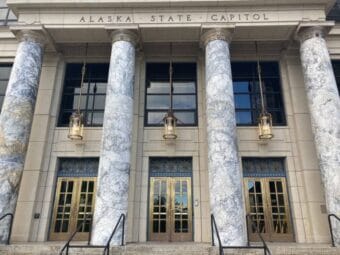
The Alaska State Capitol on March 25, 2024. (Eric Stone/Alaska Public Media)

Alaskans who rent out their cars on platforms like Turo and Getaround are no longer required to collect and submit state rental car taxes themselves.

Earlier this year, the state Legislature passed a bill mandating that the car-rental platforms collect the tax on the vehicle owners’ behalf. On Thursday, the bill became law without Gov. Mike Dunleavy’s signature. Bills that the governor fails to sign or veto within a set period of time automatically pass into law.

Last year, Dunleavy vetoed a very similar bill, calling it “unnecessary taxation.” His press office declined to explain why he allowed the new bill to become law.

Sen. Matt Claman, an Anchorage Democrat who sponsored last year’s vetoed bill, said the bill does not impose new taxes, it just changes who’s required to collect them.

“They own no cars, so Turo has taken the position that historically, that they don’t have a duty to collect the tax,” Claman said. “The interest was to make adjustments to the existing laws to make it so that Turo does collect the tax.”

Alaska has charged an excise tax on rental cars since 2004, but platforms like Turo were not collecting the tax. Few car owners were following the law and collecting the taxes themselves, the Department of Revenue told lawmakers.

As of mid-2023, Revenue officials said approximately two dozen car owners were delinquent on roughly $470,000 in back taxes.

House Bill 123 wipes the slate clean, preventing the Department of Revenue from going after Turo hosts for back taxes. That’s in the interest of fairness, said Big Lake Republican Rep. Kevin McCabe, who sponsored the bill.

“You sign up as a Turo host, and there’s nothing on there that says you’re supposed to collect taxes … outside the platform and send it to the state of Alaska,” he said. “You don’t even know how to do it. You’re just a guy that wants to rent out his car for the two weeks when you’re on the (North) Slope.”

The bill also cuts rental car taxes. Traditional rental agencies like Hertz, Avis and Enterprise will see their tax rate cut from 10% to 9%. Turo rentals get an additional 2% tax break on top of that, making it a 7% rate, through mid-2028.

Turo and Enterprise both submitted letters supporting the bill. Lawmakers said during committee hearings that they hoped the tax cut would prevent Dunleavy from vetoing it.

The Department of Revenue estimated the brick-and-mortar rental tax cut will reduce tax revenue to the state by at least $1.5 million per year. It’s unclear how much of the market Turo accounts for, but Revenue officials said that if it amounts to more than one-eighth of the total rental car market, the change will bring in more money overall. Claman said a similar ordinance in Anchorage was a boon for local rental car tax revenue.

Sport fishing for wild kings in Southeast Alaska closed to nonresidents

Sport fishing advisory announcements hang on a dockside information board at Petersburg’s South Harbor. (Photo by Olivia Rose/KFSK)

Sport fishing for wild king salmon in Southeast Alaska is now more restricted for some people.

Nonresident anglers can no longer fish for king salmon in the region. State managers closed the sector because of harvest projections.

However, harvesting hatchery king salmon is still allowed in certain areas with special fishing regulations near Juneau, Ketchikan, and Petersburg because hatchery fish don’t count toward the amount of wild king salmon anglers can harvest. That includes the Juneau designated saltwater hatchery area, Herring Bay near Ketchikan, the City Creek release site near Petersburg and the Blind Slough-Wrangell Narrows terminal harvest area.

Patrick Fowler is the regional fisheries management coordinator for the Alaska Department of Fish and Game. He said sport fish anglers have been catching more king salmon than expected so far this season, indicating they’d exceed the allowed harvest limit by about 4,000 fish. So the department took restrictive action.

“We need to keep the sport fishery within its allocation. And following the management plan that the Board [of Fish] gave us, we have to close the nonresident fishery in order to keep the sport fishery within allocation while protecting that resident opportunity,” he said.

The Alaska Board of Fisheries gave the department new directions for managing the king salmon fishery, allowing them to change fishing rules during the season as necessary so anglers only catch the amount of wild fish they’re allowed to take this year. That allocated amount is part of an agreement between the U.S. and Canada, called the Pacific Salmon Treaty, which ensures both countries get some fish.

Alaska residents get priority for sport fishing king salmon. Fowler said it’s still unknown how the resident harvest will add up, and the nonresident sector could reopen later in the season if further projections allow.

“We’re not ruling out that the fishery won’t reopen,” he said. “But we need to watch how the resident harvest materializes.”

In other restrictive action, all anglers —including residents— are prohibited from taking wild king salmon in the zone outside of state waters, called the exclusive economic zone. Fowler said very few anglers harvest king salmon in that area, which begins just over three miles from the outer coast.

We estimate about 1% of the Chinook (king salmon) harvest happens in the exclusive economic zone,” Fowler said. “The vast majority of, you know, sport fish harvest and effort occurs within state waters.”

According to state law, sport fish violations have a base fine of $100, and there’s an added $150 fine per each fish taken illegally.

According to Alaska Wildlife Troopers, which is the agency that enforces the law, sport fishing charter businesses that retain fish in violation of the law garner heavier fines —including misdemeanor charges— and gear like rods, poles and vessels could be seized.

Any king salmon caught should be released and returned to the water immediately and unharmed, according to Fish and Game.

The regulations went into effect July 7 and will last through the end of September.

Gov. Dunleavy veto of increase for Alaska child care and infant learning funding draws concerns

Students swing on a playground at Meadow Lakes Head Start in Wasilla, Alaska. It closed in 2024 due to funding and staffing challenges. (Image by Lela Seiler, courtesy of CCS Early Learning)

The budget vetoes that Alaska Gov. Mike Dunleavy issued last month included millions of dollars proposed by the Legislature to bolster child care and early intervention services for children with disabilities or developmental delays.

Dunleavy vetoed a proposed $1.86 million in additional funding for child care grant programs and place-based and home-based child care centers, citing declining state revenues. The budget retains $5.87 million for those programs for next year.

For early education and infant learning, the Legislature proposed a significant boost — $5.7 million more — for the state’s 17 programs that provide intervention services for families with children from infancy to 3 years old experiencing disabilities or developmental delays. Dunleavy rejected the increase, and allocated $10 million for the statewide programs.

“Governor Dunleavy’s goal is for Alaska to be the best place in the country to raise a family,” said Grant Robinson, a deputy press secretary for the governor in an email on Monday responding to a request for comment. “The budgeting process requires the Governor to consider all line items in view of the State’s fiscal situation. The budget the Governor signed still provides more than $5.8 million of funding for childcare benefits. Given the State’s revenue outlook, the Governor made the difficult yet fiscally responsible decision to veto increasing and expanding infant learning programs.”

The governor vetoed more than $127 million from the Legislature’s proposed budget, including $50 million for public schools. In a prerecorded video released with the veto announcement in June, Dunleavy cited lower state revenues due to falling oil prices.

“Basically, we don’t have enough money to pay for all of our obligations. So as a result of that, you’re going to see some reductions in this year’s budget. It’s not an easy thing to do. It’s certainly not a fun thing to do, but it’s necessary,” he said.

Anchorage Republican Sen. Cathy Giessel, who also serves as the Senate majority leader, agreed that the state is facing fiscal challenges, but said child care and early education programs should be prioritized, as the Legislature had proposed.

“We had a balanced budget. It is true, it was very difficult to arrive at that balanced budget,” she said in a phone interview. “We searched all the couch cushions for one-time funding to fund this balanced budget, but we achieved it. The governor’s vetoes of these two critical services are just going to mean future costs, because these services were not provided for kids in their earliest development stages. So I was very disappointed.”

An estimated 1,800 Alaskan families are currently served each year by the state’s infant learning programs, funded by the state and federal Medicaid, at no cost to families. Children and families work with developmental specialists, and can receive speech, physical and occupational therapies. In addition, parents receive training and education on child development.

For example, in the Northwest Arctic region, an early learning and family program is administered by the Northwest Arctic Borough School District. It is based in Kotzebue and serves all the Northwest Arctic villages, as well as Point Hope in the North Slope Borough.

“We’re spread very thin,” said Tracey Schaeffer, one of the program’s three staff members. “And we definitely could use another staff person to help with traveling and seeing families and spending time in the villages.”

There is only one air carrier, Bering Air, serving the region, down from four companies operating a few years ago, she said, so with weather events and disruptions, it’s increasingly challenging.

“We have to change reservations a lot because of the weather,” she said, estimating the total cost for travel and flights at up to $25,000 per year, plus significant time. “As it gets warmer, we have a lot more days that are not very safe to fly here.”

Schaeffer said they work as much as possible by phone, but intervention services are very personal. “And all the while, you’re trying to kind of build a relationship with this family, because it’s a really intimate, sensitive situation when you’re working with a family who has a child that experienced, you know, something that wasn’t expected, a disability, or something, a medical issue, that has put their development at risk,” she said.

The proposed state funding increase would have been welcome, she said. “That would have been a huge relief, because there’s a lot of pressure. I mean, (with) early intervention, three years is a short period of time, you know, and we lose so much time because of weather, flight cancellations or something,” she said. “So there’s a lot of pressure there. We’ve done this job for a long time, and we know the time goes fast, and we want to provide as much intervention as we can. And it’s just hard to do that.”

Schaeffer also runs a small child care center in Kotzebue, serving eight children, the first licensed provider to open in the community in over a decade. She said more local and state support is needed to address the lack of child care and rippling impacts for the community. “We lose people all the time because of a lack of child care. You know, we have educators or providers that come and they start a family, and then they realize, like, ‘Wow, I can’t find a child care provider,’ and we lose them because of that.”

Shaeffer and her daughter opened the child care center in 2023, a challenging process documented in a short film by Laura Norton-Cruz, a social worker, public health advocate and film producer. She and filmmaker Joshua Albeza Branstetter created a documentary film series focused on the challenges of child care and early education programs called the “Early Childhood in Alaska” series.

“Child care is just not a profitable business model. It’s an investment in child brain development and family well-being, and the economy,” Norton-Cruz said, emphasizing the need for increasing state and federal funding support. “Staffing is the majority of the costs. But also, if you run a home-based child care center, you have to pay your mortgage or you have to pay rent, you have to pay utilities: Those things cost money. And we need support from the government to be able to offer this essential service, to have a workforce, and to have children who are kindergarten ready.”

In April, Anchorage’s largest child care provider, Bright Beginnings Early Learning Center, closed, displacing 125 children. Norton-Cruz said while some progress has been made, like raising awareness around Alaska’s child care crisis, families and providers are still struggling.

“Others have cut back on hours or cut back on the number of rooms, or the number of kids they can take, in order to have this essential service for parents to be able to go to work, which we need them to do,” she said. “Because we have major workforce shortages, and parents need income to pay for, you know, rent and everything else, we have to do a better job of funding and supporting the sector.”

In 2023, Dunleavy launched a child care task force with the stated goal to develop a plan to improve availability and affordability of quality child care throughout Alaska. Norton-Cruz said the work of the task force was positive, and would like to see the governor put more state funding toward its recommendations.

“When we don’t have policy that supports child care and early childhood, we basically just rely on the unpaid labor of women,” Norton-Cruz said. “Whether that’s moms, or whether that’s grandmothers, or aunties, you can’t just say, ‘Oh, but grandmas and aunties can step in.’ That’s not policy. That relies on something that may not always be there for everyone, and isn’t fair. … People need to be able to make that choice, rather than have that choice made for them.”

Giessel also said there is a need for state funding for the governor’s own task force recommendations. She pointed to new state revenue measures that Dunleavy has opposed —like oil taxes — that leaders in the Alaska House multipartisan and Senate bipartisan majority caucuses want to pursue to bring in more state dollars.

“First of all, we have a huge gap in our tax structure on our oil resources,” Giessel said, referring to the difference between taxes paid by traditional corporations and by those corporations that report their income through their owners, known as “S corporations.”

“The S corporations pay no corporate tax to the state,” Giessel said. “There is legislation that would institute a requirement for S corporations to pay a corporate tax to the state, conservatively estimated, that would be $100 million per year.”

A bill to tax these corporations is in the Senate Rules Committee.

“That would pay for a huge amount of these child care and early education funding requirements,” Giessel said.

“For him to say that these cuts are because of declining revenue and ignoring his responsibility in this, is just amazing to me,” Giessel added.

The Legislature will meet for a special session on Aug. 2, when they will consider whether to override the budget vetoes.

Alaska lawmakers plan rare use of subpoenas to get oil tax data

The Trans-Alaska Pipeline is pictured at pipeline mile 709.7 along the Richardson Highway south of Copper Center, Alaska on August 13, 2024.
The Trans-Alaska Pipeline is pictured at pipeline mile 709.7 along the Richardson Highway south of Copper Center, Alaska on August 13, 2024. (Eric Stone/Alaska Public Media)

Alaska lawmakers plan to compel the administration of Gov. Mike Dunleavy to release data on oil taxes through a rare use of the state Legislature’s subpoena power.

It’s the latest development in a long-running dispute between the Legislature and Dunleavy administration over whether the state is getting all the tax revenue it should from its most lucrative natural resource.

Sen. Elvi Gray-Jackson, an Anchorage Democrat who chairs the Legislative Budget and Audit Committee, a joint House-Senate panel overseeing audits of state government, said subpoenas were the next logical step in completing an oil tax audit that’s been ongoing since 2020.

“We want to work with the Department of Revenue, period,” she said. “But the auditor has been trying to get this information for a very, very long time.”

Gray-Jackson’s committee unanimously authorized a $50,000 contract with outside attorneys to draft and send subpoenas to the administration to move the audit forward.

They’re looking for data that shows whether the Dunleavy administration has been properly enforcing the state’s oil tax laws. So far, the legislative auditor – the official the state Constitution puts in charge of examining the state’s books – hasn’t been able to get the data, at least, Gray-Jackson said, not in a format that the auditor can analyze.

“She’s trying to get the information she needs to complete her audit, but in the format … that’s understandable, in the format that has been done in the past,” Gray-Jackson said.

The most recent audit of that oil tax data was in 2018, and it showed that the Department of Revenue had raised $1.3 billion over six years by identifying underpayments from oil companies.

But more recently, the auditor told legislators at hearings this spring that the Department of Revenue has provided only raw data and contends that the department is not required to compile the data into a summary table similar to what state officials provided in 2018.

“That interpretation overturns longstanding precedent, and it essentially limits the oversight of the Legislature,” auditor Kris Curtis told lawmakers in May. “The fear is that state agencies from here on out will refuse to provide or compile data in any type of format for future legislative audits.”

In a letter to legislators earlier this year, Revenue Commissioner Adam Crum said his department’s Tax Division “has always been transparent” with the Division of Legislative Audit, the organization that the auditor leads, but said that compiling the data in the format requested by legislators would be time-consuming. Crum attached a 2020 letter from former Attorney General Kevin Clarkson outlining the state’s position that certain oil tax records are protected by attorney-client and other legal privileges.

Crum’s letter expressed “concerns” with Senate Bill 183, which would make it a crime for state officials not to provide data in the form or format requested by the legislative auditor.

“I think we’re dealing here with hundreds of millions and into the billions of dollars,” Sitka Republican Sen. Bert Stedman said at a committee hearing earlier this year.

The bill ultimately passed by a wide margin, but Dunleavy vetoed it, saying it raised constitutional issues.

Whether the Legislature can override the veto is unclear — not least because Dunleavy called a special session for next month and told some lawmakers to stay away from the Capitol for the first few days to prevent the rest from overriding his vetoes.

Anchorage Democratic Sen. Bill Wielechowski said he thinks the governor’s request to skip the beginning of the session isn’t just about upholding Dunleavy’s veto of $50 million in education funding.

“This is all about protecting billions of dollars in taxes, likely tax evasion, to the oil industry, and it’s about benefiting the rich and the privileged at the expense of the rest of Alaskans,” Wielechowski said.

Dunleavy and legislators have traded barbs over the bill and the dispute behind it.

As the bill came to the governor’s desk in late May, the House speaker and Senate president sent a letter to Dunleavy saying Senate Bill 183 had been an “unfortunate but necessary response” to what they called a “persistent pattern of obstruction within the senior ranks of Alaska’s Department of Revenue.”

After vetoing the bill, Dunleavy fired back with a letter of his own, saying claims the administration was acting “illegally or unethically” were “unfounded and unsupported by any evidence.”

Dunleavy said he was open to working with the legislative auditor to get the data lawmakers seek.

Asked Tuesday when the data would be turned over, Dunleavy’s office said the governor’s letter and the revenue commissioner’s earlier statement to legislators were its only response.

Rep. Will Stapp, a Fairbanks Republican, said even if lawmakers get more insight into how the administration has handled oil taxes, there’s no certainty on whether that would result in a windfall for the state.

“It’s important that we audit the functions of our executive branch and especially our oil tax structure,” he said. “I would just be very skeptical that they owe us a billion dollars.”

Stapp said he’s planning to be in Juneau for the start of the special session next month, but he said he’s not convinced that the bill would make a difference in resolving the long-running dispute.

Sick leave is now mandatory in Alaska. Here’s what you need to know.

The offices of the Alaska Department of Labor and Workforce Development in Juneau are seen on Thursday, Oct. 26, 2023. (Photo by James Brooks/Alaska Beacon)

On July 1, Alaska’s new sick-leave and minimum wage increase law took effect.

Approved by voters in November, it states that someone working at a business with 15 or more employees will earn one hour of paid sick leave for every 30 hours worked, up to a maximum of 56 per year, unless the employer voluntarily increases that limit.

Someone working at a business with fewer than 15 employees earns sick leave at the same rate, but the maximum per year is 40 hours.

The law also raised the state’s minimum wage to $13 per hour. The minimum wage rises to $14 per hour next year and $15 per hour in 2027. It will rise with the rate of inflation for each year after that.

The law also forbids bosses from forcing their employees to attend meetings about religious or political issues, including whether or not to join a labor union, political group or church.

There are exemptions for religious organizations.

Under the law, sick leave can be used for an employee’s illness or to take care of a family member who needs care. It can also be used in cases of domestic violence, sexual assault or stalking.

While workers can access the benefits now, it will be a few weeks before the state formalizes some of the details of how employers must implement the law. On June 25, the Alaska Department of Labor and Workforce Development proposed new regulations. Those won’t take effect until August at the earliest, but they would add some new rules to the sick leave law.

In the meantime, the department has published an informal Q&A about how the law works.

Under those regulations, all of the state’s employers “shall notify each employee in writing” about its sick leave policy.

Those policies may include the amount of advance notice required when using sick leave for a prescheduled medical appointment or “other foreseeable absence.”

An employer can’t require more than 10 days’ notice in that case.

If someone is unexpectedly sick, the proposed regulations would require the sick employee to “notify the employer before the start of the employee’s shift or as soon as is possible.”

If someone uses sick leave for more than three consecutive days, their boss may require them to show proof of their need for sick leave, if that requirement is included in the written policy.

Someone who needs to take sick leave because of domestic violence, sexual assault, harassment or stalking, cannot be required to verify that explanation.

Under the law, someone can carry over unused sick leave from one year to the next, but they can’t exceed the maximum, unless their employer voluntarily allows them to do so.

Employers are forbidden from retaliating against employees who use their sick leave, and nothing prevents an employer from “front-loading” sick leave by giving them the hours in advance instead of accruing them over time.

The Department of Labor’s new regulations are subject to public comment through July 31. Anyone with questions may email dol.lss.regulations@alaska.gov.

Site notifications
Update notification options
Subscribe to notifications