State Government

Revenue Commissioner Adam Crum plans to resign Aug. 8, Gov. Dunleavy announces

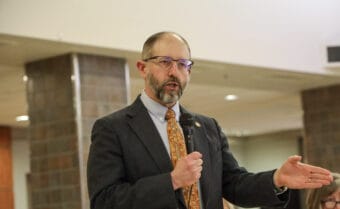
man with brown hair and beard speaks into microphone
Adam Crum speaks to reporters on Oct. 4, 2022 at the Alaska Scientific Crime Detection Lab in Anchorage. (Wesley Early/Alaska Public Media)

Gov. Mike Dunleavy announced Friday that Department of Revenue Commissioner Adam Crum plans to resign Aug. 8.

Reached by phone, Crum read a statement saying he had “accomplished a lot to put Alaska on sound economic footing” and said he would have more to say on his last day.

“It has been an honor serving Alaskans alongside dedicated colleagues and under Governor Dunleavy’s leadership,” Crum said in a statement shared by the governor’s office. “I am deeply grateful for the opportunity to contribute to Alaska’s prosperity and am excited to see the state’s continued success.”

Crum said he had not been asked to resign. He is widely seen as a possible candidate for governor. Alaska law restricts the use of state time and resources for political campaigns.

In a prepared statement, Dunleavy said Crum had prioritized the state’s economic wellbeing, public health and fiscal stability during his time in the administration. Crum served as the commissioner of the Department of Health and Social Services before Dunleavy appointed him revenue commissioner in 2022. Dunleavy’s office did not immediately respond to an interview request.

“Commissioner Crum has been an exemplary leader whose unwavering dedication and innovative approach have significantly benefited Alaskans,” he said.

In late May, the heads of the state House and Senate sent a letter to Dunleavy calling attention to what they called “a persistent pattern of obstruction within the senior ranks of Alaska’s Department of Revenue.” The letter came alongside a bill that lawmakers said would strengthen the legislative auditor’s ability to examine oil tax data.

Dunleavy vetoed the bill and said claims the administration was acting “illegally or unethically” were “unfounded and unsupported by any evidence.”

Palmer state Sen. Shelley Hughes announces campaign for governor

woman speaking in wood-paneled Senate chamber
Palmer Republican Sen. Shelley Hughes speaks on the floor of the Alaska Senate in 2024. (Eric Stone/Alaska Public Media)

Palmer state Sen. Shelley Hughes, a Republican, announced Thursday that she’s running for governor.

Hughes has served in the Legislature for more than a decade and has been a member of the Senate since 2017, including a two-year stint as Senate majority leader.

Hughes is a staunch conservative and is currently a member of the all-Republican Senate minority. At a campaign launch event at a barn in Palmer, Hughes touted her work on a variety of issues, emphasizing energy, education, agriculture and technology.

Hughes said as governor, she would be willing to work with legislators of all stripes. She recounted her work on the Alaska Reads Act, a literacy initiative put forward by Republican Gov. Mike Dunleavy and by Democratic Sen. Tom Begich.

“I think the good Lord gave me the gift of being able to build consensus without forsaking my values and my principles,” she said. “That is a skill set that is very, very important for a governor to have, because you’re not always going to be given the legislature that you would maybe hand-pick yourself.”

At the same time, though, Hughes said she was willing to make unpopular decisions to address what she called a “rough patch” in the state’s financial situation driven in part by declining oil and gas revenue. Alaska governors play a key role in determining the state’s budget. Hughes described herself as a “limited government gal” and said artificial intelligence could play a role in streamlining the state’s operations.

“We do have to look at our budget and be very strategic and prioritize, and I am willing to take the heat, and it will take heat,” she said. “Because when you do that, you can have people on all sides not happy with you, but you’ve got to have someone with a vision that will hold the line.”

Hughes said she was concerned by the large number of able-bodied Alaskans who rely on Medicaid, saying she wanted to provide them with job training. She said that would reduce the number of employees that contractors would need to import from Outside to work on megaprojects like the Susitna-Wantana Dam and the Alaska LNG pipeline, which she said was “real” and “closer than it’s ever been.” President Donald Trump has repeatedly touted the 800-mile, $44 billion pipeline as a priority, though the long-dreamed project, now shepherded by developer Glenfarne, has yet to say whether it has the investors and customers needed for it to move forward.

Hughes also said she would continue Dunleavy’s push to expand the state’s role in promoting agriculture by elevating the state Division of Agriculture to a cabinet-level department. Lawmakers narrowly rejected Dunleavy’s proposal to do so earlier this year.

Hughes has in the past supported Dunleavy’s proposals to expand alternatives to traditional neighborhood schools, including homeschool and charter schools, though she did not address school choice in her campaign announcement. In prior interviews, she expressed support for school choice ideas like “backpack funding” and education savings accounts, which parents could use to subsidize private school tuition.

Hughes joins an increasingly crowded, all-Republican field for the 2026 governor’s race. She’s the seventh candidate to join the race. No Democrats have formally joined the race. The deadline to file is June 1, 2026.

Correction:An earlier version of this story misstated Sen. Tom Begich’s title. He served in the state Senate.

What Alaska lawmakers are expecting from Gov. Dunleavy’s Aug. 2 special session

The facade of the Alaska State Capitol in Juneau on May 22, 2024.

Lawmakers are planning to gather in Juneau in just over a week for a special legislative session called by Gov. Mike Dunleavy. The governor put two items on the agenda: education reform and the creation of a state Department of Agriculture. It’ll also be an opportunity for lawmakers to try to override some of Dunleavy’s vetoes — and the governor even went so far as to ask minority Republicans to stay away from the Capitol during the start of the session to prevent his vetoes from being overridden.

Alaska Public Media’s Capitol reporter Eric Stone joined Alaska News Nightly host Casey Grove to discuss what to expect from the session.

The following conversation has been lightly edited for length and clarity.

Casey Grove: Eric, what are you hearing from lawmakers?

Eric Stone: Well, for now, most lawmakers are planning to be there — and that includes some that we weren’t sure about. Anchorage Democratic Sen. Forrest Dunbar, who’s serving with the National Guard in Poland, announced this week that he’s been granted leave to attend. That’s a pretty big deal — lawmakers had essentially taken it as a given that he wouldn’t be able to be there. But he ran it up his chain of command and got the OK, so Dunbar is planning to fly back at least for the start of the session.

Sen. James Kaufman, an Anchorage Republican who has spent some of the summer in Southeast Asia with his wife, tells me he’ll make it back for the first day of the session, too. He was another question mark.

And those two are pretty important. Back in May, they both voted to override Dunleavy’s veto of a bill boosting the formula that says how much the state should spend on public schools.

Of course, Dunleavy vetoed some of that increase from the budget, and it takes a three-quarters majority for the Legislature to override a budget veto.

Senate President Gary Stevens, a Kodiak Republican, says an attempt to override that veto will be on the agenda for the first day once lawmakers gavel in on Saturday, Aug. 2.

He says he’s expecting nearly perfect attendance from the members of the upper chamber.

“I just can’t stress how important it is that, if the governor calls a special session, our job, our duty, is to be there for that opening day,” Stevens said. “And so, anybody who chooses not to be there opening day, I would hope they have a really good reason, because they will be accountable to their public, to their constituents on why they would miss such an important vote.”

ES: Stevens says in addition to the vote on the education funding veto, he’s expecting to try and override Dunleavy’s veto of a bill that clarifies the legislative auditor’s authority. Lawmakers have questions about whether the state is getting all the money it should from oil companies, and they passed a bill by a wide margin that seeks to help answer those questions. Dunleavy said he thought it was unconstitutional and vetoed it.

Those are the two big priorities for Stevens. He says there might be some additional override votes if those are successful — Dunleavy has vetoed a handful of other bills since the Legislature adjourned.

CG: Do you think those veto overrides will succeed?

ES: That’s the big question. Stevens says he’s hopeful, but not sure at this point. Nearly everyone who voted in favor of the education funding boost in late May would need to vote yes again, and it’s not clear if they will.

As you said, Gov. Dunleavy has asked minority Republicans to stay away to prevent them from overriding his vetoes, and some House Republicans have said they’re not coming. Those include some conservatives, like Homer Rep. Sarah Vance and Anchorage Rep. Jamie Allard. But I haven’t heard anyone who’s a plausible yes vote say they’re not coming.

House Republican minority leader Mia Costello says she’s going to be in Juneau when the special session begins. But she says she hasn’t made up her mind on how she’ll vote. She says she’s going door-to-door in Anchorage asking her constituents what she should do. But she says many of her minority Republican caucusmates are likely to at least show up in Juneau.

CG: So, the veto overrides are up in the air. Aside from that, what else are you expecting?

ES: I think it’ll probably be pretty short, maybe even one day. That could change, of course, but legislators seem like they don’t have a whole lot of interest in spending a month of the summer in Juneau. Stevens says he hasn’t decided whether lawmakers will end the session after one day or remain in session for a while longer.

Dunleavy has been pretty light on specifics as far as what he wants lawmakers to work on. Education reform and the governor’s proposal for a new Department of Agriculture are the two things on the agenda. Of course, he could add to that until lawmakers come into session. He says he’ll unveil the actual bills he wants lawmakers to address on the first day of the session.

Stevens says the governor’s office is telling him he wants to again revisit letting the state Department of Education authorize new charter schools. That’s an idea lawmakers have rejected in the past, saying it would reduce local control for school districts. But Stevens says the governor has some new ideas, too, on teacher retention and boosting teacher training. The governor’s office wouldn’t provide any details.

But even Costello, whose caucus is usually aligned with the governor, says she’s not optimistic they’ll make much progress. Dunleavy could also withdraw the call for a special session at any time up until they actually gavel in, and Costello says that actually might be good for his policy agenda.

“If the governor decides not to have the special session right now, then I imagine that it improves the chances that some of the policy and the outcome-based measures that the governor is looking for would actually happen,” Costello said. “So, you know, I think it’s something that has to be considered.”

ES: I asked the governor’s office whether Dunleavy is considering canceling the session, though, and they wouldn’t say.

So for now, I’m planning to be there at 10 a.m. Saturday, Aug. 2. And if that changes, I’ll let you know.

Alaska state senator, key vote on possible budget veto override, gets waiver from U.S. Army

Sen. Forrest Dunbar, D-Anchorage, speaks in favor of Senate Bill 39, the payday loans bill, on Tuesday, April 15, 2025. (Photo by James Brooks/Alaska Beacon)

Anchorage Democratic Sen. Forrest Dunbar will be able to attend the Aug. 2 special session of the Alaska Legislature, he said late Tuesday in a post on Facebook.

Dunbar, a member of the National Guard, is deployed to Poland on active-duty service but received a federal waiver that will allow him to return to Alaska for legislative work.

Dunbar’s attendance is critical for lawmakers who hope to override Gov. Mike Dunleavy’s decision to veto millions of dollars in public school funding from this year’s state operating budget. Despite his attendance, the outcome remains uncertain, and Dunleavy has the option of canceling the session.

It takes 45 votes to override an Alaska governor’s budget veto, and Dunbar was one of 46 legislators who voted in May to reverse the governor’s decision to veto a bill increasing the state’s public school funding formula.

That formula is subject to the state’s annual budget process, and Dunleavy chose to only partially fund it, causing a wave of cuts to services at public schools across the state. Dunleavy had said he would not agree to the full funding increase without the Legislature adopting other policies he’s proposed.

Many legislators hoped to override that second veto in January, when the regular legislative session reconvenes, but Dunleavy called a special session for Aug. 2, forcing an early vote.

Writing on Facebook, Dunbar noted that he had previously requested to be excused from the Legislature during his National Guard service, “however, the Legislature obviously does not control the actions of the governor.”

Dunbar said he began seeking a formal waiver that would allow him to use his personal leave, pay for his own plane ticket, and return to the state for the special session.

“I am pleased to report that the commanding general to whom our unit now reports has indeed granted that request,” Dunbar wrote. “I plan to return to Alaska for the start of the special session, and I will be voting yes to override, so that our students have the funds they need to avoid catastrophic cuts to their schools.”

For weeks, it hadn’t been clear whether Dunbar would be able to obtain the rare dispensation needed to return to Alaska.

“In general, a service member on federal Title 10 mobilization orders is required to complete the full term of their deployment,” said Dana Rosso, a spokesperson for the Alaska National Guard, by email. “Any early release or temporary return would require approval through Department of Defense and U.S. Army channels and is only considered under exceptional circumstances — such as serious medical or family emergencies — while taking mission requirements and federal law into account.”

Rosso said there was no way for a state official — such as the governor or adjutant general — to issue the waiver.

“Any early release or temporary return would require approval through Department of Defense channels, typically at the Secretary of the Army or Secretary of Defense level,” he said. “These waivers are rare and only considered under extraordinary circumstances, such as serious medical issues, family emergencies, or extreme humanitarian situations.”

Dunbar’s chief of staff, Arielle Wiggin, said by email that it wasn’t clear until recently whether the commanding general of the U.S. Army’s V Corps — Lt. Gen. Charles Costanza — would grant the waiver.

Even with Dunbar’s attendance, it isn’t clear whether the governor’s budget veto will be overridden or sustained.

In a closed-door meeting shortly after issuing a proclamation that called the session, Dunleavy asked members of the House’s Republican minority caucus to stay away from the first five days of the special session, the period when the Alaska Constitution requires any override vote to take place.

The date of the special session also coincides with the National Conference of State Legislatures, which several lawmakers were expected to attend.

Other legislators were scheduled to work or attend family events during the period.

Since the governor’s announcement, many have said they will be canceling their plans in order to attend the special session. Sen. James Kaufman, R-Anchorage, will return from a trip to Vietnam, he said, and vote in favor of the override.

Some Republicans aligned with Dunleavy on the issue, including Reps. Jamie Allard, R-Eagle River, and Kevin McCabe, R-Big Lake, have said they will follow his wishes and stay away.

Of the 46 legislators who voted this spring to override the governor’s veto of the education funding formula, all but a handful have committed to supporting a budget veto override as well.

Rep. Dan Saddler, R-Eagle River, said he will attend the special session but declined to say how he would vote on the budget issue. House Minority Leader Mia Costello, R-Anchorage, said she has not made up her mind.

Republican Reps. Julie Coulombe and David Nelson of Anchorage, and Bill Elam of Nikiski, could not be reached by phone on Wednesday.

The governor’s legislative director is keeping close track of the number of potential “yes” and “no” votes for a veto override, and it is possible that the governor could cancel the special session.

After Dunbar’s announcement, Alaska Democratic Party chair Eric Croft issued a statement calling the timing of the Dunleavy-called special session “one of Dunleavy’s many dirty tricks.”

“There is nothing Dunleavy won’t try to further his anti-education political agenda, including taking advantage of a legislator’s active commitment to the military. We’re grateful for Senator Dunbar’s service to our country’s security and Alaska. If not for his dedication to his constituency, we may have seen our persistent efforts to fund education fail yet again,” Croft said.

Asked about Croft’s comments, Dunleavy spokesperson Jeff Turner reiterated a statement that Dunleavy made on July 2, when he declared that the special session would be devoted to education reform and an executive order creating the new Alaska Department of Agriculture.

“Enacting a few necessary reforms to our public education system can elevate those children struggling in Alaska’s school system,” Dunleavy said at the time. “As elected officials we must do all we can to put the next generation on the path to a successful and prosperous future, and that starts with a solid public education.”

Former state legislator wins lawsuit that sought to enforce a clause of the Alaska Constitution

A blue copy of the Alaska Constitution booklet with yellow writing.
A copy of the Alaska Constitution is seen on Thursday, July 28, 2022. (Photo by James Brooks/Alaska Beacon)

Former state Rep. David Eastman has won his lawsuit against Gov. Mike Dunleavy and the state of Alaska, successfully challenging the governor’s decision to allow a bill to become law last year.

In the suit, Eastman — a Republican from Wasilla — challenged the constitutionality of Senate Bill 189, citing a clause of the Alaska Constitution that requires lawmakers to limit bills to a single subject.

In the final hours of the 2024 legislative session, lawmakers combined several other bills into SB 189. Dunleavy and the executive branch had no role in the crafting of the bill, but because the governor allowed the bill to become law without his signature, the suit named him as a defendant.

On Tuesday, Juneau Superior Court Judge Larry Woolford signed an order declaring that the bill “was passed by the 33rd Alaska Legislature in violation of Article II, Section 13 of the Alaska Constitution and is therefore void.”

Woolford’s order also awards Eastman $20,250 in costs and attorney fees. Eastman was represented in the suit by attorney Joe Geldhof.

The legal victory has limited immediate impact because lawmakers this year re-passed all the bills that were combined into Senate Bill 189. Woolford’s order “does not address and has no effect on subsequent legislation repealing and reenacting the provisions of SB 189.”

Its biggest impact may be to constrain current and future legislators, preventing them from repeating the kinds of legislative logrolling that have become commonplace in the final days of each two-year legislative cycle.

Because bills die at the end of the legislative cycle and few bills pass both House and Senate, it has become common for lawmakers to make last-hours amendments that combine bills in an effort to speed them across the legislative finish line.

“We are pleased to have resolved the Eastman v. Dunleavy case, which challenged a bill on the grounds of violating the single subject rule,” Attorney General Treg Taylor said by email on Tuesday.

“Following the filing of the lawsuit, the Department of Law sought to provide the Legislature with an opportunity to rectify this by breaking the bill into separate pieces of legislation. Fortunately, the Legislature successfully completed their work prior to the conclusion of the case, avoiding confusion on the laws enacted,” Taylor said.

No appeals are expected.

Alaska school districts sue over Trump administration’s freeze of federal education funds

The side of a yellow school bus that says "Anchorage School District"
An Anchorage School District bus at the ASD Transportation Center at the intersection of Tudor Road and Elmore Road on Aug. 2, 2023. (Tim Rockey/Alaska Public Media)

A coalition of schools and advocacy groups, including the Anchorage School District, is suing the Trump administration over its decision to withhold some $6.8 billion in federal education funds approved by Congress.

“When longstanding commitments are withheld without warning, it creates instability across our schools and directly impacts the students who depend on these programs the most,” Anchorage School District spokesperson Corey Allen Young said in an emailed statement.

The Trump administration’s Office of Management and Budget has said it’s withholding the funds pending a review. OMB and the Education Department did not respond to emails seeking comment.

The plaintiffs, which also include the Fairbanks North Star Borough and the Kuspuk School District in Western Alaska, along with school districts and teachers’ unions across the country, say the funding freeze violates federal law and the constitutional separation of powers.

“The Department provided no legal authority or timetable for its review, nor did it indicate what it was reviewing given that the statutes leave no discretion in distributing the funds,” the plaintiffs said in their complaint.

The funding approved by Congress is meant to support teacher training, migrant education, English language learning, and academic enrichment. Alaska schools received $47 million for those programs in the last fiscal year, according to the top Democrat on the U.S. Senate Appropriations Committee.

In an interview, Kuspuk School District Superintendent Madeline Aguillard said her district relies heavily on federal funds. She learned June 30 that more than $180,000 in federal funding for her district was on hold.

Aguillard had already signed contracts to send students to remote areas for a summer program studying salmon populations when the news of the freeze came down, she said. Now, she’s not sure how she’ll fill the gap.

“Some of these programs are honestly the cornerstone of what we offer, what we can offer, and what we have historically offered, and now we’re talking about literally removing those cornerstones,” Aguillard said.

Anchorage has seen nearly $12 million frozen, according to the lawsuit. Young, the district spokesperson, said the freeze had caused “significant disruption to our core mission of educating all students for success in life.” The frozen funds, bolstered early literacy programs, teacher training and mental health services and supported students whose families work in logging, agriculture and fishing, he said.

Brianna Gray, executive director of student support services with Fairbanks’ school district, said the freeze of funding intended for teacher training, academic enrichment and student support would hurt students throughout the district. The Fairbanks North Star Borough School District saw $2.5 million in federal funding frozen, according to the lawsuit.

“Our teams have had to pivot and adjust programming without this dedicated funding,” she said in a statement. “There is now a clear risk for staffing impacts and program cuts.”

The plaintiffs are asking a Rhode Island federal judge to order the Trump administration to distribute the funding.

Ten Republican senators, including Sen. Lisa Murkowski, sent a letter to the administration July 16 urging it to release the money. The Trump administration said it would unfreeze some of the funds meant for after-school programs, but Gray said her district was still waiting for the money to arrive.

Site notifications
Update notification options
Subscribe to notifications