The Trans-Alaska Pipeline crosses the landscape, seen here south of Copper Center, Alaska on August 13, 2024.
Alaska lawmakers overrode Gov. Mike Dunleavy’s veto of a bill intended to bolster the authority of the legislative auditor on Saturday, handing the governor a defeat with the first vote of a special session.
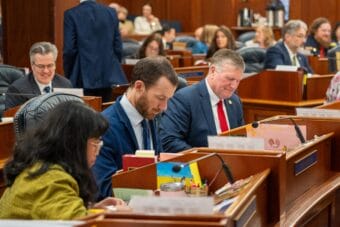
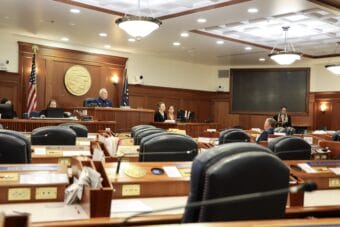
Along with an attempt to override Dunleavy’s veto of more than $50 million in public school funding, House and Senate leaders said the vote on Senate Bill 183 was a top priority for the special session. The state Constitution requires lawmakers to hold override votes within five days of reconvening.
The bill passed the Senate unanimously and by a 30-10 vote in the House. Lawmakers said it was necessary to address what the heads of the state House and Senate described as a “persistent pattern of obstruction within the senior ranks of Alaska’s Department of Revenue.” It came after a precipitous dropoff in revenue from so-called oil tax and royalty settlements, which the state negotiates with oil companies. In 2020, those provided $281 million for the state’s main savings account; in 2024, that number dropped to $3.1 million.
Legislative leaders said Dunleavy’s administration had not fully cooperated with an audit that seeks to examine the state’s collection of oil taxes by failing to produce a summary table outlining settlements that the governor’s administration provided as recently as 2019. Instead, in recent years, the administration has offered raw data that the legislative auditor said was unusable. The bill would have required the administration to turn over information to the auditor “in the form or format requested.”
Dunleavy vetoed the bill, saying it raised constitutional issues. He said any allegations that the administration had acted unethically or illegally were “baseless.”
The Legislative Budget and Audit Committee earlier this summer authorized a rare use of its subpoena power to compel the administration to turn over the data lawmakers are looking for.
A legislative staffer waits outside the Alaska State Capitol in Juneau on March 20, 2025. (Eric Stone/Alaska Public Media)
Legislators are planning to arrive soon in Juneau for the special session scheduled to kick off Saturday morning. Legislative leaders say they expect the session to move quickly, and likely not last more than a day.
Most lawmakers are now planning to show up Saturday, including some Republicans who initially said they’d skip the beginning, but they’re divided on whether it’ll be worth the money it costs to bring them to Juneau.
Precisely what this special session will cost is up in the air. A portion of the cost depends on how long legislators stick around before they adjourn.
Fifty-seven of the 60 legislators — that is, everyone who doesn’t live in Juneau — can collect per diem payments of around $300 per day to cover their daily expenses, like food and lodging. And then there’s the airfare: flying legislators from Anchorage or other communities to Juneau isn’t cheap.
Speaker of the House Bryce Edgmon, an independent, will be flying in from his home in Dillingham, and he said he expects the total cost of the session to run into the six figures.
“Accounting for the entire legislature, all the support staff, the gathering of, you know, all the pieces it takes to hold a session, it can be north of $100,000 a day,” Edgmon said.
The head of the nonpartisan Legislative Affairs Agency, Jessica Geary, said by email that her office won’t know the exact cost until lawmakers turn in their expenses for reimbursement. They have two months to do so.
But the agency has some data from the past. One six-day session in 2021 cost nearly $175,000, or around $30,000 a day.
Gov. Mike Dunleavy called this year’s special session and put education reform and the creation of a state agriculture department on his agenda. But Edgmon, an independent, said he’s expecting Dunleavy’s vetoes to be the overriding priority. Though the governor sets the legislative agenda for sessions he calls, he does not have the power to force lawmakers to consider legislation, and legislators are able to determine on their own when to adjourn.
The governor offered some new details on his agenda for the session on Monday. Many of his proposals are ideas that lawmakers have, over the past two years, rejected or have said need a closer look. They’re planning to convene an education task force to talk over ideas like inter-district open enrollment in late August.
Edgmon said he hoped legislators could muster the 45 votes needed to overcome Dunleavy’s veto of more than $50 million in education funding. If they do, he argues the cost of the session would be money well spent.
However, “for the other measures that the governor is contemplating, I don’t see any pathways towards immediate success,” Edgmon said. “Quite frankly, the money would have been better spent doing our normal course of business and regular session.”
Edgmon and the Senate president, Kodiak Republican Sen. Gary Stevens, said Monday they planned to adjourn immediately after the override votes. Edgmon said he has a hotel booked for “a couple of nights.” He’s bringing his chief of staff to Juneau, but nobody else, he said.
Rep. Zack Fields, an Anchorage Democrat, said he’s not planning to bring any staff to Juneau. He said he isn’t even booking a hotel room. He said the peak of summer tourism in Juneau makes it hard to find rooms that don’t cost an arm and a leg.
So, he’s planning to arrive Friday night, sleep in his office, and leave after the votes on Saturday.
“No one sees this as a kind of real month-long special session,” Fields said.
Like other members of the Democrat-heavy bipartisan majorities in the state House and Senate, Fields sees the session as an effort by Dunleavy to ensure his vetoes aren’t overridden. He said he can’t square that with the fact that Dunleavy cited the state’s low-oil-price-induced fiscal constraints when he vetoed the $50 million in education funding.
“It’s hypocritical to say the state is short of money and then call a special session that is sort of farcical in nature,” he said.
Dunleavy’s office didn’t respond to a request for comment.
Rep. Kevin McCabe, a Big Lake Republican and an ally of the governor, said he thinks the special session would be money well spent — but only if legislative leaders take some time to actually consider Dunleavy’s proposals.
“I think this would be a good use of the state’s money if we manage to fix the educational issues that are happening in the state of Alaska, the student outcomes,” McCabe said. “Nobody cares. Nobody seems to care about the students.”
But if lawmakers stick to their stated plan and solely focus on override votes, McCabe said, “it’s a waste of my time. It’s a waste of your time. It’s a waste of everybody’s time. And our kids, as usual, suffer the consequences.”
But McCabe said he will be there when lawmakers gavel in Saturday. That’s a change from a couple of weeks ago — he had planned to be in Idaho for a pro-life conference. McCabe got a call Thursday from a van driver wondering why he wasn’t at the airport in Coeur d’Alene, he said.
Dunleavy initially asked Republicans to skip the first five days of the session because, according to his spokesperson, he didn’t want legislators to override his vetoes. The Democrat-heavy majorities need minority Republicans’ help to do so.
But more recently, McCabe said Dunleavy’s office has told Republicans it would be a good idea to show up in Juneau. McCabe is hoping to stay in the Legislature’s Assembly building, which has apartments for lawmakers and staff. If there’s no room, McCabe said he’ll sleep in his office.
A handful of other conservative House members, including some like McCabe who initially said they were not planning to attend, say they’ll be there, too.
“Clearly, my constituents, they want me to be there to work,” McCabe said.
Some 59% of the more than 600 respondents said they wanted lawmakers to override the governor’s veto of education funding, according to the poll. An even larger majority, 72%, said they wanted legislators to override Dunleavy’s veto of bills boosting oil tax transparency and capping interest rates on payday loans.
Sen. Donny Olson, D-Golovin, is seen in his office within the Alaska Capitol on May 20, 2025. (James Brooks photo/Alaska Beacon)
On the last day of Alaska’s legislative session in May, Sen. Donny Olson made a mistake.
The longtime Democratic senator from Golovin, mishearing Senate Majority Leader Cathy Giessel, voted to sustain Gov. Mike Dunleavy’s veto of a bill that increases the state’s public school education formula.
Heads snapped to Olson, and his colleague, Sen. Lyman Hoffman, D-Bethel, elbowed him.
When Senate President Gary Stevens asked if any lawmakers wanted to change their votes. Olson stood, and without speaking, pointed at the voting board.
Olson’s silent statement was emblematic of his session.
Sen. Donny Olson, D-Golovin, rises to point to the tally board to change his vote and override Gov. Mike Dunleavy’s veto of HB 57 on Tuesday, May 20, 2025. (Photo by James Brooks/Alaska Beacon)
Now, he’s about to return to the Capitol for a special session called by Dunleavy. Again, education issues are on the calendar, and again, Olson will be asked to cast his vote.
Olson sat down for an interview on May 20, shortly after the Alaska Senate adjourned its regular session for the year. Since then, in a series of interviews, colleagues and those familiar with his work have described a man healing from a severe health condition but one still able to serve in the Legislature.
Olson isn’t up for election until 2028. Barring early retirement, he will become the most senior legislator in 2027, as several of his colleagues leave office.
“The thinking is still the same. The articulation, that’s what, uh, is,” Olson said, struggling to finish the sentence.
Can he still do his job as a senator?
He nodded.
Olson has an extensive career — he’s been a doctor, a reindeer herder, a commercial pilot, and earned a law degree. He graduated from the University of Minnesota-Duluth with a bachelor’s in chemistry before getting a medical degree from Oral Roberts University and, later, graduating from the University of Colorado School of Law.
As challenging as each of those degrees has been — plus family life and his legislative career — recovering from his stroke-like illness may be the toughest obstacle yet.
“It’s still pretty fresh. It’s like a tailspin,” he said.
“You know your feelings, but you can’t quite articulate what your feelings are,” he said.
When Olson left the Capitol in January, several of his colleagues weren’t sure whether he would be able to return. In private discussions, they debated who might fill his seat if he were to resign.
“I did hear a rumor that I am retiring,” he said by text message on July 10. “That is not true.”
“My time in Chicago was incredibly beneficial, and I am grateful for the therapy I received. While I will continue participating in speech therapy as part of my recovery, I am feeling strong and energized to be back at work,” he said in a written statement on March 10, after returning to the Capitol.
He’s continued to undergo speech therapy here in Alaska.
Does he feel like things are improving?
“Oh, for sure. With the month down in intensive (therapy) in Chicago … when I was talking to the stroke people, (U.S. Sen. John Fetterman), the senator from Pennsylvania, I think he was a lot farther down than I am,” Olson said.
Fetterman suffered a stroke in 2022 while running for office and was hospitalized for weeks with depression after being sworn into the U.S. Senate. Afterward, he relied on transcription services and other technological tools to do his job.
Olson’s colleagues say they’ve seen nothing like that from Olson.
“I think he’s got the same sense of humor. He’s got the same — I think he’s got the same cognitive ability. I think it’s just his ability to speak, but even that has improved,” said Rep. Robyn Burke, D-Utqiagvik and one of the two state representatives in Olson’s state Senate district.
Rep. Neal Foster, D-Nome, is the other and could not be reached for comment.
Since his illness, Olson has continued to meet with constituents, lobbyists and local government officials, who said they haven’t had problems communicating with him, even if he can’t speak clearly.
In a pair of interviews with the Nome Nugget — one in April and another after the end of the legislative session — Olson was able to make his positions clear through written responses. When speaking, his staff frequently finished his sentences.
Senate Majority Leader Cathy Giessel, R-Anchorage, has worked as a registered nurse and an advanced nurse practitioner and is familiar with stroke-like symptoms.
She said she hasn’t observed any personality changes. Other lawmakers said the same.
Olson said he’s not 100%, but he is getting better.
“I’m still on the road to recovery … what’s important are the milestones,” Olson said in May.
Sen. Bill Wielechowski, D-Anchorage, said on Wednesday that he spoke with Olson a few days ago.
“He sounded a lot better,” Wielechowski said.
“It was a short conversation; he called me, and he sounded much better than he was. … There was definite progress there,” he said.
Burke is supportive.
“I think he’s still there. I think his speech will continue to improve and come back stronger,” she said, “and he’ll be here. He’ll be here for years to come.”
A person takes a photograph of Chilkoot Inlet while on the MV LeConte shortly after departing Haines for Juneau on Sunday, Nov. 13, 2022. (Emily Mesner / ADN)
The administration of Gov. Mike Dunleavy has signed a $28.5 million contract for work on a new ferry terminal north of Juneau, days after an oversight board said the state had not proved that the project is economically viable.
Dunleavy administration officials say the new terminal at Cascade Point, located 30 miles north of an existing terminal in Auke Bay, will cut ferry time from Juneau to Haines and Skagway by two hours.
But the chair of the Alaska Marine Highway Operations Board — which was created by Dunleavy four years ago — says the department hasn’t shared “some kind of business plan or feasibility study” to establish that the terminal is necessary and economically viable.
“The Alaska Marine Highway System has been plagued for 50 years with one-off projects that get foisted upon it, that create operational challenges, that then the system and the users have to deal with,” said Wanetta Ayers, chair of the board, during a Friday meeting.
“This is another one of those situations where it’s going to get foisted upon the system and we’re going to have to cope with it for 20 or 30 years until somebody admits it’s not going to work,” Ayers added.
The Cascade Point ferry terminal is planned on land owned by Goldbelt Inc., a Juneau Alaska Native corporation.Ithas been under consideration since Dunleavy took office in 2019. In May, his administration announced its intention to seek bidders for the first phase of the project.
After receiving two bids, the transportation department signed a contract Monday with K&E Alaska Inc., an Oregon-based company with an office in Sitka. The contract, which has a 2027 completion date, covers engineering and environmental permitting, a bridge over Cascade Creek, a gate, site preparation and retaining wall construction.
The contract does not include any funding for the ferry terminal itself, which is set to cost tens of millions of dollars. The state expects to pay for the terminal using primarily federal funds.
Ayers said Friday that the Dunleavy administration had not provided answers to board members’ previous questions, and she is troubled by “the pursuit of this project in what is a very unconventional process, where design and now construction are way ahead of operational feasibility and customer service.”
Katherine Keith, a deputy transportation commissioner, said during the Friday meeting that the department had commissioned an independent economic analysis of the project, but it was still in “draft form” and had not been released. She did not provide any specifics on when it would be available to members of the board or the public.
“We continue to believe that this is a strong benefit to the state, to the system and the public, which is why we’re moving forward with expenditure of public dollars, but understand we haven’t communicated that in a complete narrative document to make it more accessible and comprehensive,” said Keith.
Keith pointed out that the Cascade Point project had been recommended in 2020 by a marine highway reshaping working group commissioned by Dunleavy.
Ayers, who served on the working group, said that report and its accompanying recommendations “came together on a wing and a prayer at the last minute to meet the governor’s deadline.”
“To stand on it as a justification for Cascade Point is, to me, a pretty big stretch,” said Ayers.
One of the primary reasonings provided in the working group report for the new ferry terminal was that it would “avoid the need to modify the new Alaska Class ferries to add crew quarters” by allowing for trips between Juneau, Haines and Skagway to last less than the 12-hour crew day mandated by the Coast Guard.
But that reason is partially moot because the state has already committed to retrofitting the Alaska Class ferries with crew quarters, at a cost of roughly $30 million, and because the route length between Cascade Point, Haines and Skagway exceeds the 12-hour crew day, according to Marine Highway spokesman Sam Dapcevich.
The trip from Cascade Point to Haines and Skagway, as envisioned by transportation planners, would run up against the 12-hour work limit for crew, “requiring full staffing and accommodations,” Dapcevich said in an email last week.
“A more efficient service model,” which wouldn’t necessitate crew sleeping onboard, would require ferry trips from Cascade Point to go either to Haines or to Skagway, rather than visiting both communities on a single trip, Dapcevich said. The Marine Highway System would then have to use a yet-to-be-constructed “shuttle” ferry between Haines and Skagway.
‘Standing on a cliff’
Ayers wasn’t alone among board members to raise concerns about the process used by the department to advance the Cascade Point project.
Board member Paul Johnsen, a former Marine Highway engineer, said it seemed that the board was “being ignored” by the transportation department. Member Bob Horchover, who was appointed to the board by Dunleavy, agreed.
“I’m against this until we have more information,” said Horchover. To move ahead with the project “without even a reason for doing it is, to me, a boondoggle,” he added.
Anthony Lindoff, vice chair of the board, said the department had not provided enough information for him to form an opinion of the project.
“I certainly don’t have enough information regarding Cascade Point to be unequivocal, one way or the other,” Lindoff said. “I’m just eager for more information.”
While the Dunleavy administration is moving ahead with the Cascade Point project, it is also working simultaneously on a study of a possible new road-and-terminal project on the west side of Lynn Canal.
A $2.4 million study of the project is set to examine multiple options, all of which are predicated on the existence of the Cascade Point ferry terminal, according to a service agreement signed in May.
The northern lights glow over Auke Bay as the Alaska Marine Highway ferry Kennicott approaches Juneau on February 25, 2024. (Marc Lester/ADN)
Keith told board members that the study, with initial findings expected in January, is set to examine connecting Cascade Point with new ferry terminals and road stretches on the west side of the canal, to better tie Juneau to the Alaska Highway. Keith said the “Chilkat Connector,” as the Dunleavy administration called it, would include construction of one or two new ferry terminals on the west side of the canal, along with several miles of new road.
Some board members said it appeared that Cascade Point would only be economical if paired with west Lynn Canal infrastructure, but with those infrastructure projects yet to be studied, moving ahead with Cascade Point was premature.
“If it was part of a larger infrastructure plan to build a road up the west coast of Lynn Canal, then that might have some more impact and be worth investing in that kind of a facility,” said Horchover.
“I’m a little concerned that we’re standing on the cliff and saying, ‘Why not? Let’s jump,’ ” he added.
Juneau Access
The Chilkat Connector study, like the Cascade Point ferry terminal, is funded using appropriations made by state legislators nearly 20 years ago for what is called the Juneau Access Project, a decades-old effort by the state to improve transportation options to the state’s capital that has been reimagined under each new governor.
Former Gov. Tony Knowles in 2000 nixed the idea of a 90-mile road north of Juneau toward Haines, saying its price tag — in the hundreds of millions — was too high. Former Gov. Frank Murkowski revived interest in the plan, and state lawmakers in 2006 approved $45 million for the Juneau Access Project, under a vision for a road from Juneau to the Katzehin River, allowing for quick ferry shuttles from there to Haines and Skagway and on to the mainland road system.
Former Gov. Sarah Palin paused the plan while she was in office, only for her successor, former Gov. Sean Parnell, to revive it, at a projected cost of more than $500 million.
The Parnell administration spent $5 million extending the Glacier Highway to the Goldbelt-owned land at Cascade Point. More than a decade ago, Goldbelt considered constructing a dock to transport Kensington Mine employees from Cascade Point to the mine. That hasn’t happened.
When Gov. Bill Walker was elected — and oil prices crashed — the Juneau Access Project was shelved again. Then came Dunleavy, who turned from the longer road to the Katzehin River to a plan that involved constructing the new Cascade Point terminal.
In 2023, the Dunleavy administration agreed to work with Goldbelt to study the feasibility of a terminal on land owned by Goldbelt. Members of the Alaska Marine Highway Operations Board wrote last year that “with the current information available to AMHOB and the public, we cannot see the merit of the proposed Cascade Point project.” The Dunleavy administration did not provide any further information to the board in response to their letter, members said.
A draft of the 20-year long-range plan for the Marine Highway System signed by Transportation Commissioner Ryan Anderson in February contains no recommendations regarding the Cascade Point terminal. It states that a feasibility study for the terminal was ongoing as of the time of the report’s publication. But department officials said this month that there is no ongoing feasibility study.
‘Rearranging the deck chairs’
Dunleavy vetoeda move by state lawmakers in May to reappropriate Juneau Access Project funding toward other transportation plans, stating the funds had already been obligated.
Since then, both the Skagway and Haines borough assemblies have formally expressed their opposition to the Cascade Point terminal.
“It is difficult to understand why the State is choosing to invest in the construction of a new marine facility rather than rehabilitating existing terminals, many of which — including those serving northern Southeast Alaska — are in urgent need of repair,” Skagway Assembly members wrote.
View of Auke Bay from the bridge of the Hubbard before it set sail to Haines and Skagway in Juneau on May 22, 2023. (Sean Maguire/ADN)
While Haines and Skagway leaders have bristled at the news that the Dunleavy administration is moving ahead with the terminal, one mining company celebrated the announcement.
Grande Portage, a Canada-based company with a plan to build a new gold mine near Juneau, said in a press release that it has an existing agreement with Goldbelt to cooperate on building a barge terminal at Cascade Point for transportation of ore.
Though the barge terminal is not contingent on the ferry terminal, “having the ferry terminal proceed first is highly advantageous as it would result in the development of infrastructure that will also be necessary for the ore terminal, particularly the new access road and bridge. This reduces the time and cost required for future ore terminal development,” Grande Portage wrote in its press release.
The work on Cascade Point comes as the Marine Highway System is wrapping up its work on a 20-year long-range plan. Ayers said work on that plan, and renewed focus on the system’s efficiency, have allowed it to move away from “just rearranging the deck chairs on the Titanic.”
“Here we are, spending lots of time and resources about planning and being strategic, and yet, the other hand is going to deliver us a one-off carbuncle,” said Ayers. “I feel like it’s undoing a lot of good progress.”
Alaska Gov. Mike Dunleavy delivers the annual State of the State address on Tuesday, Jan. 28, 2025, in the Alaska Capitol. (Photo by James Brooks/Alaska Beacon)
Alaska Gov. Mike Dunleavy announced his policy priorities for the Alaska State Legislature for when they reconvene for a special session scheduled to start on Saturday.
On Monday, the governor called for legislators to address what he called “Alaska’s chronic education outcome crisis” and to reconsider his executive order they had previously voted down, creating a new Department of Agriculture that he said would strengthen food security in Alaska.
Separately, the Alaska State Legislature released a joint statement on Monday from leaders of the House and Senate majorities announcing their focus for the special session: two override votes. One would override Dunleavy’s budget veto of more than $50 million for Alaska schools, and the second vote would be on a bill to boost legislative oversight of oil and gas revenues. After the votes, they said they intend to adjourn.
Dunleavy called the session last month, then asked the 19 Republican members of the House minority caucus to stay away from the session for the first five days to boycott the override votes. This drew outrage and criticism from some members of the House and Senate majorities as they rally support for the overrides, particularly to restore funding for K-12 schools.
The Legislature is required to take up veto override votes within the first five days of the next session, and 45 votes of 60 members are needed to override the governor’s budget veto of school funding. A lower bar, of 40 votes, is needed to override non-budget bills.
Dunleavy’s office did not respond to a request for comment on Monday about whether he is still asking Republicans to stay away. In a statement posted on social media, Dunleavy said he would be in Juneau when the special session begins. “I invite all legislators to be there to focus on solutions that deliver real results for Alaskans,” he said.
Dunleavy released an agenda with eight items, including an executive order creating a Department of Agriculture to focus on food security for Alaska and growing the state’s agricultural sector.
The other seven items were focused on education policy:
tribal compacting between the state Department of Education and Early Development and select tribes to create better performing schools;
expand the corporate tax credit program for education;
authorize the Department of Education as a charter school authorizer in addition to local districts;
allow public school students to enroll in any public school that has room, including outside of a student’s resident district;
support grants for reading improvement and for a new after school reading tutoring program;
pass recruitment retention payments to classroom teachers to reduce turnover, especially in areas of the state that suffer from chronic teacher turnover; and
establish long-term certainty in funding for K-12 schools if agreement is reached on policy.
“This is an opportunity to address Alaska’s performance issues and funding issues in K-12 education well into the future,” Dunleavy said in a statement released with the announcement. “By addressing this now, school districts, students, parents, teachers, and policymakers will have certainty and will not have to debate this issue during the regular session that begins in January.”
The Alaska House and Senate majorities have very different priorities for Saturday.
A statement from House Speaker Bryce Edgmon, I-Dillingham, and Senate President Gary Stevens, R-Kodiak, on Monday said legislators will immediately go into a joint session at 10:15 a.m. on Saturday to take up two override votes: “restoring $51 million in public education funding and overriding the Governor’s veto of Senate Bill 183, which affirms the Legislature’s oversight of oil and gas tax revenues.”
“After which, the Legislature intends to adjourn later that day, having completed its work,” the statement said.
Stevens questioned the timing of the session, which is being held when legislators had previous commitments and plans. He emphasized both measures passed with broad bipartisan support.
“This special session was called under circumstances that raise serious concerns, not only about its timing but also its clear aim to complicate legislative participation. Nevertheless, I urge every lawmaker not formally excused to be present in Juneau to fulfill our constitutional duty,” Stevens said.
“These override votes are not just symbolic. They are about preparing Alaska’s students, restoring public trust in how we manage billions in state revenues, and maintaining the Legislature’s role as a co-equal branch of government. We owe it to our constituents and the future of this state to show up and do our jobs,” he said.
Edgmon also called on every legislator to appear in Juneau to participate in the override votes.
“Alaskans expect us to lead, not walk away from our responsibilities. Families, students, and teachers are counting on us to follow through on the commitments we made during the regular session,” Edgmon said. “This special session is not about partisanship, but about standing up for our students and preserving the checks and balances that keep government accountable. Every elected state lawmaker needs to uphold their constitutional duty, come to Juneau, and vote their conscience.”
The Alaska and American flags fly in front of the Alaska State Capitol on Tuesday, April 22, 2025. (Photo by James Brooks/Alaska Beacon)
Gov. Mike Dunleavy allowed three bills to become law last week without his signature, creating two fishing-related laws and one that updates the rules governing accountants in the state.
Under the Alaska constitution, a governor may sign a bill into law, veto it, or allow it to become law by taking no action on it after it is transmitted to him by the Legislature.
House Bill 31, from Rep. Louise Stutes, R-Kodiak, eliminates a state law that required fishing boats to register with the Alaska Division of Motor Vehicles every three years. Now, any boat that’s actively in use fishing and registered with the Commercial Fisheries Entry Commission and the U.S. Coast Guard will not have to also register with the DMV.
In a written statement, Stutes said the DMV registration — passed by the Legislature in 2018 — turned out to be excessive, particularly in rural Alaska.
“A lot of these communities don’t even have a DMV. Alaska’s commercial fishing industry is facing historically challenging times, and I’m glad we could implement this small step to make getting started for the year a little easier,” she said in the statement.
The second fishing-related bill was House Bill 116, which allows commercial fishing cooperatives to act like insurance without being regulated like insurance.
In some cases, fishing boat owners create pools of money to act as insurance funds to pay liability and damage claims themselves, bypassing the high rates charged by insurance companies.
Three pools already exist in Alaska but are organized under Washington state law because Alaska did not permit them. The new law enables pools under Alaska law, encouraging a cheaper alternative to traditional insurance.