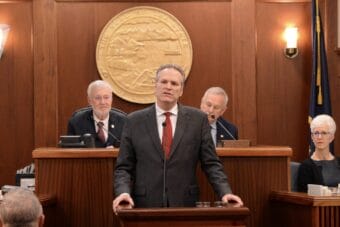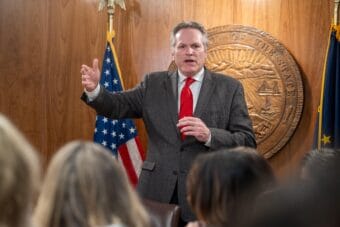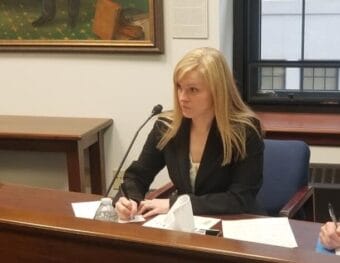
Former state senator Tom Begich announced he’s running for governor. He’s the first Democrat in the crowded race. (Liz Ruskin/Alaska Public Media)
Former state senator Tom Begich is running for governor.
Begich, an Anchorage Democrat, is the first Democrat in a field already crowded with Republicans.
The main reason he’s running, he said, is to reverse what he sees as state stagnation. He emphasized the need to boost education funding and wants to raise state revenues — from corporate taxes, trimming oil tax credits and the like. He says $500 million in new state revenue is within easy reach.
“That’s just about agreeing that these things make sense. None of those things cost an individual Alaskan anything,” he said. “What it requires is members of the Legislature and the governor to agree, and I’m not seeing that happen right now.”
Bills to change how the state taxes corporations and grants petroleum tax credits are pending in the Legislature but face an uncertain fate.
The last Democrat to win a statewide race in Alaska was Mary Peltola. She was elected to the U.S. House in 2022, lost in 2024 and hasn’t announced whether she’s running for any office in 2026. If she decides to run for governor, said he would drop out.
“I’ve always told her, and I would say this to you: if she were to get in this race, I wouldn’t need to be in this race. She would be in the race,” he said. “But I am in the race, and that is the difference.”
So far, Begich has only filed a letter of intent to run, but if he wins, he’d be the fourth in his family to hold statewide office. His father, Nick, and brother Mark served in Congress as Democrats. Tom is the uncle of Alaska Congressman Nick Begich III, a Republican.
Adam Crum, Commissioner of Alaska’s Department of Health and Social Services, answers a question during a press conference centered on Gov. Mike Dunleavy’s latest budget proposal on Wednesday, December 11, 2019, at the Capitol in Juneau, Alaska. (Photo by Rashah McChesney/KTOO)
Former Revenue Commissioner Adam Crum is throwing his hat in the ring for the 2026 Alaska governor’s race as a Republican. Crum filed paperwork on Monday allowing him to begin raising money for the campaign.
He’s running to replace his former boss, Gov. Mike Dunleavy, who is term-limited. Dunleavy first appointed Crum to lead the Department of Health and Social Services when he took office in 2018. He tapped Crum to lead the Department of Revenue in 2022.
In a brief interview, Crum said his experience in senior government roles, as well as in the private sector, gives him an edge in a crowded field.
“I understand the function of government, the function of the Legislature, the important things to the private sector, so I’ll have a functioning government up and running faster than anybody else,” Crum said.
Crum describes himself as a “conservative Christian” but said he’s willing to work across party lines. He said he’d like the state to diversify its economy and that his work as revenue commissioner would help him attract businesses to the state.
“One of the benefits of this role at Revenue is meeting with outside investors and actually talking to them about what are the issues they see, about why they don’t invest in Alaska, and what could be done to improve that,” Crum said.
Echoing Dunleavy, Crum also said he would like to reform the state’s public school system, which has languished near the bottom of national rankings. He said he hopes to work collaboratively with the Legislature on ways to improve education in the state.
“I think it’s very clear that there does need to be a level of investment, but there also has to be some change in policies,” he said.
Crum said he also wanted to work toward a new Permanent Fund dividend formula that’s predictable for residents and affordable for a state struggling with declining resource revenue.
“The reality is right now is there is not enough funds available to pay statutory dividends across the board, and I think we need an honest conversation about what is the dividend going forward, what level is appropriate and what is consistent,” he said.
The Department of Revenue faced criticism from legislative leaders earlier this year as lawmakers struggled to obtain data on oil and gas taxes in a format they could understand. The dispute led lawmakers to pass a bill bolstering the legislative auditor’s authority and override a veto from Dunleavy. Crum says on his last day in office on Friday, he directed department officials to cooperate with legislators’ requests.
“It’s going to be very costly in order to put it in this particular format, but they’re going to do that, and then everybody will see that there is no information that is being lost,” he said.
Crum is the eighth Republican to announce their campaign for governor. No Democrats or independents have formally joined the race. The filing deadline isn’t until next June.
Dunleavy announced Friday that Janelle Earls would take over as acting revenue commissioner. She had been the department’s administrative services director.
The small boat harbor in Haines, The small boat harbor in Haines, pictured above in May, 2025. (Avery Ellfeldt/KHNS)
Commercial fishermen in Alaska will soon have a new option to bring down a cost that has skyrocketed in recent years: crew and vessel insurance.
The state legislature passed a bill earlier this year that allows Alaska fisherman to create insurance pools, or co-ops, that typically offer lower insurance rates. The bill became law last week without a signature from Gov. Mike Dunleavy.
The new law was prompted by soaring insurance rates and reduced insurance availability, both of which are among a long list of challenges facing commercial fishermen. Driving the trend: inflation and a shrinking number of companies willing to provide coverage.
“Our seafood industry as a whole is in such dire straits,” said State Rep. Louise Stutes, a Republican from Kodiak whosits on a seafood industry-focused legislative task force that backed the bill.
“We had public hearings on how the state could help the fishermen at little or no cost to the state, because the state is in a fiscal crisis as well,” Status added. “One of the ideas that came up was these insurance pools.”
Many Alaska fishermen already participate in pools that operate out of Washington state. The new legislation gives Alaskans the opportunity to create their own pools by exempting them from costly regulations that apply to private insurers.
The pools provide fishermen an alternative to purchasing coverage from private insurers. Instead, members can contribute a smaller sum of money to the joint pool, which is later used to pay out claims when accidents happen.
The co-ops also pick and choose who joins, which proponents say should reduce both risk and future claims.
“They would choose their members based on their history and whether or not they maintain their vessels, whether they’re safe fishermen, and that type of deal,” she added. “So it will really allow a lot more flexibility insofar as just being able to get the insurance.”
Speaker of the House Bryce Edgmon, I-Dillingham, leaves the House chambers before the start of a special legislative session on Saturday, Aug. 2, 2025, at the Alaska Capitol in Juneau. (Photo by James Brooks/Alaska Beacon)
On Saturday, Alaska legislators voted 43-16 to override Gov. Mike Dunleavy’s veto of Senate Bill 183, which is intended to compel the executive branch to provide information about settlements paid by oil companies to the state of Alaska, in order to resolve tax disputes with the Alaska Department of Revenue.
That vote was overshadowed by an education funding veto override that took place minutes later, but the override on SB 183 could be more significant for state revenues in the long run.
Since 2020, lawmakers have unsuccessfully attempted to audit the Department of Revenue’s audit division in order to determine whether the state has been settling tax disputes with oil companies for what Sen. Bill Wielechowski, D-Anchorage, calls “pennies on the dollar.”
“I would expect that we will see there has been significant underpayments,” he said, explaining that the state had been collecting tens or hundreds of millions of dollars in settlement payments, “and then it dropped to $250,000. Based on the amount that the settlements dropped, which was huge, I expect there’s probably massive underpayments.”
In comparison, Saturday’s veto override on education funding involved just $50.6 million.
Legislative Auditor Kris Curtis, who has worked in that position since 2012, hasn’t been able to examine the Department of Revenue’s work because the department hasn’t provided the necessary information.
Until 2019, the department supplied that information regularly. Curtis previously conducted an audit of the same division in 2014.
“I’ve never seen this type of non-cooperation with any other administration,” she said in an interview Tuesday.
If the department still does not comply with the new law, the joint House-Senate Legislative Budget and Audit Committee is prepared to issue subpoenas to legally compel the department to release the information, said Sen. Elvi Gray-Jackson, D-Anchorage and chair of the committee.
“The engagement letter has been signed and executed, and the attorneys that we hired to move forward with the subpoenas are just waiting for instruction,” she said, speaking to reporters on Saturday.
Curtis said she hopes it doesn’t come to that.
“My plan is to reach out to the agency and basically restart my audit,” she said.
The commissioner of the Alaska Department of Revenue, Adam Crum, is scheduled to resign on Aug. 8, meaning that the audit will take place under a new commissioner.
“I’m hopeful that I can just restart my audit and everything will just proceed,” she said.
Curtis said she can’t provide much information publicly — or even to lawmakers — since the audit process is confidential.
“If they were to provide (the information) right away, it would be a few months,” she said of the timeline to complete her work. “And we also have financial and federal audits that are competing priorities.”
Asked whether the department will provide the information and for a timeline of work, the Department of Revenue forwarded questions to the Office of the Governor.
“The administration will continue to provide the information necessary for the legislative branch to complete its audits,” said Jeff Turner, the governor’s communications director, in an emailed response.
“Yeah, well, we’ll see,” Curtis said when told about the answer. “I’ll keep my fingers crossed. I want to give them the benefit of the doubt.”
Wielechowski said that under SB 183, state officials could face criminal charges if they refuse to comply. That possibility is a long way off, he said.
“The Legislature is not itching for a fight with the executive branch,” he said. “We just want the information.”
Senate President Gary Stevens, talks to reporters at the start of a special legislative session on Saturday, Aug. 2, 2025, at the Alaska Capitol in Juneau. (Photo by James Brooks/Alaska Beacon)
The legislators have left, but the special session of the Alaska State Legislature will continue through at least Aug. 19 as House and Senate majority leaders seek to prevent Gov. Mike Dunleavy from repeatedly ordering lawmakers back into session.
Ordinarily, the Alaska Constitution prohibits legislators from recessing — stopping business — for more than three days. Taking a break for longer than that requires the consent of both the House and the Senate.
Immediately after the House’s vote on that resolution, Rep. Will Stapp, R-Fairbanks, called for “reconsideration” — a re-vote — on the issue.
He and all 18 other members of the House’s Republican minority caucus opposed the resolution and wanted to see lawmakers keep meeting in hopes that it would pressure them into discussing education policy changes that Dunleavy has proposed.
Ordinarily, reconsideration takes place on the next legislative day. But because lawmakers aren’t scheduled to meet again until the 19th, it becomes a moot point.
“It’s an interesting problem, right?” Stapp said on Monday. “The real key in the uniform rules (of the Legislature) is enforcement, and I guess the Senate could compel the House to come back, but they’re not going to.”
Special sessions run for 30 days unless ended early; lawmakers are currently adjourned until Aug. 19 and would have to meet at least once in order to keep the session moving.
Dunleavy told reporters in a news conference on Saturday that he called the special session for lawmakers to address his policy ideas for public education. Some of the governor’s ideas were discussed and voted down during the spring regular session. Dunleavy introduced three bills on Saturday related to tribal education compacting, teacher bonuses and education tax credits, that were referred to committees.
Members of the House and Senate majority caucuses, which control the legislative agenda, have said they aren’t interested in following the governor’s schedule and will consider education policy via an out-of-session task force that’s scheduled to begin meeting Aug. 25.
Most legislators have already left Juneau, and some are traveling to the annual summit of the National Conference of State Legislatures, taking place in Boston this week.
Any education legislation would be taken up in the next regular session, which begins in January, members of the majority caucuses said.
If legislators had adjourned the special session on Saturday after voting to override Dunleavy’s vetoes, the governor could have called for a new special session, bringing lawmakers right back into session.
Speaking on the House floor on Saturday, Rep. Kevin McCabe, R-Big Lake, said the purpose of SCR 101 is to prevent Dunleavy from doing just that.
“It’s a maneuver,” he said. “I get it. And it’s something that I would probably do, maybe, if I were sitting in your seat, Mr. Speaker. We all know how politics works. Unfortunately, those of us outside this room don’t know how politics works.”
Suzanne Cohen holds a sign in the rain outside the Alaska State Capitol on Friday, Aug. 1 calling on lawmakers to override Gov. Mike Dunleavy’s veto of more than $50 million in public school funding.
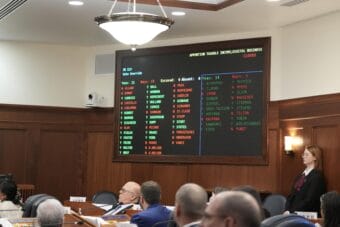
Alaska lawmakers on Saturday overrode Gov. Mike Dunleavy’s veto of some $51 million in state funding for public schools. The 45-14 vote means lawmakers successfully reversed Dunleavy’s decision to cut $200 of the per-student funding increase approved by lawmakers during the last legislative session.
The vote was the second successful veto override after lawmakers convened Saturday for a special session called by Dunleavy.
Alaska lawmakers vote on overriding Gov. Mike Dunleavy’s veto of $51 million in state education funding. (Eric Stone/Alaska Public Media)
Members of the Democrat-heavy bipartisan majorities in the House and Senate, who are typically at odds with the Republican governor, said they saw the special session as an effort to ensure the governor’s vetoes were not overridden. Dunleavy initially asked Republican lawmakers to avoid the Capitol to ensure his vetoes stood, his spokesperson said. But lawmakers overrode him nonetheless.
In May, 46 legislators voted to override Dunleavy’s veto of a bill boosting the so-called base student allocation, the per-student figure in the state’s education funding formula, by $700. The vote came after years of advocacy from teachers, students, administrators and community leaders who said the state’s education system was in crisis after nearly a decade of essentially flat long-term funding.
But after the Legislature adjourned for the year, Dunleavy trimmed the per-student increase from $700 to $500 for the upcoming school year in the state’s budget using his line-item veto power. That amounted to a year-over-year cut for schools, which last year received the equivalent of a $680-per-student boost in one-time funding. Educators and students on Friday gathered on the Capitol steps to call on lawmakers to reverse the veto.
“The state of Alaska is falling short of its constitutional responsibility to adequately fund public education,” Fairbanks Superintendent Luke Meinert said. “Instead, more and more of that burden is being shifted on the local taxpayers, stretching communities like Fairbanks beyond their limits, and the consequences are real.”
When he issued the call in early July, Dunleavy said he wanted lawmakers to consider education reforms to boost the state’s bottom-of-the-nation test scores and take up legislation that would create a state agriculture department.
In an emailed statement, Dunleavy on Friday again urged lawmakers to consider his proposals.
He introduced three bills for the special session on Saturday. One would expand tax credits for businesses that donate money or equipment to schools. Another would advance a pilot program in which the state would work with tribes to create so-called state-tribal compact schools. A third would create new retention bonuses for teachers, allow the state education department to bypass local school boards and directly create new charter schools, allow students to enroll in schools outside their district and create a new reading-focused after-school program.
Many of the proposals are ideas majority lawmakers have said they need more time to consider or have rejected in the prior two sessions, and legislative leaders said they did not plan to vote on the bills during the special session.
“No hearings on bills to improve Alaska’s dismal student test scores, no effort to lift the public school system from 51st in the nation, no tribal compacting to improve educational opportunities for our rural and Native students, and no apparent desire to prevent high school seniors from being unprepared because they don’t have the skills needed to compete for good jobs in the increasingly competitive 21st century economy,” Dunleavy said. “That is a shame.”
Lawmakers plan to evaluate some elements of what Dunleavy proposed, including a system that would allow students to enroll in out-of-district schools, with a task force that will begin meeting later this month.
The governor’s bill expanding tribal compact schools remains pending. Dunleavy introduced a new version for the special session on Saturday. A day earlier, representatives from five tribes that the bill would allow to create compact schools called on lawmakers to act on the proposal during the special session.
“This is really a pilot project,” said Knik Tribe Education Director Carl Chamblee. “This is something where we’re ready to move forward. It shouldn’t take that much time for a pilot project to be reviewed, discussed and voted on by a body of legislators.”
But Senate President Gary Stevens, a Kodiak Republican, said he had concerns about the bill. The bill would have the state work directly with tribes to create new schools, rather than placing them within existing school districts.
“It’s a very important issue, but we want to make sure that if we do tribal schools, they’re done properly, and they’re done right, and they’re done through the local school districts, not through the Department of Education,” he said.
The head of the Coalition for Education Equity, Caroline Storm, said Friday her advocacy group was readying a lawsuit that would seek to force the state to adequately fund schools.
The Anchorage Chamber of Commerce, a business group, sent a letter to lawmakers urging them to override Dunleavy’s veto.
“Continued constraints on the Anchorage School District will degrade the long-term economic health of Anchorage. As the largest community and economic hub of Alaska, these impacts have detrimental ripple effects statewide,” said the group’s president and CEO, Kathleen McArdle. “We already see the impacts in continued outmigration, and Alaska won’t get the chance to foster transformative solutions without the trust of families.”
Correction: A previous version of the story misstated the vote total. It was 45-14, with one lawmaker absent.
Close
Update notification options
Subscribe to notifications
Subscribe
Get notifications about news related to the topics you care about. You can unsubscribe anytime.